
One Watering Mistake Leaves Hydrangeas Weak And Wilted—Here’s How To Stop It
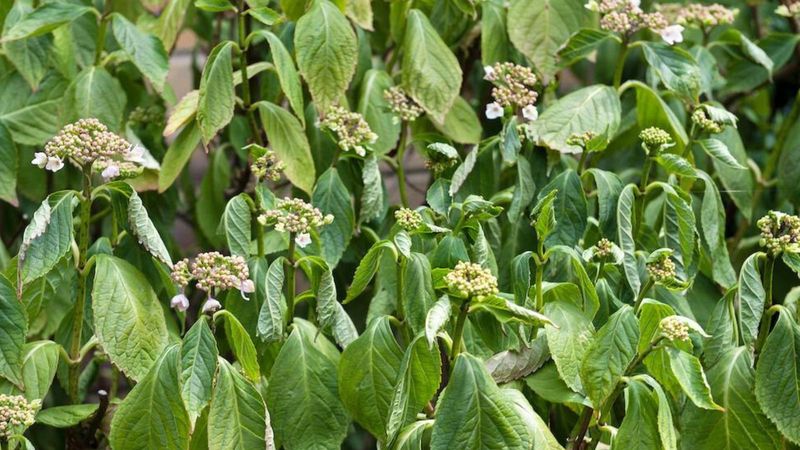
Hydrangeas are some of the most rewarding shrubs you can grow, but they have a reputation for dramatic drooping that can send even experienced gardeners scrambling for the hose. The frustrating truth is that reaching for more water is not always the right move, and in some cases it can make things worse. A common watering habit, spraying a quick sprinkle over the bed and moving on, can leave the root zone bone dry even when the soil surface looks perfectly damp. Understanding what your hydrangea actually needs, and how to check before you water, can make a real difference in how your plant looks and performs all season.
A quick sprinkle can miss the hydrangea’s roots
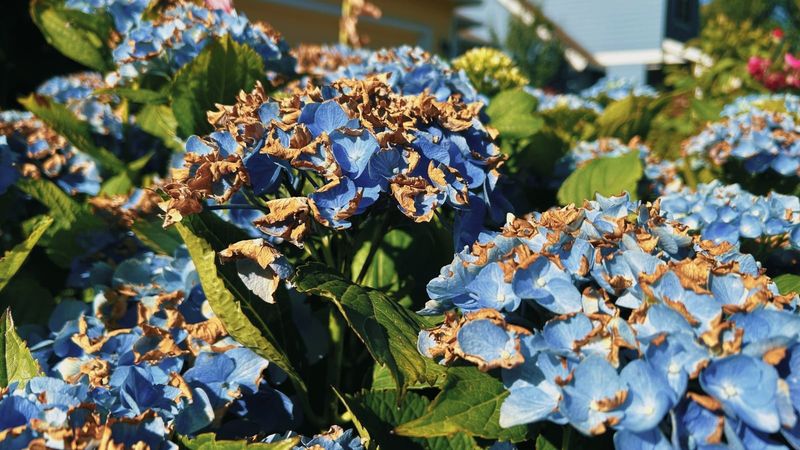
Picking up a hose and giving your hydrangea a quick once-over feels like responsible care, but that brief spray may never reach the roots that actually matter. Water applied too fast or too lightly tends to wet the top inch or two of soil and then stop, leaving the deeper root zone just as dry as it was before you started. OSU Extension’s guidance on helping hydrangeas through heat specifically flags the shallow sprinkle as a misleading habit, because the surface can look moist while the roots below stay parched.
Repeated light watering compounds the problem over time. When only the top layer of soil gets wet consistently, roots tend to grow toward that moisture, staying near the surface instead of reaching deeper. Shallow roots are more exposed to heat and dry out faster between waterings, which can leave your plant struggling even when you feel like you’re keeping up with it.
That said, wilting leaves alone are not proof that your hydrangea is thirsty. OSU’s general hydrangea care resource notes that these shrubs prefer consistently moist but well-drained soil, and that roots sitting in saturated ground can be just as stressed as roots in dry soil. Overwatering is a real risk, not just a theoretical one.
Penn State Extension’s review of common watering myths reinforces that frequent shallow watering is one of the most widespread mistakes in home gardens, and that the solution is not simply watering more often, but watering more deliberately. Before you add water, the first step is always to find out whether your plant actually needs it.
Check the soil before you turn on the hose
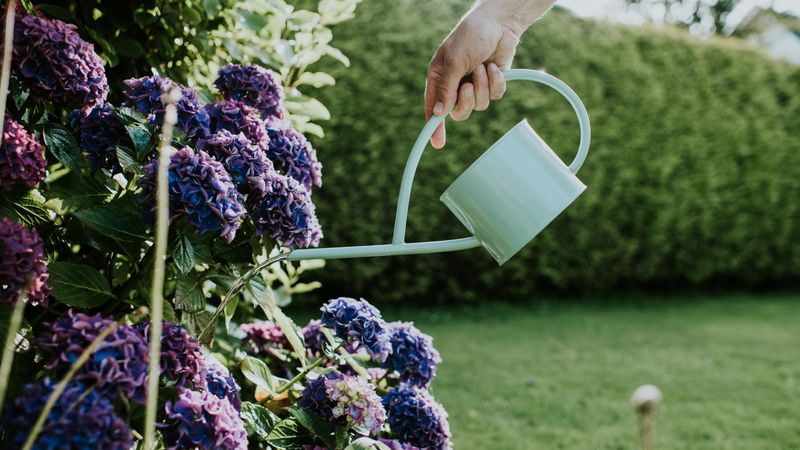
Drooping leaves feel like an urgent signal, but reacting to wilt without checking the soil first is how gardeners end up either underwatering or overwatering the same plant on the same day. The most reliable way to know whether your hydrangea needs water is to pull back the mulch and feel the soil near the root zone, not just tap the surface. For established shrubs, dryness in the upper 6 to 9 inches is a useful general indicator that it is time to water.
University of Minnesota Extension’s guide on watering established trees and shrubs recommends probing the soil rather than relying on leaf appearance, because visual cues alone can mislead. A finger, a wooden dowel, or a simple soil probe pushed several inches into the ground will tell you far more than looking at the surface or watching the leaves. If the soil feels moist below the top couple of inches, hold off and check again the next day.
Keep in mind that no single watering schedule fits every garden. Soil texture matters enormously: sandy soil drains fast and dries out quickly, while clay holds moisture longer but can become waterlogged. Rainfall, air temperature, wind, sun exposure, mulch coverage, plant size, and plant age all shift how often a hydrangea genuinely needs water. A plant in full afternoon sun on a sandy slope will dry out far faster than one tucked into partial shade with a thick mulch layer.
UMN’s drought gardening guidance cautions against treating any fixed weekly amount as a universal rule, because local conditions vary too much for that approach to be reliable. Making the soil check your decision point, rather than a calendar or a wilting leaf, is what prevents both the shallow-watering trap and the equally damaging cycle of waterlogging roots that cannot take up oxygen.
Water slowly enough to wet the root zone
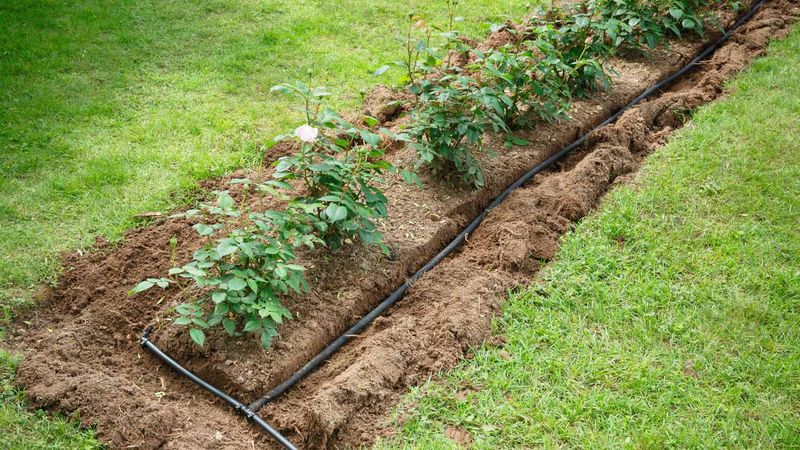
Once you have confirmed the soil is genuinely dry, the goal is to move water from the surface down through the root zone, and that takes time. A soaker hose laid around the base of the plant, or a slow-drip watering bag, lets water seep in at a rate the soil can actually absorb. OSU Extension recommends slow application methods and suggests probing the soil afterward to confirm how far moisture has actually traveled, rather than assuming a set number of minutes did the job.
The practical test is simple: after watering, push a finger or a wooden skewer into the soil near the outer edge of the root zone. If the soil is still dry a few inches down, the water has not reached where it needs to go. Run the soaker hose or drip system longer, then check again. Aim for moisture through roughly the depth where the roots are actively growing, which for an established shrub can be a foot or more.
“Watering deeply” does not mean flooding the bed or keeping the soil perpetually saturated. Water should infiltrate steadily into the soil, not pool on the surface or run off the sides of the bed. If you notice water sheeting across the surface rather than soaking in, you may be dealing with compacted soil or a clay-heavy mix that cannot absorb water quickly. Colorado State University Extension notes that adding sand alone to clay soil is not a reliable fix and can actually make drainage worse; improving compaction, adjusting organic matter, or reconsidering the planting location are more effective approaches.
Runoff wastes water and does nothing for the roots. Slow down the application rate until the soil is absorbing as fast as you are delivering, and you will get far better results than any quick blast from a spray nozzle.
Prefer morning watering without making it a rigid rule
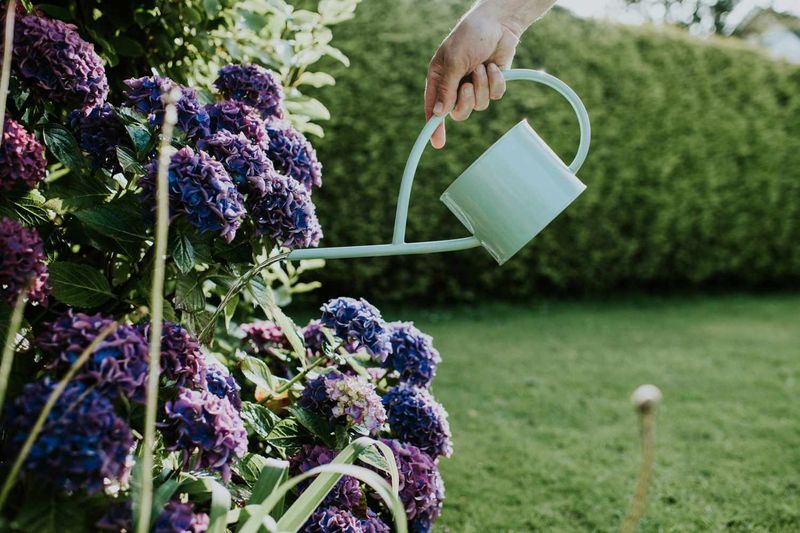
Morning is generally the best time to water hydrangeas, and the reasoning is straightforward. Applying water earlier in the day gives roots time to absorb moisture before afternoon heat peaks, and any water that does land on leaves has hours to dry before evening. Wet foliage that stays damp overnight creates conditions where fungal diseases are more likely to take hold.
That said, morning watering is a preference, not a hard rule. OSU Extension advises watering drought-stressed plants when they need it, even during afternoon heat, rather than leaving a genuinely wilted plant to struggle until the next morning. If you come home at 3 p.m. to a hydrangea that has been without water in dry soil through a hot day, water it then. The timing preference matters less than making sure a truly thirsty plant gets what it needs.
Where you aim the water matters more consistently than when you apply it. Direct the flow toward the soil at the base of the plant rather than spraying over the top of the shrub. Illinois Extension’s hydrangea care guidance recommends watering at the base rather than wetting the foliage routinely, because overhead irrigation prolongs leaf wetness and raises the risk of leaf spot and other fungal problems.
University of Wisconsin Horticulture Extension similarly connects regular overhead watering to increased disease pressure, noting that the concern is prolonged wetness rather than any claim that a few drops cause instant damage. Keeping water at the soil level is simply the lower-risk habit, and a watering wand or soaker hose makes it easy to do without any extra effort.
Adjust the method for new plantings and containers
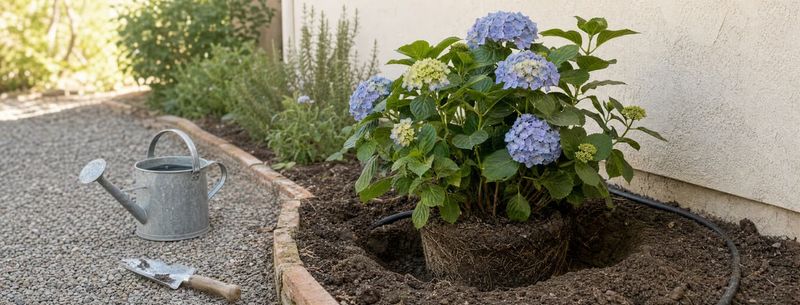
Advice that works well for an established in-ground hydrangea does not automatically translate to a plant you put in the ground last month or to one growing in a pot on the patio. Newly planted shrubs have not yet extended their roots into the surrounding soil, which means the root ball can dry out much faster than the bed around it. Checking the root ball itself, not just the nearby ground, is the right move during the first season.
University of Georgia Cooperative Extension’s guide on growing bigleaf hydrangea recommends watering new plantings thoroughly during establishment and basing the interval on whether the root ball and surrounding soil are actually drying, rather than following a fixed schedule. A new plant during a hot, dry week may need water every two to three days; that same plant after a stretch of cool, rainy weather may need nothing. Let the soil tell you.
Container hydrangeas need their own approach entirely. The most important starting point is making sure the pot has drainage holes. University of Missouri Extension’s care guide for potted flowering plants advises watering thoroughly until water runs freely from the drainage holes, then emptying any saucer or cachepot so the plant is not sitting in standing water. Roots left in water lose access to oxygen and can rot surprisingly quickly, and a wilted plant in a waterlogged pot will not recover from more watering.
Mulch supports moisture management for both new plantings and established beds. OSU Extension recommends mulching to reduce evaporation and moderate soil temperature, with organic mulch applied around the plant, not piled against the stems. UGA suggests 3 to 5 inches of organic mulch for newly planted bigleaf hydrangeas; for established beds, keeping mulch at a moderate depth avoids trapping excess moisture against the crown and creating conditions that invite rot.
Wilt may reflect heat, wet roots, or another problem
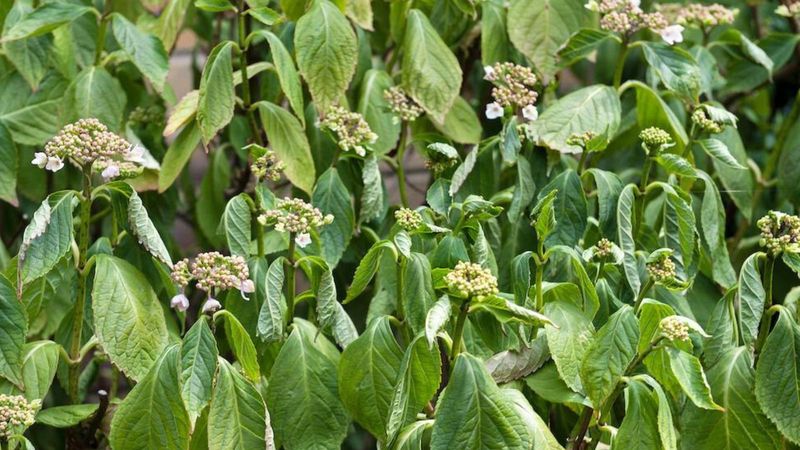
Seeing a hydrangea droop on a hot afternoon does not automatically mean the plant is thirsty. Large-leaved species, particularly bigleaf hydrangeas (Hydrangea macrophylla), can wilt noticeably during peak heat even when the soil has plenty of moisture. Illinois Extension’s explanation of heat stress describes this as a temporary response: the plant loses water through its leaves faster than roots can replace it during the hottest part of the day, and the wilt eases once temperatures drop. If the plant looks fine by evening or the next morning and the soil is moist, heat stress is likely the explanation, not drought.
Persistent wilt that does not ease overnight, or wilt paired with yellowing leaves, browning edges, dieback, or poor new growth, warrants a closer look. OSU Extension notes that severely heat-damaged plants may take until the following summer to regain their former appearance, so realistic expectations matter. If the soil around the plant is consistently wet or drains poorly, root rot becomes a serious possibility.
University of Wisconsin Horticulture Extension’s overview of plant wilt lists saturated soil and root damage alongside drought as common causes of wilting, and their root rot resource explains that damaged roots lose the ability to move water upward even when the soil is wet, which is why adding more water to a soggy, wilted plant can worsen rather than fix the problem. Pests and vascular diseases can also cause wilting that looks identical to drought stress from a distance.
Species and cultivar matter here too. UGA Cooperative Extension explains that bigleaf hydrangeas are relatively sensitive to heat and drought and generally prefer morning sun with afternoon shade, while panicle hydrangeas (Hydrangea paniculata) tolerate more sun and somewhat drier conditions, though they still prefer consistent moisture and good drainage. Knowing what you are growing helps you interpret what you are seeing.
Use a soil-led routine this weekend
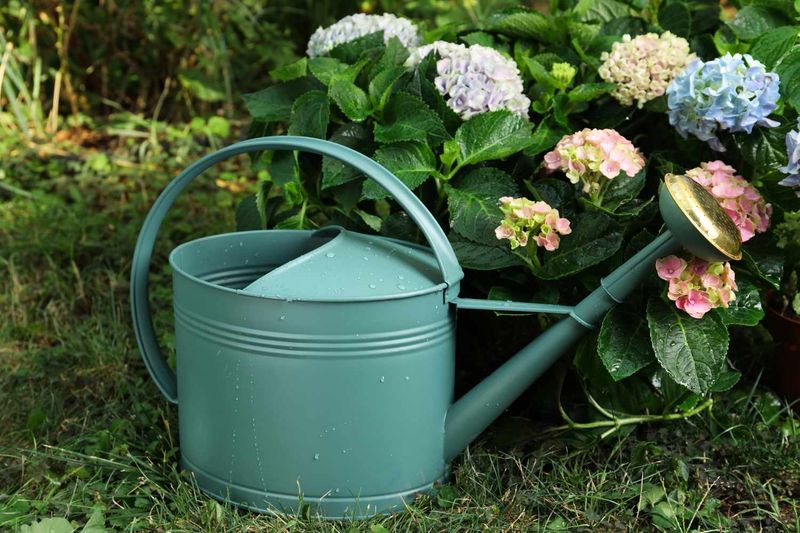
Putting this into practice does not require special equipment or a complicated schedule. Pull back the mulch near the base of the plant, press a finger or a wooden skewer 6 to 9 inches into the soil, and make your watering decision based on what you find. Dry soil at that depth means water slowly at the base until moisture has soaked through the root zone, then confirm with another probe. Moist soil means wait and check again tomorrow.
OSU Extension and UMN Extension both frame the soil probe as the most reliable tool a home gardener has. Before you water again after a session, check whether the bed drains well: if water pools for more than an hour or the soil stays soggy for days, adding more water will create more problems than it solves. UGA Extension reminds gardeners that mulch and appropriate sun exposure help reduce moisture loss, but neither one replaces a soil check.
Set realistic expectations if your plant has been struggling for a while. A hydrangea that has gone through severe drought stress or root damage may not bounce back within a few days of improved care. Consistent, soil-led watering is the foundation, but recovery takes time, and some plants need a full growing season to regain their stride.