
The Best Time Of Day To Water Your Vegetables – And Why Watering Wrong Wastes The Whole Yield
Most gardeners have heard that watering at the wrong time ruins a crop, but the real story is more practical and a lot less stressful. When you water matters, but so does how much you apply, where the water lands, and what your plants are actively doing at that moment. Getting the timing right is one piece of a bigger puzzle, and understanding all the pieces means fewer wilted plants, less wasted water, and a better harvest.
Early morning is a strong default for overhead watering
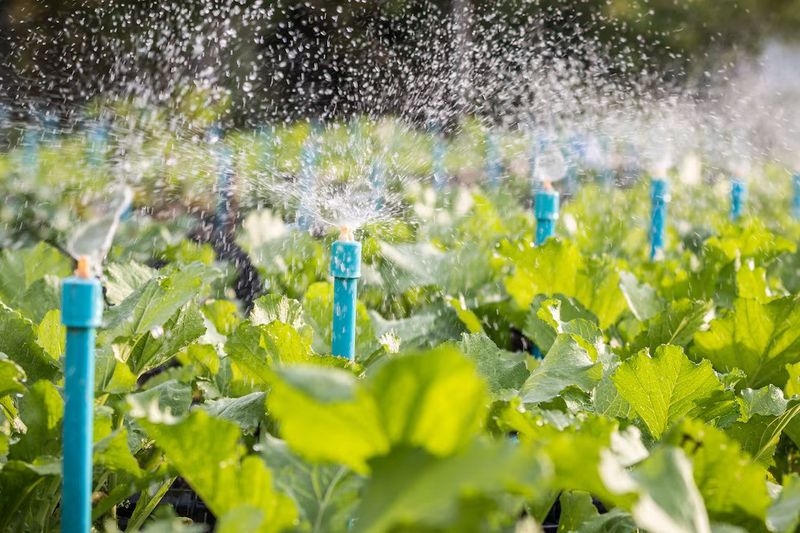
Reaching for the hose right after sunrise is genuinely good advice, especially when you are using a sprinkler, a sprinkler wand, or any method that sends water across the tops of your plants. According to University of Minnesota Extension guidance on watering vegetable gardens, early morning gives plants time to absorb moisture before afternoon temperatures peak, and it allows any water that lands on foliage to dry off before nightfall.
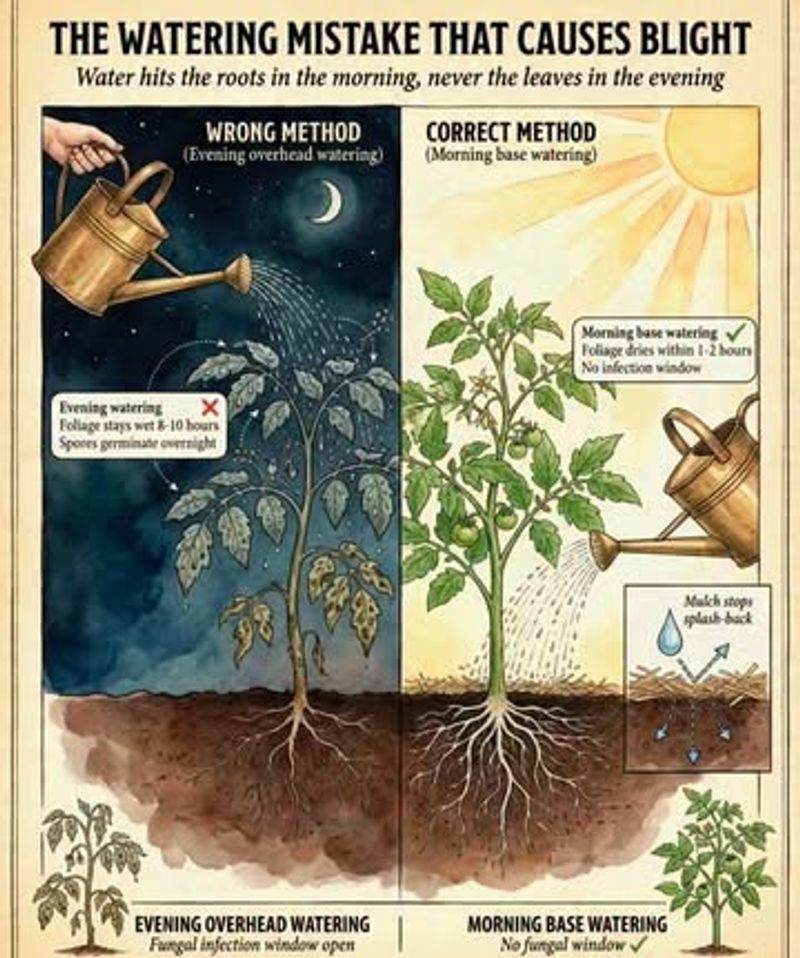
That foliage-drying window is the main reason morning earns its reputation. Leaves that stay wet for hours overnight create conditions where certain fungal and bacterial diseases can gain a foothold. Watering in the morning sidesteps that problem by giving the sun most of the day to dry things out.
Morning overhead watering also tends to lose less to evaporation than a midday session, when heat and wind can carry water away before it reaches the root zone. Neither of those advantages is trivial, but they do not tell the whole story.
Morning timing does not guarantee a bigger harvest or make up for watering too little, too infrequently, or in the wrong spot. Consistent root-zone moisture, appropriate water volume, good drainage, suitable soil, and the right irrigation method all influence plant performance at least as much as the hour on the clock. Choosing 6 a.m. over 6 p.m. is a sensible default for overhead systems, not a magic switch that controls yield.
Prolonged leaf wetness matters more than supposed sunburn
One of the most persistent watering myths is that water droplets sitting on leaves act like tiny magnifying glasses and scorch the foliage. Penn State Extension’s review of garden watering myths identifies this as an unsupported claim. Leaf damage has many real causes, including disease, insects, drought stress, fertilizer contact, wind, and frost, but droplets focusing sunlight is not among them.
The defensible concern about wet foliage is entirely different: it is about duration, not sunlight. Many fungal and bacterial pathogens that affect vegetable crops need moisture on leaf surfaces to germinate and establish. Foliage that stays wet for an extended period, especially through a warm, humid night, gives those pathogens a much better opportunity than foliage that dries within a few hours.
That is why Washington State University Extension’s vegetable gardening chapter recommends watering early in the day when using overhead methods. The goal is to keep the overnight leaf-wetness period as short as possible, not to avoid some imaginary sunburn effect.
Midday overhead watering is inefficient mainly because wind and heat increase evaporation and reduce how much water actually reaches the soil. That is a real and practical downside, but leaf scorch should not be blamed on the water itself. Focus instead on getting water to the root zone quickly and keeping leaves as dry as you reasonably can, and the timing logic takes care of itself.
Your irrigation method can matter more than the clock
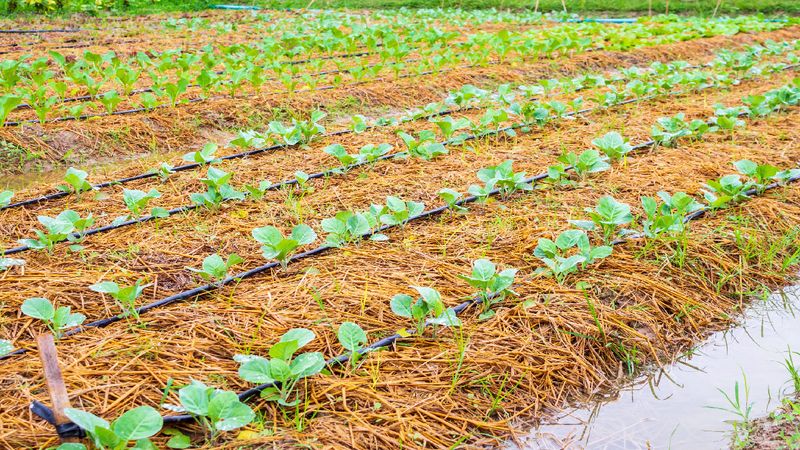
Sprinklers and hand watering with a wand or overhead nozzle are not the only ways to water a vegetable garden, and the morning-first rule does not apply equally to every method. Drip lines and soaker hoses deliver water directly to the soil at the base of plants, which means the canopy typically stays dry regardless of what time you run the system.
Directing water to the soil rather than over the leaves also reduces runoff, limits soil splash that can carry pathogens onto lower foliage, and cuts evaporation compared with overhead spray. University of Minnesota Extension notes that drip lines, soaker hoses, and a slow-flowing hose aimed at the plant base all outperform overhead sprinklers on these fronts.
For drip and soaker systems specifically, the timing question becomes much less urgent. Penn State Extension’s review of drip irrigation timing found that available research does not show a consistent efficiency difference between morning and afternoon drip sessions, particularly in the deeper portion of the soil profile where roots actively take up water. That finding applies to drip systems under typical garden conditions and should not be stretched to mean that timing never matters for any irrigation approach.
The practical takeaway is straightforward. If you use sprinklers or a handheld wand that wets leaves, morning is the smarter default. If you use drip or soaker hoses under mulch, you have more scheduling flexibility, and running the system in the evening or afternoon is a reasonable choice when your morning is busy. Match the timing advice to the actual method you are using, not to a generic rule.
Check the root zone before deciding how much to water
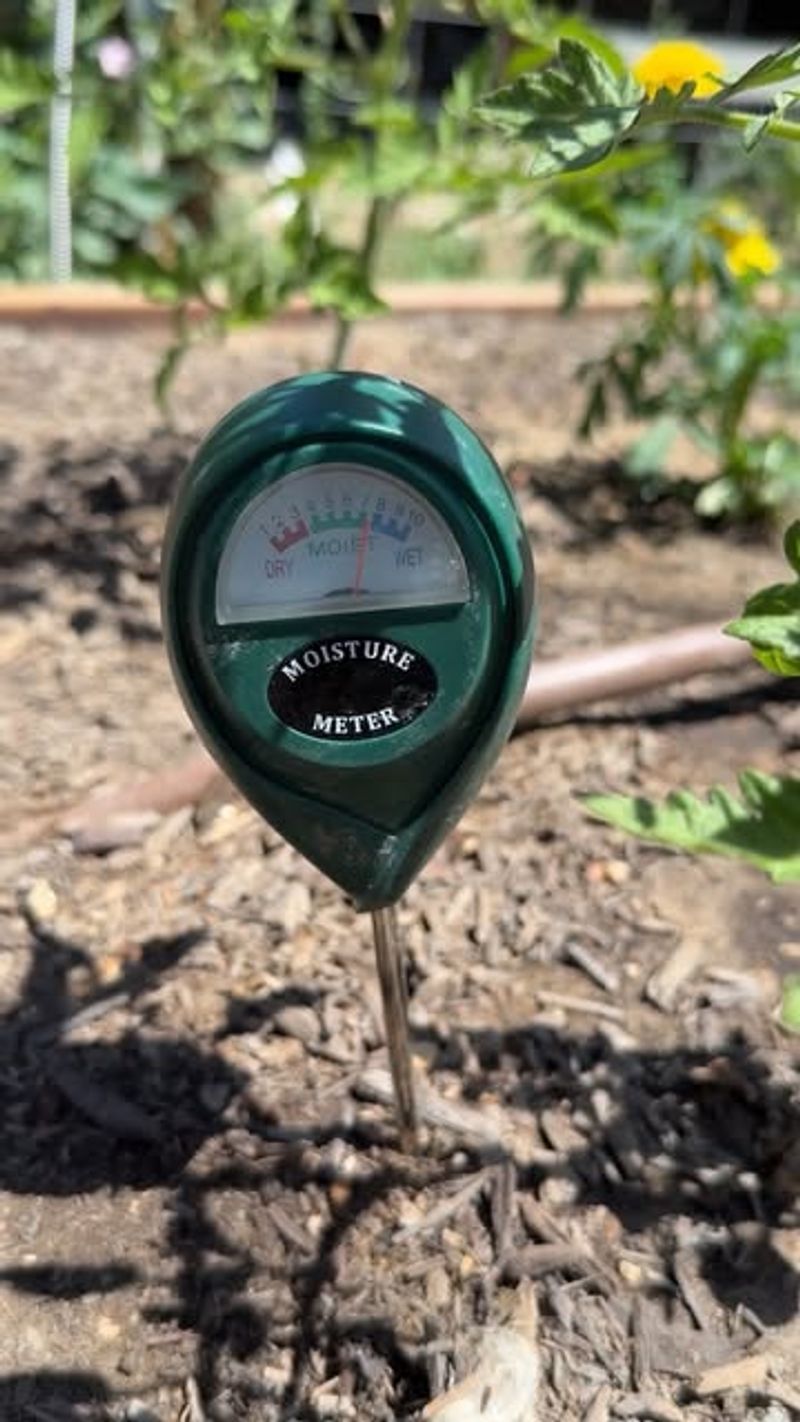
Surface soil can look and feel completely dry while the root zone a few inches down still holds plenty of moisture. Checking only the top of the bed before watering is one of the most common reasons home gardeners either overwater or underwater their vegetables without realizing it.
A reliable approach is to push your finger or a garden trowel about 2 inches into the soil near the base of your plants. If the soil at that depth feels dry, watering is generally warranted. If it still feels moist, you can wait and check again later. University of Minnesota Extension recommends this kind of root-zone check rather than relying on surface appearance alone.
When you do water, apply it slowly enough that it soaks into the profile without puddling or running off the edges of the bed. Puddling means the water is moving faster than the soil can absorb it, so it is either compacting the surface or flowing away before reaching the roots. A slow, steady delivery gives the soil time to pull water downward toward the active root zone.
Several factors change how often and how much you need to water, sometimes dramatically. Sandy or coarse soils drain quickly and may need more frequent, smaller applications. Heavier clay soils hold water longer but can become waterlogged if overwatered. Organic-rich raised bed mixes often hold moisture well but can dry unevenly.
Mulch slows evaporation and can extend the interval between waterings noticeably. Hot weather, strong wind, and low humidity all increase the rate at which soil dries out. Crop stage matters too, since a newly transplanted seedling and a mature fruiting tomato plant have very different root systems and water needs. None of these variables are captured by a single clock time, which is why checking the root zone directly is more reliable than any fixed schedule.
One inch per week is a starting point, not a commandment
The one-inch-per-week guideline shows up in nearly every vegetable gardening resource, and for good reason. It gives beginning gardeners a concrete number to work with rather than leaving them to guess entirely. University of Minnesota Extension uses it as a general benchmark for established vegetable gardens, and it holds up reasonably well under typical summer conditions in moderate climates.
Where gardeners get into trouble is treating it as a fixed rule that applies everywhere, to every crop, in every weather condition. One inch per week delivered by sprinkler is not the same as one inch delivered by drip, because overhead systems lose some water to evaporation and wind before it reaches the soil. Sandy soils may need that inch split into two or three smaller sessions to prevent it from draining past the roots before plants can use it. A week of 95-degree heat with strong wind dries soil much faster than a mild, overcast week.
Containers, seedlings, and fruiting crops in peak production all have needs that can push well beyond the standard benchmark.
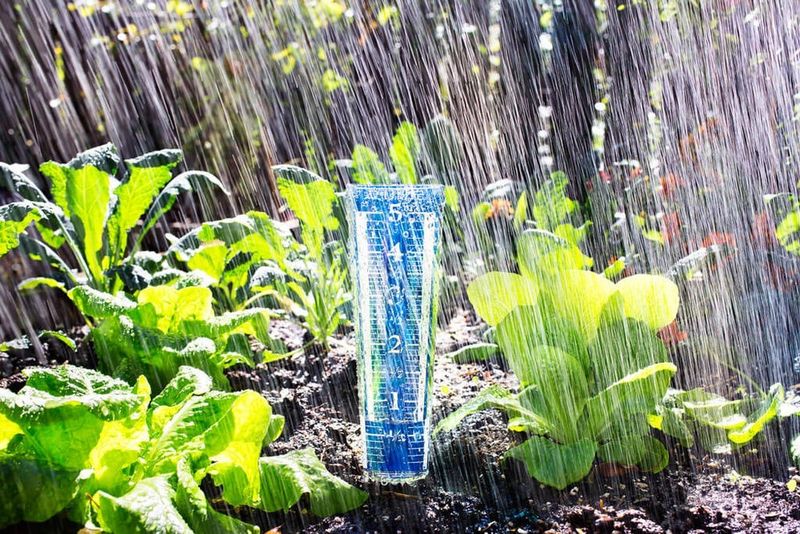
Measuring what you actually deliver is more useful than estimating by how long you ran the hose. University of Minnesota Extension points out that one inch of water equals roughly 62 gallons per 100 square feet, and you can track delivery with a rain gauge, a straight-sided can, or a bucket of known volume placed in the watering zone. Running a sprinkler for 20 minutes and assuming it applied an inch is usually a guess; measuring confirms it.
The consequences of getting the volume wrong work in two directions. Drought cycles can stress plants and reduce yield or quality, especially during the high-demand growth stages covered later in this article. Overwatering creates a different set of problems: saturated soil deprives roots of oxygen, can increase disease pressure, causes runoff that carries nutrients away from the root zone, and sometimes reduces the flavor or storage quality of the harvest. More water is not automatically better.
Steady moisture supports harvest during high-demand stages
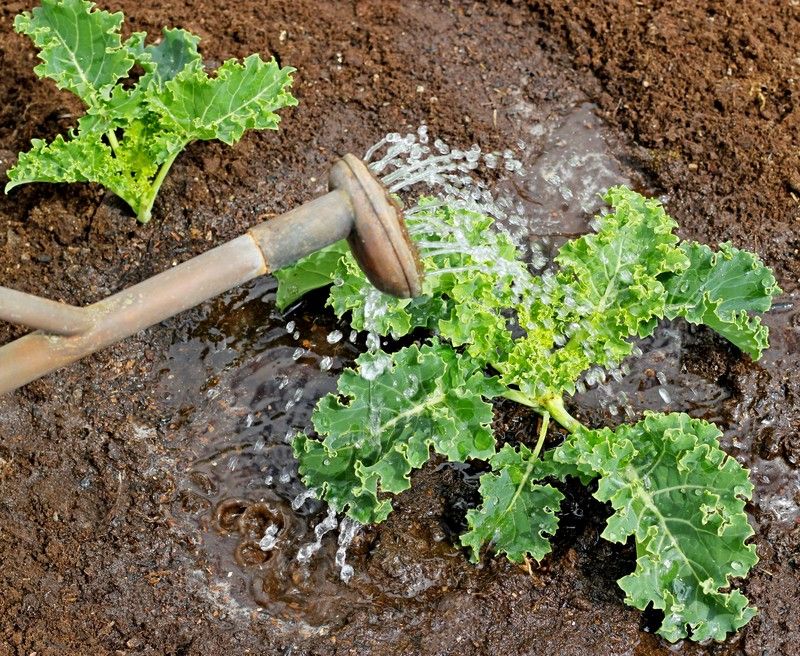
Plants do not need the same amount of water at every point in their lives. Seedlings, leafy crops in active growth, and fruiting vegetables at peak production all pull water at different rates, and some growth stages are genuinely more sensitive to moisture gaps than others.
According to University of Minnesota Extension’s irrigation strategies for vegetables, the high-demand windows break down roughly by crop type. Tomatoes, peppers, cucumbers, melons, beans, and peas are most vulnerable during flowering, fruit set, and the period when fruit or pods are actively sizing up. Running short on water at those moments can trigger blossom or fruit drop, produce smaller fruit, or cause cracking when rain or irrigation follows a dry spell. Broccoli, cabbage, cauliflower, and lettuce need steady moisture during head formation.
Carrots, beets, radishes, turnips, and potatoes are most sensitive during root or tuber enlargement, when irregular moisture can produce woody, forked, or poorly flavored roots. Onions need consistent water during bulb development to reach full size.
Repeated or substantial water stress at these stages can reduce the size, number, or quality of what you harvest. Bolting in lettuce and other leafy crops is also more likely when plants experience heat and moisture stress together. Blossom-end rot in tomatoes and peppers is worth mentioning here as well: it is a calcium-transport problem often associated with fluctuating soil moisture and other stresses, not simply a calcium shortage that adding eggshells will reliably correct.
None of this means that a single missed watering or a session at the wrong hour erases a harvest. A one-time lapse is rarely catastrophic. What causes real problems is a pattern of inconsistent moisture during the windows when crops are doing their most important developmental work. Getting the timing right on the clock matters much less than staying consistent at the root zone when it counts.
When should you water outside the morning window?
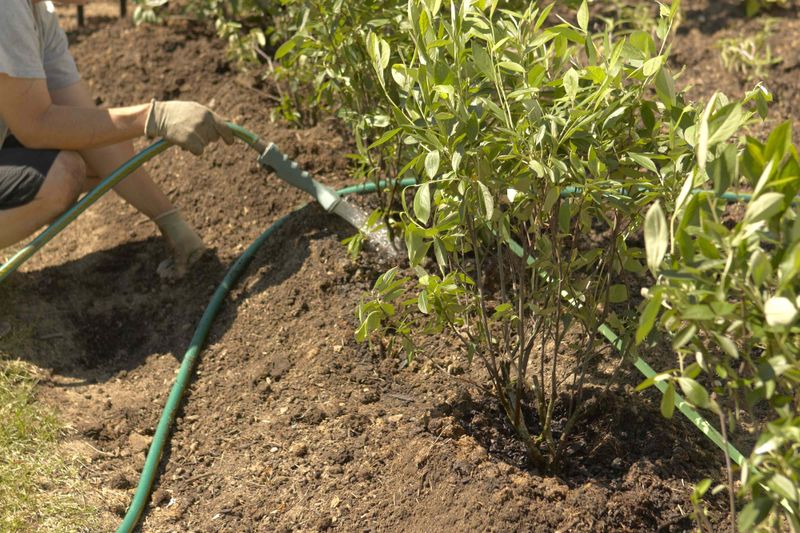
Morning is a practical default, not a strict rule, and several common garden situations call for a different approach. Newly seeded beds are one of the clearest examples. Seeds need the germination zone kept consistently moist, which often means a light, gentle watering in the morning and another in the afternoon or evening, depending on how fast the surface dries. Waiting for the next morning when the seed zone has gone dry can slow or interrupt germination.
Seedlings and recent transplants need closer attention during establishment for the same reason. Their root systems are small and shallow, so they cannot access moisture from deeper in the soil the way a mature plant can. University of Minnesota Extension notes that newly established plants may need more frequent monitoring and watering until they develop a stronger root system.
Containers are a separate category entirely. Potting mix dries out much faster than in-ground or raised-bed soil, and during hot, dry weather, Oregon State University Extension’s watering basics resource advises that container vegetables may need daily or even twice-daily checks. Water until it drains freely from the bottom, but do not leave pots sitting in standing water.
Late-afternoon or evening watering is not automatically harmful when water is directed to the soil rather than sprayed over the leaves. Washington State University Extension specifically distinguishes between overhead irrigation, where evening timing raises the overnight leaf-wetness risk, and drip or soaker systems, which can reasonably be run later in the day.
One more situation deserves a direct answer: if your plants are wilting and the soil at root depth is dry, water promptly regardless of the hour. That said, the Colorado State University vegetable guide points out that large-leaved crops can wilt temporarily on hot afternoons even when the soil is adequately moist, because transpiration briefly outpaces root water uptake. Check the root zone before adding more water, especially if it rained recently or you watered that morning.
Build a routine around roots, conditions, and dry foliage
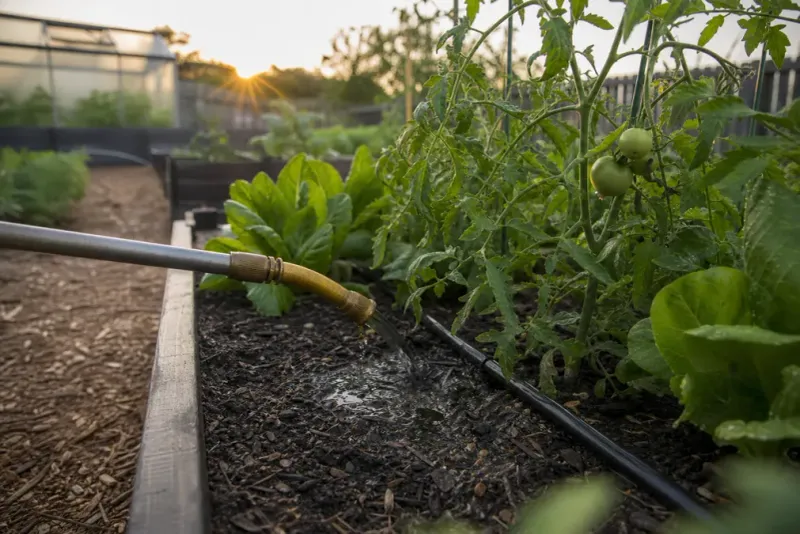
A reliable watering routine starts with knowing which irrigation method you are using. If sprinklers or a wand wet your foliage, schedule those sessions for early morning when practical so leaves have the full day to dry. If you use drip lines or soaker hoses that keep the canopy dry, you have more flexibility on timing, and late afternoon or evening sessions are a reasonable option when your mornings are occupied.
Regardless of method, direct water toward the soil and the root zone rather than over the tops of plants. Check moisture about 2 inches below the surface before deciding whether to water, and measure delivery with a rain gauge or straight-sided container rather than estimating from hose-running time. University of Minnesota Extension and their irrigation strategies guidance both support this root-zone-first approach as the practical foundation of consistent vegetable watering.
Adjust your frequency and volume for crop stage, soil type, weather, mulch, and whether you are growing in containers or in-ground beds. Water more attentively during the high-demand windows when crops are flowering, setting fruit, or sizing up roots and heads. The best watering time is simply the time that reliably supplies consistent root-zone moisture while keeping foliage as dry as you reasonably can – not a single magic hour that guarantees or destroys what grows in your garden.