
What Causes Tomato Leaves To Curl In Summer And What Each Curl Is Warning You
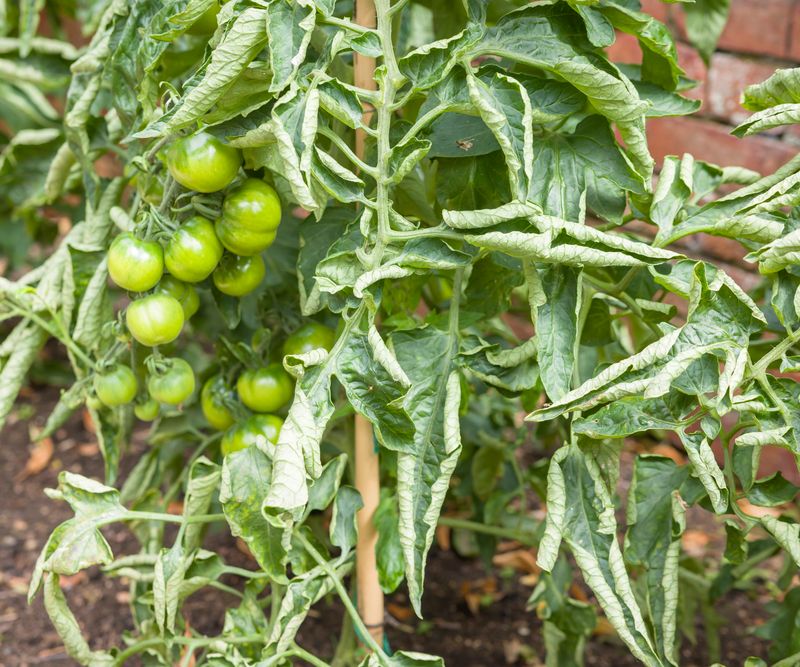
Tomato leaves that suddenly curl on a hot July afternoon can stop a gardener in their tracks and spark a wave of worry. The good news is that not every curl means something has gone seriously wrong. Summer leaf curl is more like a clue than a verdict, and learning to read it carefully can save you from watering too much, spraying too soon, or missing a problem that actually needs attention.
Treat summer leaf curl as a clue, not a verdict
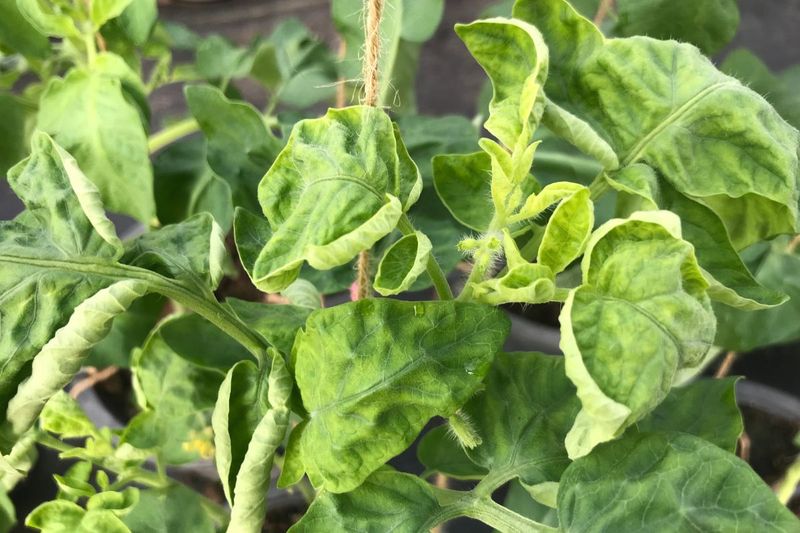
Picking up a curled tomato leaf and wondering what went wrong is a completely reasonable reaction, but the curl itself is only a starting point. Several very different problems can produce similar-looking leaf curl, and without more context, the symptom alone cannot tell you whether the plant needs water, less sun, pest control, or nothing at all.
A reliable first step is to slow down and gather information before doing anything. Note which direction the leaves are curling, whether older lower leaves or newer growth at the top of the plant are affected, how the leaf feels when you touch it, what color it is, and when you first noticed the change. Then look beyond the leaves themselves. Check the stems, the undersides of leaves, the developing fruit, and the overall shape of the plant.
Environmental stress, chemical exposure, insect feeding, and viral disease can all produce overlapping curl patterns. Illinois Extension plant diagnosticians point out that leaf curl on tomatoes has multiple possible causes, and identifying the right one requires examining the whole plant and its surroundings. Matching a curl pattern to a single explanation without that broader look can lead to a response that fails to help or makes the situation worse.
The sections that follow walk through the most common summer curl patterns one at a time, starting with the least worrying and moving toward situations that deserve closer attention. Think of each pattern as a possible explanation to test against what you actually see in your garden, not a definitive answer to apply automatically.
Older leaves that roll upward usually reflect physiological stress
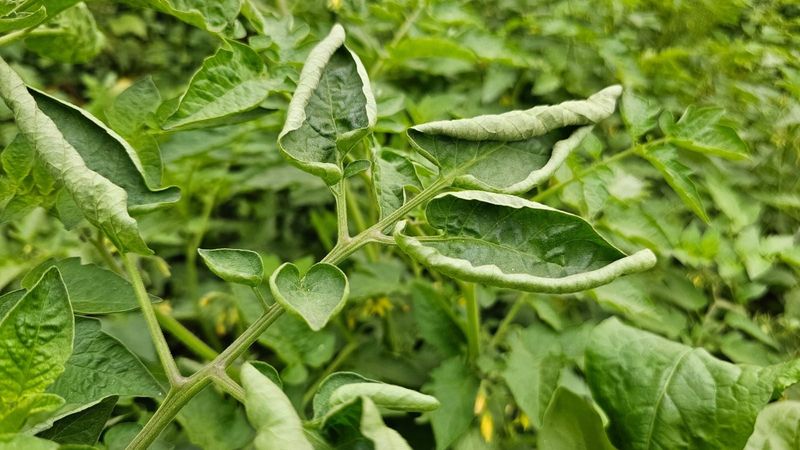
When lower or mid-plant leaves begin rolling upward along their edges and curling inward toward the midrib while staying green and firm, the most likely explanation is physiological leaf roll. This is the most common summer curl pattern backyard gardeners encounter, and it tends to show up during stretches of hot, dry weather or after periods of rapid plant growth.
The leaves take on a leathery or waxy feel and may look almost tube-shaped when the curl is pronounced. The plant continues growing and setting fruit, and the rest of the foliage usually looks normal. University of Minnesota Extension states that physiological leaf roll generally does not reduce tomato growth or yield and does not require treatment. That reassurance is worth keeping in mind before reaching for the hose or a spray bottle.
The rolling is thought to reduce the surface area exposed to sun and dry air, which may help the plant conserve moisture during stress. Other triggers besides heat and drought include pruning away too much foliage, a burst of growth after fertilizing, or root zone disturbance. Illinois Extension’s Good Growing blog notes that severe pruning in particular can push a plant into this response by upsetting the balance between roots and leaves.
One important nuance: rolled leaves can persist even after the weather cools or conditions improve. That does not mean the plant is still failing. However, if the heat or drought that triggered the roll is ongoing and severe, the stress itself can cause separate problems over time, including sunscald on fruit and reduced pollination. Illinois Extension heat management guidance notes that temperatures above roughly 92 degrees F during the ripening period can affect fruit quality, which is a separate concern from the leaf curl itself.
Stabilize moisture without watering on autopilot
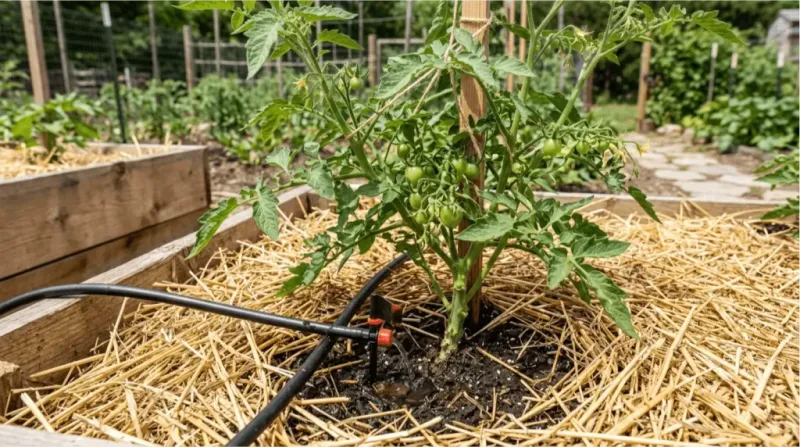
Once physiological leaf roll seems like the most likely explanation, the practical response centers on steadying growing conditions rather than flooding the root zone. Start by pushing a finger two to three inches into the soil near the base of the plant. If the soil feels moist at that depth, adding more water right away is unlikely to help and can create drainage problems or encourage root disease.
Maintaining reasonably even soil moisture over time is more useful than reacting to each new curl. Illinois Extension advises checking root-zone moisture rather than relying on leaf appearance alone, because physiological leaf roll can occur even when the plant is not severely water-stressed. Watering more than the soil can hold does not reverse the curl and sets up conditions where roots struggle to get oxygen.
A layer of organic mulch spread a few inches deep around the root zone can make a meaningful difference. Mulch slows evaporation, moderates soil temperature swings, and helps buffer the plant against the kind of moisture fluctuation that triggers rolling in the first place. Illinois Extension’s tomato heat guidance supports mulching as a practical tool for reducing summer stress, and it works whether plants are in ground beds or raised beds.
The often-cited benchmark of roughly one inch of water per week is a flexible starting point, not a fixed rule. Sandy soil, large plants, high wind, intense heat, and recent rainfall all shift the actual amount your garden needs. Illinois Extension’s tomato growing guidance highlights that containers dry out faster than in-ground beds and may need attention daily or more during a hot spell, depending on pot size and plant demand. Avoid severe pruning during heat waves, and hold off on heavy nitrogen fertilizer when plants are already stressed, since both practices can worsen the curl response.
Twisted new growth can indicate herbicide injury
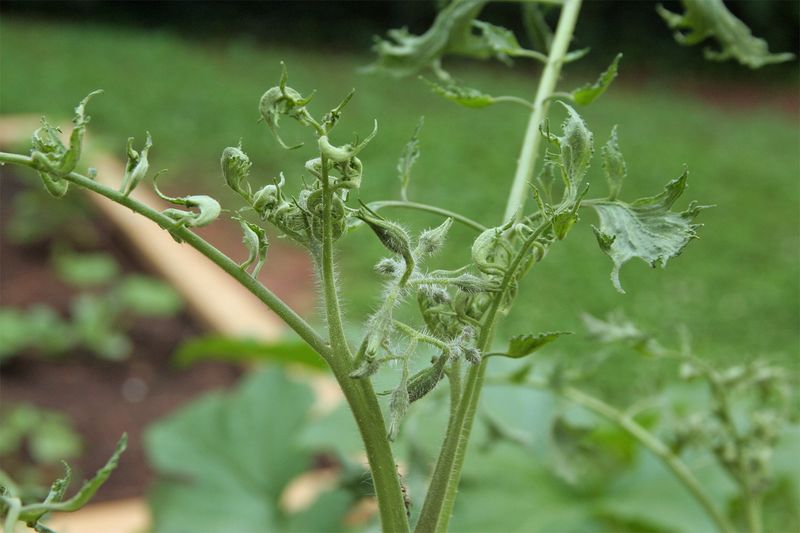
A different pattern deserves a different line of thinking. When the newest growth at the tips and tops of the plant looks twisted, narrow, or fails to expand properly, and the older leaves are not the primary concern, the situation points away from ordinary physiological leaf roll and toward something the plant was exposed to rather than simply stressed by.
Growth-regulator herbicides such as 2,4-D and dicamba are the most common culprits in backyard settings. Tomatoes are highly sensitive to these products, and the symptoms can appear after surprisingly low exposure levels. University of Minnesota Extension describes the pattern as distorted, narrow, or elongated new leaves; thickened or prominent veins; stems that become brittle or develop cracks or splits; and fruit that grows irregular or catfaced. The curl in this case tends to be downward rather than the upward roll associated with heat stress.
Exposure can come from several directions that are easy to overlook. Lawn herbicide applied on a windy day can drift into adjacent garden beds. During hot, dry weather, certain formulations of dicamba can volatilize and move even without wind. A sprayer that was used for lawn products and not thoroughly rinsed can leave enough residue to injure tomatoes when it is later used to apply fertilizer or water.
Grass clippings from a recently treated lawn, spread as mulch, are another documented source of herbicide contact.
If distorted new growth appears, think back over the past week or two and ask whether any lawn products were applied nearby, whether a sprayer was shared, or whether fresh clippings were used in the garden. Symptoms from viral disease can look similar, so consider whether other broadleaf plants in the area are also showing distorted growth. If they are, herbicide exposure becomes more plausible. There is no spray remedy for herbicide injury; the plant either recovers as it grows out or it does not, and the priority is identifying and removing the source of exposure.
Inspect leaf undersides when insects accompany the curl
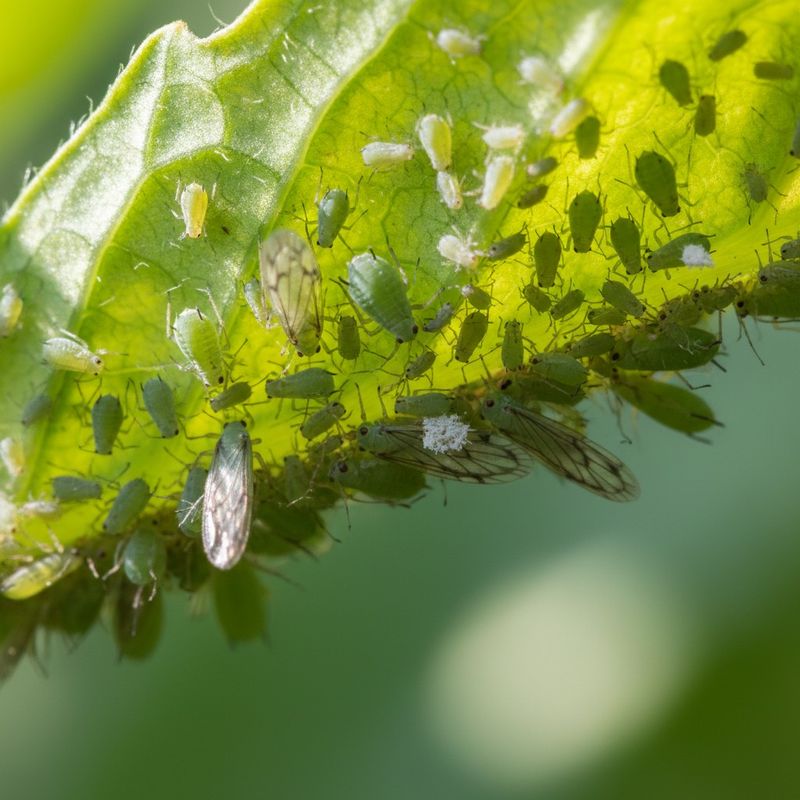
Leaf curl that comes with visible insects, sticky residue, or sooty black coating on leaf surfaces is telling you something specific: the problem has legs, literally. Before reaching any conclusion, flip a few curling leaves over and look at the undersides, especially on tender growth near the top of the plant.
Aphids are small, soft-bodied insects that cluster on leaf undersides and around new growth. Heavy populations can cause leaves to crinkle, curl, and look distorted, and the plants may appear stunted or wilted. A telltale sign is sticky honeydew on leaves below the colony, which often develops a dark sooty mold coating. University of Minnesota Extension’s plant diagnostic tool lists aphid feeding as a recognized cause of tomato leaf curl.
For moderate infestations, a strong stream of water directed at the undersides of leaves can knock populations down effectively. For more persistent problems, a properly labeled insecticidal soap, applied according to the product directions, is a commonly recommended option. Homemade detergent solutions are not a reliable substitute and can damage foliage.
Whiteflies present a related but distinct concern. They are tiny, white-winged insects that rise in a cloud when disturbed. Like aphids, they feed on plant sap and excrete honeydew, leading to yellowing, curling, and sooty mold. UC IPM’s whitefly management guidance notes that whitefly feeding itself can cause yellowing and leaf curl, but Bemisia species, sometimes called sweetpotato whiteflies, add another layer of concern because they can transmit tomato yellow leaf curl virus.
UC IPM identifies this as especially significant in southern California and parts of the San Joaquin Valley.
UC IPM’s tomato pest brochure distinguishes Bemisia whiteflies from greenhouse whiteflies, which are not equivalent vectors for the virus. Regional risk matters here; not every gardener in the US faces the same likelihood of Bemisia pressure. Identification before treatment is the priority, and no pesticide should be applied without confirming what insect is present and following the product label.
Yellowing, mottling, stunting, and fruit marks raise disease concerns
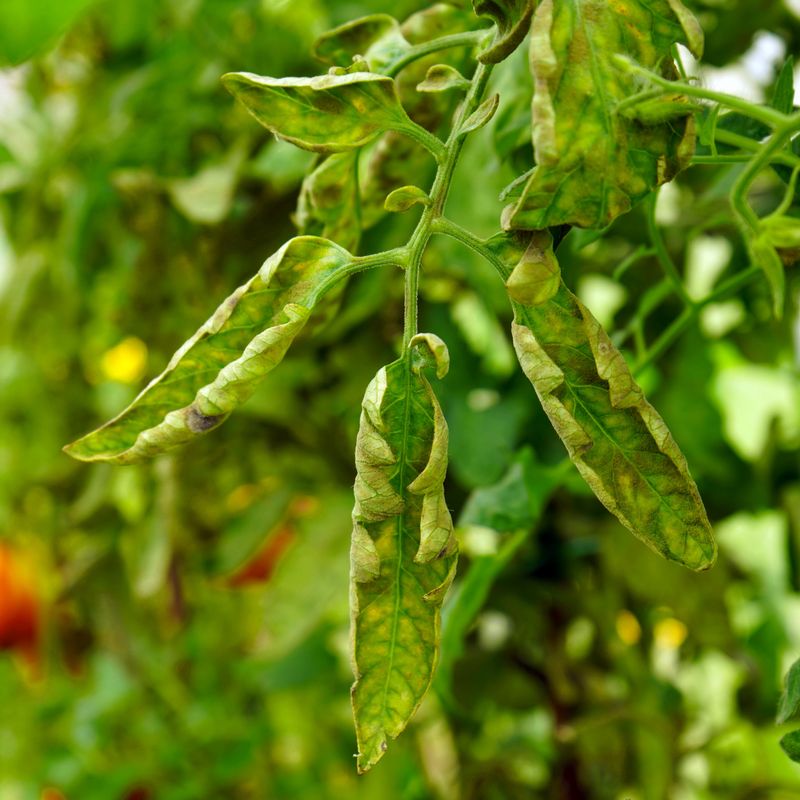
Physiological leaf roll keeps its green color and firm texture. When curl arrives alongside yellowing between veins, mottled or mosaic-patterned foliage, crumpled or unusually small leaves, reduced flower set, or spots and rings on developing fruit, the picture changes. These combinations point toward a viral infection rather than a simple stress response, and the distinction matters because the management approach is entirely different.
Tomato yellow leaf curl virus produces a recognizable set of symptoms. Leaves become small and strongly crumpled, curling upward at the margins. Yellowing appears between the veins and along leaf edges. Infected plants may grow slowly, look stunted compared to nearby plants, and drop flowers without setting fruit.
UC IPM’s tomato yellow leaf curl management page recommends laboratory testing to confirm the diagnosis and notes that the disease is spread by Bemisia whiteflies, making regional whitefly pressure a relevant factor in assessing likelihood. A plant with curling leaves and no other symptoms is not a confirmed case of this virus.
Tomato spotted wilt virus follows a different pattern. UC IPM’s spotted wilt resource describes symptoms that can include bronzing on young leaves, dark necrotic spots or streaks, wilting or curling, and distinctive rings or blotchy discoloration on fruit. This virus is spread by thrips rather than whiteflies, which is another reason to look carefully at what insects are present before drawing conclusions.
Regional context shapes how seriously to weigh viral possibilities. Gardeners in areas where the relevant vectors are established face a higher baseline risk than those in regions where these insects are rare. Curl alone, even pronounced curl, cannot establish a viral diagnosis. The combination of curl with discoloration, stunting, unusual fruit appearance, and a plausible vector population is what raises the concern to a level worth acting on.
Match the response to the evidence you can observe
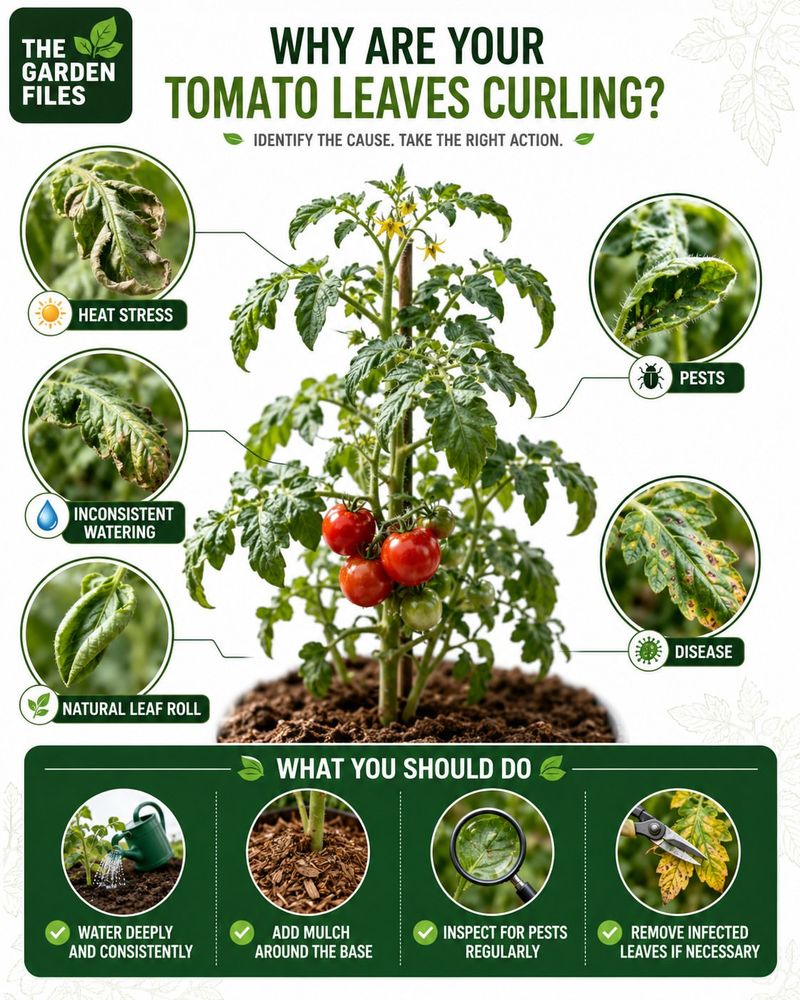
Reading the curl correctly is only useful if the response matches what you actually found. A plant with older, green, firm, upward-rolling leaves during a heat wave calls for steadier conditions and a period of observation. Check the root-zone moisture, add mulch if it is not already in place, hold off on heavy pruning, and give the plant a few days to show whether conditions are improving.
Distorted new growth with twisting, narrowing, or thickened veins calls for an exposure investigation first. Think through recent spray activity in the yard or neighborhood, check whether shared equipment could have carried residue, and look at whether other broadleaf plants nearby are showing similar distortion. If a herbicide source seems likely, remove it and let the plant grow out while monitoring new growth. University of Minnesota Extension confirms that tomatoes are highly sensitive to growth-regulator herbicides and that identifying the exposure source is the critical first step.
Curl accompanied by insects, honeydew, or sooty mold points toward pest management. Identify the insect, confirm the population is large enough to warrant action, and choose a response appropriate to what you found. A strong water spray handles many aphid situations. For persistent or more complex pest pressure, consult the product label of a properly labeled insecticidal soap before applying anything.
When viral disease seems plausible based on yellowing, crumpling, stunting, mottling, fruit spots, or a known vector presence in your region, the response shifts significantly. Separate or remove clearly infected plants to reduce the chance of spread. Manage relevant insect vectors where appropriate, following label directions. UC IPM specifically recommends testing for suspected tomato yellow leaf curl virus rather than assuming the diagnosis from symptoms alone.
A county extension office or diagnostic laboratory can provide confirmation and region-specific guidance. No pesticide application is justified simply because a leaf curled.
Let the curl guide your next inspection
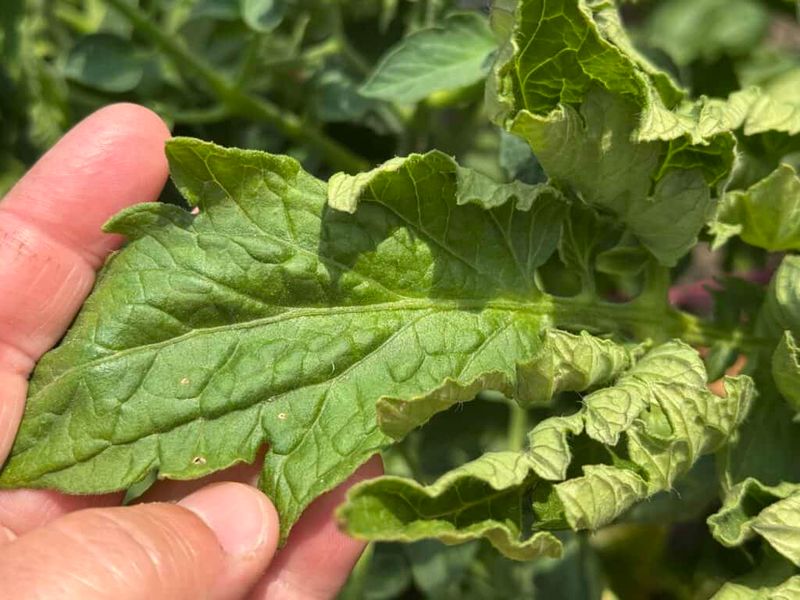
Older leaves that roll upward, stay green and firm, and appear on an otherwise healthy-looking plant during a heat wave usually call for steadier growing conditions and a watchful eye rather than an immediate intervention. That pattern is common, often low-impact, and frequently resolves or becomes less noticeable as temperatures moderate.
Distorted new growth, insects or honeydew on leaf undersides, yellowing between veins, stunted or mottled foliage, and unusual marks on fruit each point toward something that deserves a closer look and possibly outside help. University of Minnesota Extension’s tomato diagnostic tool is a useful starting point for working through those more complex situations systematically.
Leaf curl earns its usefulness only when paired with the full picture: where on the plant the curl appears, which direction it goes, what the leaf feels like, what else has changed, and what the weather and garden environment have been doing. A curl observed in context becomes a real clue. A curl noticed in isolation and treated on instinct is just a guess.