
If Your Tomatoes Grow Big Leaves But Barely Set Fruit, Here’s The Feeding Fix That Turns It Around
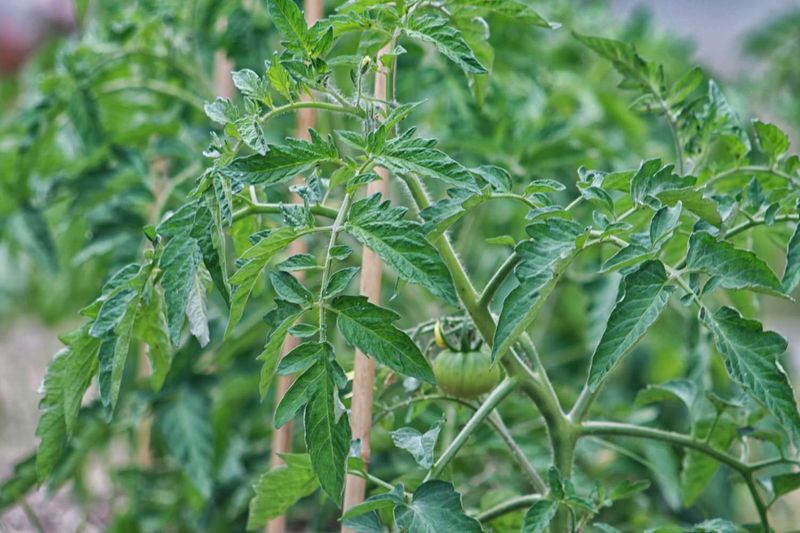
Watching your tomato plant explode with dark, lush foliage while the fruit stays stubbornly absent is one of the most frustrating surprises of the summer garden. The good news is that one common culprit, too much nitrogen, is something you can start investigating right now without spending a dime.
That said, a feeding change alone may not be the whole answer, because heat, water stress, and poor pollination can cause the same disappointing picture. Knowing how to read your plant’s clues is the first step toward figuring out what it actually needs.
Big leaves are a clue, not a diagnosis
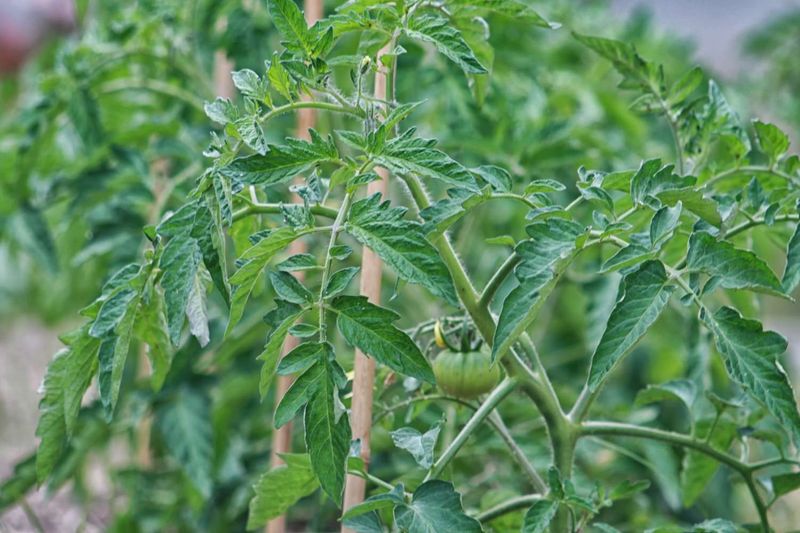
Pull up a chair next to your tomato plant and take a real look at what you’re seeing. The first thing to sort out is whether the leaves are simply large or whether the whole plant looks unusually dark green, is pushing out new growth at a surprising pace, and has a history of repeated fertilizer applications, heavy manure, or generous compost additions.
University of Minnesota Extension guidance on fertilizing plants notes that excess nitrogen promotes excessive leafy growth, and that pattern, combined with a fertilizer-rich history, is what makes overfeeding worth considering.
Leaf size alone cannot tell you whether nitrogen is the problem. Vigorous indeterminate varieties, such as Brandywine or Mortgage Lifter, naturally produce substantial foliage throughout the season.
University of Illinois Extension’s tomato page points out that big, healthy-looking leaves on a large-framed cultivar are not automatically a warning sign.
The fruiting pattern matters just as much as the foliage. A plant showing almost no flowers at all is in a different situation from one that forms flowers and then drops them before any fruit develops, which is again different from a plant carrying small green fruit that stops sizing up or shows damage at the blossom end.
University of Arizona Extension’s tomato challenges guide separates these three patterns because they point toward different causes, from nutrition and plant maturity to heat, drought, humidity, and pollination failure.
Before drawing any conclusion, run through a short mental checklist. How often have you fertilized, and what kind?
Have you added bagged manure or large amounts of compost? Is the foliage an unusually deep, almost blue-green color rather than a normal medium green?
Is the plant putting on new leaves and stems faster than expected? If most of those answers point toward a nitrogen-heavy history, excess feeding becomes a reasonable hypothesis, though not a certainty.
Minnesota Extension’s tomato growing guide frames this as one possible explanation among several, which is exactly the right starting mindset.
Excess nitrogen can favor vines over fruit
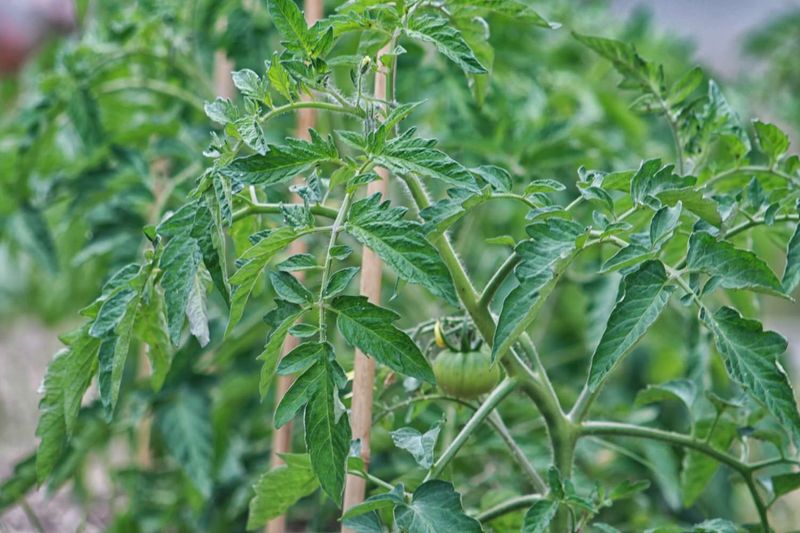
Nitrogen is the nutrient most responsible for green, leafy growth in plants. Tomatoes need it, but when they get too much, the plant can keep channeling energy into producing more stems and leaves rather than shifting into reproductive mode.
University of Minnesota Extension describes overfertilized tomatoes as bushy, leafy, and slow to bear fruit, which is a recognizable description for anyone staring at a plant that looks impressive from a distance but offers almost nothing to harvest.
Colorado State Extension echoes that point, explaining that high nitrogen levels can push a tomato plant toward excessive vine growth at the direct expense of fruit production. Research published in a peer-reviewed journal on field vegetable production found that an excessive nitrogen application rate increased vegetative growth but reduced fruit number and marketable yield compared with a more moderate rate.
That finding connects what you see in the garden, a wall of leaves, to what you don’t see, a reasonable harvest.
The mechanism is straightforward in practical terms. Nitrogen stimulates cell division and chlorophyll production, which is exactly what you want early in the season when the plant is building its structure.
Later in the season, when the plant should be directing resources toward flowering and fruit development, a continuing flood of nitrogen keeps the vegetative engine running when you’d rather it slow down. Colorado State Extension’s tomato guide recommends reducing or stopping nitrogen applications once the plant is actively setting fruit.
None of this means nitrogen is the enemy. The plant will still need an appropriate supply to support healthy growth, develop fruit, and resist stress.
The concern is specifically about excess, and only when the diagnostic pattern, dark color, rapid vegetative growth, and a nitrogen-heavy feeding history, makes overfeeding genuinely plausible rather than a convenient guess.
Pause nitrogen only when overfeeding looks plausible
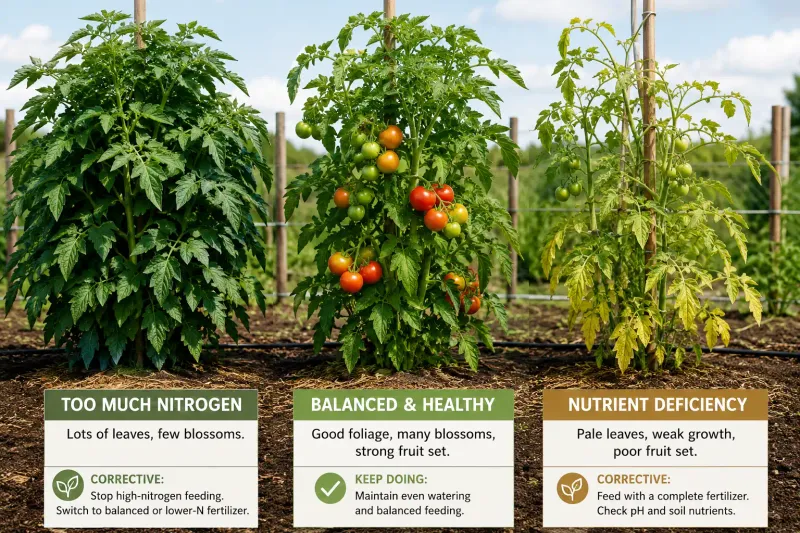
When the overfeeding pattern fits, the most sensible immediate step costs nothing: stop applying nitrogen-rich fertilizer and take stock of what the plant has already received. Write down the products you’ve used, how often you applied them, and whether you’ve added bagged manure, compost, or any other amendments this season.
University of Minnesota Extension’s fertilizer guide recommends basing all feeding decisions on actual soil conditions and plant needs rather than routine schedules, which is the principle behind pausing first and reassessing before adding anything else.
Pausing prevents additional nitrogen from loading into the soil while you investigate, but it does not remove what the plant has already absorbed. Existing nitrogen will not simply disappear from the plant’s tissues on a predictable schedule, and new flowers may still abort because of heat or pollination conditions that have nothing to do with feeding.
Think of the pause as stopping the bleeding rather than as a guaranteed cure. Penn State Extension’s tomato production guide emphasizes that fertilizer decisions should align with actual plant and soil needs at each growth stage.
While you’re pausing, check in on heat, water consistency, plant maturity, and how far along the season is. A plant that has not yet reached the fruiting stage because of a late start or a slow cultivar may simply need more time.
A soil test from your local extension service is the most reliable way to find out what’s actually in the ground before you decide whether and how to resume feeding later in the season.
Container tomatoes need a separate assessment before you apply any blanket pause. Potting mixes lose nutrients steadily through frequent watering, and the limited root volume means plants can run short faster than those growing in the ground.
Minnesota Extension’s container plant fertilizing guidance recommends factoring in the potting mix, prior applications, visible plant symptoms, and product label directions before deciding whether to hold off or continue. A container tomato showing pale lower leaves and slowing growth may need a light feeding even while an in-ground plant with the same leafy problem clearly does not.
Keep moisture steady while you investigate
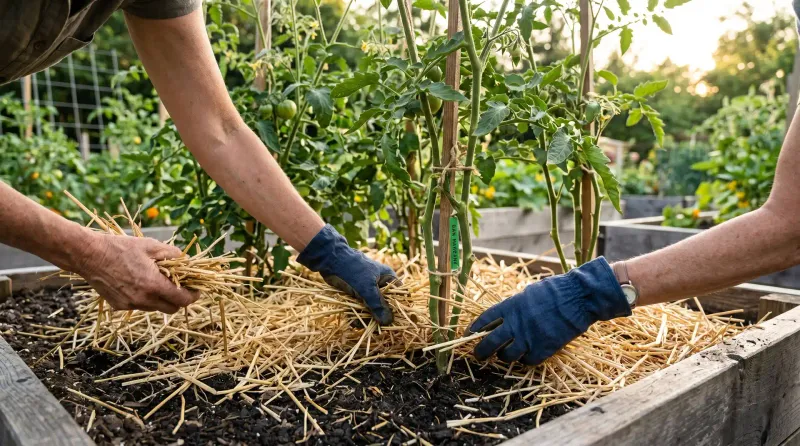
Water management during this diagnostic window matters more than most people expect. Inconsistent moisture, alternating between dry soil and sudden flooding, stresses tomato plants in ways that can worsen whatever underlying problem you’re already trying to sort out.
University of Illinois Extension connects inconsistent watering during hot weather to a range of tomato problems, including blossom drop and fruit quality issues.
The practical approach is to check the actual soil moisture before reaching for the hose. Push a finger two inches into the soil near the plant’s root zone.
If it feels dry at that depth, water deeply enough that moisture reaches the roots rather than just wetting the surface. Penn State Extension’s tomato production guide recommends even, deep watering adjusted to soil type, weather, plant size, and whether the plant is in a container.
One inch per week is a rough starting point in moderate conditions, but sandy soils, high heat, and large plants in containers can require more frequent attention.
Mulch is one of the simplest tools available. A two-to-three-inch layer of straw, wood chips, or shredded leaves around the base of the plant slows evaporation, buffers soil temperature, and reduces the moisture swings that contribute to fruit problems.
Illinois Extension’s drought and plant stress guidance supports mulching as a practical way to protect plant roots during dry or hot stretches.
Overwatering is a real risk, not just a theoretical one. Saturated soil drives out oxygen, damages roots, and can make nutrient uptake worse even when fertilizer is present.
The goal is steady and appropriate moisture, not maximum moisture. If the soil feels consistently wet without rain or irrigation, ease back and let it cycle down before the next watering.
Heat can make flowers disappear even with good nutrition
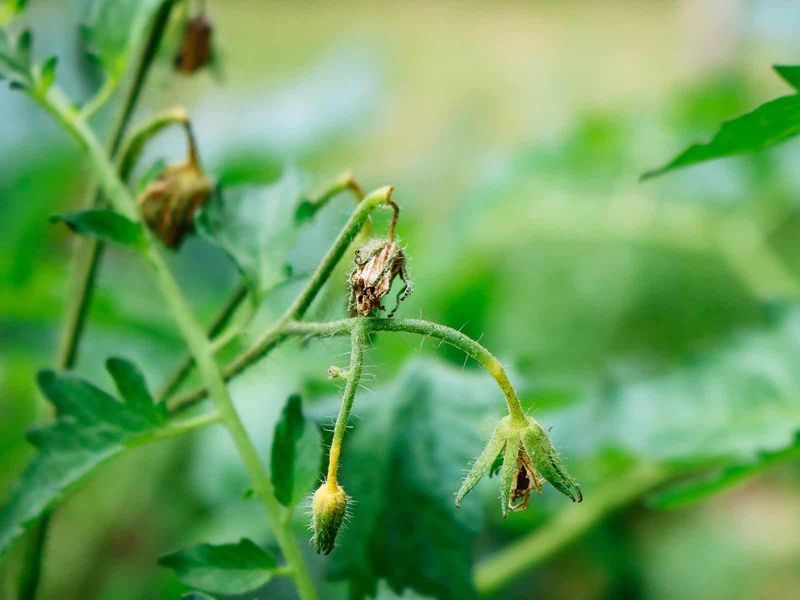
Even a perfectly fed, well-watered tomato plant can refuse to set fruit when temperatures climb and stay high, particularly through the night. Sustained heat interferes with pollen viability and the fertilization process inside the flower, leading to blossom abortion before any fruit has a chance to form.
University of Minnesota Extension explains that prolonged daytime temperatures above roughly 85 degrees Fahrenheit combined with warm nights can disrupt tomato pollination and cause flowers to drop without setting fruit.
Penn State Extension identifies heat-related flower abortion as one of the most common reasons for poor fruit set during peak summer, separate from any nutrition problem. The practical implication is that if you’re in the middle of a heat wave, pausing nitrogen and adjusting water may not be enough to keep flowers on the plant.
Penn State’s heat stress and tomatoes resource notes that the night temperature matters as much as the daytime high, because pollen development happens overnight and can be damaged by persistently warm nights even when days seem manageable.
Temporary shade cloth, positioned to reduce direct afternoon sun by around 30 percent, can help moderate temperature stress on flowers during extreme conditions. Colorado State Extension recommends approximately 30 percent shade reduction in hot growing conditions, though this is a situational tool rather than a universal requirement.
Shade that is too heavy or applied too long can reduce fruit production by limiting the light the plant needs.
Gently shaking or flicking flower clusters can help move pollen within the flower, which is useful in still air or for plants growing under cover where insects have limited access. University of Arizona Extension’s tomato challenges publication describes manual flower vibration as a practical aid in low-pollinator or covered environments.
That said, shaking flowers will not overcome heat damage to pollen, poorly developed flowers, or the other environmental conditions that prevent fruit set. Temperature thresholds vary by cultivar, humidity, and how long the heat lasts, so treat all specific numbers as regional guidelines rather than guarantees.
Skip bloom boosters and home remedies
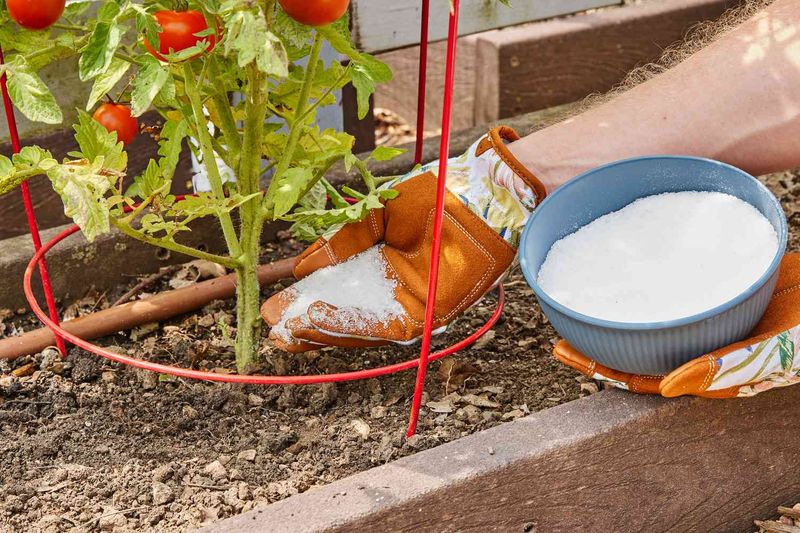
After spotting a possible nitrogen surplus, the instinct to reach for a bloom booster or a home remedy is understandable, but those moves can create new problems before the original one is resolved. Phosphorus fertilizers are often marketed as flowering stimulants, but University of Minnesota Extension recommends using low- or no-phosphorus fertilizer for tomatoes unless a soil test specifically calls for phosphorus, because many home garden soils already contain more than enough.
Adding phosphorus to a soil that doesn’t need it contributes to runoff and can interfere with the uptake of other nutrients.
Epsom salts come up constantly in garden forums as a fix for everything from yellowing leaves to poor fruit production. Minnesota Extension’s guide on home amendments including Epsom salts is direct: Epsom salts do not improve tomato productivity unless a confirmed magnesium deficiency is present, and excess magnesium can actually interfere with the plant’s ability to take up calcium.
Eggshells decompose far too slowly to deliver any timely calcium benefit to a plant struggling mid-season. Calcium sprays are not a reliable universal fix either.
Minnesota Extension’s phosphorus fertilizer guide reinforces that nutrient applications should be based on what the soil and plant actually need, not on general assumptions.
Blossom-end rot deserves a specific mention because it often gets lumped in with fruit-set failure, but it is a different problem. Blossom-end rot appears as a dark, sunken, leathery patch at the bottom of developing fruit.
Penn State Extension explains that blossom-end rot is associated with water-transport stress and inconsistent moisture rather than a straightforward shortage of calcium in the soil. Spraying calcium on the leaves or adding lime without a soil test is unlikely to fix it, and the better response is steadier watering and mulch to reduce fluctuation.
Concentrated granular fertilizer and heavy additional feeding are equally risky when overfeeding is already suspected. Excess fertilizer salts can damage roots and make water and nutrient uptake worse rather than better.
A soil test is the appropriate foundation for any later feeding decision, whether for in-ground beds or containers. Container plants that have been watered frequently may genuinely need some feeding sooner than in-ground plants, so check the potting mix label and prior application history before deciding to resume.
Minnesota Extension’s container fertilizing guidance recommends following label directions and adjusting based on visible plant response rather than applying a fixed schedule.
Watch the pattern before feeding again
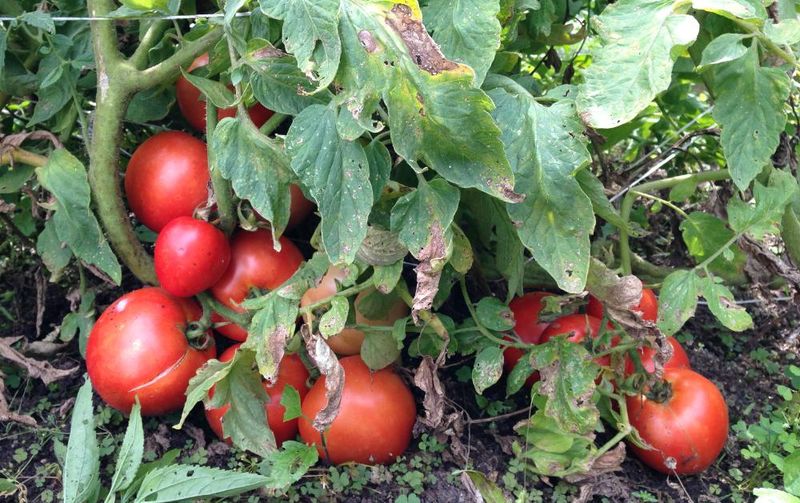
The most useful thing you can do after pausing nitrogen and steadying moisture is simply watch what happens over the next week or two. Track whether new flower buds are forming, whether existing flowers are staying on the plant, and whether small green fruit is beginning to develop.
University of Minnesota Extension’s tomato disorders guide lists the distinct symptoms associated with different problems, which makes it easier to tell whether your plant is responding to a changed approach or whether a separate issue, such as heat or disease, is still driving the pattern.
If temperatures moderate after a heat wave, fruit set often resumes on its own without any feeding change at all. Penn State Extension notes that heat-stressed tomatoes can recover and begin setting fruit again once conditions improve, though the timing depends on the cultivar, the duration of the heat, and how the plant was managed during the stressful period.
There is no fixed recovery window to count on.
When conditions stabilize and the plant has had time to show a clearer picture, a soil test is the most reliable guide to whether and how to resume feeding. Minnesota Extension’s fertilizer guide is consistent on this point: match applications to what the soil and plant actually need rather than following a calendar.
A plant that bounces back with new flowers and developing fruit after a pause in nitrogen and a stretch of steady moisture is giving you useful information. A plant that stays static despite improved conditions may have a different problem worth investigating further.
Either way, the pattern the plant shows you is a better guide than any product on the shelf.