
If A Snapping Turtle Settles Into Your Backyard Pond, Here’s The Occasional Scavenging Role It May Play Over A Possible Four-Decade Lifespan
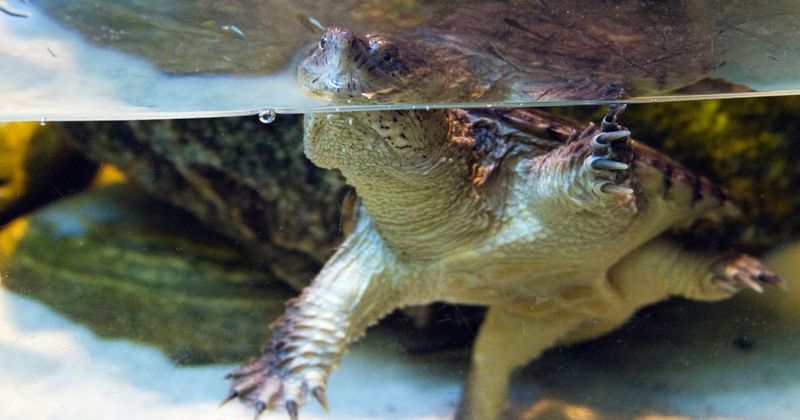
Spotting a large, prehistoric-looking turtle in your backyard pond can stop you in your tracks. That hulking shell and snapping jaw belong most likely to a common snapping turtle, one of North America’s most widespread freshwater reptiles.
Understanding what it actually does in your pond, and what it cannot do, makes it far easier to share the water responsibly. The answer is more nuanced than any single headline can capture.
Identify the Intended Turtle Before Drawing Conclusions
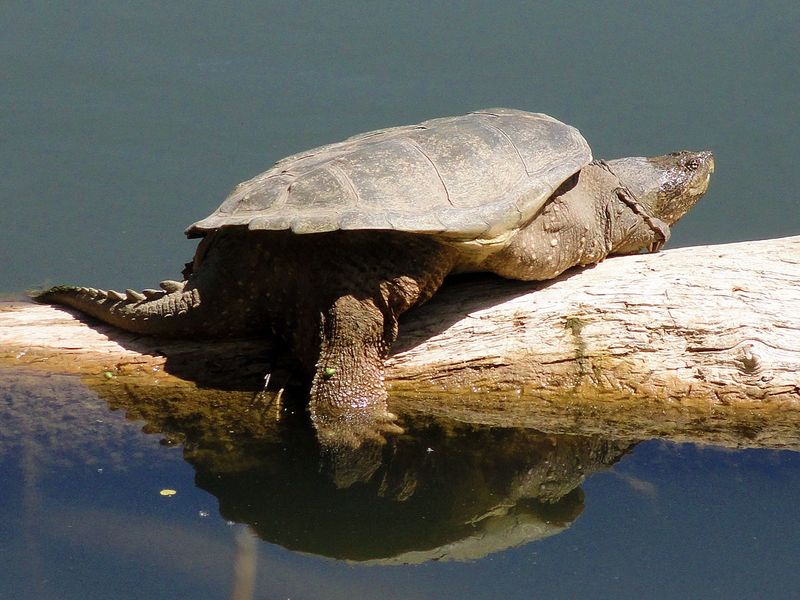
Before deciding what a pond turtle means for your backyard ecosystem, knowing which species you are actually looking at matters enormously. This article focuses on the common snapping turtle, Chelydra serpentina, the species most likely to turn up in a backyard pond across a wide swath of the United States and southern Canada.
A brief glimpse of a turtle surfacing near the cattails, however, is rarely enough to make a confident identification.
Common snapping turtles have a few recognizable features: a large, rough-edged brown or olive shell that can reach fifteen inches or more in length, a long neck, a hooked jaw, and a thick, saw-toothed tail that is often as long as the shell itself. The USGS Nonindigenous Aquatic Species profile for Chelydra serpentina notes the species occupies a broad range of freshwater habitats, with a preference for soft or muddy bottoms and vegetated areas, exactly the conditions a well-established backyard pond tends to provide.
Some readers may wonder whether their visitor could be an alligator snapping turtle, Macrochelys temminckii. That is a different genus entirely, with a much larger head, a worm-like lure on its tongue, and three pronounced rows of raised ridges running the length of its shell.
Alligator snapping turtle range data shows it is largely restricted to river drainages in the south-central United States, so most backyard pond sightings outside that range involve the common snapper instead.
Both species can bite. Common snapping turtles are generally calm when submerged but become defensive and quick to lunge when encountered on land or when handled.
Upper Mississippi River turtle survey documentation describes common snappers as highly aquatic animals that spend most of their lives underwater, surfacing briefly to breathe or bask. If you see one on your lawn or driveway, give it space and do not approach, and definitely do not attempt to pick it up by hand.
What Its Opportunistic Scavenging Really Includes
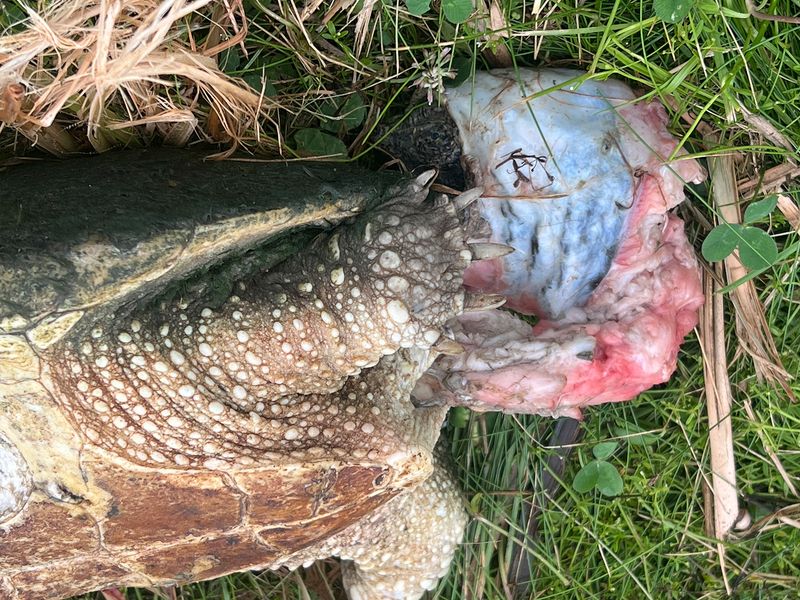
Calling a snapping turtle a pond’s cleanup crew is a metaphor, not a job description. What it actually does is eat whatever is available and accessible, and that list is surprisingly long.
Penn State Extension’s pond wildlife management guidance describes snapping turtles as important scavengers that rarely cause problems in ponds, placing them squarely in the category of animals that help process organic material rather than harm the water body.
The diet of a common snapping turtle shifts with age, season, location, and whatever happens to be within reach. Younger turtles tend to rely more on invertebrates, while larger adults can take a wider range of prey.
Documented food items include aquatic plants, algae, submerged grasses, insects, crayfish, mollusks, fish, frogs, salamanders, waterfowl, small mammals, and carrion. The COSEWIC status report on snapping turtles confirms this broad omnivory, noting that the proportion of plant versus animal material in the diet varies considerably across populations and seasons.
The piece of that diet most relevant to backyard pond owners is carrion consumption. A turtle that finds a dead fish, a drowned bird, or another animal carcass in or near the water may consume it.
Wisconsin DNR information on snapping turtles acknowledges this scavenging behavior as part of the animal’s normal ecology. In that narrow sense, the turtle participates in the pond’s natural process of breaking down animal remains.
What it does not do is remove algae blooms, filter excess nutrients, neutralize pesticide runoff, eliminate pathogens, or scrub sediment from the bottom. How much carrion any one turtle actually removes depends on its size and appetite, how accessible the carcass is, water temperature (which affects how quickly decomposition competes with scavenging), and whether other scavengers, including crayfish, insects, and microorganisms, reach the remains first.
USDA Forest Service research on freshwater turtle ecology reinforces that snapping turtle feeding is opportunistic rather than systematic, shaped by habitat conditions rather than any predictable schedule. A turtle is one participant in a scavenger community, not a solo cleanup contractor.
What Turtle Scavenging Can—and Cannot—Do for a Pond
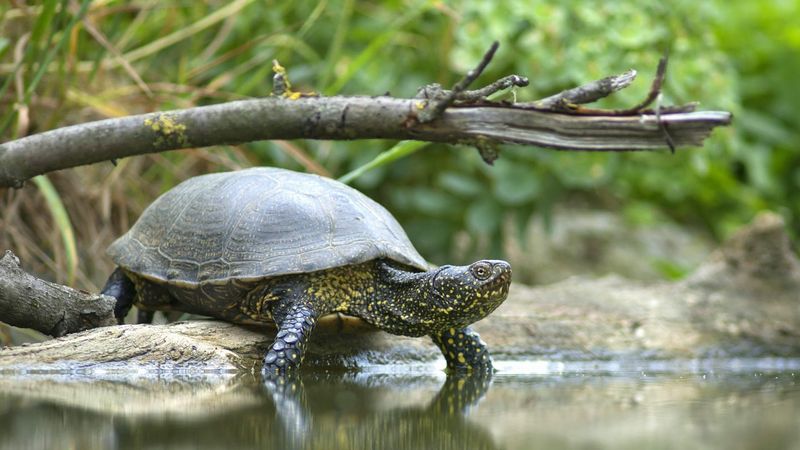
Freshwater turtles as a group do contribute to water-quality processes through scavenging, and there is controlled experimental evidence to support that general idea. A study published in PLOS ONE examining threatened Australian freshwater turtles used simulated fish kills to test whether turtles speed up carcass removal and aid water-quality recovery.
The researchers found that turtles did accelerate the consumption of fish carcasses, and water-quality indicators recovered more quickly in enclosures where turtles were present. That is meaningful evidence for a real ecological function.
The important qualification is that the study involved Australian freshwater turtle species, not North American common snapping turtles, and it used controlled enclosures rather than a typical backyard pond. The findings support the broader idea that freshwater turtles can participate usefully in carrion processing, but they do not establish that one common snapping turtle in your pond will measurably improve water quality on any predictable schedule.
Beyond scavenging, snapping turtles also function as predators, and that role can ripple through a pond’s food web in ways that are harder to predict. A 2020 EPA-indexed study using artificial pond enclosures found that even brief visits by common snapping turtles altered survival rates and body mass in some frog species.
A companion analysis available through the University of North Carolina Greensboro institutional repository shows that these food-web effects varied depending on prey species and the overall structure of the pond community. In other words, the turtle’s influence on the ecosystem is real but context-dependent, not uniform.
A related study indexed through PubMed Central on snapping turtle predation further documents that snapping turtles can affect prey populations under specific conditions. Pond size, prey abundance, turtle density, and whether a pond is managed for sport fish, koi, native amphibians, or wildlife observation all shape how noticeable those effects become.
Think of the turtle as one potentially influential participant in a living system, not the system’s sole regulator or a guaranteed ecological service provider.
Four Decades Means Possible Longevity, Not Continuous Residence
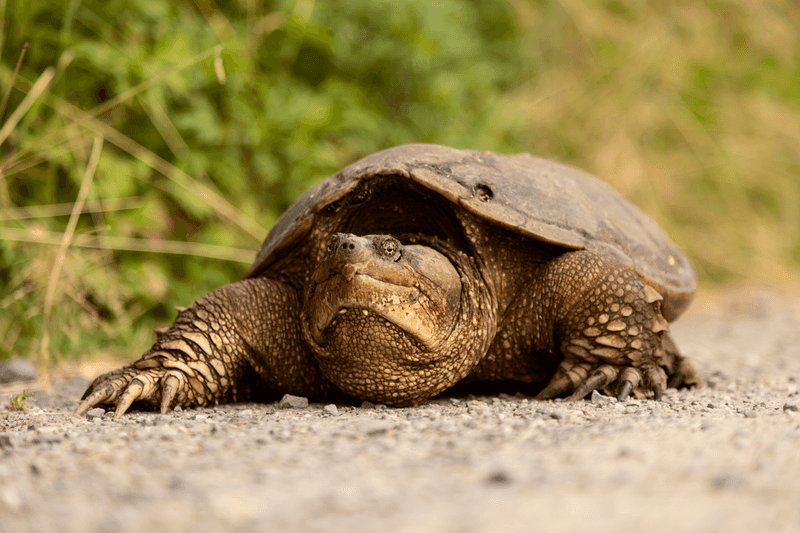
The “four-decade cleanup job” framing in popular articles about snapping turtles comes from a real biological fact, but that fact is often misapplied. Authoritative wildlife sources commonly place wild common snapping turtle longevity at around forty years, and some individuals are reported to live beyond fifty.
The Missouri Department of Conservation field guide for common snapping turtles and Environment and Climate Change Canada’s snapping turtle management plan both acknowledge this potential longevity, which is genuinely impressive for a backyard wildlife visitor.
Lifespan, however, is not the same as continuous residence in one pond. Snapping turtles are mobile animals.
They travel overland between water bodies, especially during nesting season when females seek sandy or loamy soil in which to lay eggs. North Dakota Game and Fish wildlife notes on snapping turtles confirm that the species moves between aquatic habitats, meaning a backyard pond may host different individuals at different times rather than a single turtle for decades on end.
North Carolina Wildlife Resources Commission snapping turtle profile information reinforces that these turtles use a range of wetland and pond habitats throughout their lives. The turtle you spot this summer may return next year, or it may have moved on to a nearby marsh or drainage ditch.
A snapping turtle can certainly remain associated with a local area for many years if the habitat suits it, but there is no basis for assuming the same individual will stay in your specific pond on a dependable schedule. The useful takeaway is that a turtle in your pond today is a wild animal with a potentially long life ahead of it, not a maintenance contract you signed without knowing it.
A Snapping Turtle Cannot Diagnose or Fix a Fish Kill
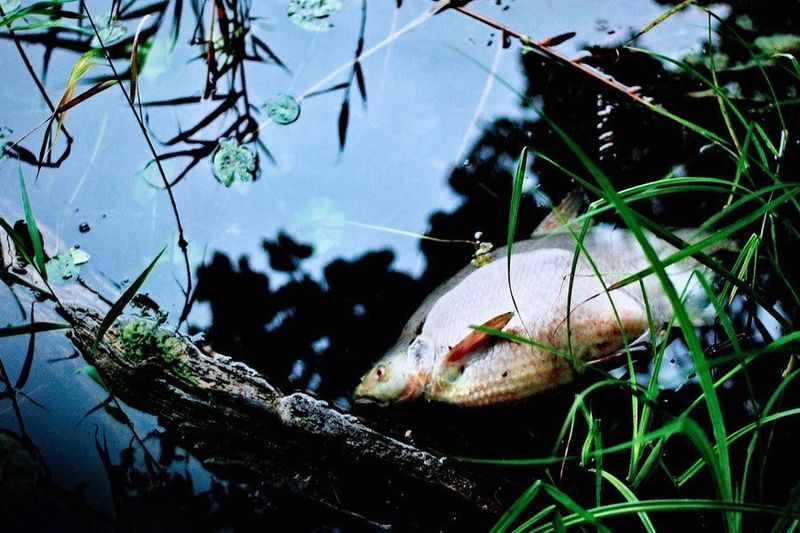
Finding dead fish in your pond is alarming, and it is tempting to look for a single cause. A snapping turtle is sometimes blamed, but fish kills in backyard ponds are almost always driven by water-quality problems, not predation.
EPA data on dissolved oxygen as a water-quality indicator establishes that low dissolved oxygen is one of the most common stressors in freshwater systems. When oxygen levels drop too far, fish suffocate regardless of what else lives in the pond.
The chain of events behind a low-oxygen fish kill often starts with organic matter. Dead fish, decaying algae, animal waste, and rotting vegetation all feed bacterial communities that consume oxygen as they break material down.
Penn State Extension’s pond water-quality guidance explains how warm summer temperatures compound the problem because warmer water holds less dissolved oxygen to begin with. A heavy algae bloom can push oxygen levels up during the day through photosynthesis but crash them overnight when photosynthesis stops and decomposing algae continues consuming oxygen.
Penn State Extension’s overview of common causes of fish kills in ponds lists low dissolved oxygen, sudden temperature changes, algae die-offs, runoff from fertilizers or pesticides, and infectious disease as the leading culprits. If you see fish gasping at the surface, notice a strong foul odor, or find widespread mortality rather than one or two dead fish, those are signs of a systemic water-quality problem that requires investigation, not a turtle problem that will resolve on its own.
EPA CADDIS guidance on dissolved oxygen and Penn State Extension’s pond fisheries management resource both point toward testing oxygen levels, checking for algae conditions, reviewing recent runoff or chemical applications, and consulting a fisheries professional when kills are large or repeated. A snapping turtle may consume some carcasses after a die-off occurs, and that scavenging is a real ecological function, but it does not correct the underlying oxygen deficit, remove excess nutrients, or prevent the next kill from happening.
How to Share the Pond Safely
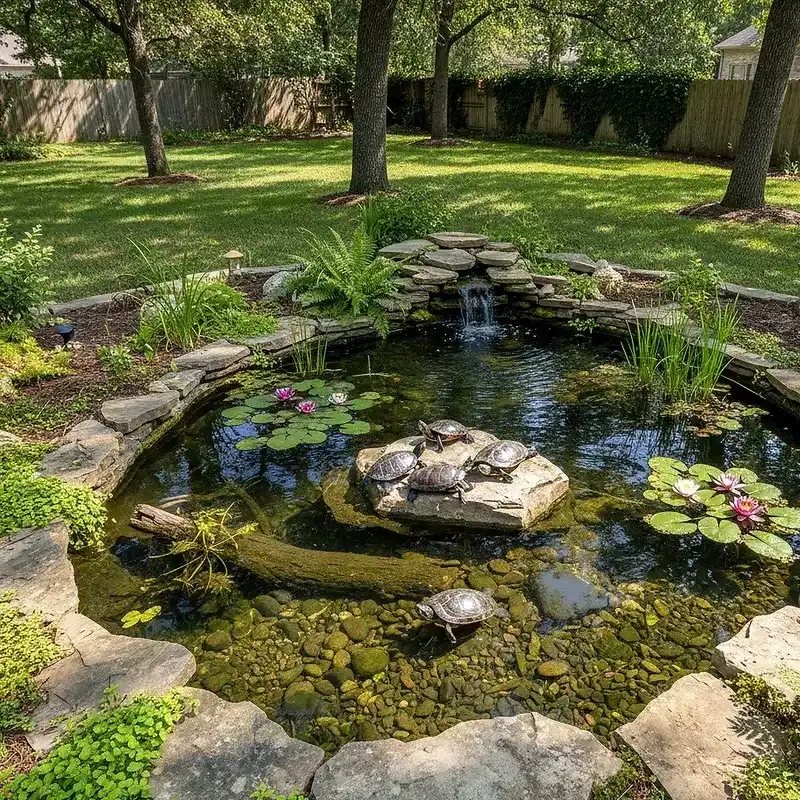
The most practical response to a snapping turtle in your pond is usually the simplest one: leave it alone. A healthy wild turtle living in suitable habitat is doing what it evolved to do, and removing it does not guarantee another one will not move in later.
U.S. Fish and Wildlife Service guidance on when to intervene with wildlife makes clear that well-meaning relocation often causes more harm than good, disrupting the animal’s movement patterns and placing it in unfamiliar or unsuitable habitat.
Observation from a distance is the right approach. Keep children and pets away from the turtle, particularly when it is on land.
Common snapping turtles are generally calm when submerged but become much more defensive out of the water, where they feel vulnerable and cannot retreat quickly. North Carolina Wildlife Resources Commission species information on common snapping turtles and the Missouri Department of Conservation field guide both note that a snapping turtle on land can lunge a surprising distance and deliver a painful bite.
No child or pet should approach one.
Do not attempt to hand-catch the turtle, grab it by the tail, or improvise a removal method based on something you read online. Tail-grabbing can injure the animal’s spine, and handling a large snapper without training is genuinely dangerous.
Additional FWS guidance on helping turtles reinforces that moving a turtle miles away is rarely the right solution. If removal is genuinely necessary because the turtle poses a real risk to people, livestock, or a managed fish population, contact your state wildlife agency, a licensed wildlife professional, or a local wildlife rehabilitator.
Rules about capture, relocation, harvest, trapping, and nesting-period protections vary by state, so national one-size-fits-all removal advice does not apply. Penn State Extension’s pond wildlife management page recommends consulting local authorities before taking any action.
Anyone who does handle the turtle, or who contacts pond water near where it lives, should wash their hands thoroughly with soap and running water afterward. CDC guidance on reptiles and amphibians as pets and wildlife explains that reptiles and amphibians can carry Salmonella bacteria even when they appear completely healthy, and CDC hygiene practices around animals recommends thorough hand-washing as a basic precaution after any contact with these animals or their environment.
This applies to adults and children alike.
Treat the Turtle as One Part of a Living Pond
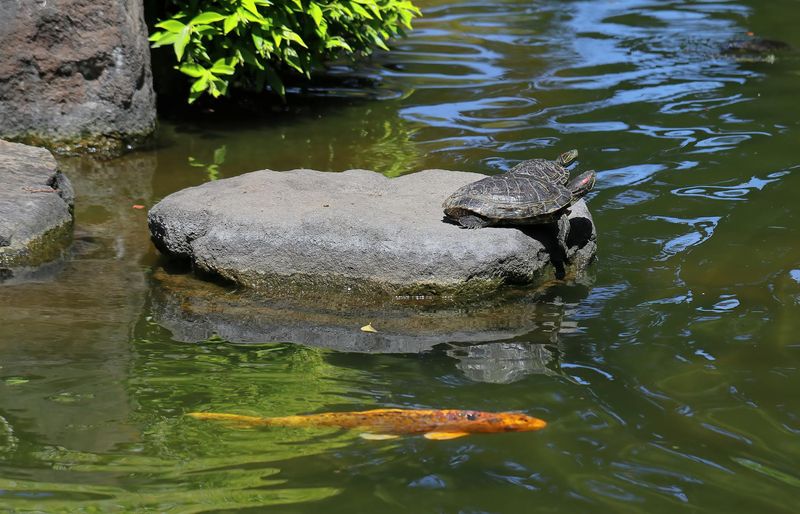
A common snapping turtle in your backyard pond is a real ecological participant. It may consume some carrion, influence what frogs and fish do near it, and connect your small water feature to a broader food web.
Penn State Extension and peer-reviewed food-web research both support the idea that snapping turtles play a real role in freshwater systems, even if that role is context-dependent and variable.
What the turtle does not provide is a guaranteed forty-year cleanup contract, continuous residency, or total control over your pond’s health. Missouri Department of Conservation field guide data confirms the potential for a long wild lifespan, but longevity and permanent presence in one pond are different things.
Monitor your water quality, manage fish populations thoughtfully, and watch for signs of oxygen problems rather than relying on any single animal to keep things in balance.
Observe the turtle from a safe distance, respect the space it needs, and let it move through your yard on its own terms. A pond that supports a snapping turtle is usually a pond with enough life in it to sustain one, and that is something worth noticing.