
A Sudden Spike In Dragonflies Over Your North Carolina Yard Points To Water Nearby
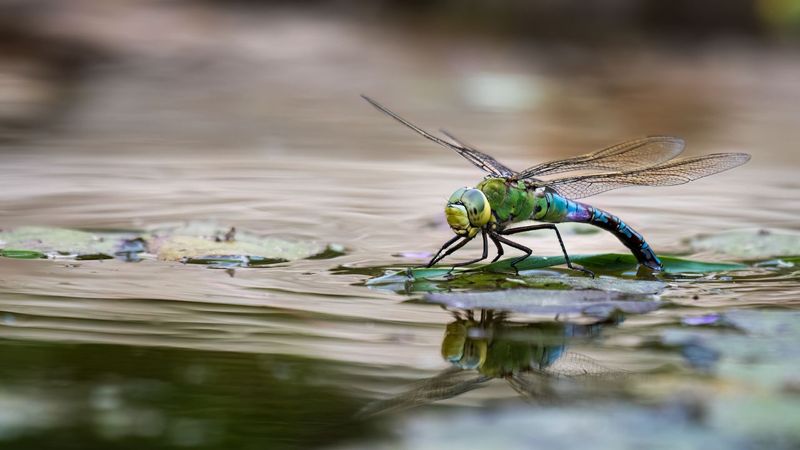
Most North Carolina homeowners barely notice a single dragonfly, so when a sudden crowd of them appears over the yard, it is hard not to wonder what changed. Dragonflies spend most of their lives underwater as nymphs, which means a big gathering above your lawn can be a quiet hint that freshwater habitat exists somewhere in the area.
Understanding what that hint does and does not mean helps you become a better steward of your yard and the wildlife that depends on it.
The clue begins underwater
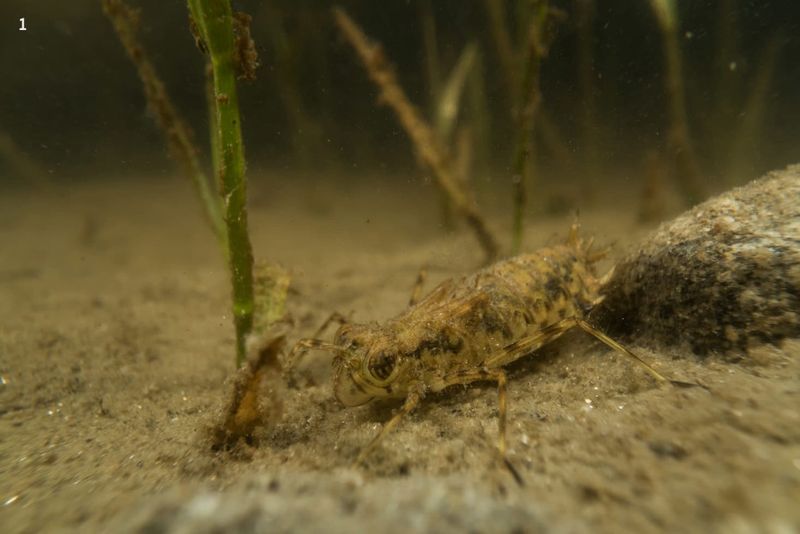
Few insects carry as much hidden biography as a dragonfly. The creature hovering over your North Carolina lawn almost certainly spent months or even years living on the bottom of a pond, stream, wetland, or other freshwater body before it ever took a single flight.
That underwater chapter is the key to reading what a sudden yard sighting might mean.
Dragonfly eggs are laid in or near water, and when they hatch, the nymphs settle into an aquatic life almost immediately. NC State Extension reports that dragonflies spend most of their life cycle as nymphs, ranging from one to several years depending on species, hunting aquatic organisms including mosquito larvae while living fully submerged.
That long developmental period is why adult dragonflies are so reliably tied to freshwater.
When a nymph is ready to emerge, it climbs out of the water on a plant stem, rock, or other surface, splits its exoskeleton, and pumps fluid into its wings. The adult that lifts off is the same animal that spent years underwater, now hunting above the surface instead of below it.
Penn State Extension notes that adult dragonflies regularly leave their breeding water to forage in open meadows, yard edges, and other habitats away from the pond or stream where they developed.
So when dragonflies appear in numbers over your yard, the life-cycle connection is what makes the sighting meaningful. Somewhere within flying range, there is likely a body of freshwater suitable for nymph development, or at minimum a concentration of flying insect prey that drew adults in.
The sighting does not pinpoint that water on your property or at any particular distance, but it gives you a reasonable reason to look around.
What counts as water nearby?
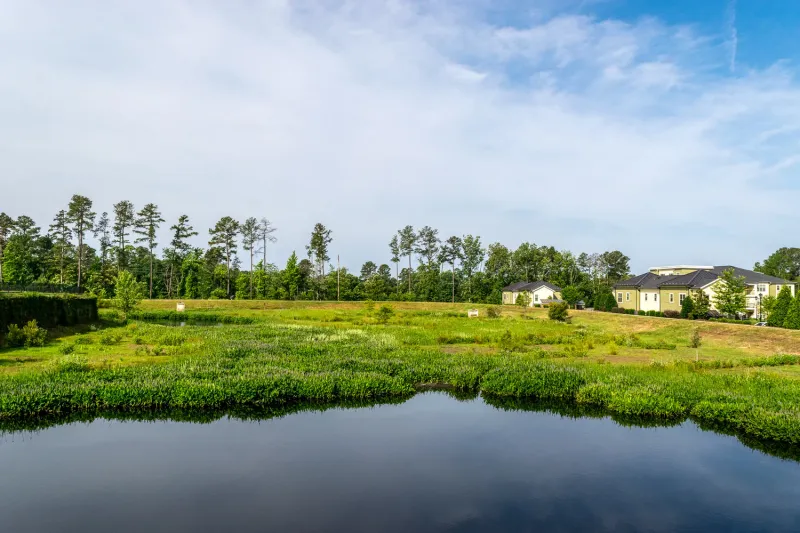
The phrase “water nearby” covers more ground than most homeowners expect. A sudden increase in dragonflies over a North Carolina yard could point toward a neighborhood retention pond, a stormwater basin at the edge of a subdivision, a stream or creek running through a wooded buffer, a wetland tucked behind a tree line, a drainage swale that holds water for days after rain, or a low-lying area of the yard that stays saturated long enough to function as a seasonal pool.
Penn State Extension confirms that dragonflies and damselflies use a wide range of aquatic systems, from permanent ponds and slow-moving streams to shallower emergent-plant zones along lake margins. Species preferences vary considerably, so the type of water that produced a particular generation of adults depends on which species you are seeing.
Penn State’s vernal pond guidance also points out that some species breed successfully in seasonal or temporary pools that fill only during wet months, so a habitat that appears dry in summer may have supported nymphs earlier in the year.
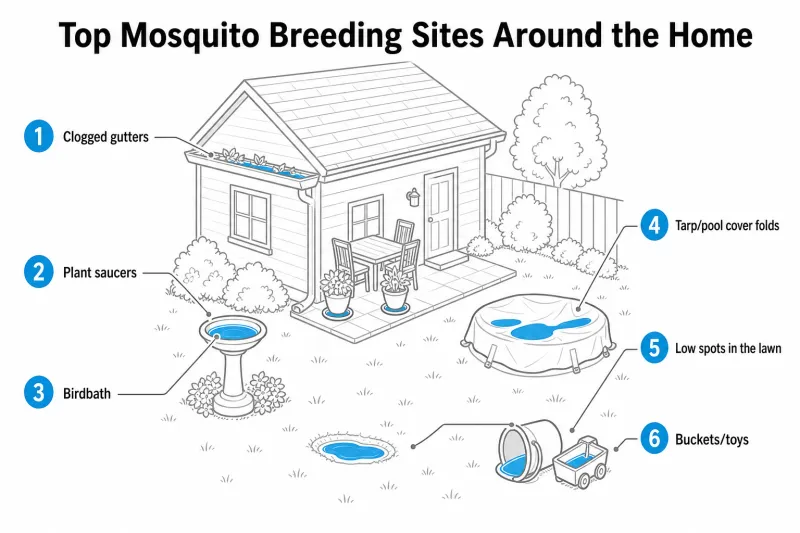
Equally worth inspecting are the overlooked water sources that do not function as dragonfly breeding habitat but can quietly fuel a mosquito population. Clogged gutters, uncovered rain barrels, upturned buckets, saucers under potted plants, pool covers that sag and collect water, and even low spots in tarps can hold enough water for mosquito larvae.
CDC guidance on home mosquito control lists these small containers as primary targets for weekly attention.
Tree holes deserve a separate mention. The CDC notes that tree cavities can collect rainwater and support mosquito breeding but are not the kind of aquatic environment that dragonfly nymphs typically require.
A birdbath or saucer in your yard may attract mosquitoes and bring songbirds to drink, but it is not automatically useful to a dragonfly trying to complete its multi-year aquatic development. The distinction matters: one type of water source calls for removal or weekly dumping, while the other may be worth protecting or even expanding with proper planning.
A sudden swarm can have several explanations
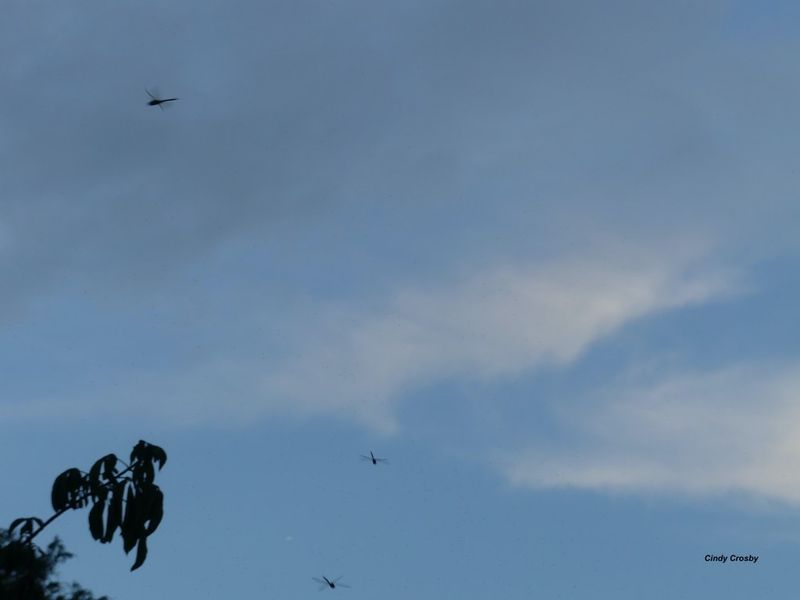
Seeing dozens of dragonflies appear over a yard that had none the day before can feel dramatic, but the explanation is not always a hidden pond next door. Adults are strong fliers and regularly hunt far from whatever water body produced them.
A yard full of gnats, midges, or other small flying insects after a warm rain can pull dragonflies in from a considerable distance, with no local breeding habitat required.
Seasonal emergence is another common driver. When a pond, wetland, or stream produces a large cohort of adults over a short window, those individuals may spread out across a wide area as they mature and begin foraging.
Penn State Extension explains that newly emerged adults often disperse away from the water where they developed, which is why a yard with no obvious water feature can still see a temporary spike in activity.
Migration adds yet another layer. A critical review of dragonfly migration research in North America documents large-scale movements, especially involving the common green darner, one of the most frequently seen large dragonflies in North Carolina.
These migrations can produce impressive concentrations of insects that have little to do with local water conditions.
Weather also plays a clear role. Research published in Animal Behaviour found that autumn dragonfly migration is closely tied to wind direction and temperature, meaning a favorable weather pattern can push hundreds of individuals into a yard on a single afternoon.
The gathering may be gone within a day or two, leaving no lasting evidence of what caused it. Treating a temporary spike as proof of standing water on the property would be a mistake, but treating it as a reason to look around more carefully is entirely reasonable.
Read the pattern before you investigate
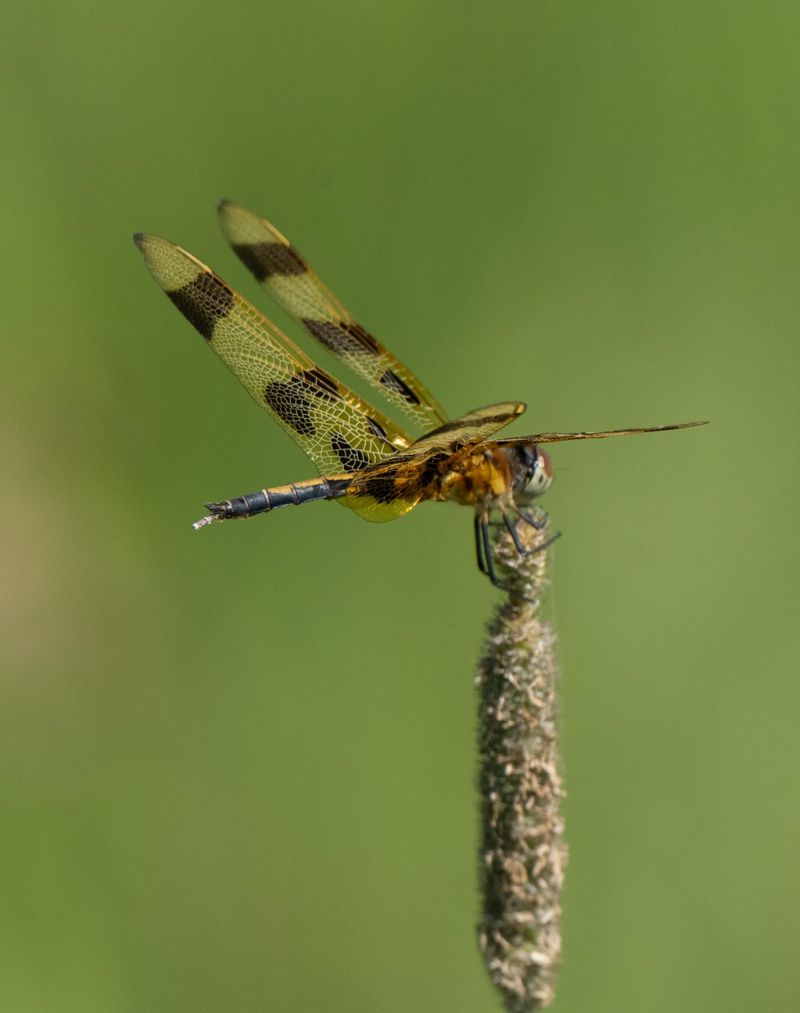
Before reaching for a shovel or calling a pond contractor, spend a few days simply watching. The pattern of dragonfly activity can tell you more than a single afternoon of observation, and it costs nothing.
A handful of dragonflies repeatedly working the same sunny patch of lawn or hovering low over a specific corner of the yard suggests territorial or foraging behavior tied to that spot. Males of many species establish and defend hunting territories, returning to the same perch or patrol route day after day.
That kind of repeated, localized activity is a stronger hint of nearby breeding habitat than a one-time swarm that moves through and disappears. The migration overview referenced earlier distinguishes between resident foraging behavior and the large, directional movements that characterize migratory pulses, and the difference is often visible to a careful observer.
A large, loosely organized group drifting in a particular direction, especially on a cool autumn afternoon after a front moves through, fits the migration profile far better than it fits a sign of a hidden pond in the backyard. The Animal Behaviour study on autumn migration notes that these movements are often weather-driven and short-lived, which matches the experience of homeowners who see an impressive gathering that is completely gone by the next morning.
Keeping brief notes on timing, weather, flight direction, and whether the activity repeats in the same location gives you useful context before drawing any conclusions. If you want to go further, species identification can sharpen your interpretation considerably.
North Carolina’s official odonate database documents approximately 190 dragonfly and damselfly species in the state, each with its own habitat preferences, flight season, and geographic range. Knowing whether you are looking at a green darner or a skimmer does not require an entomology degree, and even a rough identification can help you decide whether the sighting fits a migratory species or a resident pond-dweller.
Dragonflies are not a water-quality test
One of the most common assumptions that follows a yard full of dragonflies is that the nearby water must be clean and healthy. That conclusion goes further than the evidence supports, and it is worth setting a firm boundary here.
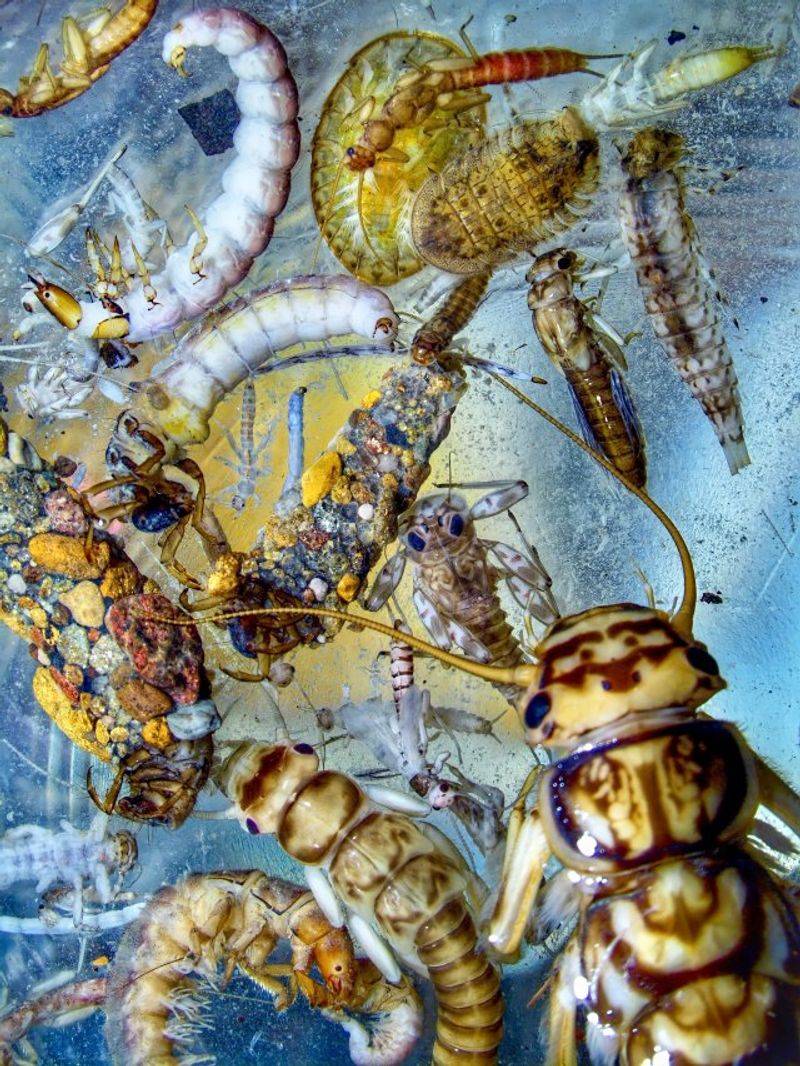
Aquatic macroinvertebrates, the broad group that includes dragonfly and damselfly nymphs along with mayflies, stoneflies, caddisflies, and many others, are genuinely useful for assessing biological water quality. The EPA’s benthic macroinvertebrate indicators program uses the composition and diversity of the entire bottom-dwelling community, not the presence of any single group, as the meaningful assessment tool.
Species differ in their sensitivity to pollution, temperature change, and habitat disturbance, and it is the mix of tolerant versus sensitive species that reveals something about water condition.
Dragonfly nymphs span a wide range of pollution tolerance. Some species are sensitive indicators, while others survive in considerably degraded conditions.
Seeing adults in your yard tells you that at least some odonate species completed development somewhere nearby, but it does not tell you which species, how many, or whether the broader macroinvertebrate community looks healthy.
USGS research on dragonfly larvae as bioindicators of mercury exposure illustrates the point from a different angle: nymphs can accumulate contaminants from their environment, meaning their presence reflects exposure, not necessarily clean conditions. A yard sighting of adults is a habitat clue, and a useful one, but it is not a water-quality certificate.
If you have genuine concerns about the condition of a pond, stream, or wetland on or near your property, a professional water-quality assessment or contact with NC DEQ is the appropriate next step.
Start with mosquito prevention, not a dragonfly cure
When dragonflies appear in numbers, some homeowners immediately wonder whether the insects will take care of a mosquito problem. The short answer is that they will not, at least not reliably enough to replace the steps that actually work.
Adult dragonflies do eat mosquitoes along with many other flying insects. The catch is that they are generalist predators, meaning they take whatever prey is abundant and catchable at the moment.
A peer-reviewed review of odonate ecosystem services found that mosquitoes are often not taken in sufficient numbers by adult dragonflies to produce meaningful suppression of mosquito populations. A meta-analysis on odonates and mosquito biological control reached a similar conclusion: larval predation by nymphs can be substantial under controlled experimental conditions, but that does not automatically translate into neighborhood-scale control in a residential yard.
Source reduction is the approach that consistently works. CDC home mosquito control guidance recommends emptying, scrubbing, turning over, covering, or discarding any water-holding container at least once a week.
That weekly reset prevents mosquito eggs from completing their development, which takes as little as a week in warm North Carolina summers. Gutters, saucers, buckets, pool covers, and anything else that holds even a small amount of standing water deserve attention before any other measure.
Where water genuinely cannot be removed, covered, or managed by dumping, a labeled Bti (Bacillus thuringiensis israelensis) larvicide product can be used. CDC larvicide guidance specifies following the product label precisely, as Bti is a targeted bacterial product that affects mosquito and gnat larvae but not most other aquatic organisms when used correctly.
Chemical choices around any water feature also matter for the broader yard ecosystem. NC State Extension advises minimizing broad insecticide use near ponds, wetlands, and pollinator habitat, and keeping fertilizers, herbicides, and insecticides out of water and storm drains.
Broad spraying to knock down adult mosquitoes can harm the dragonflies, native bees, and other beneficial insects you may be trying to support.
A wildlife pond requires more than a wet spot
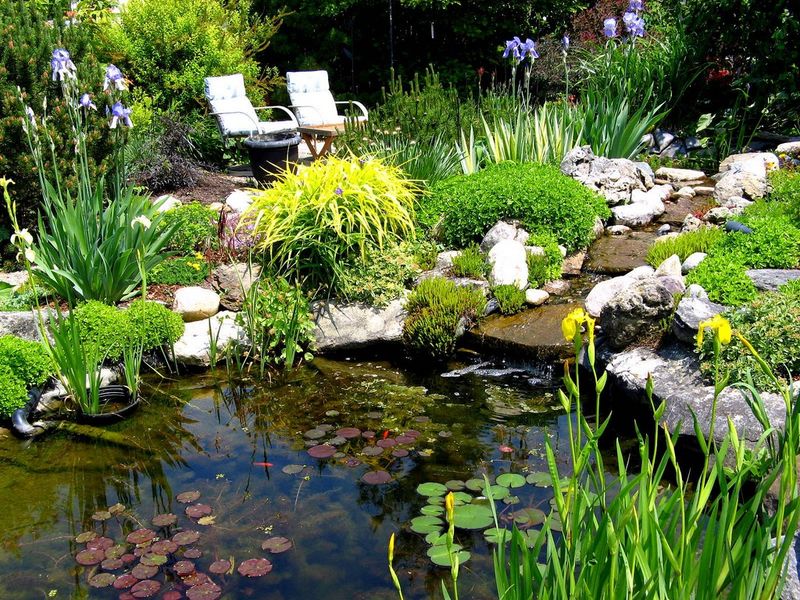
For homeowners who want to go beyond observing dragonflies and actually support them, a deliberately designed wildlife pond is the right direction. A random low spot that holds water after rain, a half-barrel left to stagnate, or a birdbath does not provide what dragonfly nymphs need to complete their development.
The aquatic environment has to be stable enough, deep enough in at least some areas, and vegetated enough to function as real habitat.
Penn State Extension’s pond attraction guide recommends underwater vegetation for nymph shelter and hunting, emergent plants along the edges where adults can perch and lay eggs, and a mix of water depths to support different life stages. Rocks, submerged branches, and sunny open areas for basking round out a habitat that dragonflies can actually use.
Native plants are the best choice for the pond edge. NC State’s plant toolbox entry for pickerelweed highlights this native emergent as a solid option for a North Carolina pond margin, providing structure for egg-laying and emergence while supporting pollinators.
Other native emergents and shoreline plants adapted to NC conditions will generally outperform non-natives for wildlife value.
Fish are not a default part of a wildlife pond focused on dragonflies or amphibians. NC State Extension specifically cautions that fish can consume amphibian eggs and larvae, and the same predation risk applies to invertebrates including dragonfly nymphs.
Fish stocking is a separate management decision that should be weighed carefully against the wildlife goals for the pond.
Before breaking ground, check whether the wet area you have in mind is already a regulated feature. NC State’s pond management guide notes that construction affecting a wetland or involving a dam across a stream may require state and federal permits.
NC DEQ permitting guidance and NC DEQ wetlands information are the right starting points before any excavation, filling, or alteration of a suspected wetland or stream corridor. Acting without checking can create legal liability and damage the very habitat the dragonflies were pointing you toward.
Let the sighting guide a careful inspection
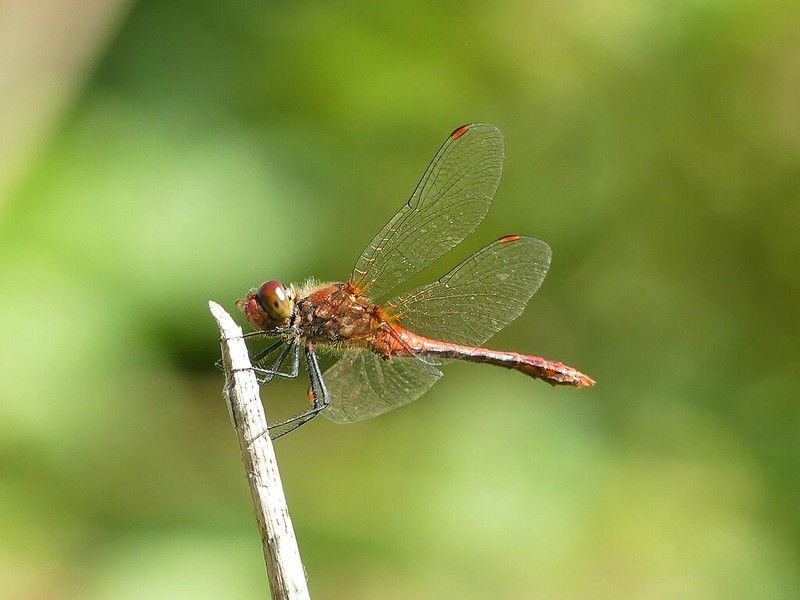
A yard full of dragonflies is a genuinely interesting clue, and treating it as one is the right response. NC State Extension’s dragonfly profile makes the aquatic connection clear: these insects need water to complete their development, and their presence above your yard reasonably suggests that suitable freshwater or abundant flying-insect prey exists somewhere within range.
What the sighting cannot do is locate a hidden pond on your property, certify that nearby water is clean or ecologically healthy, or replace the source-reduction steps that actually prevent mosquito problems. Use the observation as a prompt to walk the yard and immediate surroundings, check the obvious and overlooked water sources described earlier, and protect any wet areas you find rather than altering them without guidance.
CDC home mosquito control steps remain the practical foundation regardless of how many dragonflies are overhead.
If the inspection reveals a pond, stream, or wetland worth improving, NC State’s pond management resources and the permitting contacts at NC DEQ are the place to start before making changes. A dragonfly hovering over a North Carolina yard is one of nature’s more elegant signals: easy to miss, easy to misread, and genuinely worth following up on with patience and care.