
A Sudden Rush Of Carpenter Bees Around Your North Carolina Eaves Signals Something About The Wood
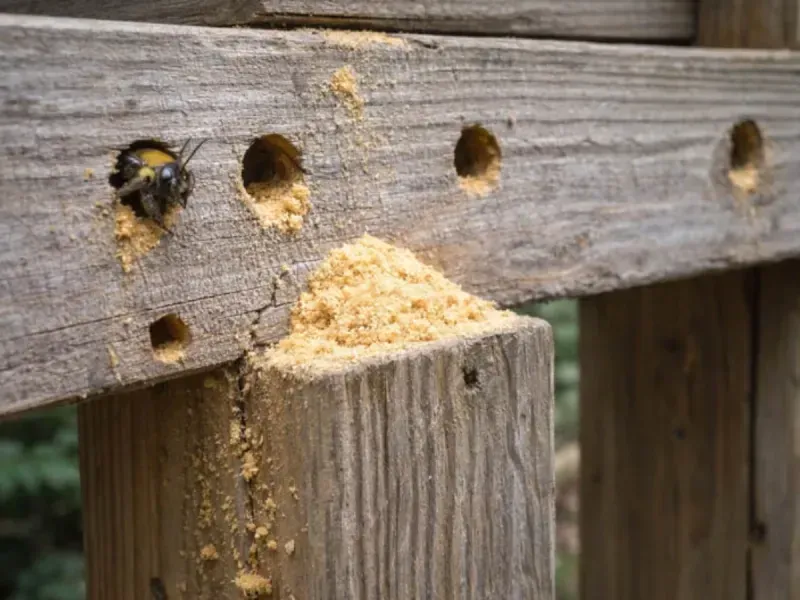
When big, buzzing bees start circling your porch eaves every spring, it is easy to reach for a can of spray and call it a day. Those large bees are almost certainly eastern carpenter bees, and their presence is less of an emergency and more of a clue worth reading carefully.
The wood on your eaves, fascia, or deck rails may be giving them an invitation you did not realize you had posted. Understanding what that invitation looks like, and how to respond to it thoughtfully, can save your wood and keep a valuable pollinator working in your yard.
A spring rush is a seasonal clue, not a wood diagnosis
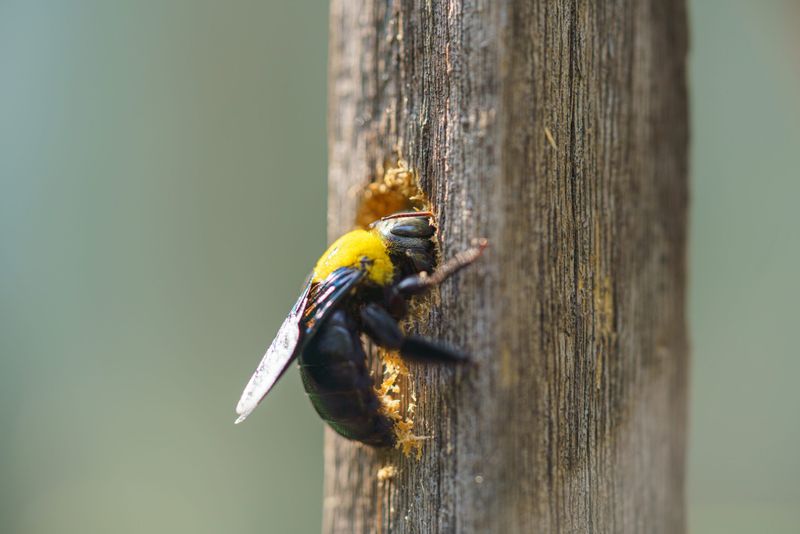
Warm April mornings in North Carolina bring a familiar sight for many homeowners: large, glossy bees circling the roofline, hovering near the fascia, or buzzing back and forth along a porch ceiling. The urge to grab something and swing is understandable, but the bees are actually doing something more useful than pestering you.
They are advertising a condition of your wood that deserves a calm, systematic look.
According to NC State Extension’s guide to non-honey bee stinging insects, large carpenter bees in North Carolina commonly emerge in April and May. What looks like a sudden invasion may simply be seasonal emergence, mating activity near established nest sites, or bees scouting for a place to reuse old tunnels from previous years.
None of those behaviors, by itself, proves that your eaves are made of untreated wood or that the structure is under immediate threat.
Male carpenter bees, which cannot sting, are often the most visible performers in this springtime display. They hover aggressively near old nest entrances to attract females and drive off rivals.
Females, meanwhile, may be foraging for pollen or investigating the wood for nesting potential. The activity looks alarming precisely because several bees may concentrate on a small section of eave at once.
The NC Department of Agriculture’s overview of carpenter bee behavior describes this springtime male activity around old holes as a routine part of the species’ life cycle, not evidence that the wood is suddenly deteriorating. The rush is a prompt to inspect, not a verdict.
Before you reach for caulk or a spray can, spend a few minutes watching and noting what you actually see, because what you find during that inspection will tell you far more than the bees’ hovering ever could.
First, make sure the carpenter bees are the large structural-nesting kind
Not every bee buzzing around your yard that goes by the name “carpenter bee” is a threat to your eaves. North Carolina is home to two distinct groups that share the name but behave very differently, and telling them apart is the necessary first step before you decide whether your wood is at risk.
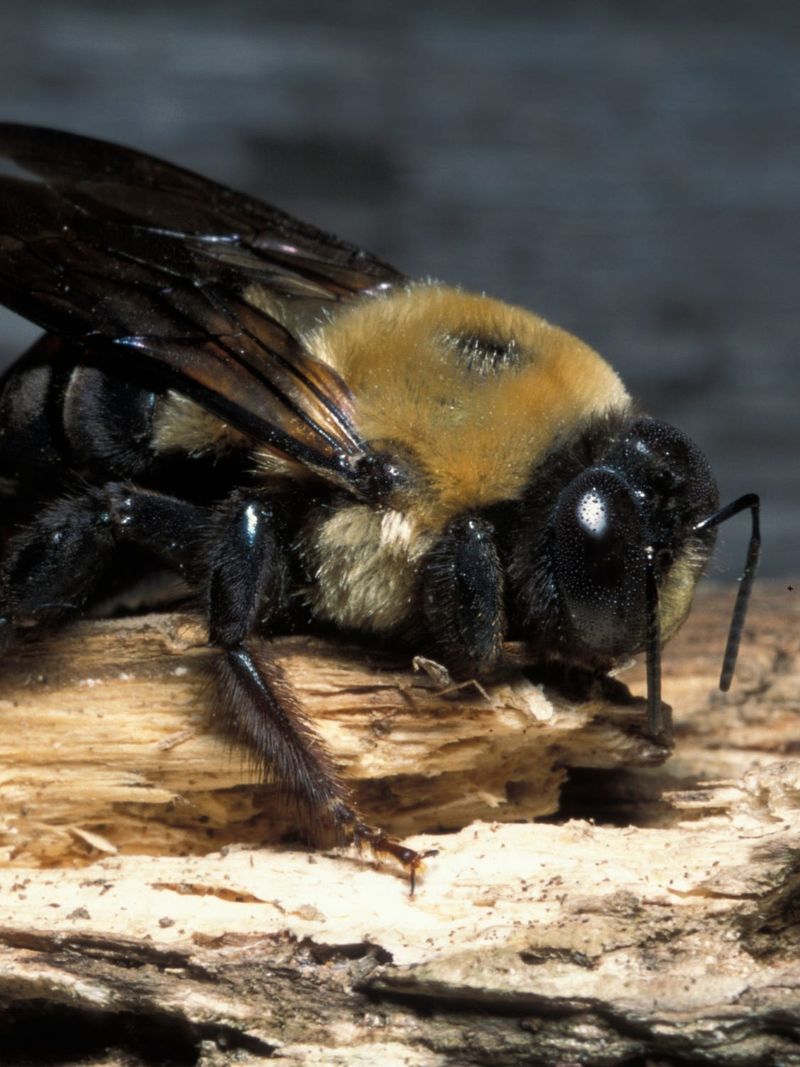
Large carpenter bees belong to the genus Xylocopa and are roughly the size of a bumblebee. The eastern carpenter bee, the species most commonly seen around North Carolina homes, has a shiny, largely hairless black abdomen that sets it apart from the fuzzy-bodied bumblebee.
These are the bees that excavate round tunnels in structural wood, and they are the ones relevant to any concern about eave damage.
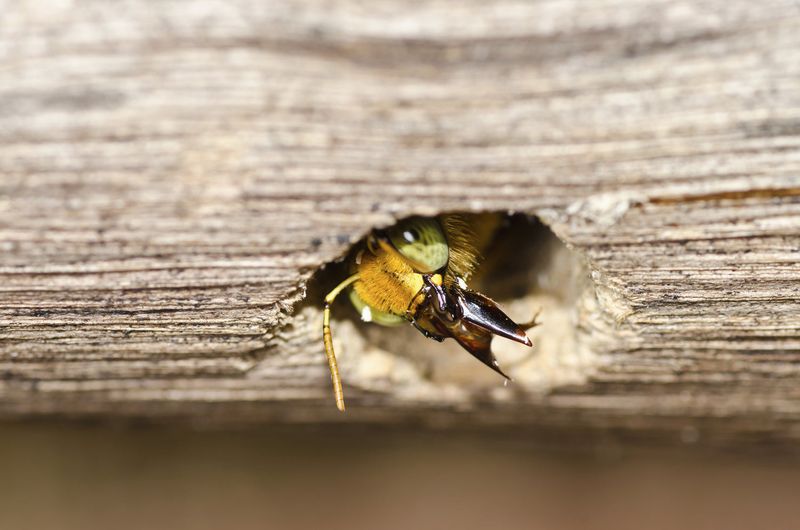
Small carpenter bees, in the genus Ceratina, are a completely different story. As described by NC State Extension’s bee hotel resident guide, these bees are much smaller, often with a metallic blue or green sheen, and they typically nest in already damaged or cut pithy stems rather than sound structural wood.
A Ceratina bee visiting your black-eyed Susans or investigating a hollow stem in the garden is not the same animal as the large bee drilling into your fascia board.
NC State’s profile of small carpenter bees confirms that these smaller species are not normally responsible for tunnels in house eaves. If you are seeing small, iridescent bees near cut perennial stems or brush piles, NC State’s guidance on garden cleanup for pollinators notes that leaving hollow stems intact over winter actually supports these beneficial nesters, and no structural control is warranted.
The practical rule is straightforward: confirm that you are dealing with a large, bumblebee-sized bee before treating any activity around eaves as a structural problem. If the bee is small and metallic, redirect your attention to the garden rather than the fascia board.
Identification and physical evidence come first; everything else follows from what you find.
The eave can reveal evidence of nesting or possible activity
Once you have confirmed that large carpenter bees are the ones circling your eaves, the next move is a careful look at the wood itself. Watching bees hover is not enough to know whether an active nest is present.
The wood will often hold physical clues that are more reliable than bee flight patterns alone, but those clues require interpretation rather than a snap judgment.
Start by scanning eaves, fascia boards, porch ceilings, deck rails, deck boards, exposed cut ends of lumber, and any weathered wood with nail holes or cracks. NC State Extension identifies a nearly round entrance hole about one-half inch in diameter as the most recognizable sign of carpenter bee excavation.
Below or near that hole, look for sawdust-like material, which is actually the compressed wood the bee has removed, and yellowish-brown staining from the bees’ waste and pollen stores.
Woodpecker damage near an eave is another clue worth noting. Woodpeckers sometimes excavate wood to reach carpenter bee larvae inside tunnels, and their work can enlarge a small entrance into something that looks much more alarming.
Utah State University Extension’s carpenter bee fact sheet notes that secondary woodpecker damage can significantly increase the structural impact of a nest that might otherwise have been minor.
Here is the critical point that many homeowners miss: a hole, staining, and sawdust can all persist long after bees have vacated a tunnel. Old evidence does not mean current activity.
Penn State Extension’s carpenter bee resource is clear that confirming an active nest requires observing bees actually entering or exiting the hole, not just finding physical evidence nearby.
Position yourself safely, preferably at a distance and at ground level, and watch the suspected entrance for several minutes on a warm, calm morning. If you cannot safely view a high eave or roofline entrance, or if the evidence is ambiguous, a licensed pest-control professional can assess the site without requiring you to climb or reach overhead.
Rushing to seal or treat before confirming activity can trap bees inside, create additional damage, or simply waste effort on a tunnel that has been empty for a season or more.
Most carpenter-bee damage calls for proportionate concern
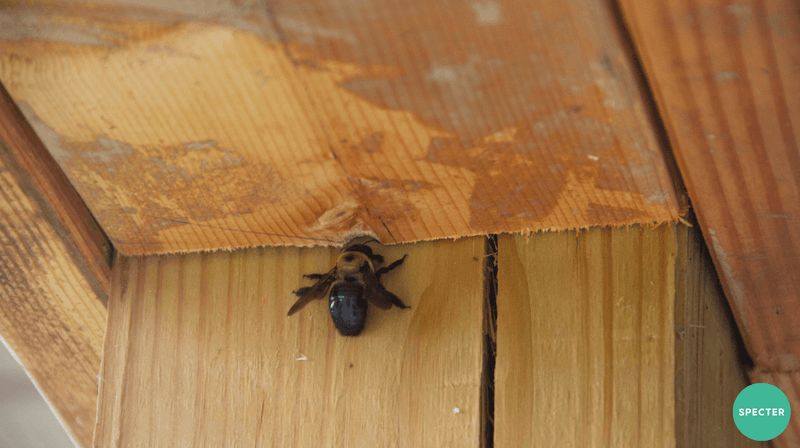
Finding a carpenter bee hole in your eave does not automatically mean your house is in danger. Understanding what the bees actually do to wood, and what conditions make the damage more or less serious, helps you calibrate a response that fits the situation rather than the worst-case scenario.
Large carpenter bees do not eat wood the way termites do. They excavate it, removing material to carve out nesting chambers.
NC State Extension explains that a female bee tunnels with the grain of the wood, creating a main gallery that can extend several inches and branch into individual egg chambers. The excavated wood is not consumed; it falls away as the frass you may notice below the hole.
A single tunnel in a sound, thick beam is generally a nuisance rather than a structural emergency. NC State’s guidance is clear that serious structural damage is not typical in ordinary infestations.
The picture changes when several factors combine: repeated nesting in the same area over multiple years, thin fascia or siding that leaves little wood between the tunnel and the surface, moisture that softens wood and makes existing galleries more vulnerable, and secondary woodpecker excavation that widens and deepens the original damage.
Penn State Extension notes that carpenter bees commonly return to and expand existing tunnels rather than excavating entirely new ones each season, which means a hole that seems minor in year one can become more significant over three or four seasons of reuse. Thin boards along a roofline or an older porch rail already softened by moisture are more vulnerable than a thick, dry structural timber.
Use what you find during the inspection to place yourself in one of three categories. A single old hole in sound, dry, thick wood with no current bee activity is likely a maintenance issue: clean, seal, and refinish when the nest is confirmed inactive.
Multiple holes, thin or moisture-damaged wood, evidence of woodpecker activity, or uncertainty about the extent of tunneling inside the wood are reasons to seek a professional evaluation before deciding on a repair plan. Active nesting in a location that poses no real structural risk may simply warrant monitoring rather than immediate intervention.
Native blooms support the yard, but they do not relocate an established nest

Eastern carpenter bees are native to North Carolina, and that fact matters for how you think about the ones circling your eaves. They are not invasive pests that arrived from somewhere else; they are part of the region’s pollinator community, and they provide real ecological value as they forage for pollen and nectar across the landscape.
Planting a varied succession of regionally appropriate native blooms is genuinely good for your yard’s ecosystem, and it gives carpenter bees something productive to do beyond investigating your fascia. NC State Extension’s native plants chapter recommends selecting plants suited to your specific ecoregion, whether you garden in the Piedmont, the Coastal Plain, or the mountains, and aiming for blooms that span spring, summer, and fall rather than concentrating all flowering in a single season.
NC State’s landscaping for wildlife guide supports the same staggered-bloom approach as the foundation of a pollinator-friendly yard. For early spring, options like redbud, serviceberry, and flowering dogwood provide nectar when few other plants are open.
Red buckeye and blueberry extend that window, and wild columbine bridges into late spring. NC State’s butterflies and backyard wildlife resource lists lyreleaf sage among the natives that support a range of pollinators through the season.
What a diverse native garden cannot do is persuade an established carpenter bee nest to move. Penn State Extension’s profile of the eastern carpenter bee is straightforward on this point: adding flowers supports pollinators as habitat, but no reviewed evidence shows that a particular bloom will draw bees away from an active tunnel in your eave.
The garden and the eave are separate issues that deserve separate attention.
Plant the natives because they belong in a North Carolina yard and because they feed the full range of pollinators that visit your property. Treat the eave because the wood may need it.
Keeping those two goals distinct lets you pursue both without expecting one to solve the other.
Wood maintenance prevents new excavation without erasing old tunnels
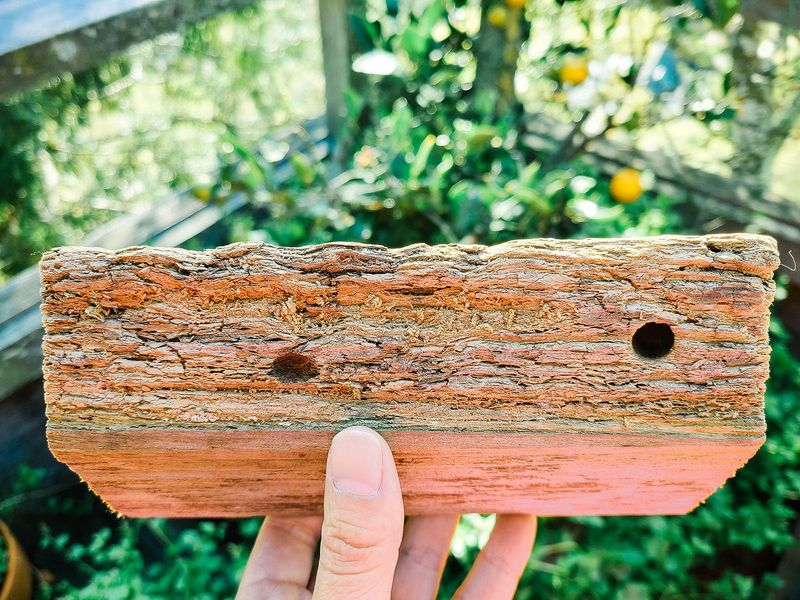
Bare, weathered softwood is an open invitation to a carpenter bee looking for a nesting site. Keeping that wood covered with paint, varnish, or an exterior stain is one of the most practical steps a North Carolina homeowner can take to make the structure less attractive for new excavation, and it does not require any pesticide or professional help.
Penn State Extension’s eastern carpenter bee guide describes painted or varnished wood as less appealing to bees seeking a nesting site, because the smooth, sealed surface does not offer the same purchase as raw or weathered grain. Composite materials, such as fiber-cement siding or PVC trim boards, can reduce future nesting opportunities even further because they do not have the wood grain that bees prefer.
These are deterrents, though, not guarantees. A finish that has aged, cracked, or peeled in a humid North Carolina summer may no longer provide meaningful protection, and Penn State’s broader carpenter bee resource notes that bees will sometimes attack painted wood, particularly if an existing tunnel is already present beneath the surface.
That last point leads to the most important timing distinction in any wood-maintenance plan. Painting over a board that contains an active nest does not remove the nest.
The tunnel, the larvae, and the adult bees remain inside, and applying a finish without addressing what is underneath can trap bees, cause them to chew new exit points, or simply result in a fresh paint job over an ongoing problem.
University of Georgia Extension’s home pest management bulletin reinforces the correct sequence: confirm that the tunnel is inactive, or have it appropriately treated, before sealing the entrance and refinishing the wood. Once the nest is resolved, clean the entrance hole, fill it with wood putty or a wooden dowel, and then apply a finish over the repaired surface.
Skipping the confirmation step is the most common maintenance mistake, and it is one that can turn a simple repair into a recurring problem season after season.
Routine inspection and timely refinishing of exposed wood, especially on north-facing surfaces that hold moisture, are the habits that keep new excavation from starting in the first place. A well-maintained surface is not bee-proof, but it is meaningfully less appealing than the weathered alternative.
Choose professional treatment when the location or risk makes DIY unsafe
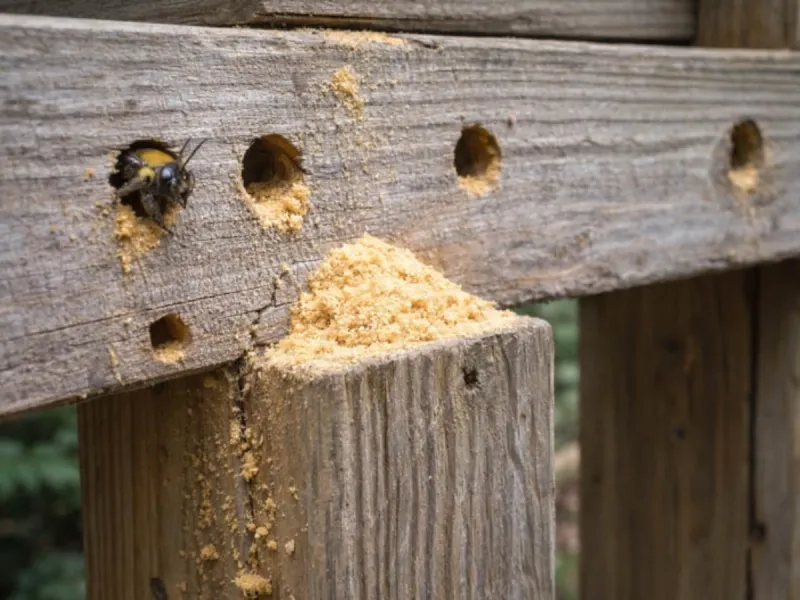
Some carpenter bee situations are straightforward enough for a homeowner to handle with observation, patience, and a paintbrush. Others call for a licensed professional, and knowing the difference protects both you and the structure.
Leaving a nest alone is a genuinely defensible choice when the tunnel is in a location that poses no meaningful structural risk, when the wood is thick and sound, and when you have confirmed that activity is limited. Male carpenter bees cannot sting, and females are not aggressive unless directly handled or threatened at the nest entrance.
NC State Extension notes that if an active nest is not threatening the structure, monitoring rather than immediate intervention is a reasonable path.
The calculation changes when the nest is in a high eave, soffit, or roofline that requires a ladder to reach, when thin fascia or siding is involved, or when the extent of tunneling is unclear. Overhead pesticide applications present a real hazard to the person applying them, and the NC Department of Agriculture specifically advises against spraying bees that are merely hovering, noting that much of an overhead application falls back onto the applicator rather than reaching the target.
Swatting or blocking an active entrance while bees are present is equally counterproductive and can provoke the female into stinging.
When treatment is warranted, hire a licensed North Carolina structural-pest-control professional. The NC Department of Agriculture advises homeowners to verify that any contractor holds the appropriate credentials before work begins.
A qualified professional can assess whether treatment is actually necessary, apply it safely at height, and advise on the correct timing for sealing and repair afterward.
Any pesticide used must be applied strictly according to its current label. NC State’s Agricultural Chemicals Manual notes that pesticide registrations and permitted uses can change, and the EPA’s citizen’s guide to pest control and pesticide safety is clear that applying a pesticide in any manner inconsistent with its label is illegal.
This is not a situation for improvised recipes, unlabeled products, or guesswork about what might work on a high eave. The right professional with the right product and the right credentials is the appropriate response when the nest location or structural risk moves beyond what a homeowner can safely manage alone.
Read the bees, then make the smallest effective change
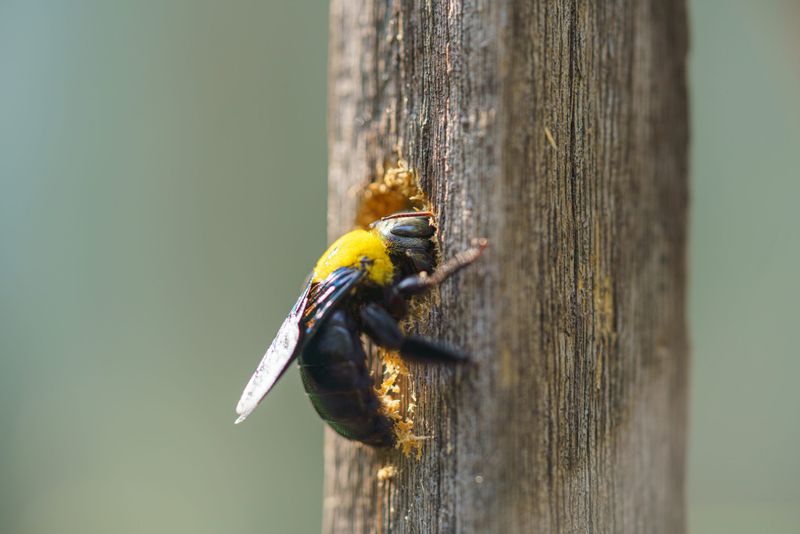
A cluster of large carpenter bees around your eaves in April or May is telling you something specific, and the most useful response is to listen before acting. Work through a short, ordered sequence: confirm the bee is a large Xylocopa carpenter bee rather than a small Ceratina species, then inspect the wood for physical evidence of nesting such as a round entrance hole, sawdust-like material, or staining.
Do not treat hovering alone as proof of current activity.
Once you have evidence of a hole, watch from a safe distance to see whether bees are actually entering or exiting. NC State Extension and Penn State Extension both point to confirmed entry and exit as the clearest sign of current activity.
If the tunnel appears inactive and the wood is otherwise sound, a clean fill and a fresh coat of paint may be the only repair needed. If the location is high, the damage is extensive, or activity is confirmed but ambiguous, a licensed professional is the appropriate next step.
Keep your native plants flowering through spring, summer, and fall. The NC Department of Agriculture reminds homeowners that carpenter bees are native pollinators with real value in the yard.
Sound wood care and a pollinator-friendly garden are not competing priorities; they are the same stewardship habit expressed in two different places on your property.