
Cardboard Beats Landscape Fabric For Smothering North Carolina Weeds And Here’s Why
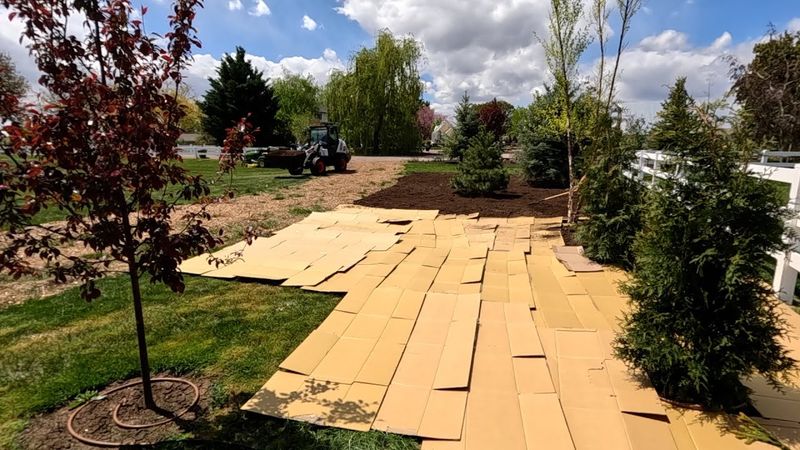
Most North Carolina gardeners reach for landscape fabric when they want to smother weeds in a new bed, but there is a cheaper, simpler option sitting in the recycling bin. Plain corrugated cardboard, laid over the ground and covered with mulch, can suppress existing grass and many germinating annual weeds while the bed gets established.
For homeowners converting a weedy lawn patch into a planting bed across the Piedmont, Coastal Plain, or mountains, cardboard often fits the job better than fabric does. Neither one eliminates weeding forever, but understanding why cardboard works and where it falls short helps you choose the right tool for the project at hand.
Why cardboard often fits a new North Carolina bed better
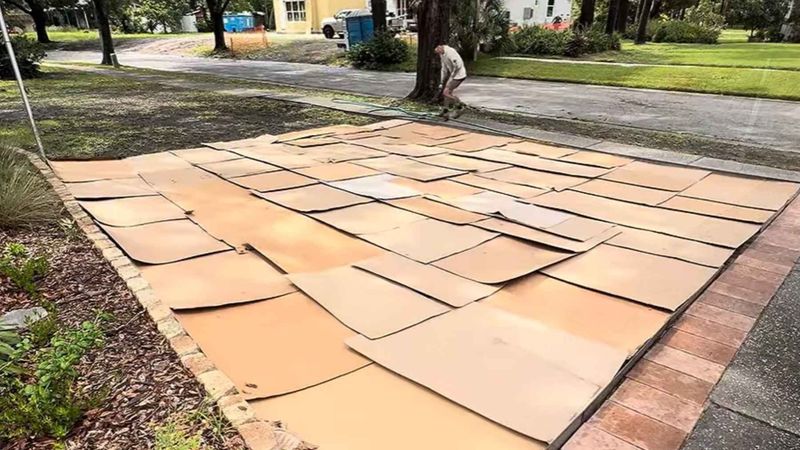
For a homeowner converting a lawn or overgrown patch into a new residential planting bed, plain cardboard beneath organic mulch is often the better short-term fit. NC State Extension’s organic gardening guidance recommends cardboard or newspaper under pine bark, shredded hardwood, or pine straw as a way to achieve excellent weed suppression, and it favors organic mulch over landscape fabric specifically because fabric can become difficult to weed once organic material accumulates on top.
That practical concern matters a lot in a frequently tended residential bed.
The comparison here is specific: short-term bed establishment and ongoing maintenance in an organic-mulched planting area, not every soil, weed, or landscape situation. NC State Cooperative Extension’s guidance on the appropriate use of landscape fabric makes clear that fabric is not the right default choice for beds that will be regularly replanted, amended, or disturbed.
Cardboard sidesteps that problem because it breaks down over time and leaves no synthetic layer behind.
Landscape fabric does have legitimate uses, and treating it as a universally failed product would be unfair. UC IPM’s weed management guidance notes that fabric beneath mulch can provide stronger initial control of some annual weeds when installed correctly over prepared soil.
Fabric may also be a reasonable choice beneath rock, on certain slopes, or in permanent low-disturbance areas where the bed will not be regularly dug or replanted.
The honest answer is that neither barrier is maintenance-free. NC State’s plan-before-you-plant resource points out that site preparation, weed pressure, and ongoing attention all shape how well any barrier performs.
Cardboard earns its place in the lawn-to-bed conversion because it fits the project’s short-term needs, not because it wins every weed-control comparison.
Cardboard suppresses light-loving weeds while it breaks down
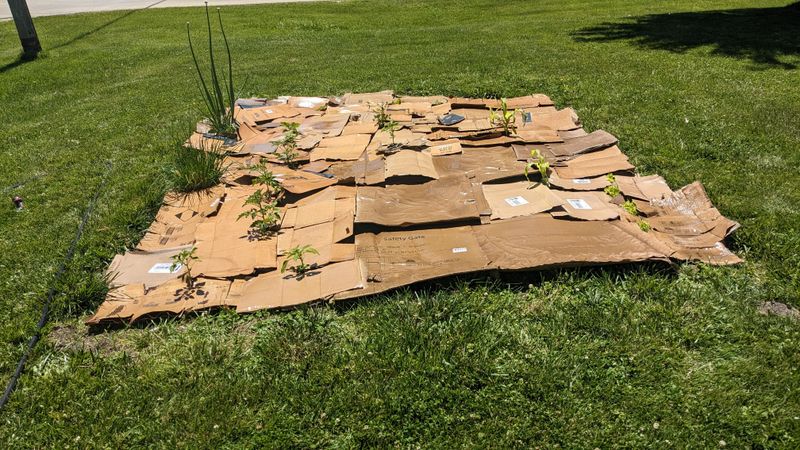
Cardboard works by cutting off light. Grass, clover, and most annual weed seedlings depend on sunlight to grow, and a solid layer of cardboard laid directly on the soil denies them that resource.
The existing vegetation underneath yellows and weakens, and seeds that would otherwise germinate in the top inch of soil never get the light signal they need to sprout.
Oregon State Extension’s sheet mulching guidance describes this light-blocking function as the core mechanism of cardboard sheet mulching, and recommends covering the cardboard with mulch to keep it in place and protect it from drying out too quickly. An exposed cardboard surface can curl, crack, and shed water rather than absorbing it, which defeats the purpose and leaves gaps where weeds can push through.
Breakdown happens gradually, not overnight. Depending on moisture levels, cardboard thickness, mulch depth, and soil biology, the material may take several months to soften and integrate with the soil below.
Penn State Extension’s sheet mulching steps recommend beginning the process roughly five to six months before the area needs to be ready for planting, which reflects how variable that timeline can be. As it decomposes, cardboard can contribute organic matter to the soil, though it should not be counted on to improve every site.
The light-blocking benefit is real but limited. Oregon State’s sheet mulching PDF and NC State’s planting preparation guidance both note that weeds with rhizomes, tubers, stolons, or bulbs can survive smothering and push through even a well-installed cardboard layer.
Annual weed suppression is where cardboard earns its keep; perennial weed control is a separate problem that requires more than any single barrier can deliver.
Install cardboard for variable, not guaranteed, suppression
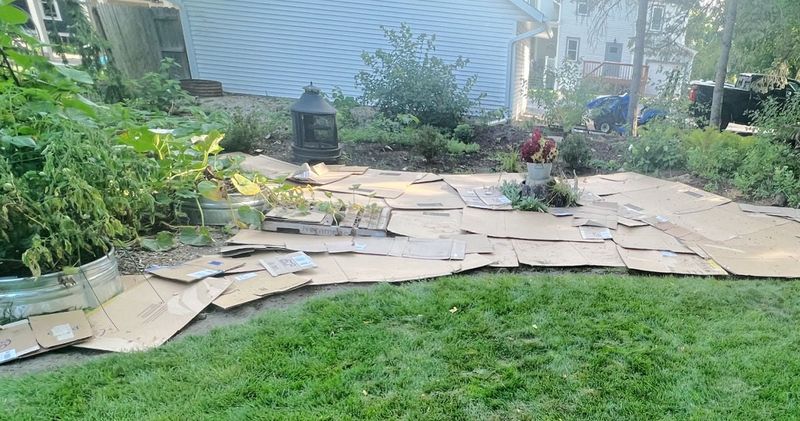
Good results start before the cardboard hits the ground. Mow or cut existing vegetation as short as possible, and dig out large perennial weeds by the root where you can reach them.
Leaving tall stems under the cardboard creates air pockets and uneven contact with the soil, which gives weeds a head start at the edges and seams.
Choose plain, brown, unwaxed corrugated cardboard. Clemson Extension’s cardboard-in-the-landscape guidance cautions against glossy boxes, plastic-coated surfaces, heavily colored sections, and heavy-duty seams that may contain different adhesives.
Pull off all plastic tape, peel away shipping labels, and remove any staples before laying the sheets. Black box ink is generally vegetable-based and considered safe, but colored inks and coated surfaces are a different matter.
Penn State Extension’s sheet mulching instructions recommend overlapping seams by about 8 to 10 inches so there are no gaps where light can reach the soil. Seams are the most common failure point, and weeds are quick to find even a narrow opening.
After laying each section, wet the cardboard thoroughly with a hose before moving to the next piece, then cover the finished layer with 4 to 6 inches of organic mulch.
Wetting serves two purposes. It helps the cardboard conform to the soil surface and begin the biological process that eventually breaks it down.
Oregon State Extension’s sheet mulching guide also notes that dry cardboard can form a water-repelling layer, so thorough initial soaking matters for water movement to reach plant roots.
Plan to check the bed during the growing season. Mulch can shift, cardboard can develop soft spots or tears, and seams can open after heavy rain or foot traffic.
Replenish mulch where it has thinned, press down or patch any exposed cardboard, and pull any weeds that emerge before they set seed. Oregon State’s sheet mulching PDF frames this as ongoing stewardship rather than a one-time installation, which is the right way to think about it for any North Carolina season.
Let organic mulch carry the bed after installation
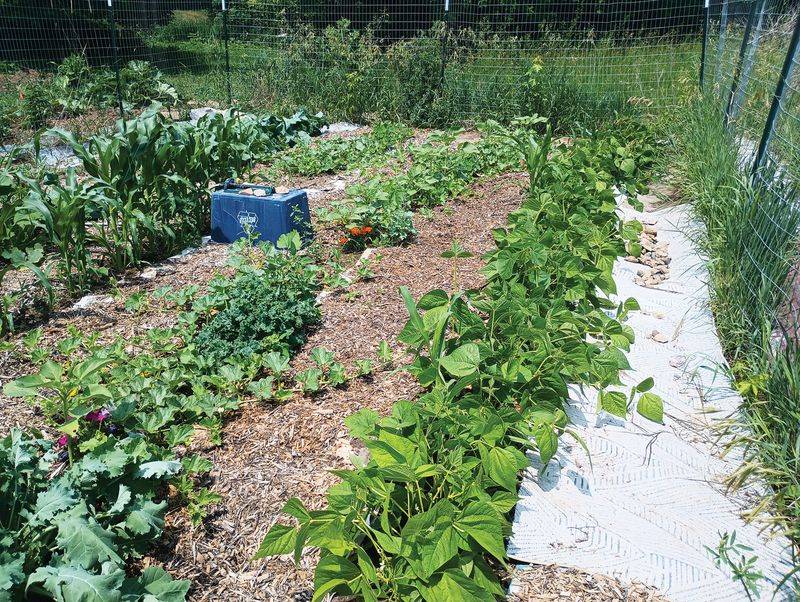
Cardboard handles the initial smothering, but mulch does the sustained work. Once the cardboard is wetted and in place, the organic mulch layer on top protects it from rapid breakdown, holds it against wind and rain, and takes over as the primary surface barrier against new weed seedlings.
Without mulch, cardboard dries out, cracks, and loses its effectiveness quickly.
For a lawn-to-bed conversion using sheet mulching, a 4 to 6-inch mulch layer is appropriate. NC State Extension’s organic gardening handbook recommends cardboard or newspaper paired with organic mulch for excellent weed suppression during bed establishment.
That depth is specific to the conversion project, where the goal is smothering existing vegetation and building a new growing environment. It is deeper than what NC State recommends for an already-established woody or perennial bed.
NC State’s woody ornamentals guidance suggests approximately 3 to 4 inches of organic mulch for maximum weed-management benefit in mature shrub and perennial beds, and warns that excessive mulch creates its own problems. Piling mulch too deep against established plants can interfere with gas exchange, encourage shallow rooting, and hold moisture against bark in ways that invite disease.
Moisture management matters throughout the season. Thick cardboard combined with deep mulch can sometimes slow water from reaching roots, particularly on sites with heavy clay or compacted soil.
Oregon State Extension recommends checking soil moisture regularly after installation rather than assuming overhead irrigation will penetrate the layered system. Illinois Extension’s irrigation guidance supports using drip irrigation or watering directly at plant openings in mulched beds when overhead coverage may be uneven.
Keep mulch and cardboard away from trunks, stems, and plant crowns. Leave a visible gap of several inches around woody plants so the base of each stem stays dry and well-ventilated.
Illinois Extension’s pollinator garden infosheet reinforces this practice for new planting beds. Mulch volcanoes piled against bark are one of the most common mistakes in residential beds and one of the easiest to avoid.
Landscape fabric still fits some permanent, low-disturbance sites
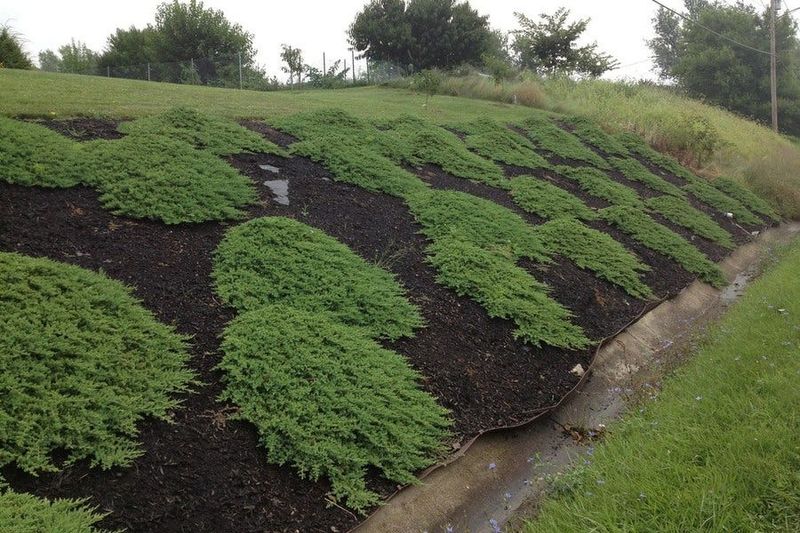
Landscape fabric deserves a fair look rather than a blanket rejection. When installed correctly over prepared, relatively weed-free soil, fabric beneath mulch can deliver stronger initial suppression of annual weeds than mulch alone.
UC IPM’s weed management in landscapes guide supports this point, noting that fabric-plus-mulch combinations can outperform mulch by itself in the short term when the soil underneath has been properly prepared. That is a genuine advantage in the right setting.
The trouble comes later. Soil particles, decomposed mulch, and windblown organic matter accumulate on top of the fabric over time, creating a thin growing medium where weed seeds can germinate just as easily as they would in an open bed.
NC State’s woody ornamentals handbook and Penn State Extension’s ornamental planting guidance both describe this accumulation as an inevitable outcome that makes fabric-covered beds progressively harder to weed. Perennial weeds can also thread roots through the fabric, making removal more difficult than if no barrier had been used at all.
University of New Hampshire Extension’s perennial garden fabric assessment concludes that fabric is generally not the right choice for perennial beds that will be regularly divided, replanted, or amended. The same caution applies to beds in heavy clay soils, where fabric can further restrict drainage and air movement in an already-stressed root zone.
Where fabric makes sense is in permanent, low-disturbance areas that will not be regularly dug. Beneath decorative rock along a foundation, on a slope where erosion and mulch movement are concerns, or in a utility area planted with large, established shrubs that will not be moved, fabric can hold up and continue providing some weed resistance for several years.
NC State’s plan-before-you-plant resource acknowledges these specific use cases while cautioning against treating fabric as a general-purpose solution. Matching the barrier to the actual conditions of the site, rather than defaulting to one material or the other, is what produces a bed that stays manageable over time.
Perennial weeds and local conditions can overturn the plan

Neither cardboard nor landscape fabric is a match for a determined perennial weed. Plants that spread by rhizomes, tubers, stolons, or bulbs store energy underground and can push new growth through almost any surface barrier.
NC State’s plan-before-you-plant guidance specifically identifies this limitation, noting that site preparation and repeated control are necessary when aggressive perennial weeds are already present. Nutsedge, bindweed, thistle, and certain warm-season grasses fall into this category across much of North Carolina.
UC IPM’s landscape weed management guide reinforces the point that smothering layers work best against annual weeds and existing surface vegetation, not against established perennial root systems. If a bed has a heavy nutsedge or bindweed infestation, the honest expectation is that some of those plants will return regardless of the barrier chosen.
Removing as much of the root system as possible before installation gives the cardboard a better chance.
Local conditions in North Carolina add another layer of uncertainty. Warm, humid summers in the Piedmont and Coastal Plain can accelerate cardboard decomposition significantly compared to cooler mountain sites.
Oregon State Extension’s sheet mulching PDF and Oregon State’s sheet mulching guide both describe breakdown timing as site-dependent, shaped by moisture, cardboard thickness, mulch depth, and soil biology. A layer that holds through most of the season in the NC mountains may soften and fail much sooner in a low-lying Coastal Plain bed that stays moist.
Heavy rain can shift mulch, open seams, and expose cardboard edges. Clay soils may pond water above the cardboard layer rather than letting it drain through to roots.
Slopes can cause mulch to creep downhill over time, thinning the protective cover at the top of the bed. Illinois Extension’s new garden bed preparation timeline notes that checking and adjusting the barrier system throughout the growing season is part of the process, not a sign that the installation failed.
Walk the bed after heavy rains, press down or patch exposed sections, pull any weeds that emerge through mulch, and check that soil moisture is reaching plant roots.
Choose the barrier that matches the bed you can maintain
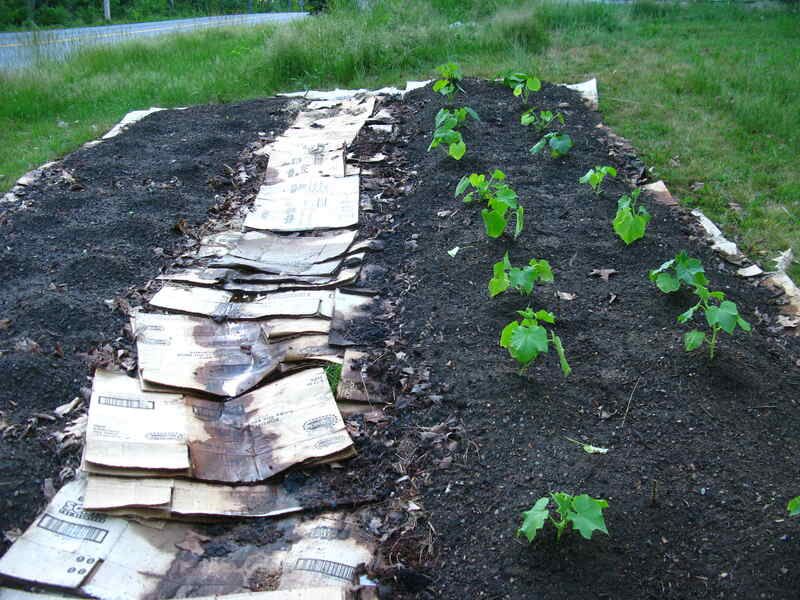
The decision comes down to what the bed is and how it will be used. For a homeowner converting lawn or a weedy patch into an organic-mulched planting bed, wetted, overlapped plain cardboard beneath 4 to 6 inches of organic mulch is usually the better fit.
NC State Extension’s organic gardening handbook and NC State’s landscape fabric guidance both point in this direction for beds that will be regularly tended, amended, or replanted over time.
Fabric earns its place only when the site genuinely supports it: permanent, low-disturbance plantings, areas covered with rock rather than organic mulch, or some slopes where erosion control matters more than soil improvement. UC IPM’s weed management guidance acknowledges those legitimate uses while making clear that fabric is not a fit-all solution.
Whichever material you choose, keep it away from woody stems, plant crowns, foundations, and wooden structures. NC State’s woody ornamentals guidance is direct on this point: mulch and barriers piled against bark invite moisture problems and disease.
Inspect the bed regularly, pull weeds that emerge in the mulch layer before they root deeply, and replenish mulch as it breaks down.
Cardboard is not a universal winner over landscape fabric. For the specific project of converting a North Carolina lawn or weedy area into a new planting bed, it is simply the more practical, soil-compatible choice for most residential gardeners.
A bed that is easy to weed, easy to amend, and gradually improving in organic matter is a bed worth maintaining.