
If Hummingbirds Ignore Your Full Feeder All Through Migration, Where You Hung It Is Scaring Them Off
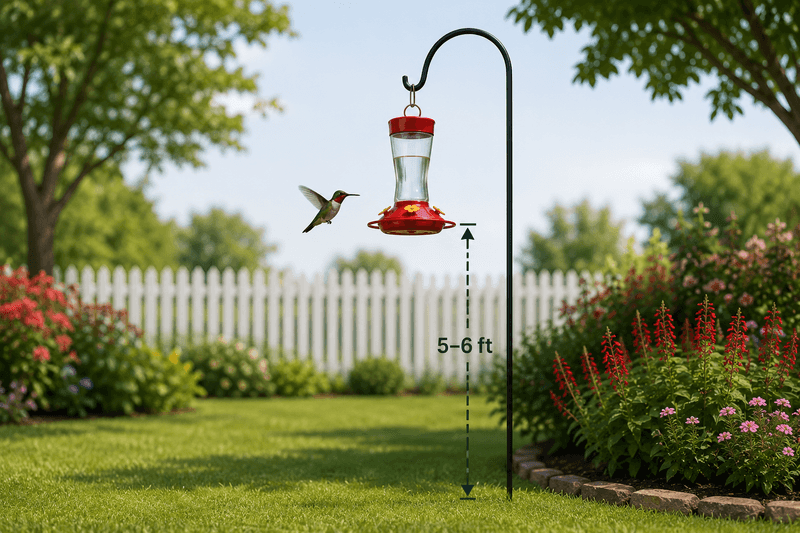
You filled the feeder, hung it up, and waited, but not a single hummingbird stopped by. Before you blame the birds or the feeder itself, the spot where it is hanging may be worth a second look. Placement can affect how easy a feeder is to find, how quickly the nectar spoils, and whether birds feel safe enough to stop, but it is rarely the only reason a feeder goes untouched. A few targeted adjustments and a little patience can make a real difference.
Placement is worth testing, but an empty feeder has several possible causes
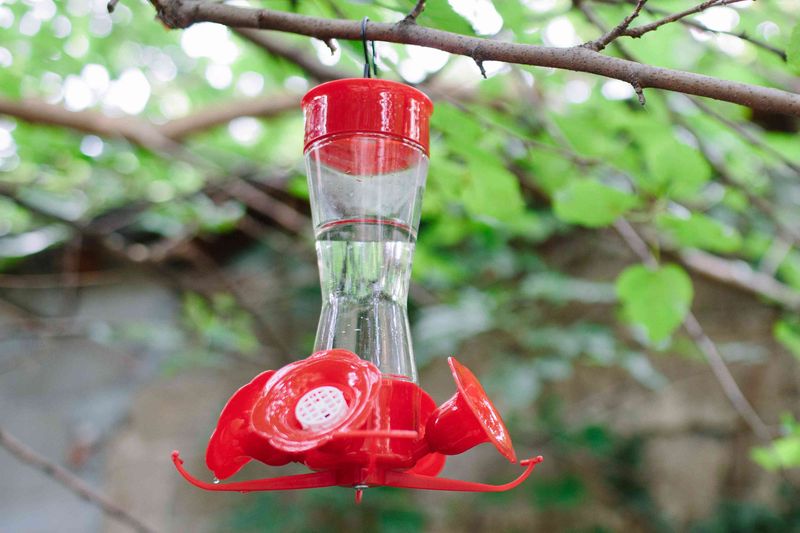
Plenty of backyard birders hang a full feeder and spend weeks watching nothing visit it. The instinct is to blame the location, and sometimes that instinct is right. Placement can affect whether birds spot the feeder, whether the nectar stays fresh, and whether the site feels safe enough to approach. Even so, Audubon’s birding FAQ points out that bird populations and individual yard conditions fluctuate in ways that have nothing to do with where a feeder is hung.
Local hummingbird numbers vary from yard to yard and season to season. A neighbor two streets over may have daily visitors while your feeder sits untouched, and that gap often comes down to habitat, flower availability, and how many birds are moving through your specific area rather than whether you chose the right hook. Cornell Lab’s guidance on fewer feeder visits lists territorial behavior, natural food abundance, nectar quality, and delayed discovery as explanations that can each produce an empty feeder on their own.
Migration timing adds another layer of complexity. Hummingbird activity does not follow a single national calendar. Ruby-throated hummingbirds move through the eastern half of the country on a schedule that differs from that of Rufous hummingbirds pushing up the Pacific Coast or through the Rockies, and some western and Gulf Coast areas host year-round residents. Range maps for the Rufous Hummingbird show just how much timing differs by region and species.
One more common worry is worth addressing directly: leaving your feeder out does not normally prevent hummingbirds from migrating. Cornell Academy’s fall migration guidance confirms that day length and environmental cues trigger migration, not feeder availability. Keeping a feeder stocked gives passing birds a fuel stop without holding them back. The placement recommendations in the sections that follow are practical adjustments worth testing, not a guaranteed diagnosis for why your feeder is empty.
Use partial shade to protect nectar quality
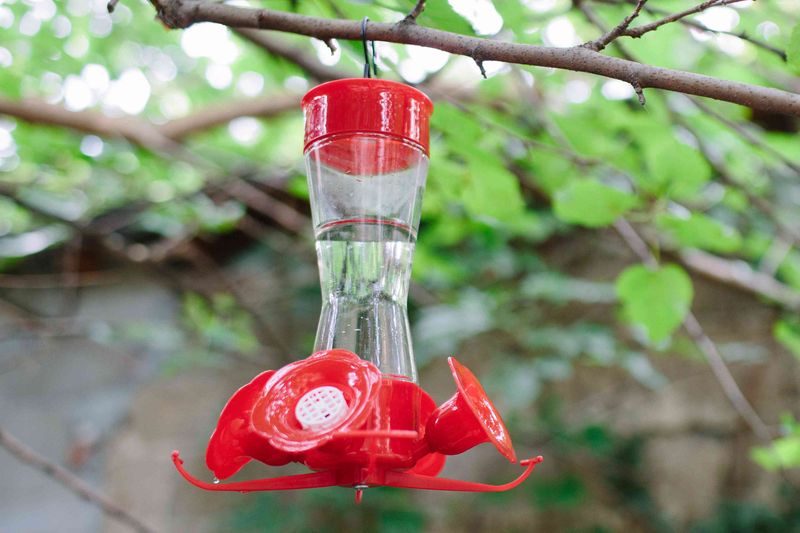
Moving a feeder out of direct sun is one of the most practical first steps you can take, especially during the hottest months of summer. When a feeder sits in full sun all day, the nectar warms quickly, and warm sugar water ferments and spoils far faster than nectar kept in cooler conditions. Cornell Lab’s hummingbird feeding guide notes that heat accelerates spoilage and that nectar should be replaced more frequently in warm weather to keep it safe for birds.
There is also a practical leakage problem with bottle-style feeders in direct sun. As the air trapped inside the bottle warms and expands, it can push liquid through the feeding ports, dripping nectar onto the ground and attracting ants, wasps, and bees. Shade reduces that pressure effect and makes the feeder easier to maintain between cleanings.
What shade does not do is prove that hummingbirds actively fear or avoid sunny spots. The stronger case for moving to partial shade is about nectar condition and feeder performance, not about a demonstrated fear response to sunlight. Cornell’s feeder placement guidance recommends choosing a spot that stays mostly shaded, particularly in afternoon heat, while still leaving the feeder visible and accessible.
Morning sun with afternoon shade tends to work well across most of the continental United States. A spot under a tree canopy, on the shaded side of a structure, or beneath an eave can fit that description. Just make sure the chosen location still lets you see the feeder clearly from a window or path so you can check the nectar color and catch spoilage early. A feeder you cannot easily inspect tends to go longer between cleanings than it should.
Shield the feeder from strong wind
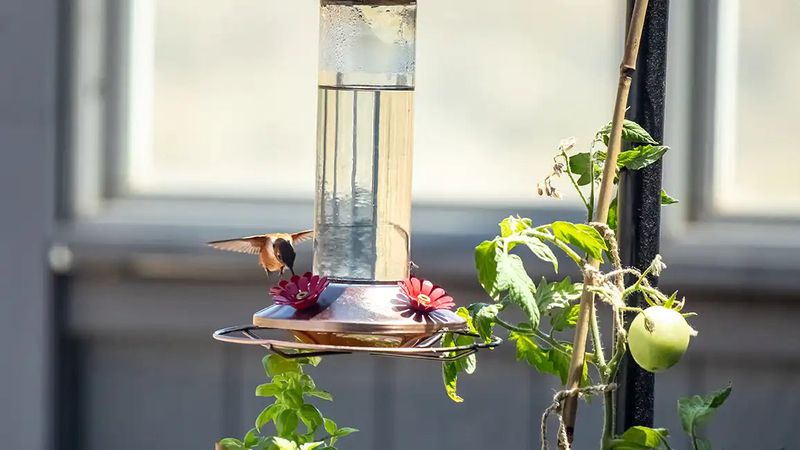
Wind is a quieter problem than sun, but it causes real trouble for feeders. A feeder that swings hard in a gust can slosh nectar out through the ports, creating drips that run down the outside of the feeder and pool on the ground below. That puddle of sugar water is an open invitation for ants, bees, and wasps, and once those insects find the feeder, they can make it difficult for hummingbirds to use comfortably. Audubon’s guide to keeping feeders pest-free identifies drips and spills as a primary reason insects congregate around hummingbird feeders.
Steady swinging can also loosen the seal between a feeder’s bottle and its base over time, turning a small drip into a steady leak. Choosing a location with some natural wind protection, such as the sheltered side of a fence, a wall, or a dense shrub a few feet away, can reduce that constant motion without hiding the feeder from view. Cornell’s feeder placement advice lists wind exposure as a factor worth considering when picking a permanent spot.
Keep in mind that this is not an argument that hummingbirds refuse to visit any feeder that moves. A feeder that sways gently in a light breeze is not a problem. The concern is persistent hard swinging that spills nectar, attracts insects, and strains the feeder’s hardware. Before committing to a new location, spend a few minutes watching the feeder during the windiest part of the afternoon.
If it swings more than a few inches, try a spot with a little more shelter and see whether the dripping and insect activity decrease before evaluating whether birds are visiting more or less.
Place the feeder near cover, but keep the approach open
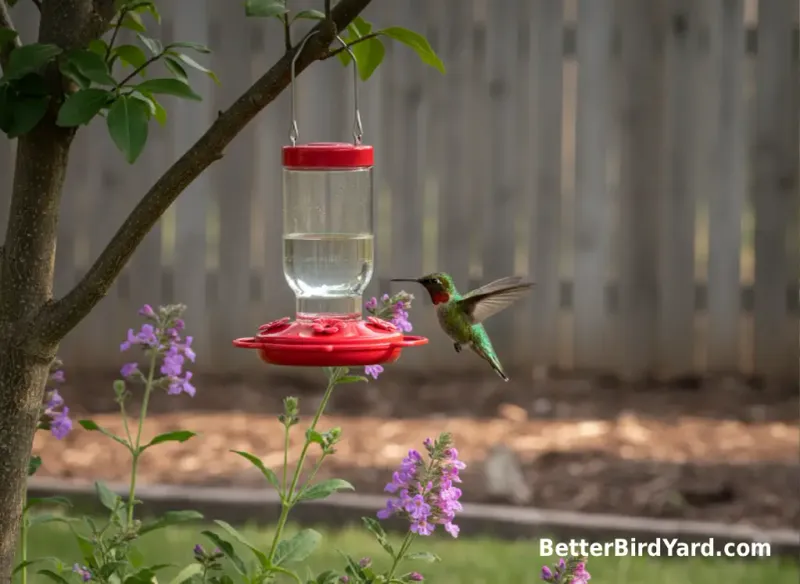
Hummingbirds are small, fast, and acutely aware of predators. Having a shrub or small tree within easy flying distance of the feeder gives them a perch to rest on between visits and a quick escape route if a hawk or other threat appears overhead. That kind of nearby cover is genuinely useful for birds. Cornell’s placement guide recommends positioning feeders near natural cover for exactly that reason.
The important qualifier is that “near cover” and “tucked inside dense foliage” are two very different things. A feeder buried in thick shrubs gives cats, squirrels, and other predators a place to hide and wait. Penn State Extension’s hummingbird guidance recommends keeping cats indoors and, where outdoor cats are a concern, placing feeders in open areas elevated enough to reduce access. A feeder hanging in the open with a shrub or tree roughly 10 feet away hits a reasonable middle ground: close enough for perching and escape, far enough that a cat cannot spring directly from the vegetation to the feeder.
That 10-foot figure comes from general bird feeder guidance as a practical starting compromise, not from a hummingbird-specific study. University of New Hampshire Extension’s bird feeding tips frame nearby cover similarly, as a way to balance shelter and predator access rather than as a hard rule. Treat it as a starting point and adjust based on what you observe in your own yard.
Before settling on a new spot, walk around the feeder and look at it from a predator’s perspective. Can a cat crouch beneath the nearest shrub and swipe upward? Can a squirrel jump from a fence rail directly to the feeder? If the answer to either question is yes, move the feeder to a more open position or raise it higher.
The ABA Code of Birding Ethics emphasizes minimizing hazards to birds, and reducing predator access at feeding stations is a direct application of that principle.
Treat windows as hazards and give birds time to find the feeder
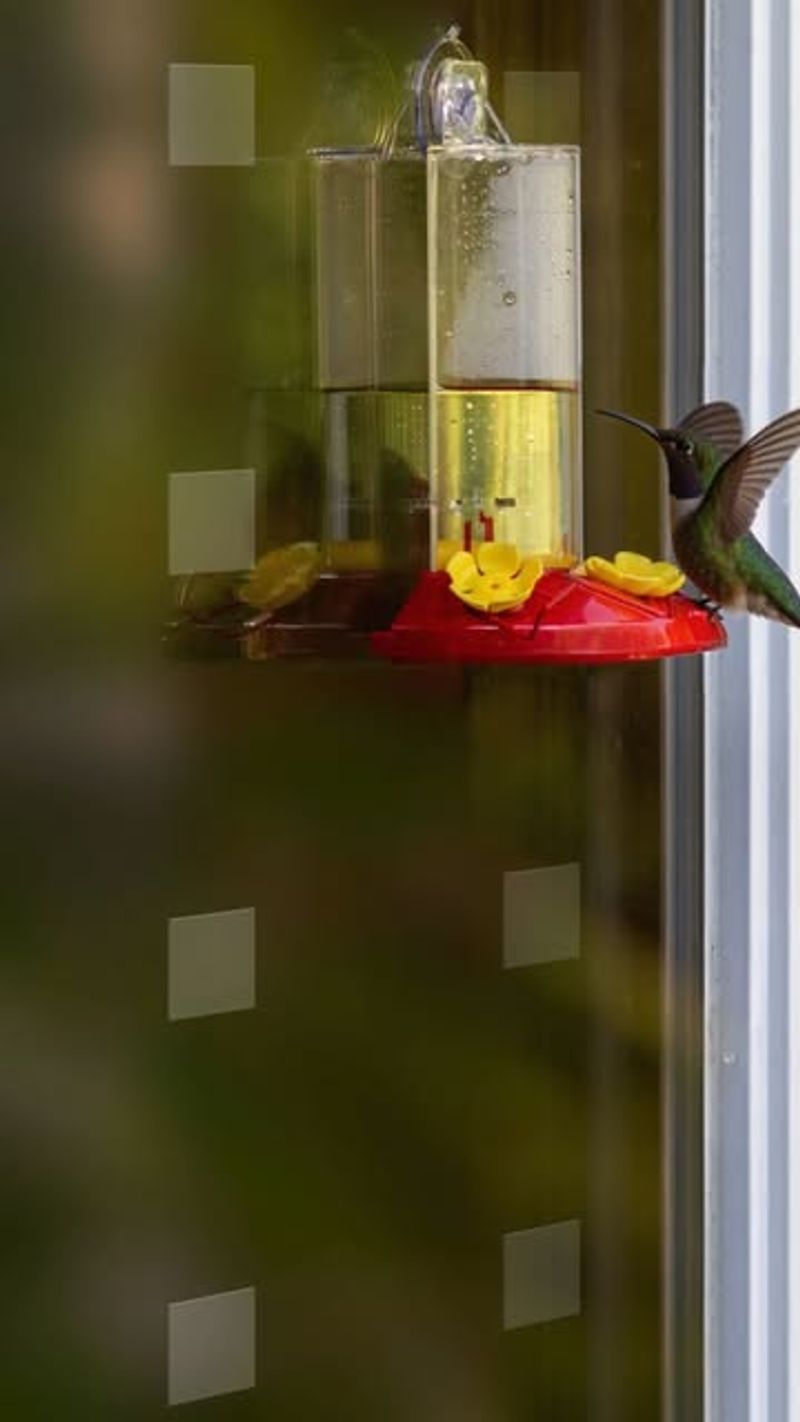
Windows deserve more attention than most feeder guides give them. A feeder hung at an intermediate distance from a large window, say 10 to 20 feet away, can actually increase collision risk because birds build up speed before hitting the glass. Cornell Lab’s window collision guidance explains that the traditional “within 3 feet or beyond 30 feet” rule is not sufficient on its own. The more important step is treating the window itself with effective external markings, such as closely spaced decals, tape strips, or screens, so birds can see the glass as a barrier rather than open airspace.
If your feeder is currently hanging somewhere between those two distance extremes and there is a large window nearby, that combination is worth addressing regardless of whether you have seen a collision. Move the feeder closer to the window, beyond 30 feet, or treat the window with external markings, and ideally do more than one of those things. Cornell’s placement advice and Audubon’s winter feeding guidance both address window proximity as part of responsible feeder siting.
Discovery time is the other factor worth building into your expectations. A feeder that was just hung, or one that was recently moved, may go unvisited for days or even a couple of weeks while local birds learn it is there. Penn State Extension recommends placing a new feeder near existing hummingbird flowers initially, since birds already visiting those flowers are more likely to notice the feeder. Once they do, you can shift the feeder gradually toward a more convenient spot over several days without losing the birds you have attracted.
Resist the urge to move a new feeder every few days because nothing is visiting yet. Frequent repositioning resets the discovery clock and makes it harder to tell whether any single location is working. Pick a spot, apply window protection if needed, and give it at least a week or two before drawing conclusions.
Check local conditions, territorial behavior, and seasonal timing
An empty feeder after a placement adjustment is not necessarily proof that the new spot failed. Before moving the feeder again, run through the most common non-placement explanations in a useful order. Start with the simplest one: hummingbirds may just be scarce in your immediate area. Audubon’s birding FAQ notes that some yards naturally attract fewer hummingbirds than neighboring yards due to differences in habitat, flower availability, and local bird density.
Seasonal timing matters more than most people realize, and it varies by region and species. A yard in coastal California may host Anna’s hummingbirds year-round, while a yard in Ohio sees Ruby-throated hummingbirds only between late April and early October. Cornell Academy’s migration Q&A explains that hummingbird numbers naturally peak and drop during the season as resident birds, migrants, males, females, and juveniles cycle through at different times. A yard that was busy in late spring may go quiet in midsummer and then pick up again as fall migrants move through.
Natural food abundance is another variable that no feeder can override. When a yard or neighborhood is full of flowering salvias, trumpet vines, or bee balm, hummingbirds may prefer those sources and visit the feeder only occasionally. UNH Extension’s homeowner experience article describes exactly this pattern, where feeders get heavy use early in the season and then see fewer visits once native flowers peak.
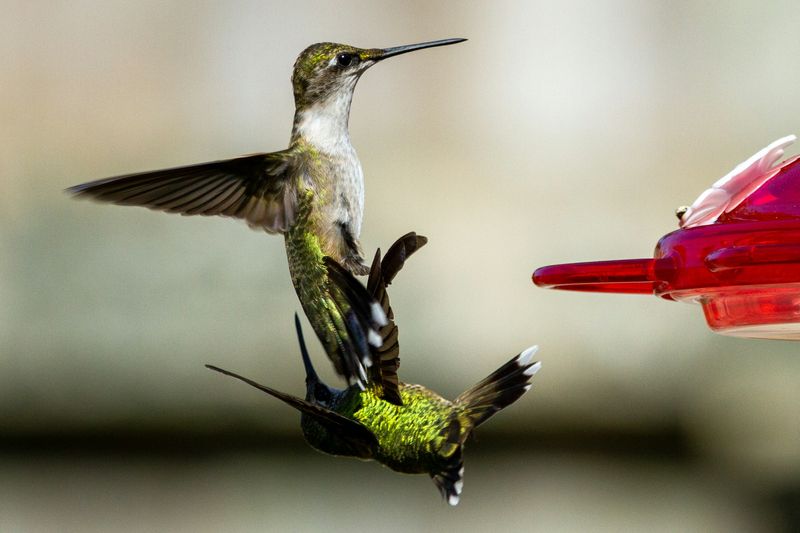
Territorial exclusion is worth checking too. One aggressive male hummingbird can chase every other bird away from a single feeder and still not drink much of the nectar himself. Cornell’s explanation of hummingbird fighting behavior describes this as normal and common. The practical response is to add a second or third feeder in locations that the territorial bird cannot see simultaneously, such as around a corner of the house or on the opposite side of the yard.
Cornell’s hummingbird feeding overview recommends multiple separated feeders specifically for this situation. Adding feeders addresses access, but it does not guarantee that more birds will arrive if local abundance is simply low.
Maintain safe nectar and build habitat beyond the feeder
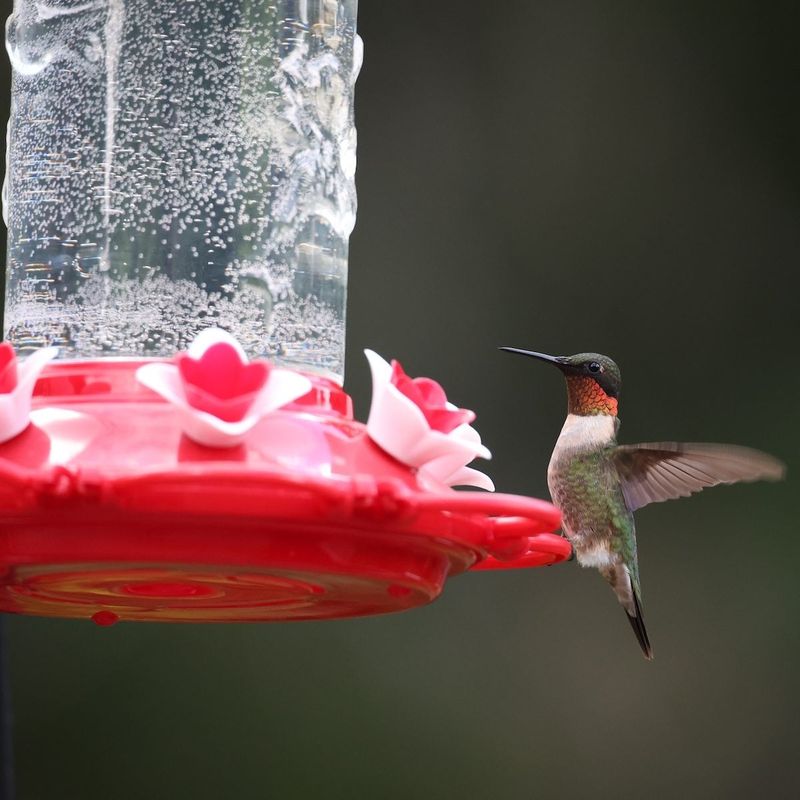
Even a perfectly placed feeder will underperform if the nectar inside it is stale, contaminated, or made with the wrong ingredients. The correct recipe is simple: one part refined white sugar dissolved in four parts water. Audubon’s hummingbird feeding FAQ is explicit about what to leave out, specifically red dye, honey, brown sugar, molasses, artificial sweeteners, and extra-concentrated mixtures. Honey and brown sugar can promote harmful fungal growth, and artificial sweeteners provide no calories for birds that burn enormous amounts of energy in flight.
How often you replace the nectar depends on the weather. In hot conditions, nectar can ferment or turn cloudy within a day or two. Cornell Academy’s migration feeding guidance recommends replacing nectar every one to two days during heat waves and every few days in cooler weather. Clean the feeder every time you refill it, and clean it immediately if you see cloudiness, mold, fermentation bubbles, or insect contamination inside.
Ant management deserves a specific caution. Never use petroleum jelly, cooking oil, or other sticky substances on the feeder hook or pole. Those materials can contaminate nectar and coat the feathers of any bird that brushes against them. Cornell’s guide to unwanted yard visitors recommends water-filled ant moats, which hang above the feeder and block ants from crossing, along with reducing drips, cleaning spills promptly, and relocating the feeder if ant trails become persistent.
Finally, a feeder is a supplement, not a complete habitat. Penn State Extension and Cornell Academy’s feeder bird resources both point out that hummingbirds also rely on insects for protein, native flowers for natural nectar, and shrubs and trees for shelter and nesting. U.S. Fish and Wildlife Service bird feeding guidance frames supplemental feeding as one piece of a broader habitat picture.
Planting native flowers alongside your feeder, reducing pesticide use so insects remain available, and providing natural cover will do more for hummingbirds over the long term than any single feeder adjustment.
Run a simple placement trial before drawing conclusions
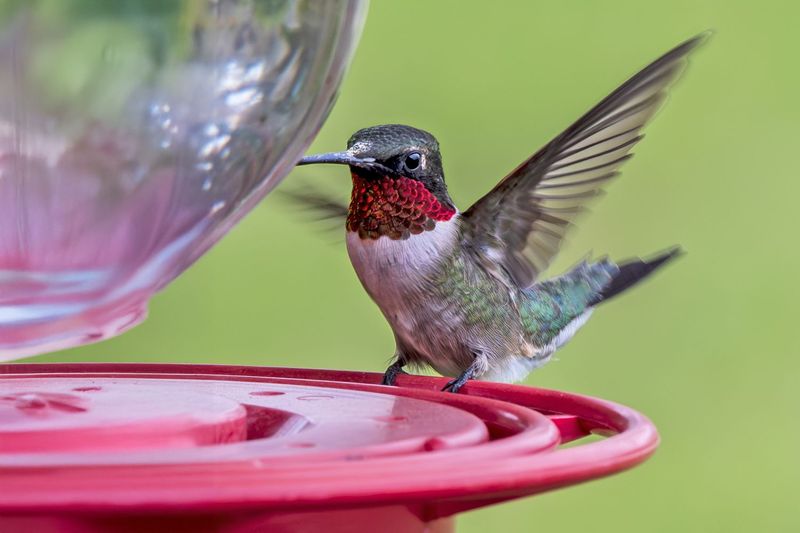
A structured trial takes the guesswork out of placement changes. Start by moving the feeder to a spot that gets morning light and afternoon shade, sits out of the path of strong prevailing winds, and hangs roughly 10 feet from a shrub or small tree while staying clear of dense foliage at ground level. Check nearby windows and apply external bird-safe markings to any large glass surface within the flight path. Verify that no cat or squirrel can reach the feeder easily from surrounding vegetation.
Cornell’s feeder placement overview covers each of these factors as part of a sensible starting position.
Fill the feeder with fresh one-to-four sugar water, and commit to replacing it on schedule rather than waiting until it looks bad. If the feeder is new to the spot, place it near any hummingbird flowers you already have and leave it there for at least one to two weeks before evaluating results. Penn State Extension notes that birds discover feeders near familiar flowers faster than feeders placed in unfamiliar open areas. Audubon’s FAQ reinforces that patience is part of the process.
If visits still do not come after a reasonable trial, revisit the non-placement explanations from earlier sections: local bird numbers, seasonal timing, territorial exclusion, and natural food competition. Window safety aside, the best placement in the world cannot conjure hummingbirds that are not present in your area. A well-placed, well-maintained feeder in good habitat is an open invitation, and sometimes the birds simply need more time to accept it.