
If Mushrooms Keep Popping Up In Your Yard, Here’s What They’re Quietly Telling You About Your Yard Conditions Below
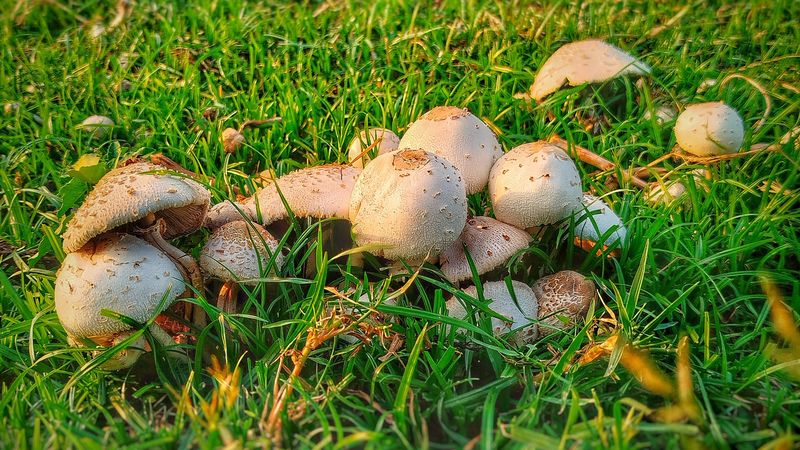
Stepping outside to find a cluster of mushrooms in your lawn can feel like your yard is sending you a message. The good news is that most of the time, those mushrooms are not a sign that something has gone seriously wrong.
What they do signal is that fungi have found moisture and something to feed on nearby, whether that is old roots, buried wood, thatch, or decomposing mulch. Understanding what that actually means, and what it does not, can save you from unnecessary worry and misguided fixes.
Mushrooms are yard clues, not soil reports
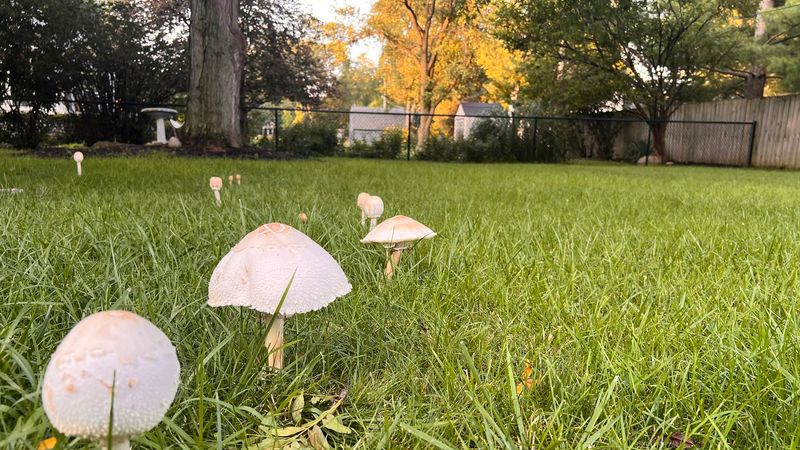
Waking up to a yard full of mushrooms after a rainstorm is surprising, but it is rarely a reason to panic. The common instinct is to assume that something must be wrong, or, on the flip side, that the soil must be thriving.
Both reactions go further than the evidence supports. A mushroom popping up in your grass or mulch bed is telling you something narrow and specific: a fungus has found enough moisture and organic material to produce a fruiting body.
That is the extent of what you can reliably read from it.
Mushrooms commonly appear after heavy rain or irrigation, and University of Minnesota Extension notes that their appearance is often temporary and does not usually mean the lawn has a disease or pest problem. The flush you see after a wet week can disappear just as quickly as it arrived, especially when the soil surface dries out.
A brief appearance in otherwise healthy-looking turf is not cause for alarm.
Where mushrooms grow matters too. A cluster appearing in a mulched bed is almost certainly a decomposer working through the wood chips, not a reflection of what the deeper soil is doing.
Penn State Extension explains that mulch mushrooms are generally harmless decomposers of the mulch itself and are not a problem for landscape plants.
What mushrooms cannot tell you is equally important. They are not a complete soil report.
They do not confirm that your soil is healthy, fertile, too wet, too acidic, compacted, or poorly drained. Those are separate questions that require separate tools.
A mushroom is a clue about local conditions, not a verdict on your entire yard.
What the visible mushroom reveals—and what it does not
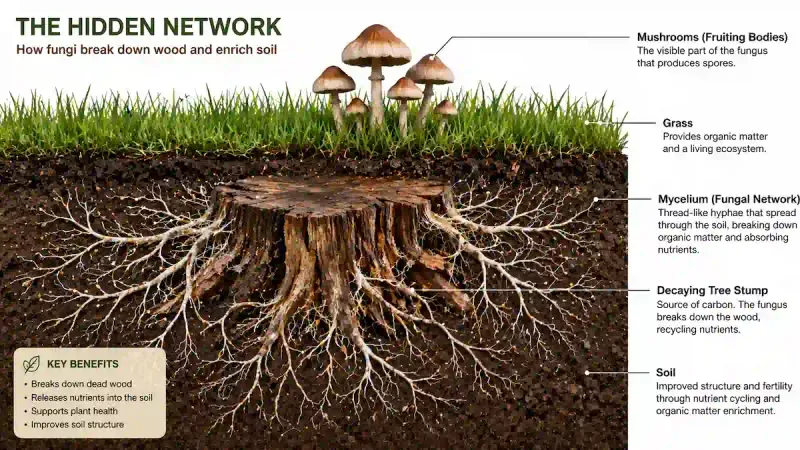
The mushroom you see above ground is only one small part of a much larger organism. Below the surface, a web of thread-like structures called mycelium spreads through the soil or organic material, breaking down whatever food source the fungus is using.
Penn State Extension describes the mushroom as the fruiting body, comparable to the apple on a tree, while the bulk of the fungus remains hidden underground.
Most lawn and garden mushrooms are decomposer fungi. They feed on dead and decaying organic material: old grass roots, fallen leaves, branches, thatch, buried stumps, wood chips, and similar carbon-rich matter.
This is a normal part of how organic material breaks down in any yard. Oregon State Extension’s guide on mulching confirms that fungi breaking down woody organic material in mulch are performing a routine decomposition process, not damaging landscape plants.
A separate category of fungi, known as mycorrhizal fungi, forms partnerships with living plant roots. These relationships can help plants access water and nutrients more efficiently.
USDA Agricultural Research has documented how mycorrhizal associations support plant growth in various soil environments. However, seeing a mushroom in your yard does not tell you whether a mycorrhizal fungus or a decomposer is responsible.
The two types look similar above ground and serve very different roles.
A visible fruiting body does not prove that nearby plants are being helped, fed, or connected to any underground network. It means a fungus is active and has found conditions favorable enough to reproduce.
Identifying its role requires more than a glance at what is growing in the grass.
A recurring patch can point to a hidden food source
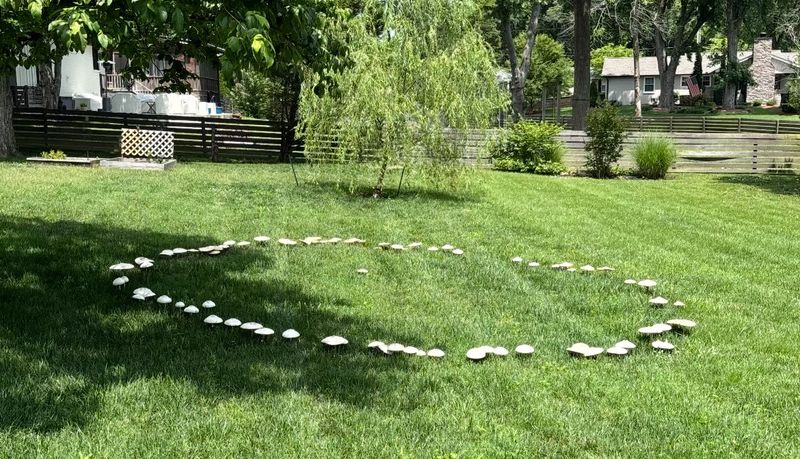
Random mushrooms after rain are one thing. Mushrooms that keep returning to the exact same spot, or that form a circle or arc, are telling you something more specific worth investigating.
Rather than treating repeated appearances as a general soil score, walk over and look at what is in and around that area. There is usually a reason fungi keep fruiting in that location.
Common culprits include buried tree roots left behind after a removal, an old stump that was ground down but not fully extracted, leftover construction debris, heavy thatch, or a concentration of wood chips. University of Wisconsin-Madison horticulture resources on fairy rings explain that these circular or arc-shaped patterns develop as mycelium spreads outward from a central food source, producing mushrooms at the growing edge as it expands year after year.
Not all fairy rings look the same, and that distinction matters for how you respond. Some rings produce a band of noticeably greener or taller grass around the mushrooms.
That extra growth often happens because the fungus releases nitrogen as it breaks down organic matter, giving the grass nearby a temporary fertilizer boost. Oregon State Extension’s fairy ring guidance notes that greener growth in a ring is a recognized symptom of this nitrogen release, not evidence that the whole yard has unusually fertile soil.
Other rings produce mushrooms without any visible grass change. Still others, particularly those where the mycelium has built up a dense, water-repelling layer, can create brown, drought-stressed, or dying turf.
University of Minnesota Extension’s circular turf problem guide distinguishes these ring types and makes clear that the appropriate response depends on which version you are dealing with. A cosmetic green ring and a ring with dead turf are not the same problem.
Let the surrounding turf determine whether you need a diagnosis
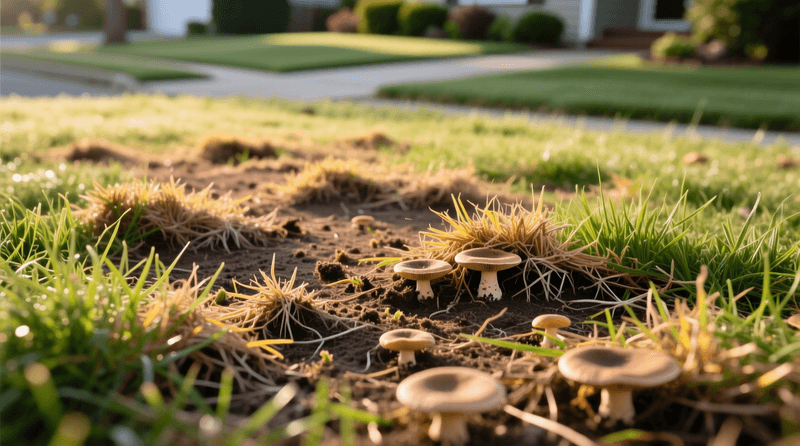
The mushrooms themselves are rarely the issue. What deserves your attention is the grass around them.
Mushrooms surrounded by healthy, green, vigorous turf are almost always a low-priority cosmetic concern. Mushrooms surrounded by persistent brown patches, thinning grass, poor growth, or soil that sheds water instead of absorbing it are a prompt to look more carefully at what is happening with the lawn, not just the fungi.
Compaction, poor drainage, low pH, and nutrient deficiencies all affect how grass grows, but none of those conditions can be diagnosed from a mushroom. Penn State Extension’s soil test interpretation guide is clear that pH, nutrient levels, and organic matter content require an actual soil test to measure accurately.
Mushroom presence is not a substitute for that data, and acting on it without testing can lead to unnecessary or counterproductive changes.
Adding lime or fertilizer based on mushrooms alone is a common mistake. Some fairy rings actively release nitrogen and create greener grass, so adding fertilizer to that area could push growth in the wrong direction or cause runoff.
Penn State’s guidance on liming turfgrass recommends testing soil pH before applying lime, because adding it to soil that does not need it can create new problems rather than solving existing ones.
If the turf is genuinely struggling, core aeration and thatch management are worth considering under the right circumstances. University of Wisconsin’s lawn maintenance guide connects these practices to documented turf conditions rather than mushroom presence.
Oregon State’s soil health publication reinforces that understanding what is actually happening in your soil requires observation, testing, and matching the response to the real condition, not to a surface-level indicator like a fruiting fungus.
Most ordinary mushrooms need little intervention
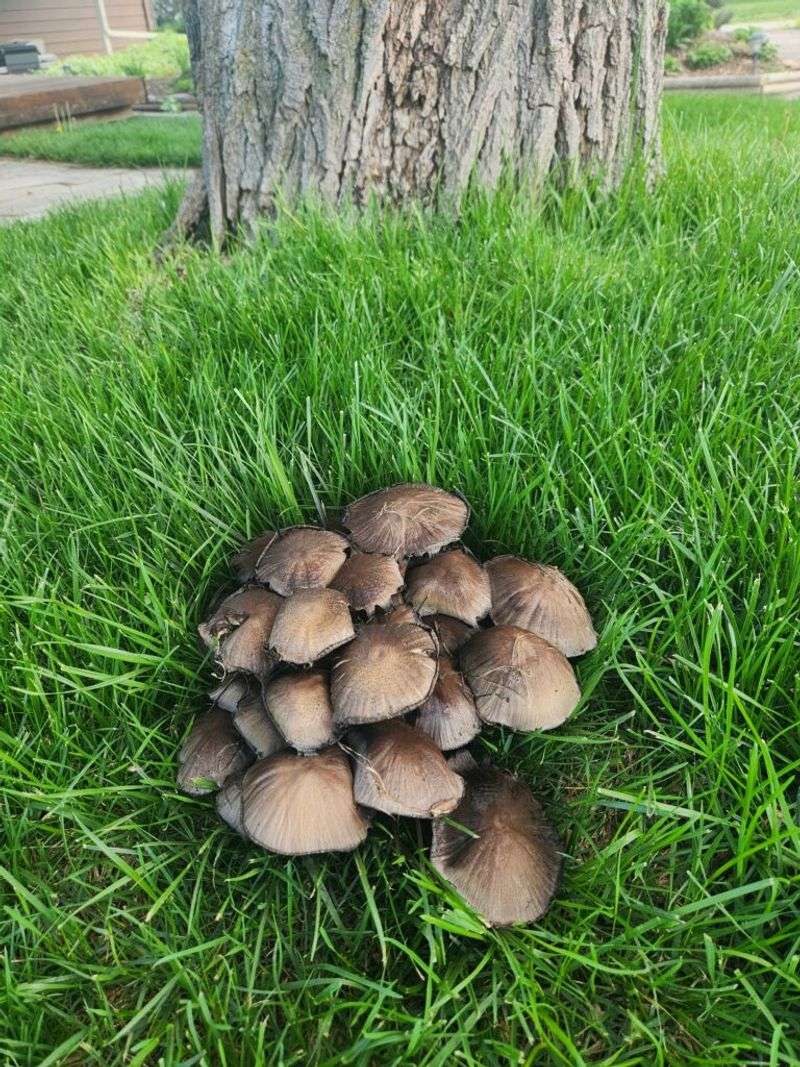
For the majority of homeowners, the right response to lawn or mulch mushrooms is to leave them alone or remove the visible caps if appearances matter. There is no rule that says mushrooms must be eliminated.
Penn State Extension confirms that ordinary mushrooms in lawns and mulch generally do not require eradication, and that a brief flush after rain is a normal part of yard life.
If you want to remove the fruiting bodies, the method is straightforward. Wear gloves, then knock them over with a rake, mow them down with the rest of the lawn, or pick them up and drop them in household trash.
Any of these approaches clears the surface without harming the grass around it. The important caveat: removing the visible mushroom does not remove the underground fungus.
University of Georgia Extension notes that the mycelium remains in the soil or organic material and mushrooms may return, especially as long as the food source persists.
Two habits can reduce how often mushrooms appear without requiring aggressive intervention. First, avoid routine overwatering.
Fungi fruit when conditions are moist, so letting the soil surface dry between watering cycles can limit favorable windows. Second, check for accessible decaying material that could be removed or reduced, such as piled wood chips against a fence, heavy thatch, or surface debris.
Oregon State’s mulching guide points out that reducing excess organic material can lower the food supply available to fungi, though it will not eliminate all fungal activity from the yard.
These steps may reduce recurrence rather than guarantee it stops entirely. Fungi are a permanent part of any healthy yard ecosystem, and the goal is managing conditions, not wiping out organisms that play a real role in breaking down organic matter.
Use caution around consumption, trees, and chemical fixes
Three situations call for more careful thinking than a standard mushroom-removal routine covers. The first is the question of eating what you find.
No matter how familiar a yard mushroom looks, eating it without expert identification is genuinely dangerous. Poison Control’s wild mushroom warning states that poisonous species can look nearly identical to nonpoisonous ones, and that cooking does not reliably neutralize toxins.
Photographs and apps are not reliable substitutes for hands-on expert identification. Keep children and pets away from yard mushrooms entirely, and treat any accidental ingestion as a medical situation requiring an immediate call to Poison Control.
CDC reporting on mushroom poisoning cases has documented serious illness and death linked to wild mushroom consumption, including cases where the mushrooms were gathered from yards and neighborhoods. The risk is real and not limited to foraging in forests.
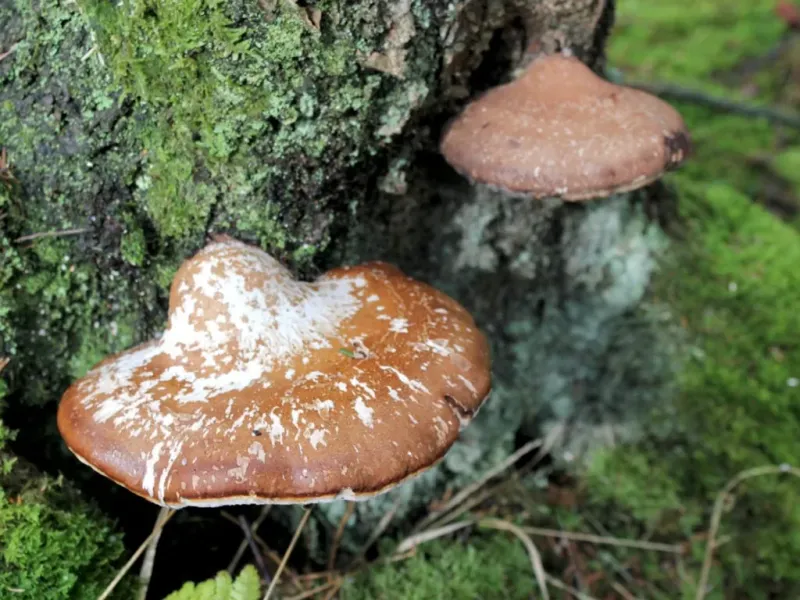
The second situation involves mushrooms growing on or immediately beside a living tree trunk or major branches. That is a different concern from mulch or lawn mushrooms.
Penn State Extension distinguishes between mushrooms that decompose mulch and fruiting bodies that appear directly on living wood, which can indicate a fungal issue within the tree itself. A certified arborist is the right person to assess that situation, not a lawn care routine.
The third situation is the appeal of a quick chemical fix. Fungicides are not an effective solution for fairy rings or recurring lawn mushrooms.
University of Wisconsin’s fairy ring resource explains that the fungus lives deep in the soil and organic material, well beyond the reach of surface-applied products, making chemical treatment impractical and generally not recommended as a first response.
Observe the pattern, then test the question mushrooms cannot answer
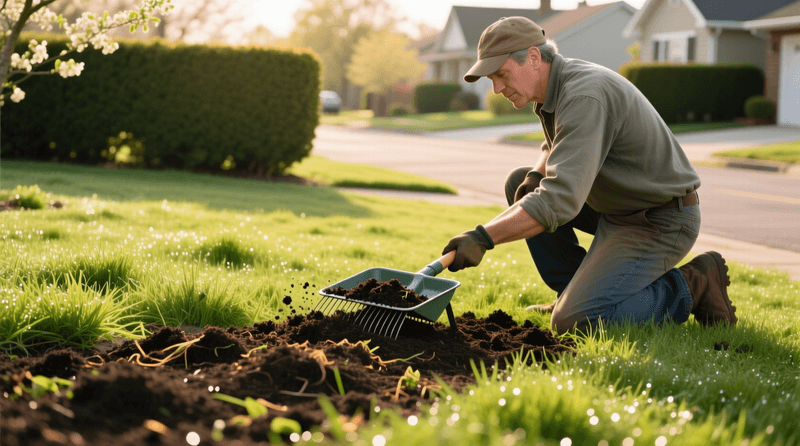
A simple observational habit covers most of what you need when mushrooms appear. Note where they are growing, whether the same spot keeps producing them, and whether there is an obvious moisture source or organic material nearby.
Check the surrounding grass: if it looks healthy, the situation is almost certainly low-priority. If the turf is struggling in the same area, that is worth investigating further.
University of Georgia Extension’s mushroom guidance supports this observe-first approach and reinforces that mushrooms alone are not a reason to reach for fertilizer, lime, or fungicide. Each of those products addresses a specific, measurable condition.
None of them should be applied based on what a fruiting body looks like.
When a real question about pH or nutrients comes up, especially if plants or turf are actually declining, a soil test is the right next step. Penn State Extension’s soil test guide walks through how to interpret results and connect them to targeted action.
Soil fungi, including decomposers and mycorrhizal types, are a recognized part of USDA soil health frameworks, but their presence in a yard is not itself a health score.
Your yard will keep growing fungi. That is not a problem to solve so much as a process to understand.
The mushroom you see this week is a sign that conditions briefly aligned for a fungus to reproduce, and it is worth a curious look, not a worried one.