
If Your Peace Lily’s Leaf Edges Keep Browning, Softened Water May Be Worth Checking
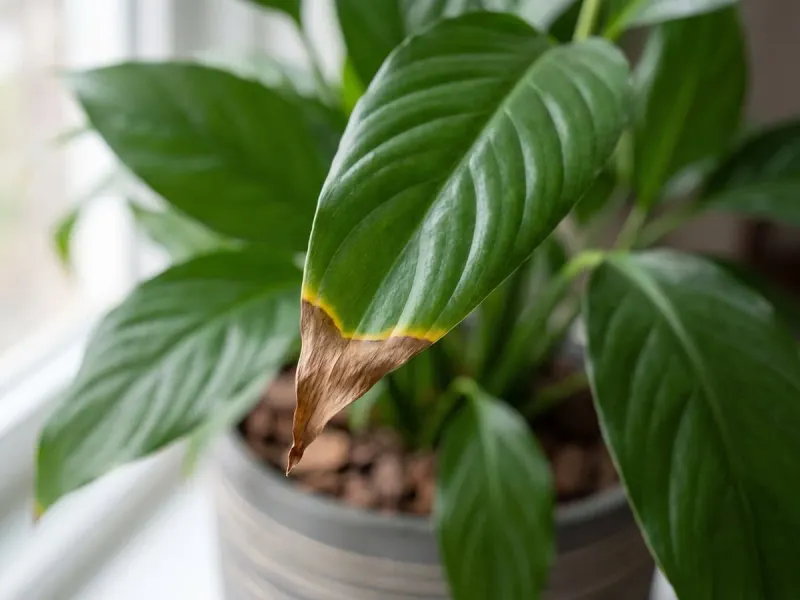
Brown, crispy edges on a peace lily can make you feel like you are doing something wrong. Sometimes the cause is sitting right in your house, in the water you pour into the pot.
If your home uses a sodium-based water softener, that water is worth a closer look. Here is how to check, what you can try, and what a water change cannot promise.
Brown edges point to a problem, not a diagnosis
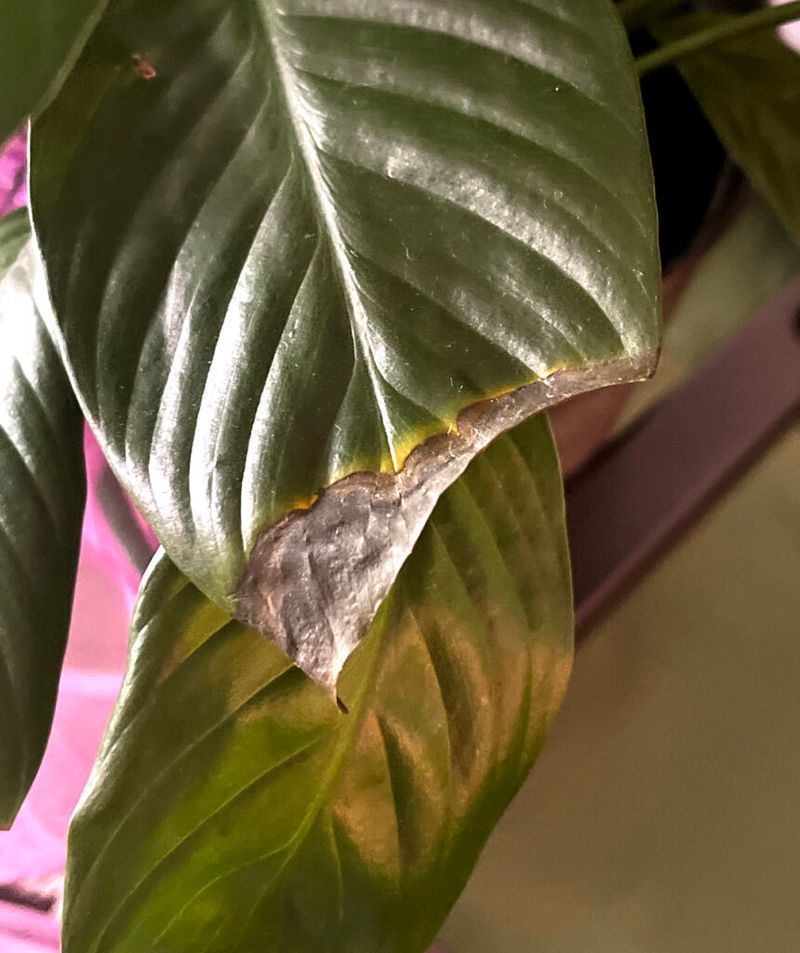
Seeing brown on your peace lily is stressful, but the color change is a symptom, not an answer. Many different things can make leaf edges turn crisp and tan, so the browning alone cannot tell you what went wrong.
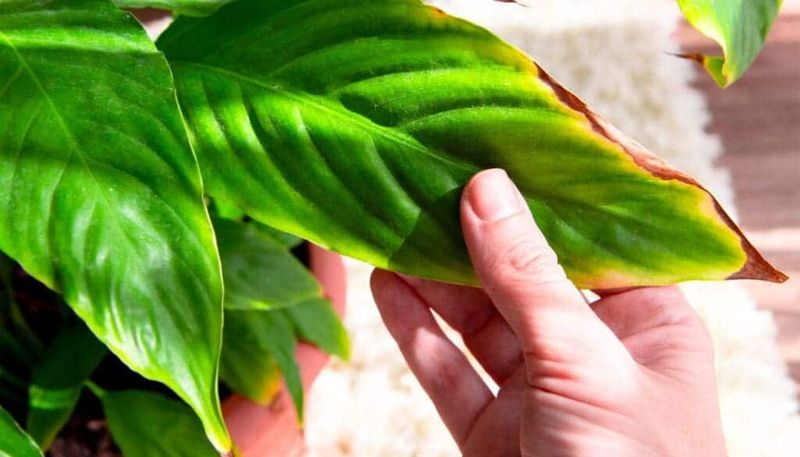
According to NC State Extension’s peace lily profile, brown tips can come from too much direct sun, underwatering, or low humidity. Other extension guidance also points to overfertilizing and a buildup of soluble salts in the soil.
That is a long list, and it is good news in a way. Most of these causes are fixable with small changes, and none of them mean the plant is doomed.
Look at the pattern on your plant. Browning on leaves that sit near a sunny window suggests a light problem.
Crispy tips on a plant near a heating vent may be about dry air. A dry, shrunken root ball points to watering gaps.
Browning with a white crust on the soil surface raises the salt question.
Salt can come from fertilizer, and it can also come from the water you use. That last piece is the one many people never think about, so it is worth a quick check.
Finding out where your plant’s water comes from is a simple first step. It will not prove the cause, but it can rule a possibility in or out.
Could your softener be adding sodium?
Many household water softeners work by swapping hard-water minerals for sodium. That makes the water gentler on pipes and soap, but plants may not enjoy the trade.
Washington State University Extension explains this swap and advises against using softened water on houseplants unless it is deionized.
A Florida extension office looked at a peace lily with browning edges that was watered with softened tap water. UF/IFAS Extension named salt buildup as a plausible cause and suggested checking the soil for white, flaky deposits.
Keep one thing straight: softened water and hard water are not the same. Hard water is full of calcium and magnesium.
Those minerals can leave white crust on pots and soil, but WSU says they are usually harmless. So a white crust alone does not prove your softener is the culprit.
Sodium is also a separate issue from fluoride. Peace lilies are described as fluoride-sensitive, and that is its own water-quality concern.
Switching to unsoftened water would not necessarily help with fluoride.
In short, sodium from a softener is a reasonable suspect only when your plant actually gets softened water. Brown edges by themselves cannot settle it.
A water switch depends on what your home provides
Start by finding out whether the water you use on your plant passes through a softener. Look for a large tank, often near the water heater or in the basement or garage, with a bin of salt pellets beside it.
If you rent or are unsure, ask your landlord or whoever installed your plumbing.
Next, check which taps are softened. In many homes the softener treats the whole house.
In others, the outdoor spigot or one kitchen tap bypasses it. A bypass or unsoftened tap could be your no-cost option.
If you do find an unsoftened source, using it for your peace lily is a reasonable thing to try. WSU Extension’s houseplant guidance advises against sodium-softened water for houseplants, which is the reasoning behind the swap.
Not every home has this choice. If every tap is softened, you are not stuck, and you do not have to buy bottled water.
Other care steps, covered below, may still help.
Skip the old trick of letting tap water sit overnight. Standing water can let chlorine drift off, but it does not remove sodium or fluoride.
Treat the switch as a test, and give it a few weeks of watering before judging.
Flush suspected salts only if the pot can drain
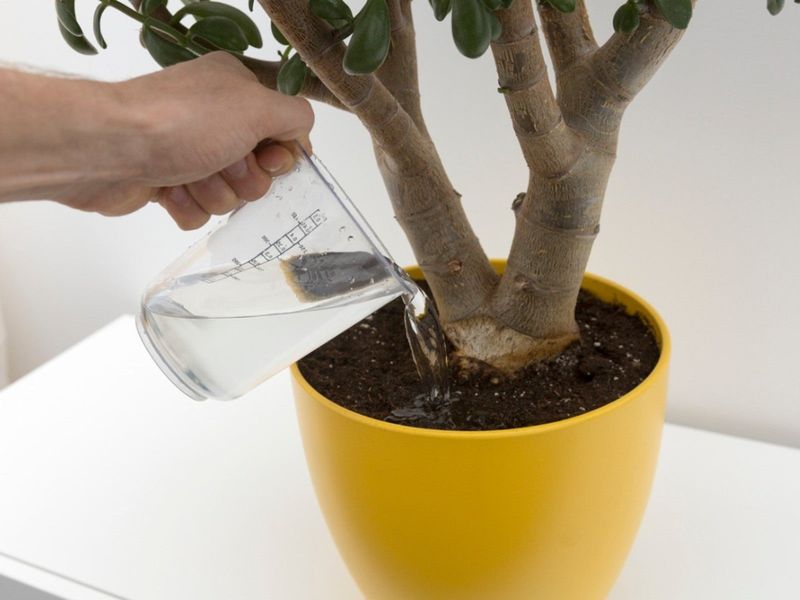
If you suspect salts have built up in the soil, flushing can help reduce them. Set the plant in a sink or tub, and slowly pour water over the top of the soil.
Use several times the volume of the pot, letting water run out through the bottom holes.
University of Maryland Extension recommends this approach for salt deposits and says to let the pot drain completely. It also warns against doing this with pots that have no drainage holes.
In severe cases, fresh potting mix may be the better answer.
Use suitable water for the flush. If your home has an unsoftened tap, that is the one to use.
Flushing with sodium-softened water would defeat the purpose.
Drainage is the safety limit here. If your pot has no holes, do not flush it.
The water has nowhere to go, and soggy soil can harm the roots. After flushing, let every drop drain out, then empty the saucer or cachepot.
Never leave the plant standing in runoff.
Keep your expectations realistic. Flushing works on salts in the soil.
It cannot turn brown leaf tissue green again. What you are watching for is fewer new brown edges on new growth.
Old damaged leaf tips can be trimmed if they bother you.
If browning continues, review the care routine
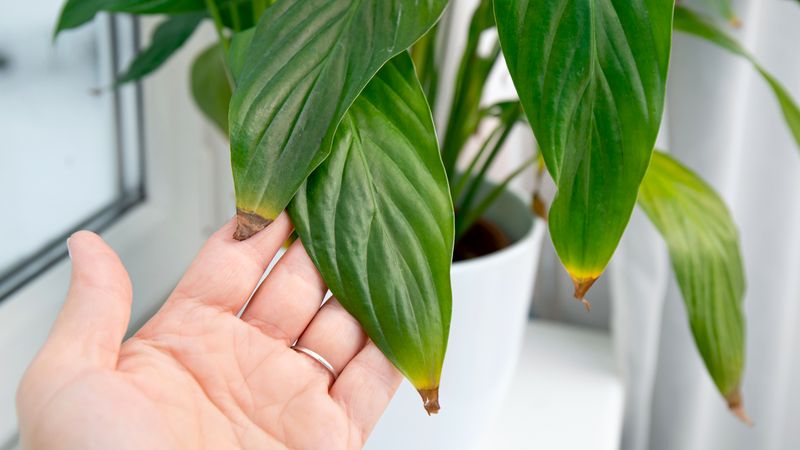
When browning keeps going after a water check, the plant may be telling you something else. Take a fresh look at the basics.
Start with moisture. NC State Extension advises soil that is moist but not soggy.
A University of Tennessee Extension guide notes peace lilies prefer that their soil not dry out. Test with a finger an inch or two down, water when it feels just barely dry, and make sure extra water can drain.
More water is not the answer; steady, even moisture is.
Next, check light. Bright indirect light suits a peace lily, while strong direct sun can scorch the leaves.
Humidity matters too. Plants near heaters or vents may brown at the tips from dry air.
Finally, think about fertilizer. Follow the product directions, and NC State suggests quarter-strength feeding.
Flushing the soil between applications can limit fertilizer-related salt buildup.
Change one thing at a time, so you can tell what helps. Patience matters here, since new leaves are the real report card.
Treat the water change as a test, not a cure
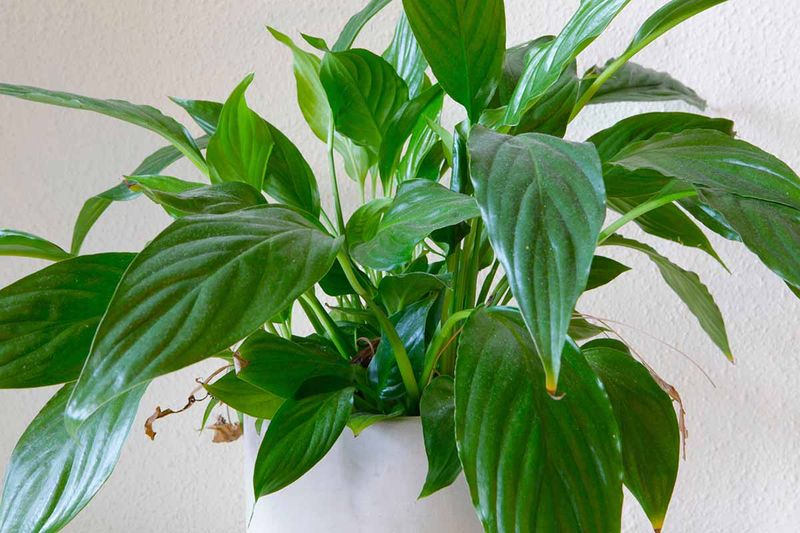
Here is the sequence: find out if your plant gets sodium-softened water, switch to an unsoftened source if you have a suitable one, and flush with Maryland Extension’s method only if the pot drains. Browning has other possible causes, and brown edges already on the leaves will not return to green.
Think of it as a low-cost experiment. Your peace lily’s next leaf will tell the story.