
That Low Plant in Your Sidewalk Cracks May Be Plantain, and Its Story Is Worth Knowing
You have probably stepped on it a hundred times without a second look. That tough, low plant squeezed into a crack near your yard often turns out to be a plantain, and it has a long history with people.
Some folks have eaten its young leaves, and others have used it as a folk remedy. Here is how to recognize it, what its reputation really means, and how to handle it safely.
What is that rosette in the crack?
Look closely at the green tuft in the crack and you may be looking at broadleaf plantain (Plantago major). It is a common possibility in sidewalk cracks and lawns, but it is not in every crack, and where a plant grows cannot tell you what species it is.
You have to check the plant itself.
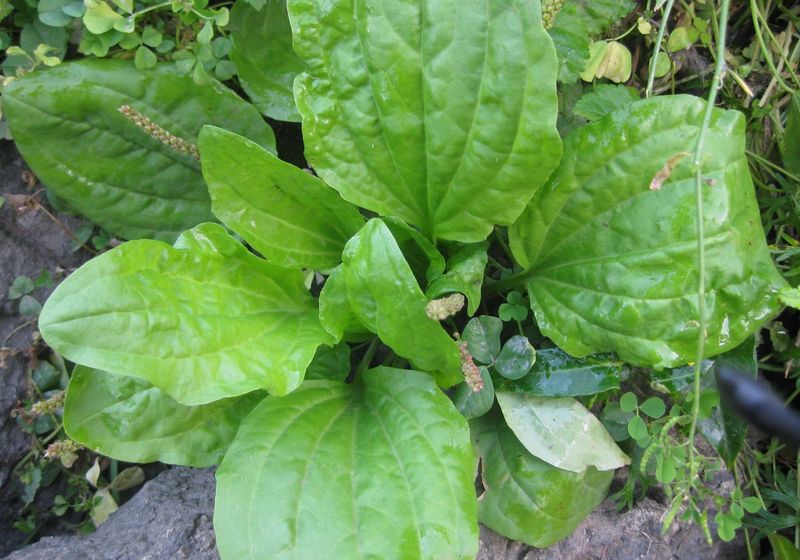
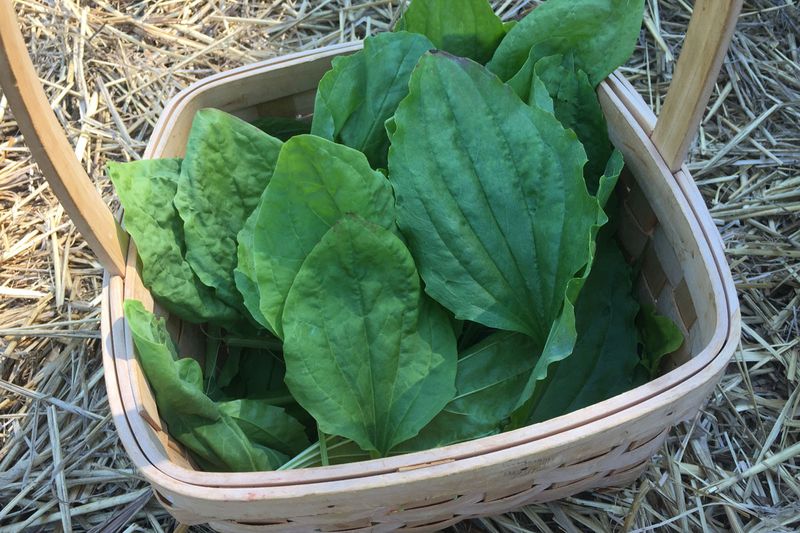
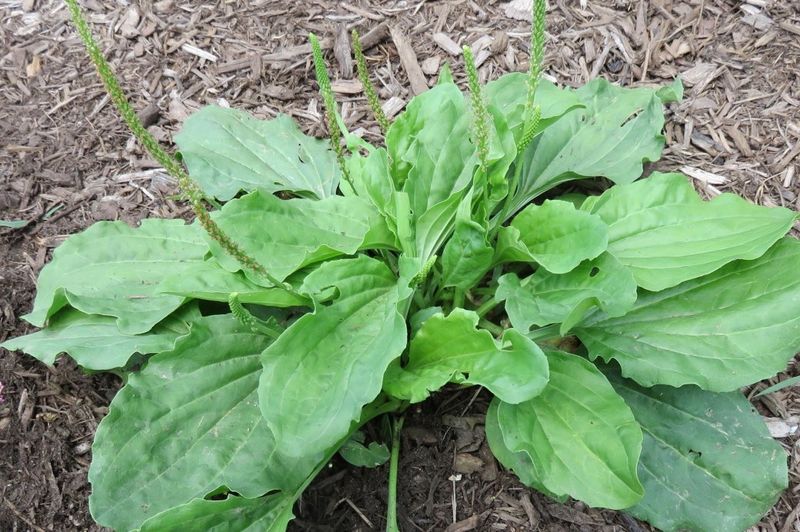
According to UC IPM’s weed gallery, broadleaf plantain forms a low rosette of broad, oval leaves that lie close to the ground. Each leaf has several prominent veins running nearly parallel from base to tip.
Later in the season it sends up a leafless stalk topped with a narrow spike of small flowers.
Those veins are a handy clue. Pinch a leaf stalk gently and pull the blade apart, and you may see the stringy veins stretch, though that is only a hint and not proof.
Lookalikes are common. Narrowleaf plantain (Plantago lanceolata) has longer, narrower, lance-shaped leaves, and Iowa State Extension notes that American or blackseed plantain (Plantago rugelii) can be hard to tell apart from P. major.
Several Plantago species can occupy lawns and disturbed ground, so a confident name often takes a close look at the leaves, stalks, and seed heads, or a photo sent to your local extension office.
One note on words: here, plantain means this small Plantago weed. It is not the banana-like cooking plantain sold in grocery stores, which is an entirely different plant.
The NC State plant database lists Plantago major under names such as Englishman’s-foot, which can help when you search.
Why does it thrive where the ground is hard?
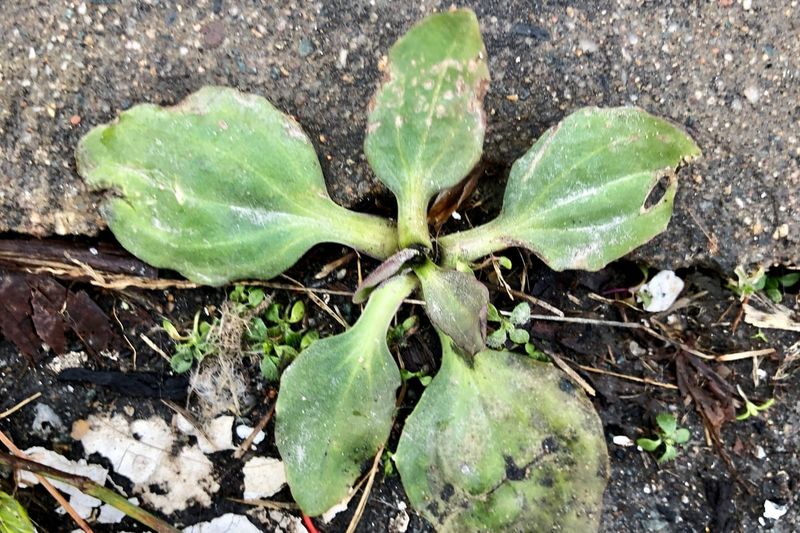
Foot traffic packs soil down until water and air struggle to move through it. Many garden plants sulk in that kind of ground, but plantain shrugs it off.
University of Maryland Extension notes that plantain grows well in compacted soil, which helps explain why it turns up along paths, driveways, and in cracks.
Its low rosette also helps. Leaves stay tight to the ground, so mowers and shoes tend to pass over the growing point, and the plant keeps going.
It is tempting to read a patch of plantain as a soil report card. UC IPM describes broadleaf plantain as associated with alkaline, low-fertility, compacted soils.
That makes it a possible clue, not a diagnosis. Plantain may show up in soil that is perfectly fine, just walked on a lot.
If you suspect a real soil problem, test for it. A soil test from your local extension office or a reputable lab will tell you about pH and nutrients far better than any weed can.
A simple screwdriver test also helps: if it will not push easily into moist soil, compaction is likely.
Practical next step: if the plantain sits on a shortcut across your lawn, the fix may be a stepping-stone path rather than any soil treatment.
Young leaves have a food history, but a sidewalk is no guarantee
Spend time around foraging circles and plantain comes up as a pot green. The NC State plant database notes that young Plantago major leaves are used as a spinach-like vegetable in some traditions.
Older leaves get tough and stringy, which is why the young ones get the attention.
A food history is not a safety guarantee for the plant at your feet. First, you need to be confident of what it is.
Not every low rosette is a plantain, and not every plantain is the same species.
Second, think about where it grows. A study of urban wild edible plants, “Edible weeds: Are urban environments fit for foraging?”, found traffic-related contamination patterns and elevated lead in some samples collected in high-traffic areas.
That does not mean every city plant is contaminated. It does mean busy roadsides are poor places to gather food.
So skip plants from roadsides, sidewalk edges along busy streets, and any spot that may have been sprayed with weed killer or other treatments. If you are curious about eating plantain, a better route is a patch you know well, in an area you control and have never treated, and only after a confident identification.
When in doubt, leave it out. A weed is easy to find again, and no salad is worth a guess.
What does its medicinal reputation actually establish?
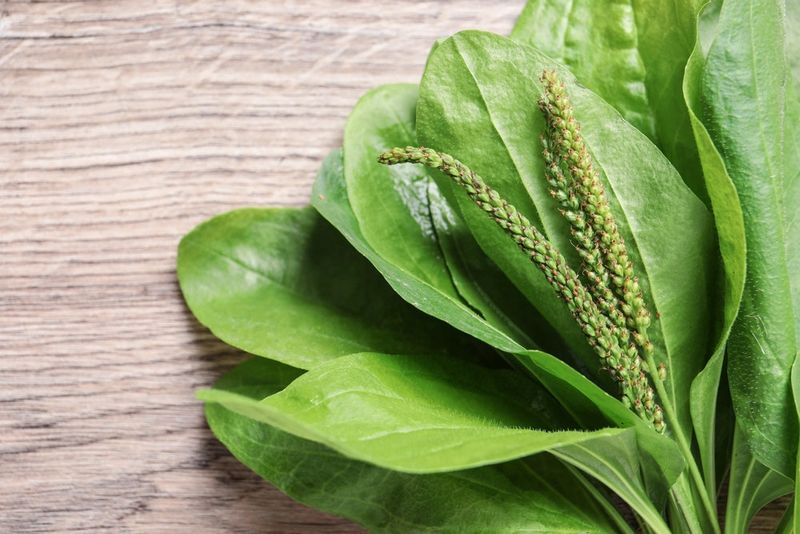
Plantain has a long history of medicinal use in folk traditions, and that history is part of why people still talk about it. History is not the same as proof, though.
Looking at what researchers actually tested helps set realistic expectations.
A few human studies have looked at prepared Plantago major products. One controlled study, available through PubMed Central, tested a 10% P. major gel on diabetic-foot and pressure ulcers, alongside clinical wound care.
The authors themselves listed limits: a small sample, no blinding or placebo, a short intervention, and different dressings in the control group. They called for more study.
A separate trial, a randomized study on stage 1 pressure ulcers, used a formulated preparation. Both studies involved prepared products for particular ulcers in clinical-care settings.
Neither tested a freshly crushed leaf from a yard on a bee sting or a scraped knee, so neither can be stretched to everyday first aid.
Skin can also react. One published case report describes irritant contact dermatitis after contact with Plantago major.
A single case report does not show that reactions are common, but it is a good reason not to treat plant-on-skin use as risk-free.
You may hear that a leaf can draw out a stinger, venom, a splinter, or an infection. Those claims are not backed by the research described here, so this article does not endorse them.
For a sting or scrape, follow ordinary first aid
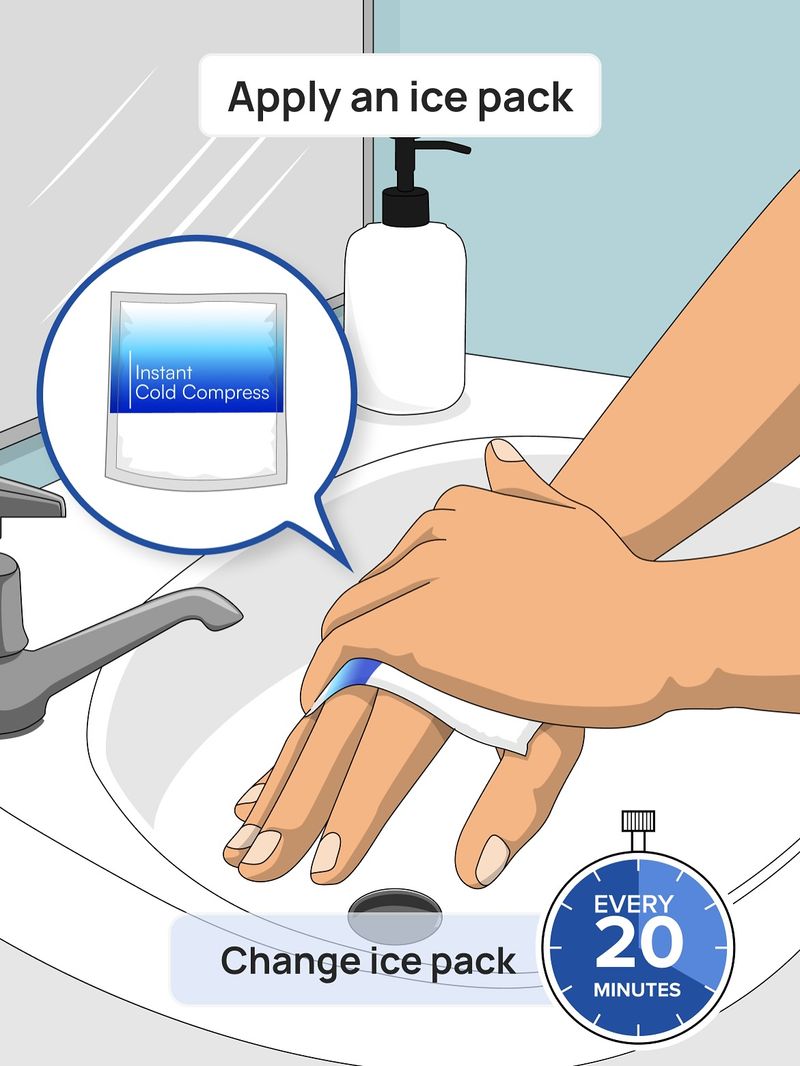
Picture it: you are weeding by the walk, and something stings your wrist. The reliable steps are simple and live in your first-aid kit, not in the crack.
For a minor insect sting, Mayo Clinic first-aid guidance is to remove the stinger if one is left in the skin, wash the area with soap and water, and apply a cold compress. A cloth-wrapped ice pack works well, and keeping the cold on for a short stretch can ease swelling.
For a minor cut or scrape, CDC wound-care tips call for cleaning the wound with soap and water and covering it with a clean, dry bandage. Change the bandage if it gets wet or dirty.
Notice what is missing: a foraged leaf. Putting a plant from a sidewalk crack onto broken skin adds dirt and unknowns to a spot that needs to stay clean.
These steps cover minor injuries only. Get medical care for signs of a serious allergic reaction, such as trouble breathing or swelling of the face or throat.
Also seek care for deep or dirty wounds, bleeding that will not stop, or redness and warmth that spread. First aid is a starting point, not a replacement for a clinician when something looks worse than minor.
If it is in the wrong place, remove it before it sets seed
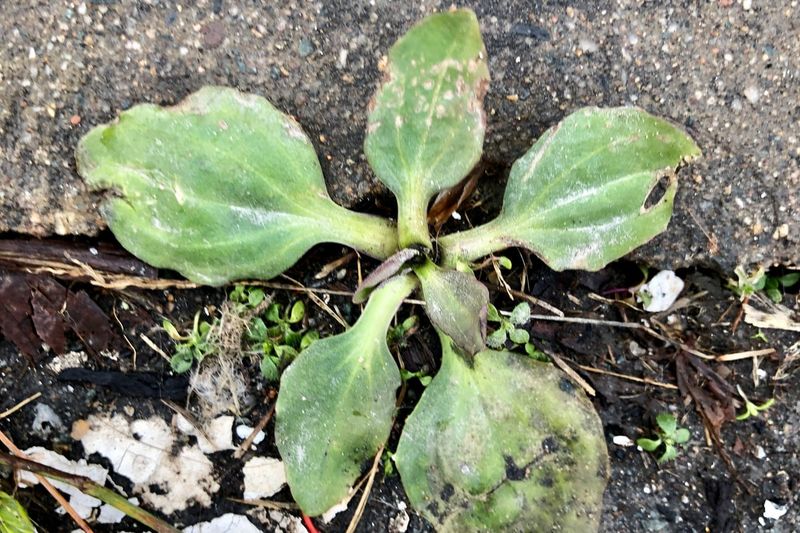
Maybe you like plantain, or maybe it is crowding your flower bed. For a small patch, hands and a trowel do the job.
UC IPM advises removing plants while they are young and before they set seed, and digging or pulling is easiest when the soil is moist, such as the day after rain.
Loosen the soil around the rosette and lift out the whole crown with its roots. Established plants can persist or regrow from leftover crown pieces, so walk the spot again over the next few weeks and pull any resprouts.
Flower spikes that have started forming are your cue to act fast, since seeds are how a few plants become many.
Plants in a crack are trickier because roots tuck into narrow gaps. Use a narrow tool, and keep checking back.
The UC IPM weed gallery is a handy place to confirm what you are pulling.
The takeaway is a measured one. Identify the plant carefully, treat its location as a clue rather than a diagnosis, and do not mistake traditional uses or limited extract research for proof that a sidewalk leaf is safe food or medicine.
Some of the toughest plants in the yard are the ones growing exactly where nobody planned for them.