
What It Really Means When A Green Anole Turns Bright Brown On Your North Carolina Fence
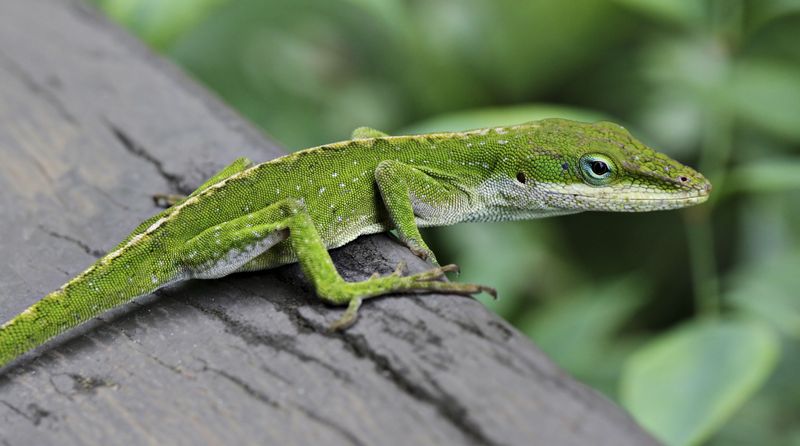
Spot a bright-brown lizard darting along your backyard fence and you might assume a new species has moved in. Chances are good, though, that you are looking at the same native green anole you have always had, just wearing a different color.
Green anoles can shift between green and brown and back again, and understanding why that happens tells you a lot more about your yard than a quick glance ever could.
That brown lizard is often still North Carolina’s green anole
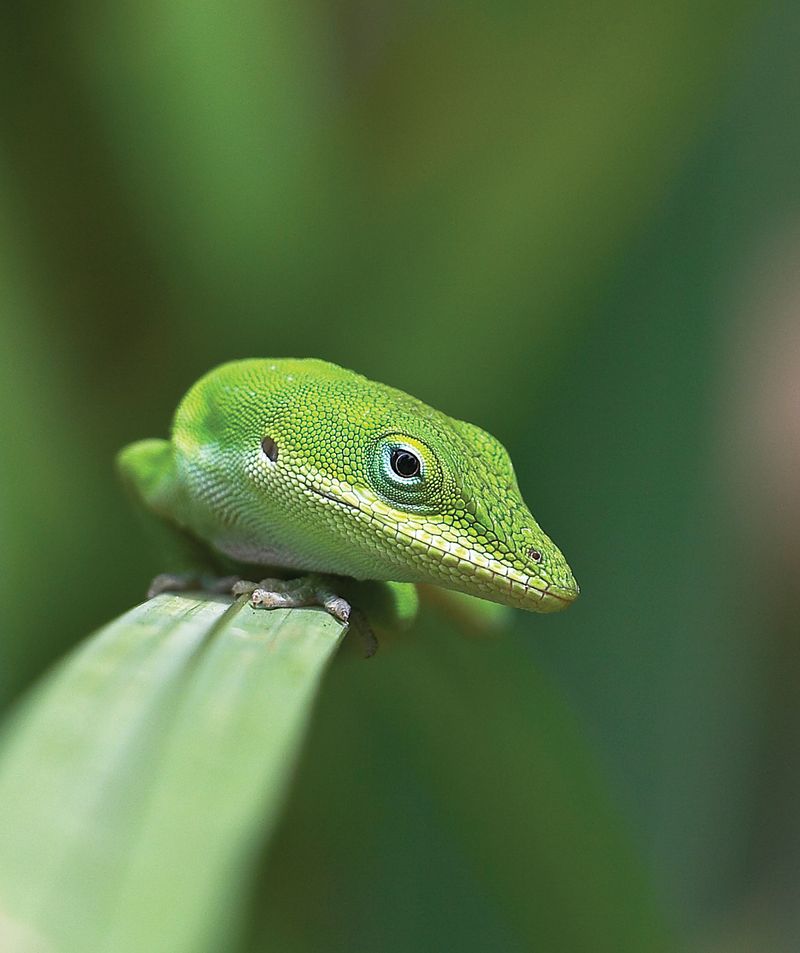
Native green anoles, Anolis carolinensis, are some of the most adaptable little reptiles in the Southeast, and they have a habit of surprising homeowners who expect them to stay green. The NC Wildlife Resources Commission confirms that green anoles are common across the state’s Coastal Plain and into the southern Piedmont, including suburban neighborhoods, and that they can appear fully green, partly brown, or completely brown depending on the moment.
If you live closer to the Blue Ridge or the western mountains, the picture is less clear. The species is documented most consistently in the eastern and south-central regions of North Carolina, so homeowners in those areas should hold their identification more loosely and look carefully at markings and body shape before assuming any brown lizard is a green anole.
Statewide abundance is simply not uniform.
The color shift itself is physiologically reversible, meaning the same individual lizard can be brown on your fence post this morning and back to bright green by afternoon. A single fence-side sighting cannot tell you that you have found a different species.
Several overlapping influences, including temperature, season, social context, and acute stress, can nudge a green anole toward brown at any given moment, and none of those factors permanently alters the animal’s identity. Watching the lizard over a few minutes or across multiple visits gives you far more useful information than the color alone.
Color change carries information, not a fence-colored disguise
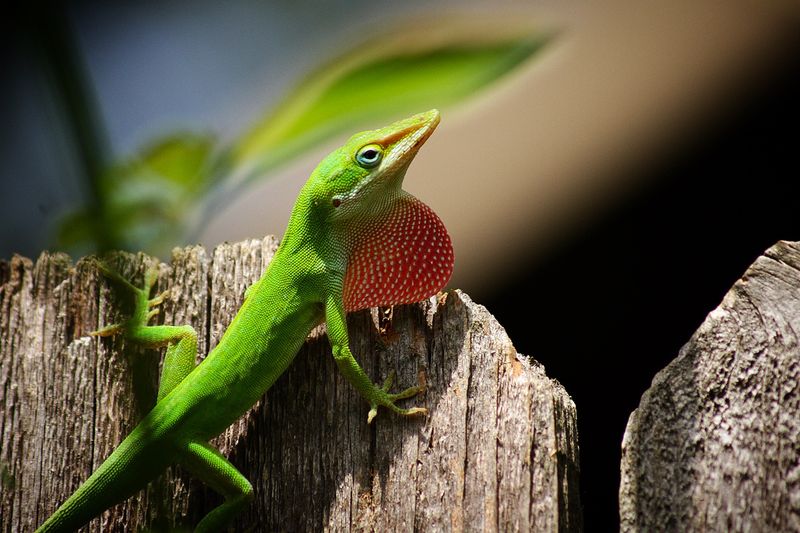
A popular explanation for the brown phase is that the lizard is blending into the wooden fence, but North Carolina’s official reptile species account states plainly that green anoles do not change color to match their background. Field studies have found little or no evidence of background-color matching, which means the fence is almost certainly just a convenient perch rather than the trigger for the color you see.
The actual mechanism is physiological. Pigment-containing cells called chromatophores in the anole’s skin can shift the animal’s appearance across a spectrum from vivid green to deep brown.
Light, activity level, social context, temperature, season, and acute stress can all influence which direction that shift goes, and several of those factors may be operating at the same time. Large-scale community science research on Anolis carolinensis confirms that color change is reversible and reflects multiple overlapping influences rather than a single clear cause.
Fences happen to be attractive to anoles for practical reasons. A sun-warmed fence rail offers a clear sightline for hunting insects, a raised perch for spotting rivals, and quick access to surrounding vegetation.
Davidson College’s North Carolina herpetology resource notes that green anoles use a wide range of vertical surfaces, from shrubs and vines to buildings and fences, as hunting and observation posts. The fence reveals where the lizard chose to station itself, not why its color changed.
Temperature matters most in some seasons, not every sighting
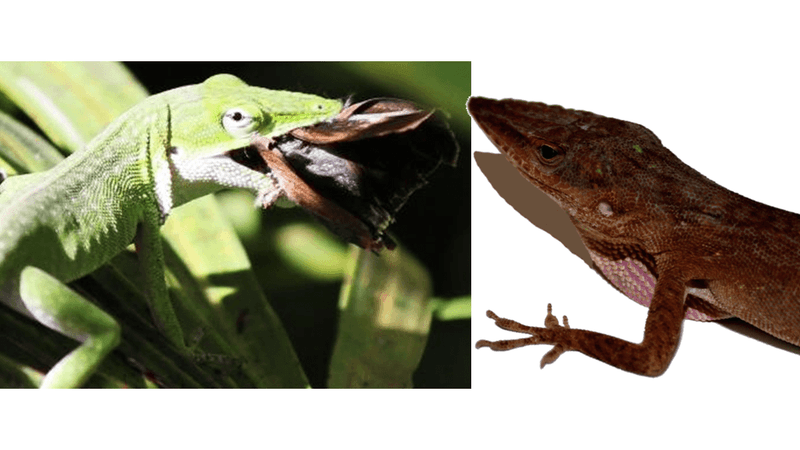
Temperature does play a role in anole color, but how much weight to give it depends heavily on the time of year. A recent analysis using large-scale community science photographs found that brown coloration was more common when temperatures were cooler, particularly outside the breeding season, while green presentation tracked warmer conditions during the same nonbreeding period.
That pattern makes intuitive sense for a cold-blooded animal regulating its heat absorption.
The picture changes considerably in summer. The same large-scale study reported that during the warm breeding season, anoles were consistently green regardless of temperature, suggesting that social factors outweigh thermal ones when males are actively competing for territory and mates.
A separate summer field investigation, published in Behavioral Ecology and Sociobiology, found no significant relationship between body color and body temperature at all during that warm-weather window and concluded that social communication was the dominant driver of color change during that period.
For a North Carolina homeowner, these findings translate into a practical caution: a brown anole on a cool April morning may well be absorbing warmth, but a brown anole on a hot July afternoon is probably not telling you it is cold. Season and context shape how much the temperature explanation applies, and no color observation from the other side of a fence gives you a reliable read on what the lizard’s body temperature actually is at that moment.
Brown is not your outdoor thermometer.
The safest approach is to note the season and the general weather conditions alongside the color, and treat temperature as one possible contributor rather than the definitive answer to why the lizard looks brown today.
Social encounters can darken an anole without making brown a distress signal
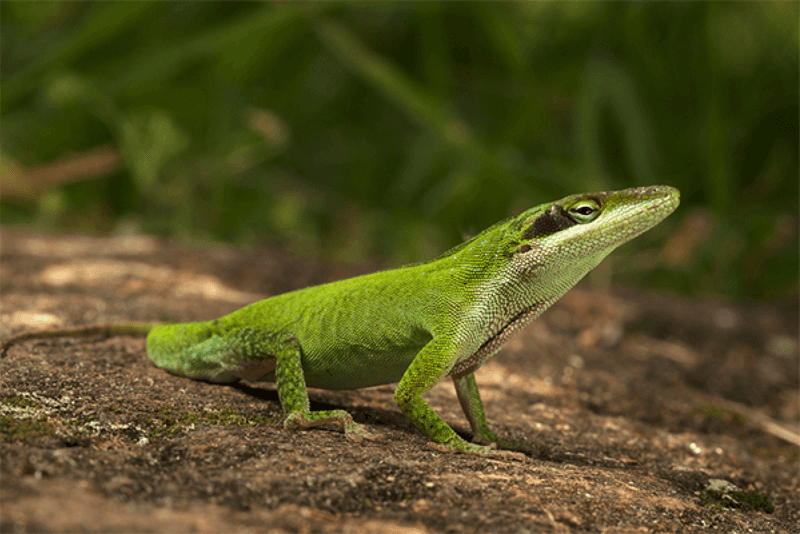
Social life among green anoles is surprisingly intense, and some of the most vivid color signals happen during encounters between rivals. Research published in Hormones and Behavior found that social challenges can darken the postorbital eyespots, the dark patches behind the eyes, and that darker overall body coloration has been associated with subordinate status in controlled social studies.
These are physiological responses linked to the sympathetic nervous system, not evidence that the lizard is experiencing human-like fear or sadness.
The research cited in Behavioral Ecology and Sociobiology adds nuance by noting sex differences in how color is used dynamically. Males and females may use color change in somewhat different social contexts, which means the signal value of brown or green is not identical across all individuals.
A male turning darker after spotting a rival is communicating something very specific, while the same shade on a female resting alone may carry a different meaning entirely.
From where you stand on the other side of the fence, there is a real limit to what you can infer. Without seeing the triggering interaction, such as a rival male approaching or a predator passing nearby, a brown body color alone does not tell you that the lizard is currently distressed.
Stress-linked darkening is a documented mechanism, but it is one piece of a larger picture that also includes temperature, season, activity, and individual variation. Watching for accompanying behaviors, such as rapid dewlap displays, push-up postures, or an unusually rigid stance, gives you a far better read on what the animal is actually doing than color alone ever could.
Pattern and structure separate a brown-phase green anole from a brown anole
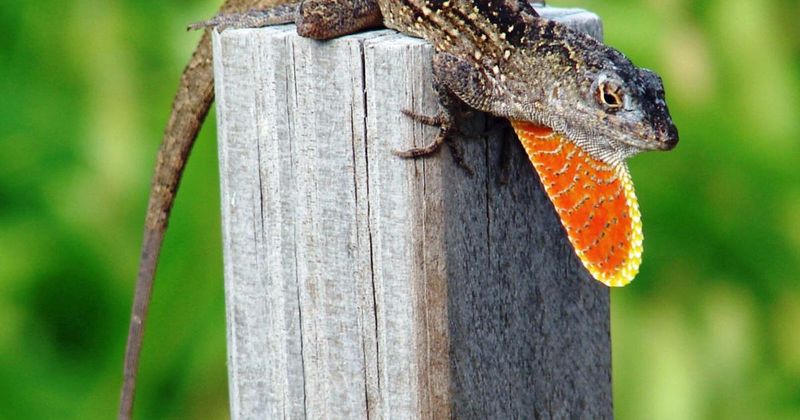
Body color is the worst possible tool for telling a brown-phase green anole apart from an introduced brown anole, Anolis sagrei. Both lizards can look remarkably similar at a glance when the green anole is fully brown, which is exactly why homeowners need a short checklist that goes beyond color.
Start with the pattern on the lizard’s back and sides. North Carolina’s reptile species account notes that brown anoles typically retain a reticulated pattern of pale and dark markings, often described as a net-like or banded arrangement, even when they are brown.
A green anole in its brown phase tends to be more uniformly colored, without that strongly patterned look. If you see a busy, mottled pattern of lighter and darker patches, that is a meaningful clue pointing toward the brown anole.
Next, look for the dewlap, the throat fan a male extends during territorial and courtship displays. On a native green anole, the male’s dewlap is typically pink, reddish, or what North Carolina field guides describe as strawberry-colored.
Brown anoles have an orange or orange-red dewlap that often shows a pale or yellowish border, a detail visible even at a modest distance when the fan is fully extended. If you can catch that display, it is one of the most reliable identification markers available.
A pale stripe running down the center of the back can appear on female green anoles and juveniles, so that marking alone does not confirm species or sex. NC Wildlife’s species profile reinforces that identification should rely on the combination of body form, pattern, dewlap color, and local distribution context rather than any single feature.
Take a moment to watch for a dewlap display or compare the overall body shape before drawing a conclusion.
The fence reveals a perch, not the health score of your yard
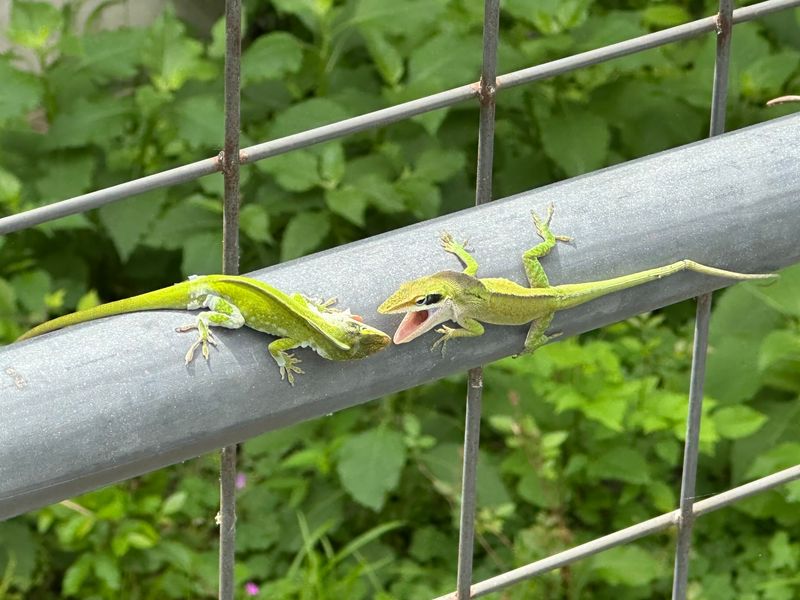
Anoles are opportunistic hunters that use whatever elevated surface gives them a good view and quick access to prey. Davidson College’s North Carolina herpetology resource documents green anoles using fences, shrubs, vines, trees, buildings, and ground surfaces interchangeably, moving between them as hunting conditions and social pressures shift.
A fence rail in full sun simply happens to offer a warm, elevated platform where insects are visible and rivals can be spotted early.
Seeing an anole on your fence does suggest that the immediate area has something the lizard needs, whether that is insects to eat, vegetation to retreat into, or a warm surface to rest on. NC State Extension’s guide to reptiles and amphibians in the backyard connects anole presence to available shelter, vertical habitat, and food sources, which are reasonable indicators of a yard that supports some wildlife.
One anole on one fence post, though, cannot tell you that your yard is free of pesticides, free of ticks, or ecologically balanced in every respect. Presence is not a health certificate.
The lizard may have wandered in from a neighboring property, or it may simply be passing through on the way to a more sheltered spot. What you can reasonably take from the sighting is that the immediate habitat offers at least some of what a small insectivorous reptile requires, and that is worth protecting and building on rather than treating as a complete ecosystem report.
Support anoles by protecting the habitat they already use
The most effective thing a North Carolina homeowner can do for backyard anoles costs nothing and requires no special equipment: leave the vegetation alone. Dense shrubs, vines, low tree branches, and leaf litter at the base of a fence all provide the shelter, hunting ground, and escape routes that anoles depend on.
Removing those layers to tidy the yard removes the habitat itself.
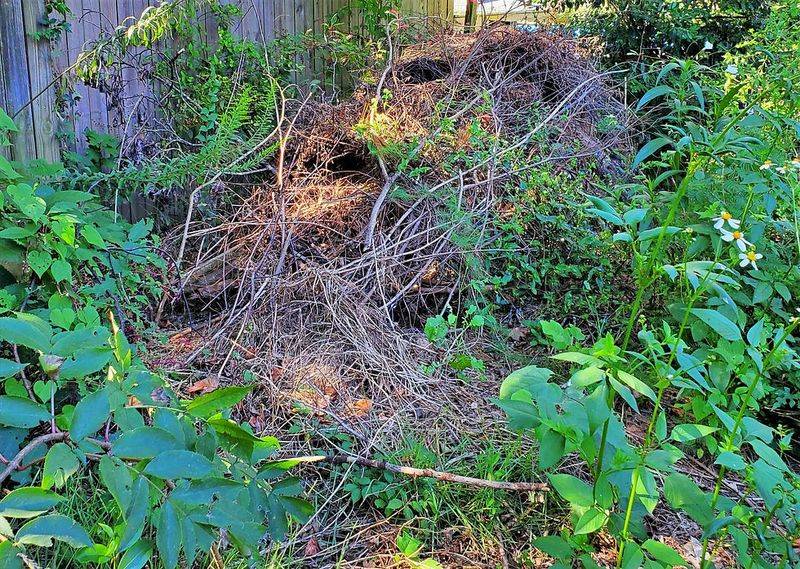
NC State Extension recommends adding dry brush piles built from untreated wood as supplemental cover for reptiles and amphibians. Chemically treated lumber can leach compounds into the surrounding soil, so the pile should use natural, untreated branches and sticks.
Position it near an existing shrub border or fence line where lizards already travel, and leave it undisturbed through the active season.
Pets are a significant and often underestimated hazard. Cats are efficient hunters of small lizards, and even a cat that appears uninterested can injure an anole faster than the lizard can escape.
Keeping cats indoors or restricting dogs from newly created reptile habitat is one of the most direct steps a homeowner can take. This is not a minor precaution: free-roaming cats are documented predators of native reptiles across residential areas of the Southeast.
Pesticide use deserves careful thought as well. EPA guidance on reducing pesticide impacts on wildlife emphasizes reading the label fully, considering site conditions before application, and preventing pesticides from moving into water or non-target habitat.
For a yard where anoles forage, that translates to targeting specific pests rather than broadly spraying vegetation, avoiding applications near brush piles or dense ground cover, and choosing the least-toxic product that will address the problem. None of these steps guarantees that anoles will stay, but each one reduces the risk that your yard becomes hostile to the wildlife already living there.
Color alone is not a reason to intervene
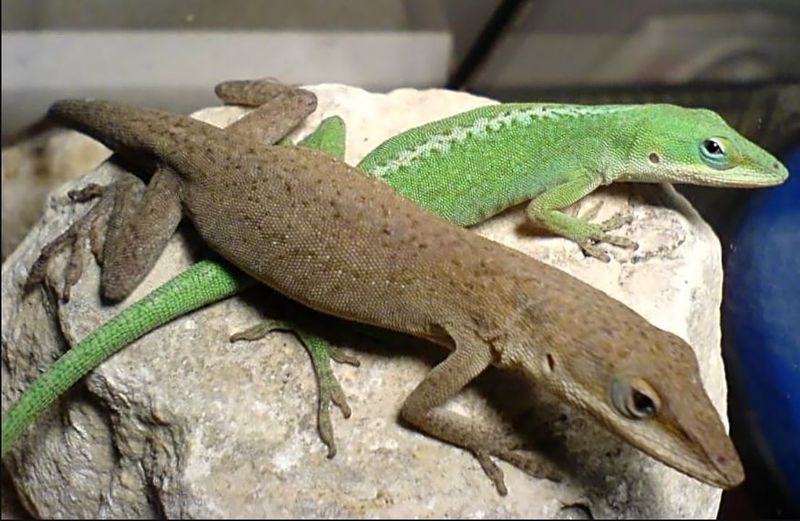
Watching a brown anole hold perfectly still on a fence board can feel like an invitation to help, but stillness is a normal defensive response, not a reliable sign of injury. Green anoles routinely freeze when they sense a large animal nearby, and that behavior can last for several minutes.
Approaching more closely, cornering the lizard, or reaching for it adds stress to an animal that is already on alert and does not give you useful information about its condition.
NC Wildlife guidance on injured and orphaned wildlife is clear that wild animals generally have the best chance of survival when left alone, and that color and stillness are not sufficient grounds for capture or relocation. The threshold for action is obvious, serious injury, such as an inability to move normally after a collision with a window or a vehicle.
If a lizard is lying on its side, dragging a limb, or cannot escape when given a clear path, that is the moment to contact a licensed North Carolina wildlife rehabilitator rather than attempting to transport or care for the animal yourself.
Color alone, even a deep, uniform brown that looks nothing like what you expect from a green anole, does not meet that threshold. Brown is a normal, reversible phase.
The lizard may be warming up, responding to a nearby rival, or simply going about its morning routine. Give it space, keep pets away from the area, and let it move on when it is ready.
A bright-brown anole on a fence is most often a small, native predator doing exactly what it should, and the best form of care is quiet, respectful observation.