
If Your Fall Mums Grow Bushy And Green But Refuse To Bud, One Pinching Habit Went On Too Long
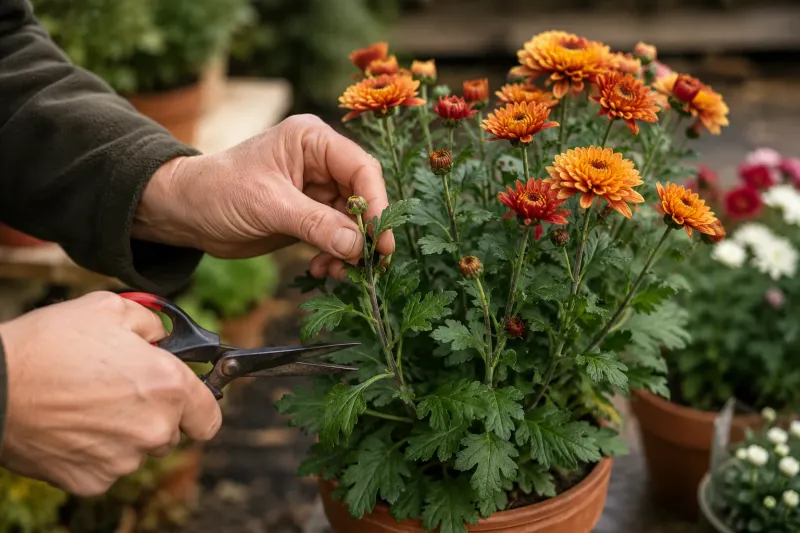
You did everything right: you watered, you fed, and you pinched your mums into a gorgeous green mound all summer long. Now fall is creeping in and every other yard has flowers, but your plant just sits there, full and leafy with no blooms in sight. Late pinching is one reason this happens, but it is not the only one, and knowing the difference can save your fall display this year and every year after.
Late pinching may be part of the problem—but it is not a diagnosis

Plenty of gardeners look at a full, leafy mum in late summer and immediately wonder whether they kept pinching too long. That instinct is reasonable, and continuing to remove shoot tips well past the point where branching is established can keep a mum churning out vegetative side growth instead of shifting its energy toward flower development. As Iowa State University Extension guidance on pinching mums explains, repeated pinching past early July can delay or reduce the fall flower display that gardeners are counting on.
The problem with jumping straight to that conclusion is that a bushy, green plant does not prove late pinching caused the trouble. Chrysanthemums are short-day plants, which means they need long, uninterrupted dark periods each night to trigger flower initiation, and that process is sensitive to light, temperature, cultivar type, and seasonal timing. A mum that looks perfectly healthy but refuses to bud could be reacting to a porch light cutting into its nighttime darkness, a stretch of unusually warm weather, or simply the fact that it belongs to a later-flowering variety that has not reached its natural window yet.
University of Illinois Extension’s overview of garden mums notes that artificial light and temperature both interact with the short-day response, meaning two plants in the same yard can behave very differently based on where they are positioned. Heat delay is another factor worth considering, and Michigan State University Extension’s research on high temperatures in mum production identifies sustained warmth as a possible contributor to delayed budding. The most useful question to ask is not simply “did I pinch too late?” but rather whether pinching continued past the point appropriate for the specific cultivar, and whether other conditions in the garden might also be playing a role.
Pinching creates branches, not instant flowers
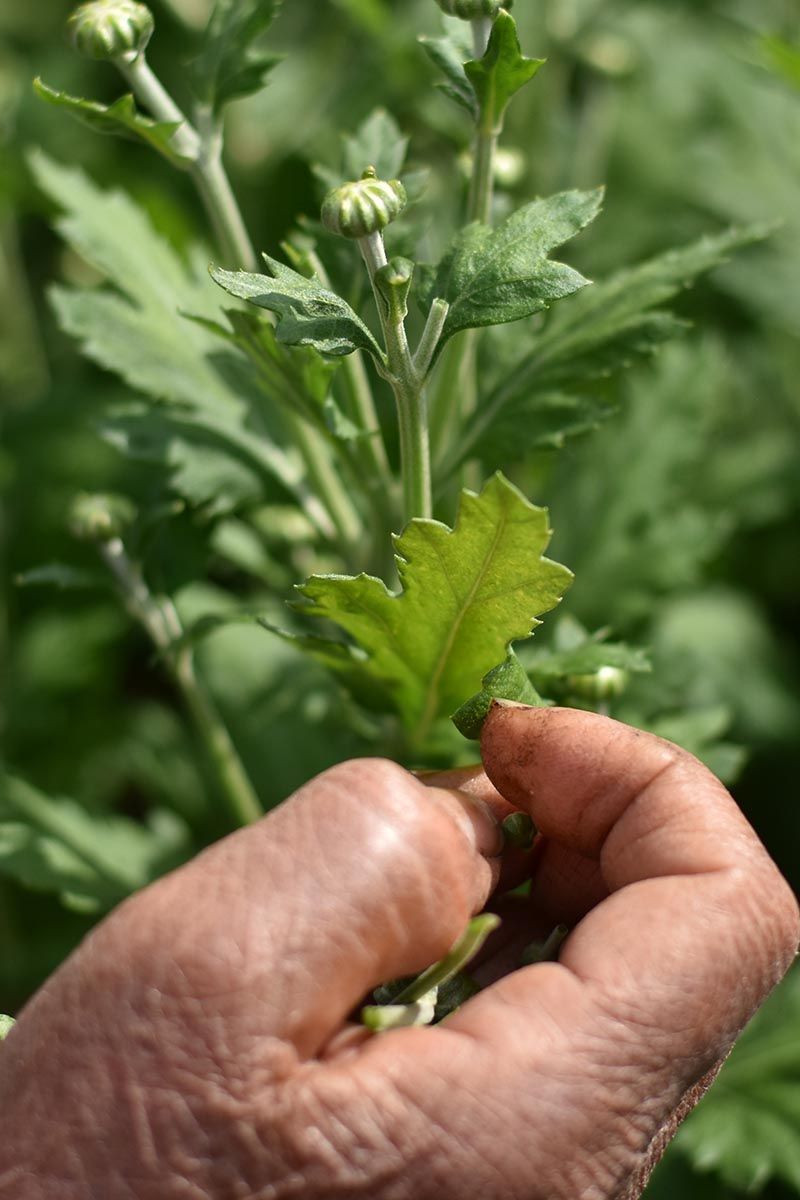
When you remove the very tip of a growing shoot, the plant responds by releasing the buds that were waiting along the sides of that stem. Those lateral buds push out into new shoots, making the plant shorter and wider with more stems overall. More stems mean more potential flowering points come fall, which is exactly why pinching works so well when the timing is right.
What pinching does not do is create flowers on the spot. Each new lateral shoot that sprouts after a pinch needs time to grow, mature, and eventually form its own flower buds. Penn State Extension’s guidance on pruning herbaceous plants describes this process clearly: removing a terminal growing point redirects growth into side branches, but those branches still require adequate development time before they can support blooms. The plant is not choosing between leaves and flowers in the moment you pinch it.
It is simply starting over on a new set of stems.
This is why timing matters so much. An early pinch, made when shoots are young and the season still has months of growing time ahead, gives those new laterals plenty of opportunity to develop and set buds before short days arrive. A pinch made in late July or August, after the plant has already begun responding to the longer nights of late summer, can clip off developing growth points or interrupt a process that was quietly underway. The plant may still produce flowers, but later than expected, with fewer blooms, or with less time to open fully before frost arrives.
Thinking of pinching as a branch-creator rather than a flower-creator makes the timing logic much easier to understand, because every pinch essentially resets a small part of the plant’s developmental clock.
Use a flexible final-pinch window
Rather than treating a single calendar date as a hard national rule, it helps to think of the final pinch as something that varies depending on what you are growing and when it is expected to bloom. The general approach is to pinch shoots when they reach roughly 6 to 8 inches long, let the new laterals grow to a similar length, and then pinch those as well. Most home gardeners need only two or three rounds of this before stopping for the season.
When you pinch, you are removing roughly the top half-inch to one inch of new, actively growing tip growth, either by snapping it off cleanly with your fingers or using a pair of clean, sharp shears. The goal is to redirect the growing tip, not to shear the plant back into a hard shape or remove established stems. University of Georgia Extension’s chrysanthemum care guide recommends stopping once flower buds become visible, because continuing past that point removes the very growth you have been working to encourage.
As for when to make that final pinch, Iowa State Extension advises stopping by early July, while Penn State Extension’s chrysanthemum guidance distinguishes between cultivar types: early-flowering varieties should receive their final pinch between mid-June and July 1, while later-flowering types can tolerate a final pinch up to approximately July 15. Those ranges reflect the reality that not all mums are on the same schedule. An early-blooming cultivar needs its growing points left alone sooner, while a variety bred to flower in October has a little more flexibility. Knowing which type you have, even roughly, helps you pick the right stopping point rather than defaulting to a single date that may not fit your plant.
Stop cutting when buds appear—or when the season says to wait
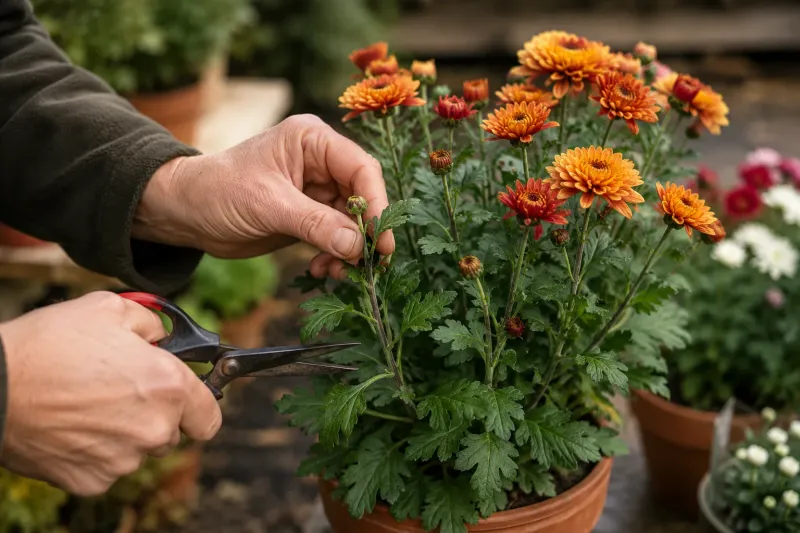
Once you can see actual flower buds forming on your mum, put down the shears and walk away. Removing tips at that point does not improve the plant’s shape or fullness. It removes the exact growth points that were about to give you flowers, setting the plant back by weeks at a time when weeks are precious.
The trickier judgment call comes when the plant has no visible buds but you are not sure whether that is a problem or just a matter of timing. Michigan State University’s research on temperature effects in chrysanthemums notes that bud initiation in garden mums is tied to the arrival of sufficiently long nights, which in most parts of the continental United States do not become reliably consistent until late summer. A plant observed in June or early July with no buds is almost certainly behaving normally. Concern is more warranted when August arrives and a mum that should be entering its bud-forming period still shows no sign of development.
If you suspect a late pinch set your plant back, Michigan State Extension’s guidance on crown bud development reinforces the case for leaving the plant alone rather than cutting it again to force a fresh start. More cutting delays flowering further, and late-season regrowth may simply run out of time before frost shuts everything down. UGA Extension’s chrysanthemum care page describes August as the period when buds typically begin appearing, which is a useful benchmark for deciding whether your plant is behind schedule or just running on its own clock. A late-pinched mum may still produce flowers, but realistic expectations help: the display may arrive later, be somewhat less full, and have a shorter window before cold weather arrives.
Check darkness, cultivar timing, and heat before blaming the shears

Before concluding that late pinching is the reason your mum has no buds, spend a few minutes walking around the plant after dark. Chrysanthemums need long, uninterrupted nights to trigger flower initiation, and even a modest amount of artificial light falling on the plant can interrupt that dark period and delay or prevent budding. University of Illinois Extension’s guide to garden mums specifically calls out porch lights, streetlights, and similar sources as potential disruptors of the short-day response. Moving the plant to a darker location or using a physical barrier to block the light is a more productive response than reaching for the shears again.
Cultivar timing is another variable that gets overlooked. Not every mum sold as a fall variety blooms on the same schedule. Some are bred to open in September, others in October, and a plant that appears stubbornly green in mid-August might simply be a later-flowering type doing exactly what it was designed to do. If you do not know your cultivar’s expected bloom time, that uncertainty alone is a reason to hold off on any additional intervention and give the plant more time.
Sustained high temperatures can also play a role. Michigan State University Extension’s research on heat and mum production identifies temperatures around 85 degrees Fahrenheit or higher as capable of contributing to what is called heat delay, particularly early in the short-day period. That figure comes from production research and should be understood as an approximate reference rather than a precise backyard threshold, since individual plants, soil conditions, and local microclimates all vary. MSU Extension’s work on cool nights and crown bud development points out that cooler nighttime temperatures in late summer are actually part of what helps shift garden mums into their budding phase, which means a stretch of warm nights can slow that transition even when day length is favorable.
Addressing light, heat, and cultivar timing gives you a much clearer picture than pinching alone can provide.
The safest recovery usually means leaving the growing points alone
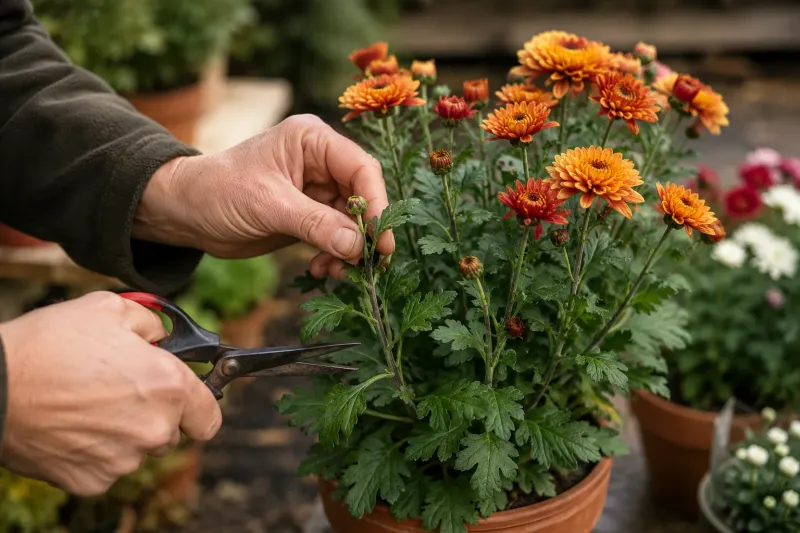
Finding out in late summer that your mum received one too many pinches is frustrating, but the instinct to cut it back hard and force a fresh start is exactly the wrong move. Additional pruning at that point removes more growing tips, pushes the plant to produce another round of vegetative shoots, and eats further into the limited time remaining before frost. The better choice, even if it feels passive, is to stop touching the plant and let whatever growth is present continue developing.
Michigan State Extension’s guidance on crown bud development in garden mums supports this approach, noting that natural cool nights in late summer help trigger the transition to budding. Allowing existing shoots to mature without interruption gives the plant its best chance of completing that process before temperatures drop too far. Cutting back hard could also leave regrowth that simply does not have enough season left to develop into anything useful.
Some gardeners hear about commercial growth regulators that producers use to manage mum timing and wonder whether those products could help in the backyard. MSU Extension’s production-focused research on high temperatures and mum management makes clear that those treatments involve precise application rates, water chemistry adjustments, specific timing windows, and cultivar-specific testing. Applying them casually without that context can delay flowering further or damage the plant. Home gardeners are better served by patience and appropriate growing conditions than by reaching for chemical shortcuts designed for controlled greenhouse environments.
Set a realistic expectation: a mum that was pinched a little too late may still flower this fall, but the display could arrive later than hoped and may not be as full as it would have been with better timing.
Pinching and disbudding solve different problems
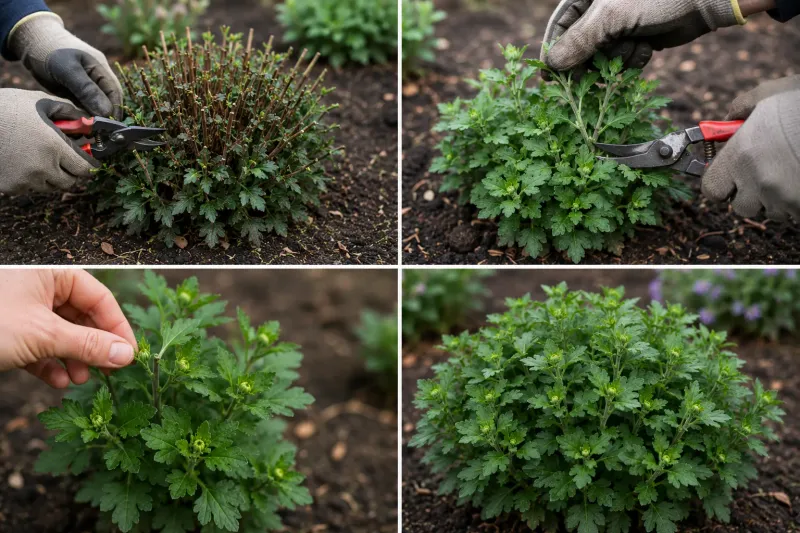
Two words show up constantly in mum care advice, and mixing them up can lead to the wrong action at the wrong time. Pinching means removing the tip of a growing shoot to encourage the plant to branch out. The goal is more stems, a bushier shape, and more flowering points later in the season. Disbudding means removing selected flower buds, usually the smaller side buds around a central bud, to concentrate the plant’s resources into fewer, larger, more impressive blooms.
These are separate techniques that serve opposite purposes at different stages of the plant’s life. Pinching happens in spring and early summer while the plant is in active vegetative growth. Disbudding happens later, after buds have already formed, and is a choice about how to distribute the plant’s flowering energy. Penn State Extension’s feature on the Longwood Gardens thousand-bloom chrysanthemum illustrates how precisely managed disbudding contributes to large-scale exhibition displays, which is a very different context from a backyard bed where most gardeners simply want a full, colorful show.
For a gardener trying to figure out why a mum is green and budless, keeping this distinction clear matters practically. Removing flower buds from a plant that has barely started forming them will not improve the situation, and cutting the plant back in a way that removes shoot tips is pinching, not disbudding, regardless of what it is called in the moment. Knowing which tool fits which problem keeps you from accidentally making things worse while trying to help.
Prevent the problem next season with an earlier stopping point
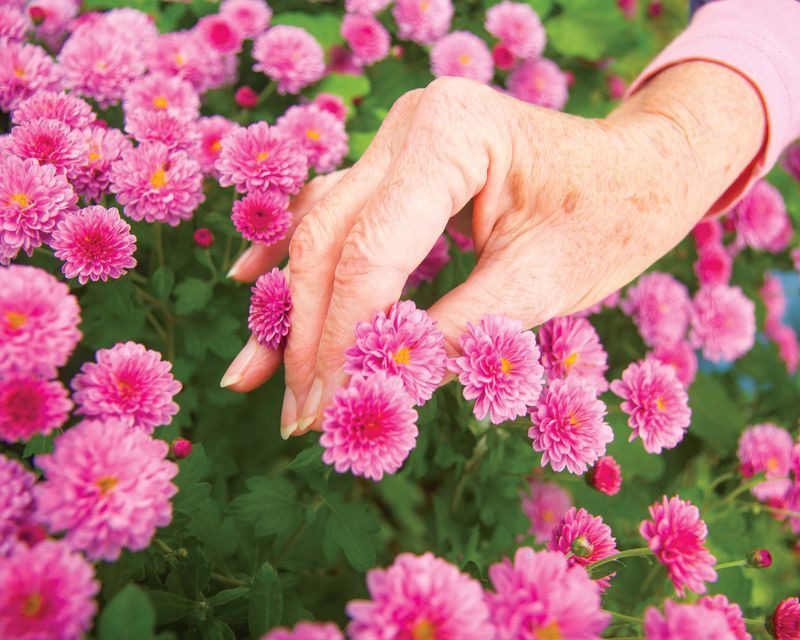
Next spring, start pinching when the first shoots reach about 6 to 8 inches long. Repeat the process once or twice more as new laterals grow to a similar length, then stop. Two or three rounds is enough for most garden mums to develop the full, branched shape that supports a generous fall display.
The stopping point depends on your cultivar. Iowa State Extension recommends finishing by early July as a general guideline, while Penn State Extension’s cultivar-specific guidance suggests that early-flowering types need their final pinch by July 1 or earlier, and later-flowering types can go up to approximately July 15. If you bought your mum without knowing its bloom time, aim for the earlier end of that range to stay safe.
While you are planning, do a quick check of the plant’s location. University of Illinois Extension’s garden mum overview reminds gardeners that nighttime light from nearby fixtures can interfere with the long dark periods mums need to initiate buds. A spot that gets even a little artificial light after sunset is worth reconsidering. And if your plant looks perfectly green and budless in June or early July, that is almost certainly normal.
Buds take time, and a healthy plant working through its natural schedule does not need more intervention. A bushy mum signals that timing and growing conditions deserve a closer look, not that a single mistake has closed the door on fall color.