
What It Really Means When A Carpenter Bee Keeps Drilling Into Your North Carolina Deck Railing
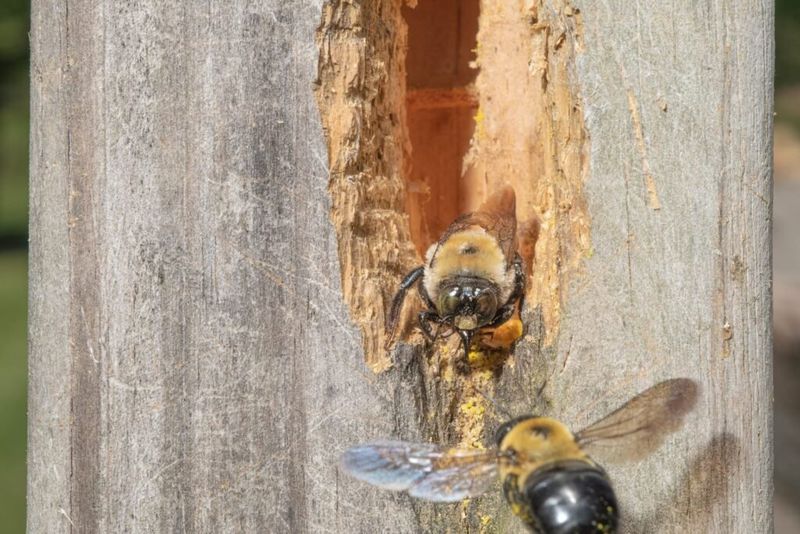
Spotting a large, buzzing bee boring into your deck railing can feel alarming, especially when you see a neat round hole and a little pile of fresh sawdust below it. Most North Carolina homeowners assume the worst – a failing deck, a dangerous infestation, or both.
The reality is more nuanced, and understanding what the bee is actually doing gives you a much clearer path forward than grabbing a can of spray.
The hole usually points to suitable nesting wood—not a failed railing
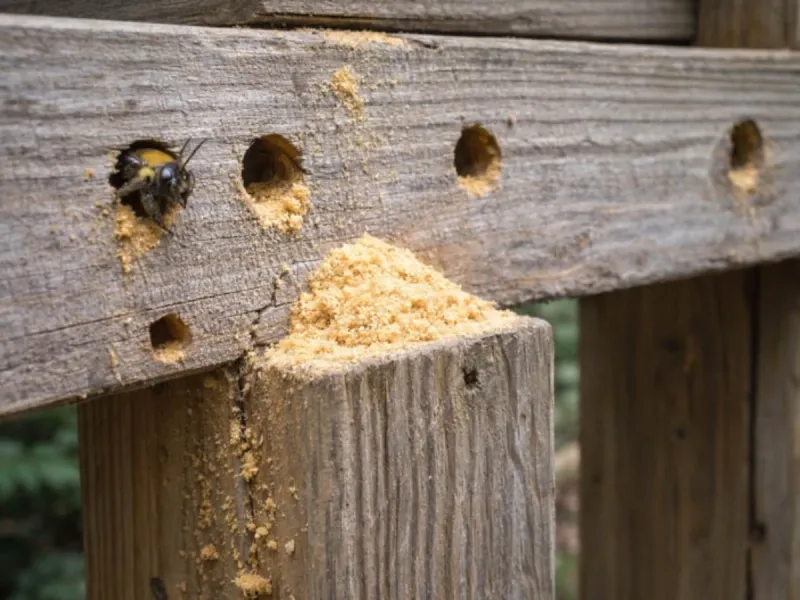
A large carpenter bee drilling into your deck railing is sending a specific message: the wood there is workable. These bees are not eating the lumber or digesting it for nutrients.
They excavate nest galleries – tunnels shaped to shelter and provision their offspring – and they select wood that makes that job easier. Exposed, weathered, cracked, or lightly finished softwood fits the bill far better than a freshly painted, well-sealed surface.
As NC State Extension’s guide to non-honey bee stinging insects explains, large carpenter bees in the genus Xylocopa typically begin across the wood grain and then turn to run with the grain, creating a tunnel that can extend several inches into a board.
That distinction matters before you draw any conclusions about your deck’s condition. The bee chose your railing because it offered a suitable nesting substrate – not necessarily because the railing is rotting or structurally compromised.
A single entrance hole in a sound board generally represents limited, localized damage. The wood around it may be perfectly solid.
Where the situation changes is with accumulated use over multiple seasons. When the same gallery is enlarged or reused year after year, the tunnel grows longer, weakening the board from the inside.
Moisture can enter through the opening and accelerate decay. Woodpeckers, attracted by the larvae inside, may tear into the wood further.
Penn State Extension’s overview of the eastern carpenter bee notes that this compounding cycle – bee activity followed by moisture entry and woodpecker damage – is what eventually threatens boards, not the first hole alone. One entrance is a signal worth reading carefully.
A railing covered in old, expanded holes surrounded by cracking wood and woodpecker excavations is a different situation entirely, and deserves a closer look.
First, make sure the deck visitor is a large carpenter bee
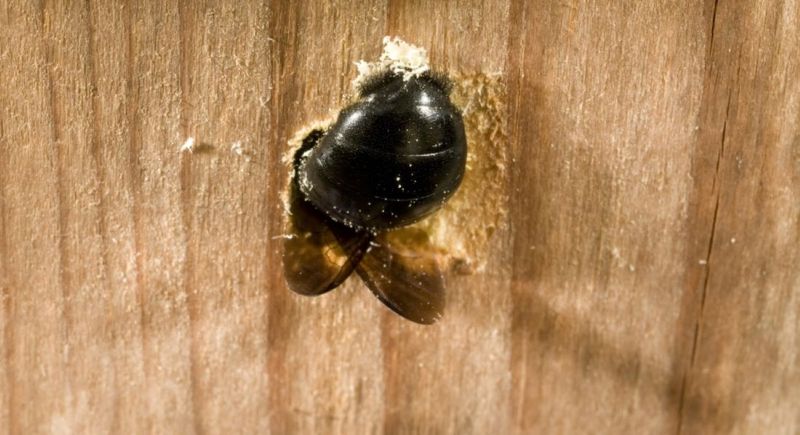
Before deciding on any response, confirm what you are actually looking at. Grabbing a spray can because a large bee is hovering near your railing – without knowing which bee it is – can lead to unnecessary pesticide use and missed information about what is really happening.
Large carpenter bees in the genus Xylocopa are roughly half an inch long or bigger, and the most reliable field mark is the abdomen: it is shiny and relatively hairless, often appearing glossy black. Compare that to a bumble bee, which has a visibly fuzzy, densely haired abdomen and typically shows yellow banding.
The entrance hole is another clue. A carpenter bee opening is nearly round and about half an inch in diameter, cleanly bored into the wood surface.
Fresh pale or tan sawdust beneath the hole and yellowish-brown fecal staining on the wood nearby are additional signs that the tunnel is active. The Bees of North Carolina identification guide lists two Xylocopa species present in the state, both capable of excavating structural wood.
A separate group worth knowing is the small carpenter bee, genus Ceratina. These bees are only a few millimeters long, often metallic blue-green in color, and they nest in pithy plant stems rather than deck lumber.
NC State Extension’s bee hotel resident guide describes Ceratina as common in garden settings but unrelated to the structural drilling that concerns deck owners. If the bee near your railing is tiny and metallic, your lumber is almost certainly not the issue.
The safest way to identify your visitor is to observe and photograph it from a comfortable distance. Do not handle the bee, and do not place your hand over or near the entrance hole.
Penn State Extension’s carpenter bee fact sheet recommends keeping a careful distance when inspecting active galleries. A clear photo taken from a step back will tell you most of what you need to know without putting you at risk.
Why a railing can seem to become a drilling site overnight
Many homeowners notice carpenter bee activity suddenly in spring and assume a new problem has appeared. What they are often seeing is an old situation becoming visible again.
Across much of North Carolina, large carpenter bees typically emerge and begin nesting activity in April and May, though that timing can shift earlier along the Coastal Plain or later at higher Blue Ridge elevations depending on local temperatures and conditions. The NC State Extension guide on non-honey bee stinging insects describes this spring emergence as the period when females construct or enlarge tunnels and provision nest cells.
Adults produced in those galleries emerge later in summer, and some of those individuals will overwinter and return to the same wood the following spring.
That return behavior explains why a railing that seemed quiet all winter can look like an active construction zone by mid-April. The bees are not starting fresh – they are often reopening, cleaning, and extending galleries that have existed for one or more seasons.
Each year of reuse means a longer tunnel and a larger footprint inside the board.
The hovering bee that tends to alarm homeowners most is frequently a male. Males station themselves near the entrance and dart at anything that approaches – people, pets, other insects.
That aggressive-looking behavior is territorial display, not colony defense, and it matters because males cannot sting. Penn State Extension is clear that this is not a swarm preparing to attack.
Carpenter bees are solitary, not colony-forming, so there is no hive defending a queen.
Females are a different matter. They are capable of stinging and will do so if handled, trapped, stepped on, or directly threatened.
The safe approach is to treat every bee near an active gallery with respect, keep children and pets away from the immediate area, and avoid any action that involves reaching toward or into the hole. Understanding the seasonal pattern helps you respond calmly rather than reactively when the bees reappear each spring.
A weekend inspection can reveal warning signs and the need for professional evaluation
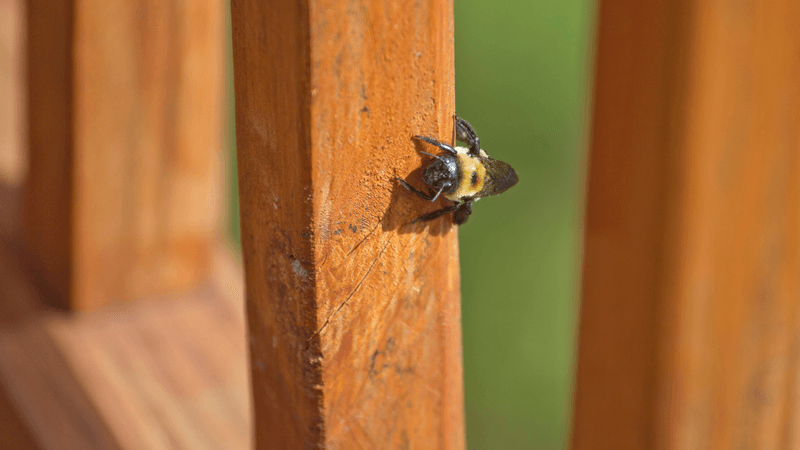
Walking through a focused inspection of your railing gives you much better information than a quick glance from the doorway. The goal is not to prove the deck is safe or unsafe – a homeowner inspection cannot do that for hidden or load-bearing components.
What it can do is document warning signs and help you decide whether the situation calls for maintenance, monitoring, or a qualified professional’s assessment.
Start by photographing everything before touching anything. Capture the entrance hole, the sawdust beneath it, any yellowish-brown staining on the wood face, visible cracks running from the hole, and any areas where the wood surface has been torn or pried open by woodpeckers.
Then count and map the holes. Note whether each one is in a railing board, a top cap, a baluster, a post, a stair stringer, a ledger, or another component.
Location matters as much as count. NC State Extension and Penn State Extension both support inspection-based judgment rather than any fixed hole-count rule for deciding when a board is at risk.
For wood that is visibly damaged and clearly noncritical – a decorative trim board, for example – you can gently probe the surface with a screwdriver to check for unusual softness or spongy areas that suggest decay. Do not drill into or pry open an active gallery.
Disturbing an occupied tunnel risks stings and can trap bees in ways that create secondary damage.
Check the finish condition of every surface near the holes. Bare, weathered, or peeling wood is more attractive to nesting bees than a well-maintained surface.
Cracking along the grain near a hole, soft spots under probing, or evidence of moisture staining inside cracks all indicate that decay may be underway.
Any hole located in a load-bearing post, stair support, ledger board, or structural connection deserves professional evaluation rather than a DIY judgment call. Repeated reoccupation of the same gallery, extensive cracking, or signs of hidden deterioration are also situations where a qualified contractor or deck inspector can assess what the surface inspection cannot reach.
Sound, noncritical wood can sometimes support coexistence
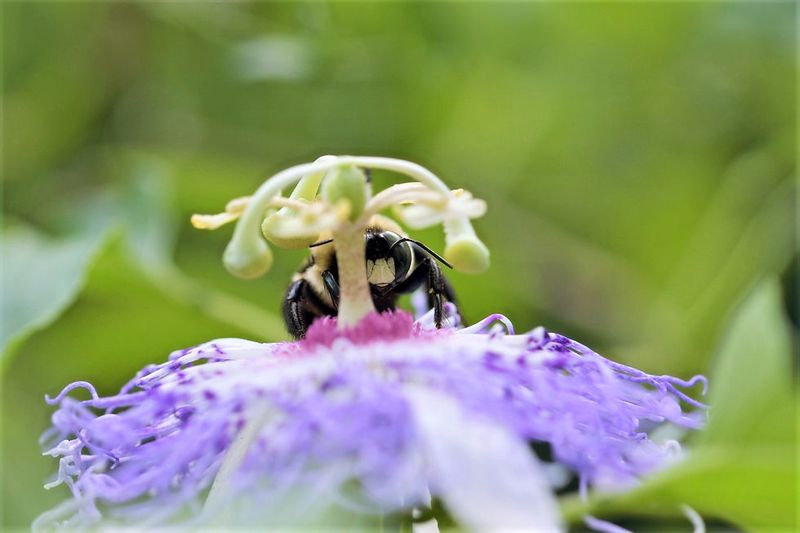
Not every carpenter bee hole requires immediate action. When a single gallery or a small number of holes occupy sound, noncritical wood – a decorative fascia board, a top rail cap, a trim piece that carries no structural load – and no safety concern is present, leaving the situation alone is a legitimate choice.
Penn State Extension explicitly presents coexistence as an option when the nest is not threatening the structure, and that framing fits many situations North Carolina homeowners actually encounter.
The stewardship case for tolerance is straightforward without being overstated. Large carpenter bees are native pollinators that collect pollen and nectar from a wide range of flowering plants.
NC State Extension lists them among visitors to cucurbits, blackberries, mustards, and other plants common in North Carolina yards and gardens. Avoiding unnecessary broad-spectrum insecticide use around flowering areas protects not just carpenter bees but the broader community of native pollinators that share the same foraging space.
That means keeping sprays away from blooms, avoiding blanket applications to the yard, and not treating areas where bees are actively foraging.
Coexistence is not the same as neglect, and that line is worth keeping clear. A single hole in a sound board is one thing.
Recurring galleries in the same location, wood that is beginning to soften or crack around the tunnels, or a component that is gradually being hollowed out over successive seasons changes the calculation. When the railing’s condition is deteriorating or the holes are multiplying, the situation has moved past the point where observation alone is the right response.
At that stage, maintenance, repair, or targeted management becomes appropriate – and the next sections address exactly those options.
Maintenance can make the railing less inviting without making it bee-proof

Once you understand what attracted the bees in the first place – exposed, weathered, or lightly finished softwood – the prevention strategy becomes clearer. Keeping wood surfaces well maintained with a durable exterior paint or opaque stain removes some of the appeal.
Penn State Extension identifies paint and stain as deterrents to new excavation, and that holds up in practice: bees consistently show a preference for bare or weathered surfaces over well-finished ones. The protection is real but incomplete.
Treated wood can still be attacked, and surface treatment applied after galleries are already present does nothing to remove those existing tunnels.
For boards that have been repeatedly targeted over multiple seasons, replacement with composite decking material or another less attractive construction option is worth considering where practical. Penn State specifically names composite materials as an effective conflict-reduction strategy for areas where carpenter bees keep returning.
Composite boards do not offer the same nesting substrate as softwood, making them a more durable long-term solution for high-traffic problem spots on the railing.
An optional experiment some homeowners try is placing an untreated pine or cedar nesting block away from the deck – sometimes called a trap nest or bee board – to offer an alternative site. This can be a reasonable habitat-management gesture, but it should not be framed as a reliable solution.
A USGS study on eastern carpenter bee nest structure and trap nest acceptance found relatively low occupancy of experimental trap nests, which means there is no guarantee that bees will relocate to the alternative board and leave the railing alone. Offer the block as an experiment, not a fix.
NC State Extension also notes that almond oil has been suggested as a surface deterrent for new nesting, but surface treatments of any kind do not affect bees already established inside a gallery. Think of maintenance as reducing future attraction, not solving an active nest situation.
Treatment belongs to the gallery and the risk assessment—not the air around it
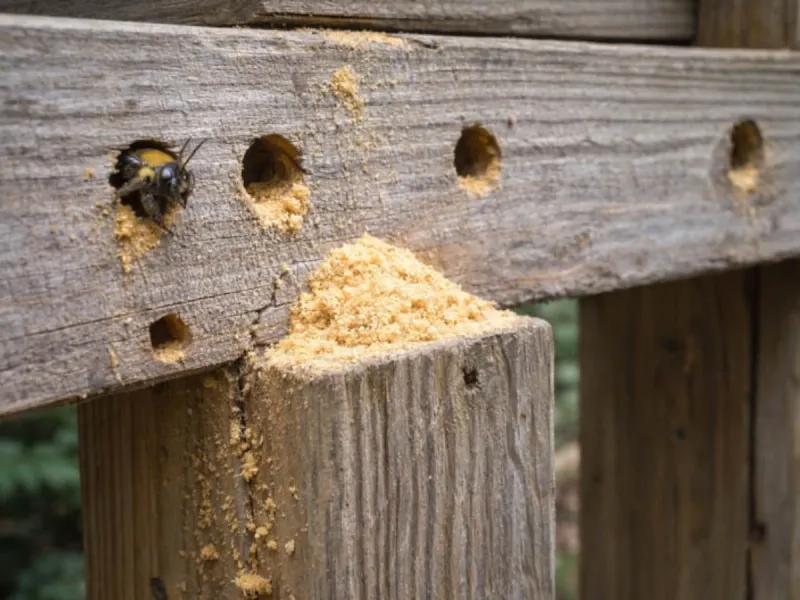
Targeted treatment becomes appropriate in specific circumstances: numerous or repeatedly occupied holes, damage concentrated in elevated or load-bearing components, proximity to children or pets who spend time on the deck, or a setup where the homeowner cannot safely reach or treat the affected area. Those are meaningful thresholds, not a reason to spray at the first sign of a bee.
Spraying hovering bees in flight is not effective treatment and is not good practice. NC State Extension describes it as impractical, and the EPA’s pollinator protection guidance advises applying insecticides when pollinators are not actively foraging and following all label restrictions.
Applying pesticides across flowering plants or anywhere bees are gathering nectar and pollen increases harm to non-target insects without addressing the gallery. Homemade pesticide recipes are not a substitute for labeled products, and no internet formula carries the legal or safety review that a registered product label does.
When treatment of individual galleries is warranted, it must follow the specific product label exactly. The EPA’s pesticide label system makes clear that the label is the law – what is written there governs legal use for that product and site, not general extension lists or online suggestions.
Extension guidance from NC State and Penn State differs somewhat on the timing of sealing after treatment: NC State suggests waiting roughly 24 to 36 hours before plugging the gallery, while Penn State recommends leaving the opening accessible long enough for returning and emerging bees to contact the treatment. The shared point is that plugging an active, untreated hole immediately is counterproductive – it may trap bees inside or prompt them to chew a new exit.
Treating holes in elevated railing sections, eaves, or structural posts also carries real exposure risks: sting hazard from disturbed females, airborne dust from the gallery, and pesticide contact during application. For any situation that is extensive, elevated, near children or pets, or beyond what you can safely manage, use a qualified pest-management professional.
When pesticide application is involved, verify any North Carolina credential or authorization required for the product, site, and service, and confirm you are working with a properly authorized applicator.
Read the railing before you reach for the spray
The carpenter bee drilling into your railing is giving you information, and the most useful thing you can do first is read it carefully. Identify the bee, document the wood condition and the component’s structural role, and let that assessment guide your response rather than defaulting to a spray can out of reflex.
Three bounded options cover most situations. A small number of holes in sound, noncritical wood with no safety concern can be left alone, with monitoring to catch any change in the wood’s condition over time.
Boards that are weathered, repeatedly targeted, or showing early decay warrant maintenance – fresh finish, targeted repair, or replacement with a less attractive material. When damage affects a load-bearing component, involves extensive tunneling, or creates a treatment situation that is unsafe to handle alone, professional assessment and targeted gallery treatment are the right call.
NC State Extension and Penn State Extension both support matching the response to the actual risk rather than treating every hole as an emergency.
Protecting your deck and avoiding needless harm to native pollinators are not competing goals. A well-maintained railing is simply less attractive to nesting bees, which means the same upkeep that protects your investment also reduces future conflict.
The bee at your railing is a native animal doing what it evolved to do – your job is to decide, calmly and with good information, how much of that you can share and where a firm boundary makes sense.