
What It Really Means When A Copperhead Turns Up Along The Edge Of Your North Carolina Yard
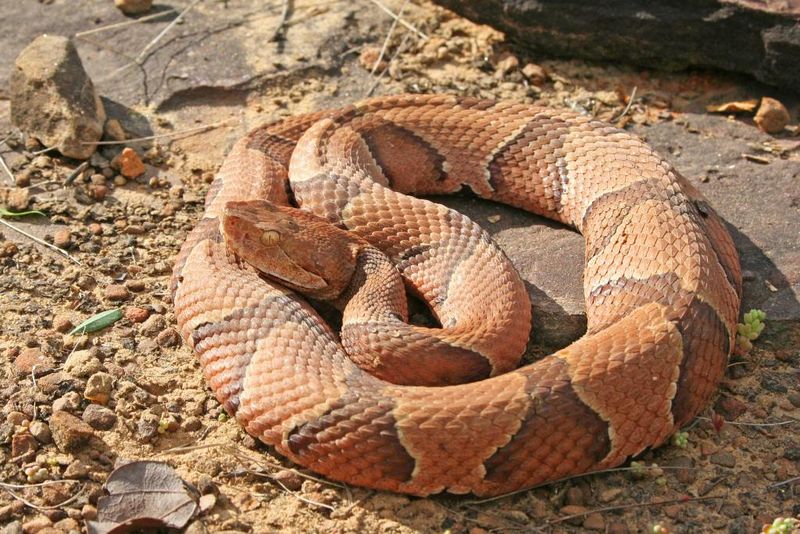
Spotting a copperhead along the edge of your yard can stop you cold, and the first instinct for many homeowners is to worry that something has gone wrong. Most of the time, though, that snake is telling you something far more specific than “your yard is in trouble.” Understanding what a copperhead sighting actually signals can help you protect your family and pets while making smarter decisions about the land right outside your door.
The answer matters whether you live in the Piedmont, the Coastal Plain, or the mountain foothills of North Carolina.
The sighting points to connected habitat, not yard failure
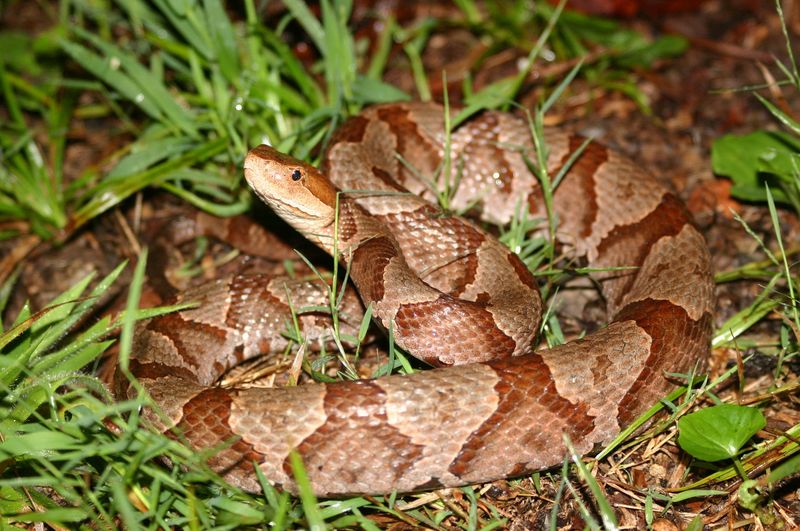
Finding a copperhead at the boundary of your yard is far more likely to mean your property connects to suitable snake habitat than that anything has gone badly wrong. NC Wildlife’s copperhead profile confirms that the species occurs statewide across North Carolina, inhabiting wooded residential areas, adjoining fields, forest edges, rocky or brushy spots, and places with fallen logs or other ground-level cover.
That statewide reach means a copperhead can show up along almost any yard edge that borders suitable terrain.
What the sighting signals most reliably is that your yard offers some combination of cover, warmth, movement corridors, and access to foraging areas. A forest-to-yard edge, a brushy fence line, a rock border, or a stand of mature trees can all make a property part of a snake’s larger range.
None of those features represent a failure of yard management; they are simply characteristics that allow a wide-ranging native predator to move through.
One observation cannot tell you how many copperheads use the property, whether prey animals are unusually abundant, or whether a breeding group is nearby. North Carolina Division of Parks and Recreation reptile records describe the copperhead as a widespread woodland snake, not a species that concentrates only where conditions are exceptional.
A single individual may simply be passing through on a well-traveled route between two patches of habitat.
The most defensible read of the situation is this: the yard edge provides access to resources that copperheads use across their range. That is a habitat clue, not a population count, a prey survey, or a report card on the health of your ecosystem.
Reframing the sighting that way is the first step toward a proportional, practical response.
Why the yard edge creates an attractive route
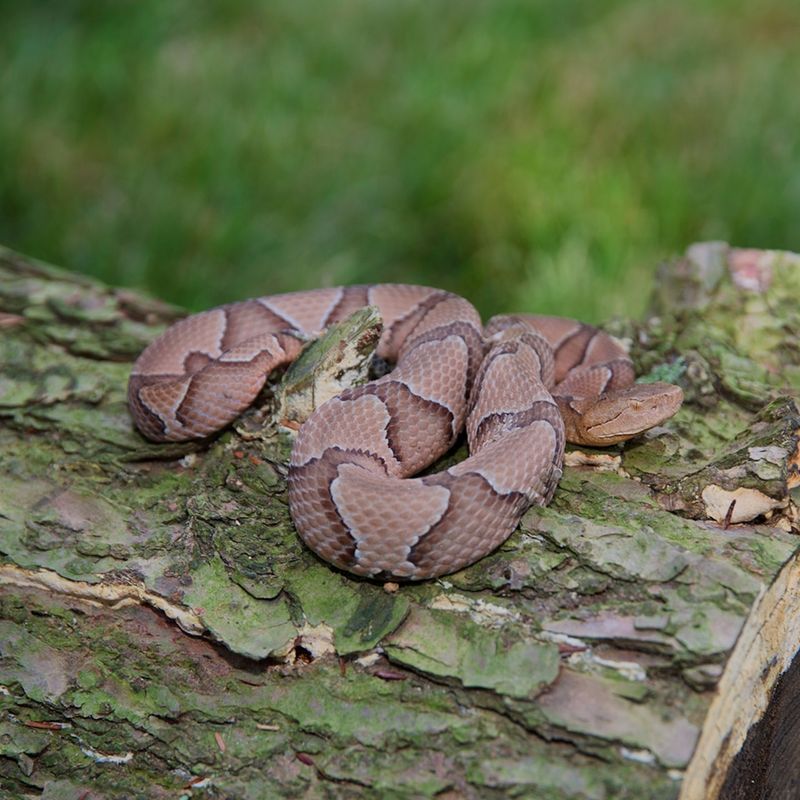
Boundaries between two types of habitat are among the most ecologically active places on any property. Where a wooded lot transitions into a lawn, a brushy fence row meets an open path, or a rocky slope gives way to a garden bed, you get a mix of features that many animals – including copperheads – can use in a single short movement.
Shade and leaf litter from the trees, warmth from the open ground, cover from brush, and access to both forested and open foraging areas all converge along that narrow strip.
Copperheads are primarily forest and woodland snakes. NC Parks and Recreation reptile data places them in upland forests, wooded hillsides, rocky outcrops, and brushy edges – not in open turf or standing water.
The yard edge matters because it sits right next to that preferred woodland habitat, giving a snake a relatively sheltered corridor to move through while still accessing the more open ground where some of its prey may be active.
Warmth is another factor. Copperheads, like all reptiles, regulate body temperature by moving between warmer and cooler spots.
A sunny patch of stone, a concrete step, a gravel border, or even a dark mulch bed along the yard edge can provide the warmth a snake needs to digest a meal or stay active during cooler parts of the day. That does not mean the snake is trying to live under your porch permanently; it may simply be using a warm surface for an hour before moving on.
NC State Extension’s Viperidae guide notes that copperheads are generally secretive and spend much of their time under cover. The yard edge, with its mix of leaf litter, low vegetation, rock, and wood, provides exactly the kind of layered cover a secretive snake uses as shelter and as a hunting position.
Recognizing that the edge itself is the attractant – rather than any single feature like a bird feeder or a decorative pond – helps homeowners think clearly about where to focus any changes they want to make.
A copperhead does not diagnose a mouse problem
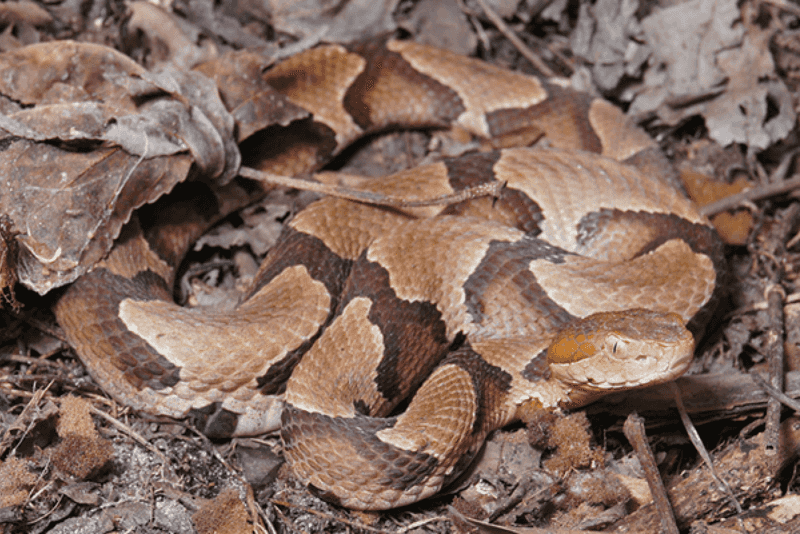
One of the quickest conclusions homeowners reach after a copperhead sighting is that the yard must be crawling with mice. The reasoning feels logical – snakes eat rodents, so a snake means rodents – but that chain of thought skips several important steps.
NC State Extension’s guide to pit vipers documents a much broader diet for copperheads: amphibians, reptiles, birds, small mammals, and large insects all appear on the menu, and what an individual snake eats shifts with its age, the season, and what is locally available.
Adult copperheads in some populations do rely more heavily on small mammals, including mice and voles. Juveniles, however, often take smaller prey such as insects and small amphibians.
A young snake along your yard edge may have been hunting crickets or a small frog rather than working through a rodent population. The prey available along a specific stretch of woodland edge varies considerably, and no single observation tells you which prey item brought the snake there.
The broader food-web picture is worth understanding, even if it should not be overpromised. Snakes consume rodents, and rodents can carry ticks and spread pathogens.
CDC guidance on wildlife and healthy pets acknowledges the role wildlife plays in disease transmission cycles involving rodents. A copperhead that regularly hunts rodents along a yard edge may contribute to keeping local rodent activity in check, but there is no established measure of how much tick reduction, if any, one snake produces in a residential yard.
Treat that relationship as a possible ecological benefit, not a guaranteed pest-control service.
What a single sighting genuinely cannot tell you is that mice have taken over. The snake could be moving through connected habitat, sheltering temporarily under a log, or hunting a prey type that has nothing to do with your compost bin or garage.
If you want to assess whether rodents are a separate concern, look for the direct signs – droppings, gnaw marks, nesting material in sheds or walls – rather than using the snake as a proxy diagnosis.
When one appears, distance is the first intervention
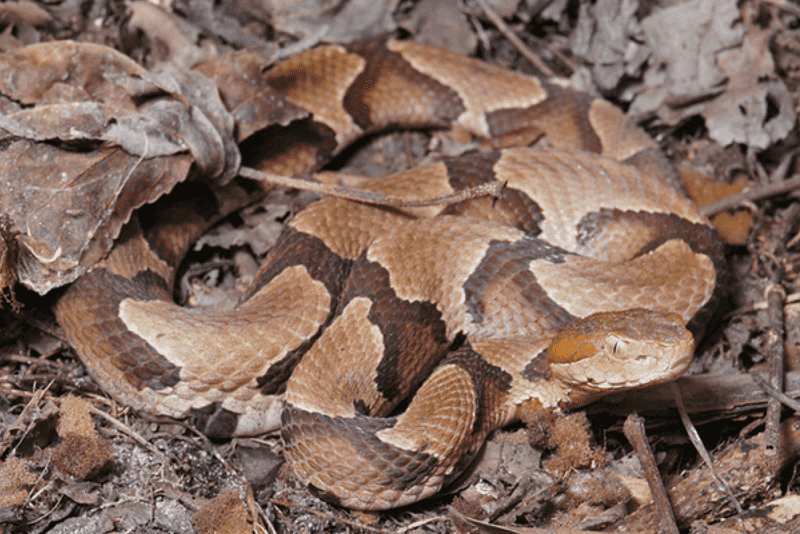
Seeing a copperhead outdoors calls for a clear, calm sequence of actions, and the first step is the most important: move children and pets away from the area immediately. Put distance between everyone and the snake before anything else happens.
NC Wildlife’s copperhead page is direct on what comes next – in most cases, leave the snake alone and it will move away on its own. Copperheads are not hunting you or your pets; they are passing through or resting, and given space and time, most will continue on.
“Substantial space” means more than a few feet. Copperheads can strike at a portion of their body length, and a snake that feels cornered or threatened can shift from motionless to striking posture faster than most people expect.
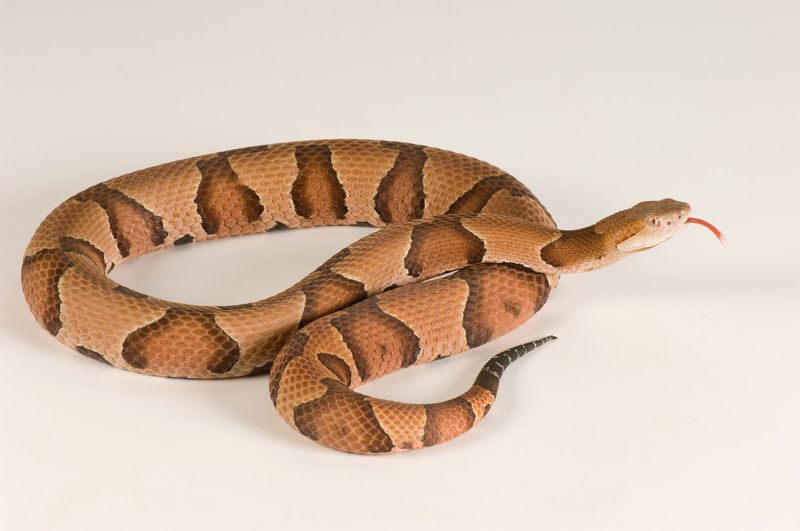
Stay well back, keep other people back, and resist the urge to get closer for a better look or a photograph. Folk identification rules – triangular head, cat-eye pupils, pit between eye and nostril – require a proximity that puts you at risk, and copperheads can be confused with nonvenomous species at a glance.
There is one narrow exception to the “leave it alone” guidance. If the snake is directly blocking a doorstep, a driveway, or a path that cannot be avoided, NC Wildlife’s snake conflict guidance notes that spraying the snake with a garden hose from a safe distance can encourage it to move.
That is the extent of the physical intervention recommended for an outdoor snake. Do not approach, corner, trap, pin, or strike the snake with any object.
NC State Extension points out that many copperhead bites occur when people attempt to capture or kill the snake. The defensive bite – triggered by being stepped on, handled, or cornered – is exactly the outcome that patience and distance prevent.
If the snake has not moved after a reasonable amount of time and continues to block a high-use area, that is the moment to call for professional help rather than to escalate the encounter yourself.
Make the house and daily paths less inviting
Once the immediate encounter has passed, the useful work shifts to making the areas you and your family use most often less hospitable to a snake looking for shelter or warmth. The goal is not to strip every natural feature from the yard – that would be both unnecessary and ecologically counterproductive.
The focus belongs near the house, on frequently traveled paths, and around the places where children and pets spend time.
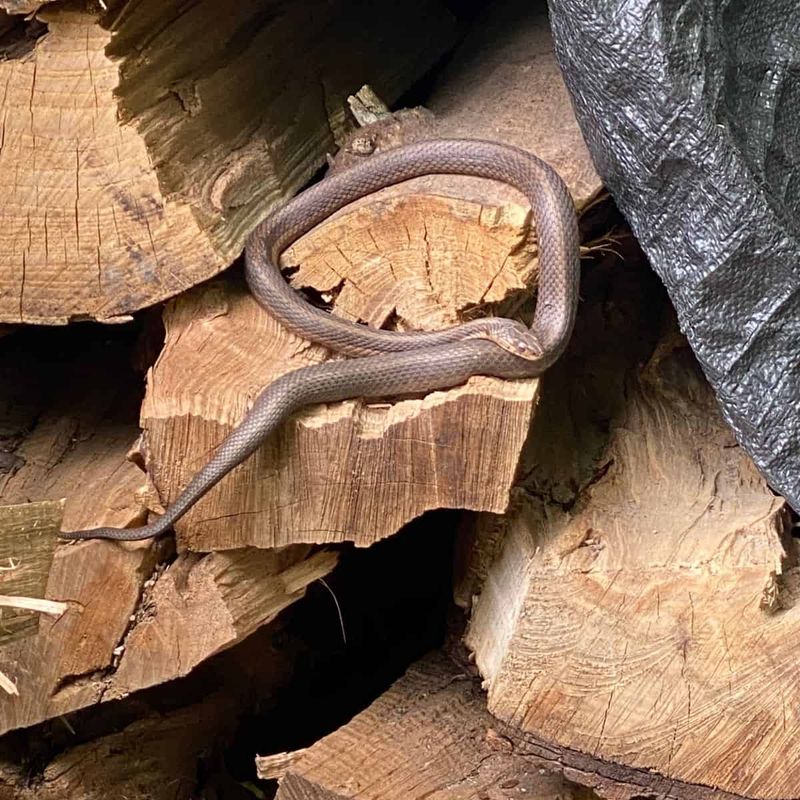
NC Wildlife’s guide to preventing conflicts with snakes offers specific, practical recommendations. Move or reorganize rock piles, firewood stacks, and debris piles that sit close to the foundation.
These features make excellent shelter for snakes and for the small prey animals that snakes follow. Relocating a woodpile to the far edge of the property, or stacking it on a rack above the ground, removes a prime resting spot from the zone you use daily.
Vegetation management along steps, walkways, and doorways also matters. Thick groundcover, overgrown shrub borders, and low-hanging branches that obscure a path or a doorstep create exactly the kind of sheltered corridor that a secretive snake will use.
Keeping those areas trimmed and visible does not mean converting the yard to bare lawn; it means reducing the blind spots in the places where an unexpected encounter would be most dangerous.
Rodent attractants are worth addressing as a separate task. Unsecured garbage, pet food left outside, open compost bins, and clutter in sheds or garages can draw rodents, and rodents can draw snakes.
Controlling those attractants reduces one component of what makes the property edge attractive. NC Wildlife also recommends sealing openings around doors, foundations, siding, and utility pipes to prevent any snake from finding its way inside.
A combination of reduced shelter, fewer attractants, and sealed entry points near the house addresses the conflict zone without treating the broader yard as a problem to be solved.
Killing, relocating, and repelling the snake create new risks
The impulse to eliminate the snake immediately is understandable, but the methods most homeowners reach for first are also the ones most likely to result in a bite. Copperheads are generally defensive rather than aggressive, but they will bite when stepped on, cornered, restrained, or handled.
NC Wildlife is clear that many bites happen during attempts to kill or capture the snake – meaning the very act of trying to solve the problem creates the emergency the homeowner was trying to prevent.
Self-relocation carries its own set of problems. Picking up a snake – even with a tool – puts you in close proximity to an animal that can strike faster than you can react.
Beyond the bite risk, NC State Extension’s snake resource notes that snakes have distinct home ranges and that moving them long distances can significantly increase mortality. Dropping a copperhead at a park or a field edge does not solve the habitat conditions that brought it near your yard; it may simply harm the animal without producing any lasting result for you.
Commercial snake repellents deserve a clear answer: they do not work. NC State Extension states that no commercially available repellent has been scientifically shown to reliably repel snakes.
Products based on mothballs, sulfur, lime, or proprietary blends can also pose hazards to children, pets, and the surrounding environment if misused. Spreading them around the yard perimeter is not a substitute for the structural and habitat changes described in the previous section.
When the situation moves beyond a single outdoor sighting – when a snake has entered the house, when encounters are recurring in a high-use area despite reasonable habitat modifications, or when you are simply not confident about what you are seeing – that is the right time to contact a professional. NC Wildlife’s Have a Wildlife Problem page connects homeowners with licensed Wildlife Control Agents, and the NC Wildlife Helpline at 866-318-2401 (Monday through Friday, 8 a.m. to 5 p.m.) can help you find the appropriate resource for your specific situation.
A suspected bite is a medical emergency
Everything in this article about calm interpretation and proportional response applies to an outdoor encounter with a snake that has not bitten anyone. The moment a bite occurs – or is suspected – the ecological framing steps aside entirely.
A copperhead bite requires emergency medical care, and that means going to an emergency room right away, not waiting to see whether symptoms develop.
CDC guidance on venomous snakes outlines the correct response clearly. Keep the person calm and as still as possible – movement increases the rate at which venom spreads through the body.
Remove rings, watches, and any other constricting items from the affected limb before swelling begins. Wash the bite area gently and cover it loosely.
Then get to an emergency department without delay.
A number of responses that feel intuitive are actually harmful. Do not cut the wound or attempt to suck out venom.
Do not apply ice, a tourniquet, or any form of electric shock. Do not give the person alcohol or any medication that has not been specifically directed by emergency medical personnel.
None of these actions help, and several can make the injury worse or complicate treatment.
If you can photograph the snake from a safe distance without approaching it, that image may help medical staff identify the species, but do not risk a second bite to get it. NC Wildlife notes that copperhead bites are painful and serious, though generally not life-threatening when treated promptly.
Even so, NIOSH guidance on venomous snakebites treats any suspected venomous bite as a medical emergency because venom effects can progress and lasting tissue damage is possible. One more point that catches people off guard: the absence of visible fang marks is not proof that a venomous bite did not occur.
If there is any reason to believe a copperhead made contact, seek emergency evaluation immediately and let medical professionals make that determination.
Read the encounter as information, then manage the boundary
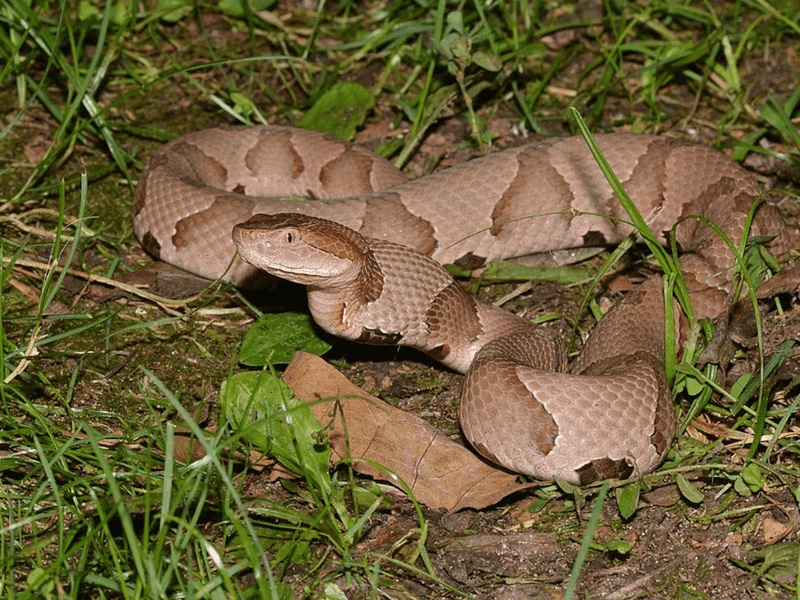
A copperhead along your yard edge is a data point about the habitat your property connects to, not a verdict on how well you manage your land. NC Wildlife describes copperheads as a normal part of the North Carolina landscape, present statewide in the kinds of wooded and brushy settings that border countless residential properties.
One sighting tells you that your yard edge offers access to resources this species uses – cover, warmth, movement routes, and prey. That is useful information for making targeted changes near the house.
The practical order of operations is straightforward. Protect people and pets first by maintaining distance and keeping children and animals away from the area.
Avoid any handling or direct intervention. Then focus habitat modifications on the high-use zone near the house: reorganize shelter near the foundation, seal entry points, and reduce rodent attractants.
NC Wildlife’s conflict prevention guidance and the Wildlife Helpline are available when encounters move indoors or become recurring in a high-traffic area.
The broader yard can remain what it already is – a piece of North Carolina’s connected landscape. A safer home boundary and a yard that still supports native wildlife are not opposing goals.
Managing the transition zone between your daily living space and the wild edge is how you hold both at once.