
The Most Underrated North Carolina Native That Only Gets Better In August Heat And Humidity
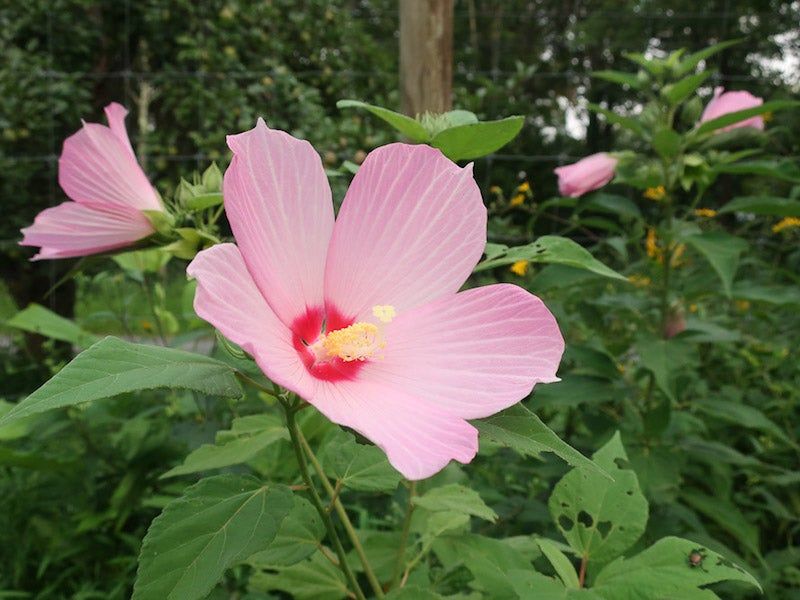
Most North Carolina yards look exhausted by August, with spring bloomers long gone and summer flowers wilting in the heat. Swamp rose-mallow, a native perennial that tolerates the state’s muggy late-summer conditions, keeps producing large, showy flowers right through that difficult stretch.
It grows across the Coastal Plain, Piedmont, and Mountains, and for homeowners with a sunny, moist spot, it can be one of the most visually striking plants still performing when everything else has faded.
Rose-mallow stands out during North Carolina’s August bloom window
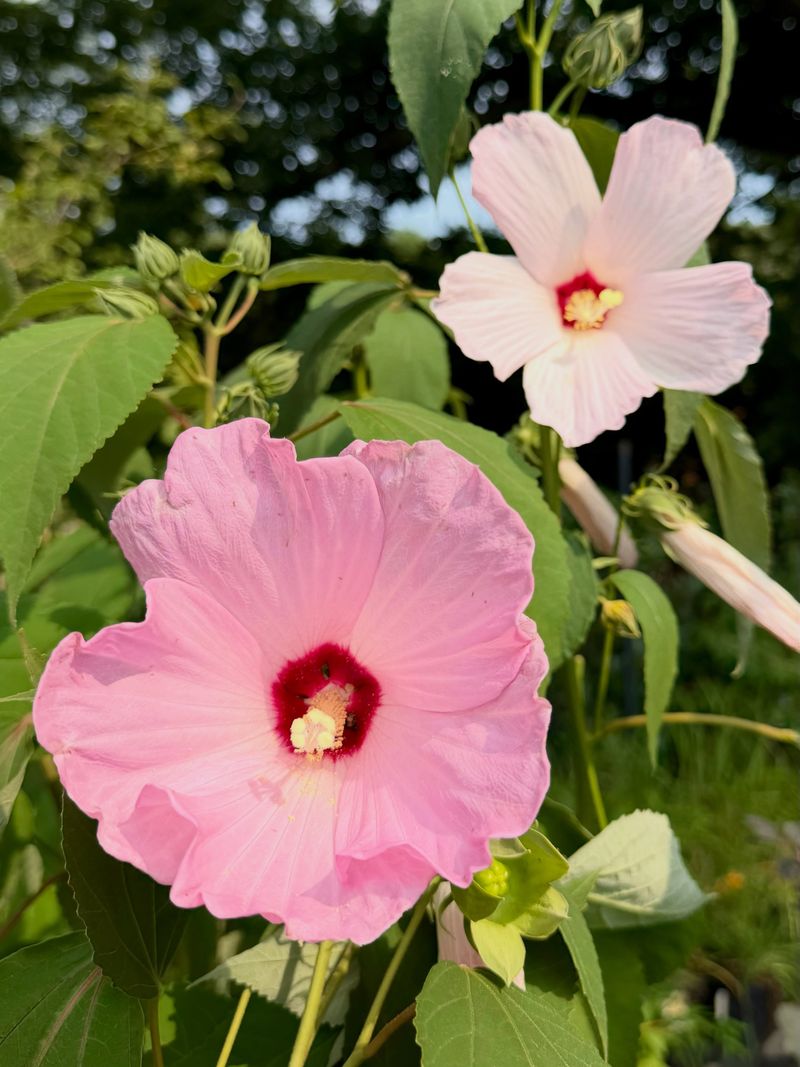
Swamp rose-mallow – sold under several names but currently recognized by NC State as Muenchhusia moscheutosHibiscus moscheutos, formerly listed as – earns its place as the article’s single answer for a conspicuous late-summer native in North Carolina. You may also see it labeled “hardy hibiscus,” “common rose-mallow,” or “wild cotton” at local nurseries.
All of these names point to the same plant, so checking the scientific name is the most reliable way to confirm you have the right one.
According to the NC State Extension Gardener Plant Toolbox profile for wild cotton, the species is native to North Carolina’s Coastal Plain, Piedmont, and Mountains, and is specifically described as tolerant of heat, humidity, and wet soil. Those documented traits make it a realistic choice for moist residential sites across most of the state, though local conditions still determine whether any individual yard is suitable.
The defensible case for rose-mallow is narrower than the title implies. Heat and humidity do not automatically improve its performance.
What the plant does offer is a documented flowering period from midsummer into early fall, placing August squarely within its bloom window when many spring and early-summer plants have already declined. For a homeowner with the right site conditions, that timing makes it an unusually conspicuous late-season native.
It is not the only North Carolina native suited to late summer – buttonbush, mountain mint, coneflowers, and summer phlox also perform during that period – but few match its flower size or visual presence at that time of year.
Its long bloom window keeps the display visible
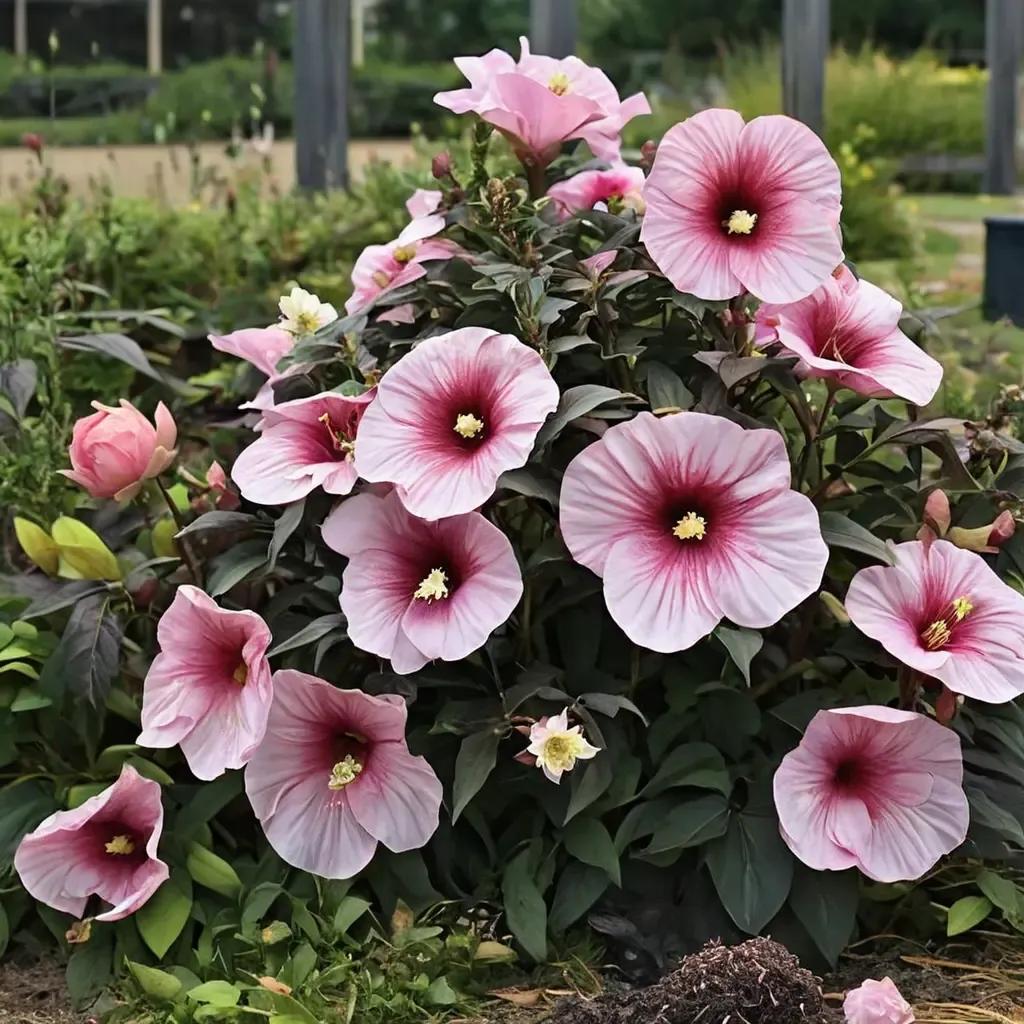
Flower size alone sets rose-mallow apart from most late-season natives. Individual blooms can reach roughly 8 inches across, making the plant visible from across a yard at a time when many other perennials are producing small flowers or no flowers at all.
That scale is not typical for a North Carolina native perennial, and it is one reason the plant tends to draw attention even in an otherwise quiet late-summer border.
The bloom period runs from midsummer into early fall, with a July through September window cited by Missouri Botanical Garden’s plant profile for Hibiscus moscheutos. Individual flowers last only about one to two days, which sounds like a limitation but works differently in practice.
The plant opens new blooms in succession over an extended period, so the display continues week after week rather than peaking briefly and stopping. On any given day during that window, multiple fresh flowers are typically open at once.
August falls within that documented bloom period, but heat itself is not what drives flowering. Rose-mallow is heat- and humidity-tolerant, meaning it can maintain its performance under those conditions rather than declining the way some spring-adapted plants do.
That distinction matters: a plant installed in the wrong location – too dry, too shaded, or newly transplanted without adequate water – will not deliver the same display regardless of how hot the summer gets.
Earlier bloomers like irises and mountain laurel are genuinely finished by late July in most North Carolina yards. Rose-mallow’s extended window makes it a useful source of late-season color, though describing it as the only option overstates the case.
Its combination of flower size and bloom timing is what makes it stand out for a moist, sunny site.
Match the plant to a sunny, consistently moist site
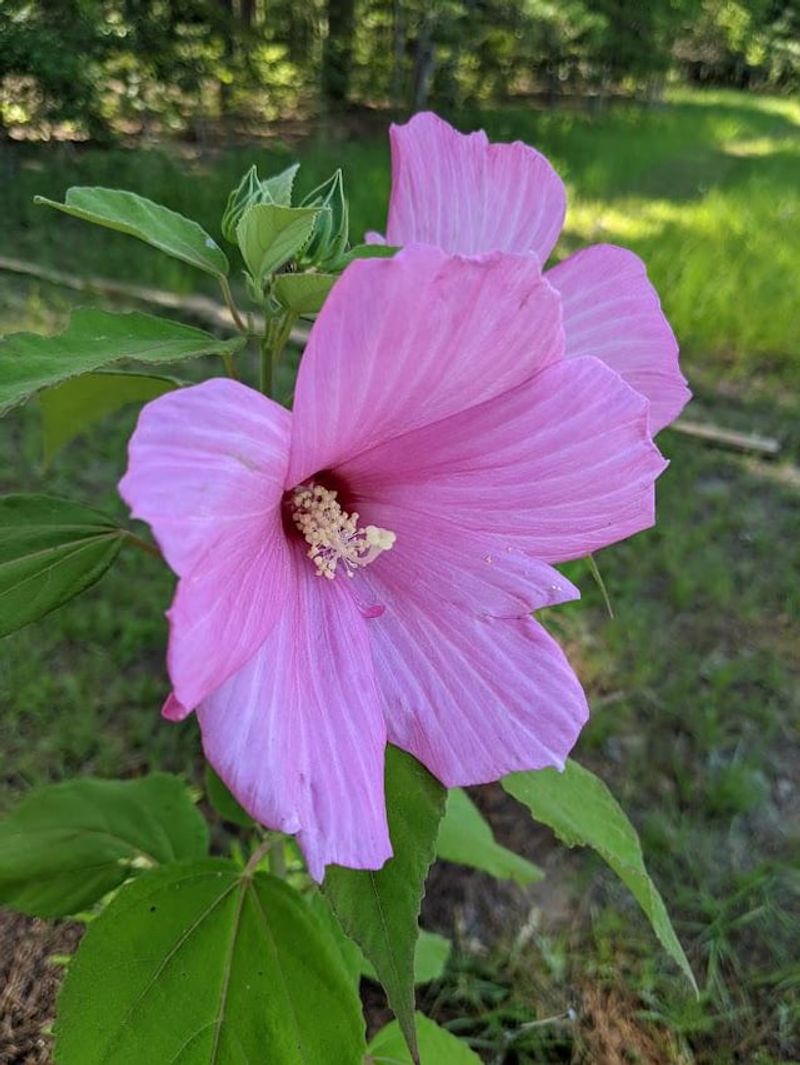
Before purchasing rose-mallow, assess the candidate site honestly. The plant performs best in full sun, where it produces the most flowers and shows better disease resistance than in shadier spots.
Partial sun is tolerable, but flower production tends to drop as shade increases. If the location receives fewer than six hours of direct sun daily, a different plant is likely a better fit.
Soil moisture is the other non-negotiable. The NC State plant profile describes rose-mallow as preferring wet to constantly moist soil, and lists appropriate placements as rain gardens, pond margins, stream edges, low spots, and moist borders.
Those are not interchangeable descriptions – they all share one trait: the soil stays reliably wet or moist through summer without depending on the gardener to compensate for a dry site.
Heat tolerance is not the same as drought tolerance, and conflating the two is the most common siting mistake with this plant. A raised bed, a sandy coastal berm, a south-facing slope with reflected heat from pavement, or any spot where soil dries out between rains is a poor match unless irrigation can maintain consistent moisture throughout the growing season.
Leaf scorch is a visible sign that soil has dried too much, and it can follow quickly during a North Carolina heat stretch if the site is wrong.
The plant’s relationship to water also affects surrounding plants. Rose-mallow tolerates wet conditions, but placing it in a chronically waterlogged spot where other plants are already struggling does not automatically fix a drainage problem.
The broader NC State species profile recommends assessing the site’s hydrology as a whole rather than using rose-mallow to absorb excess water without considering how that moisture level affects neighboring plants.
The NC State Extension Gardener Handbook chapter on native plants reinforces this point: matching a native plant to the local ecoregion, drainage pattern, light level, and available space determines success more reliably than the plant’s native status alone. A plant listed as native to all three North Carolina regions can still fail in conditions that do not match its documented preferences.
Good establishment supports reliable late-summer performance
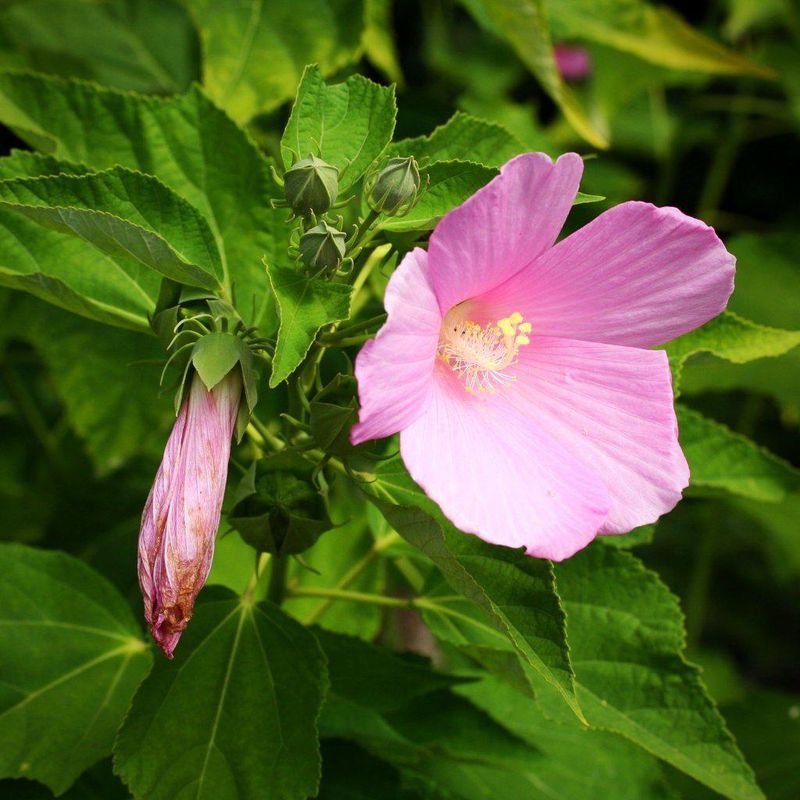
Getting rose-mallow through its first season in good shape takes consistent attention to water, mulch, spacing, and timing. None of those tasks are complicated, but skipping them – especially during the hot months – can set back the plant significantly.
Native status does not make rose-mallow maintenance-free in a residential landscape, and NC State is direct about that point for native plants generally.
New plants need deep, regular watering during establishment. Once the root system is established, the plant still needs consistent moisture because soil that dries out can cause leaf scorch even on a plant that has been in the ground for a full season.
The goal is not to keep the soil saturated but to prevent it from drying between waterings, particularly during dry spells in July and August.
A 2-3 inch layer of mulch helps considerably. It slows moisture loss from the soil, moderates soil temperature during heat waves, and reduces weed competition that would otherwise stress a new plant.
Keep the mulch pulled back from the base of the stem – piling it against the crown can encourage rot and disease in a plant that is already sitting in moist conditions.
Spacing matters for a plant growing in North Carolina’s humid summers. NC State recommends good air circulation around rose-mallow, and crowding it against a fence or neighboring plants traps moisture on foliage and increases disease risk.
Give it room to breathe from the start rather than planning to thin it later.
For planting timing, fall is generally the safer window for a new native wildlife planting in North Carolina. NC State’s guidance on hummingbird and butterfly gardening recommends fall planting for native species, and the NC State native plants handbook notes that summer transplanting carries higher risk.
August installation can work for container-grown plants if reliable irrigation is available, but the combination of heat, dry air, and transplant stress makes fall a more forgiving choice for most homeowners. If you do plant in August, plan to water more frequently and monitor the plant closely through the rest of the season.
Plan for a tall perennial, not a compact bedding plant
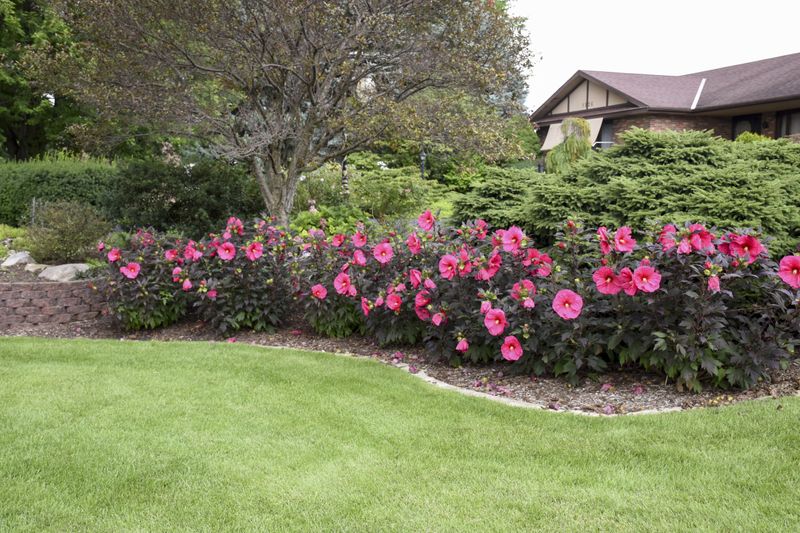
Rose-mallow grows large enough to surprise homeowners who are used to compact annuals or smaller native perennials. NC State lists the mature size as roughly 2-6 feet tall and 2-5 feet wide, and Missouri Botanical Garden gives a similar range of 3-7 feet tall by 2-4 feet wide.
Either way, a mature plant occupies a meaningful footprint in a residential border, and that needs to be part of the siting decision before you buy.
Placement toward the middle or back of a border is the practical rule. A 5-foot plant at the front edge of a bed will shade the smaller perennials and groundcovers growing behind it, and repositioning a well-rooted rose-mallow is harder than getting the location right from the start.
The NC State profile and Missouri Botanical Garden’s entry both describe it as appropriate for middle-to-back border placement for exactly this reason.
In exposed locations, wind can become a problem for a tall, broad-leafed plant. Staking or a sheltered position near a fence or larger shrub can prevent stem damage during summer storms.
This is not a plant that needs elaborate support, but ignoring wind exposure in an open yard is a common oversight.
Optional pinching in early growth – when stems are still young and flexible – can encourage a bushier, more branched form rather than a single tall stalk. Once the season ends and the plant goes dormant, stems can be cut back near the ground.
That end-of-season cutback is standard practice and keeps the bed tidy through winter, though there is a good reason to leave some stem height temporarily, which the next section covers in more detail.
The flowers can support pollinators when the habitat supports them
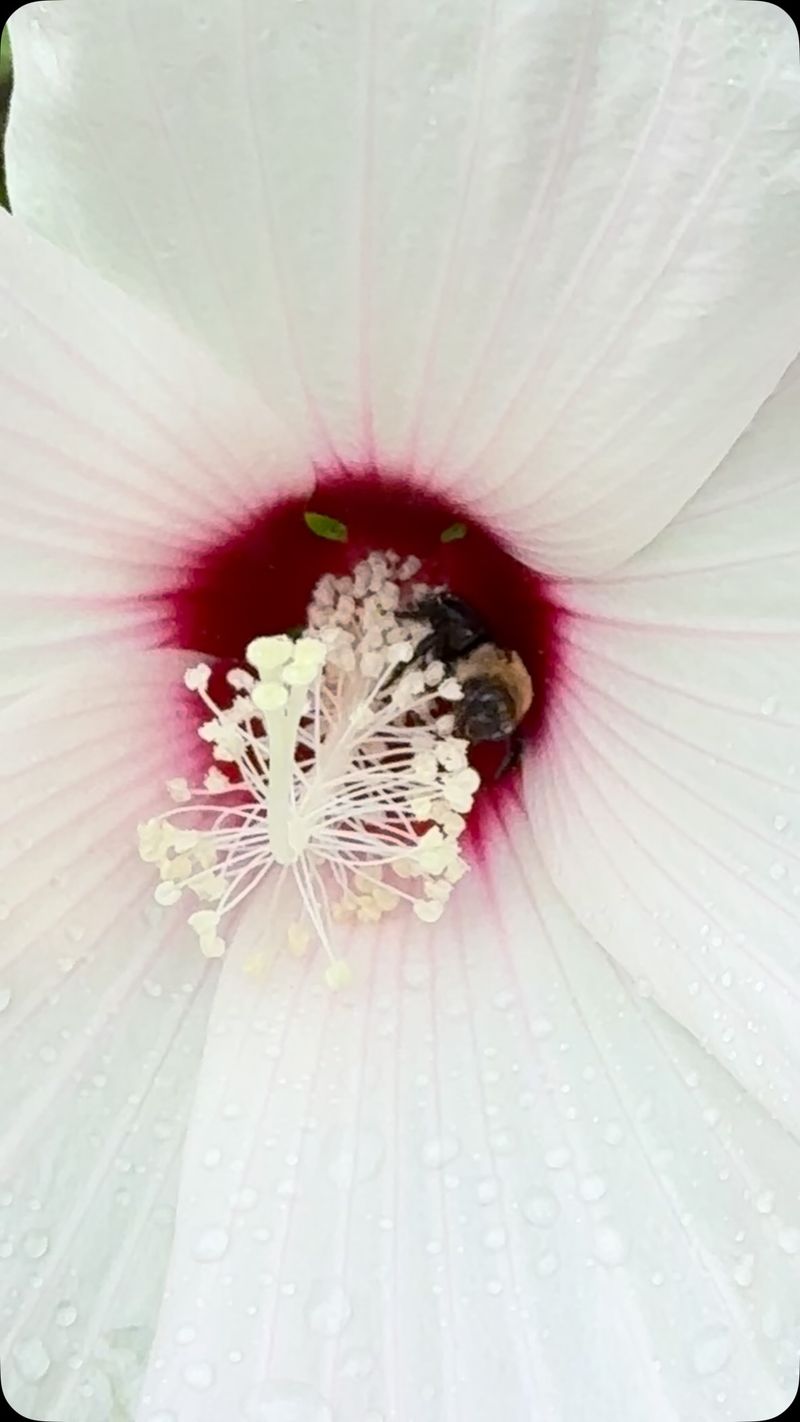
Rose-mallow’s flowers provide nectar and pollen for a range of pollinators, and that wildlife value is one of the stronger reasons to include it in a North Carolina yard. Bees, butterflies, and hummingbirds are all documented visitors.
One particularly notable association is with Ptilothrix bombiformis, a specialist hibiscus bee that collects pollen almost exclusively from hibiscus flowers. The NC State guide to the bees of North Carolina documents specialist bees like this one as particularly dependent on specific host plants, making the presence of rose-mallow potentially meaningful for that species at the local level.
Pollinator visits are not guaranteed, though. Whether bees, butterflies, or hummingbirds actually show up depends on factors the plant itself cannot control: local insect populations, pesticide use in the surrounding area, weather patterns, and whether the yard provides bloom succession across spring, summer, and fall.
A single plant in an otherwise sparse yard will attract less activity than the same plant surrounded by a layered, diverse planting. NC State’s native plants handbook recommends multiple species blooming across all three seasons to support pollinators reliably, and rose-mallow fits best as one component of that succession rather than a standalone solution.
Flower accessibility also matters when selecting cultivars. Standard single-flowered forms allow bees and other pollinators to reach the reproductive structures directly.
Double-flowered cultivars, which have extra layers of petals, can restrict that access and reduce the plant’s value to visiting insects even if it looks more elaborate.
NC State advises leaving dead rose-mallow stems 12-24 inches high for a period after the season ends, because native bees may use hollow stems for nesting. The practical approach is to leave them temporarily through winter and remove them gradually as they begin to disintegrate, rather than cutting everything to the ground immediately after the first frost.
That small adjustment costs little effort and provides a measurable habitat benefit.
Verify the species and inspect the plant’s form
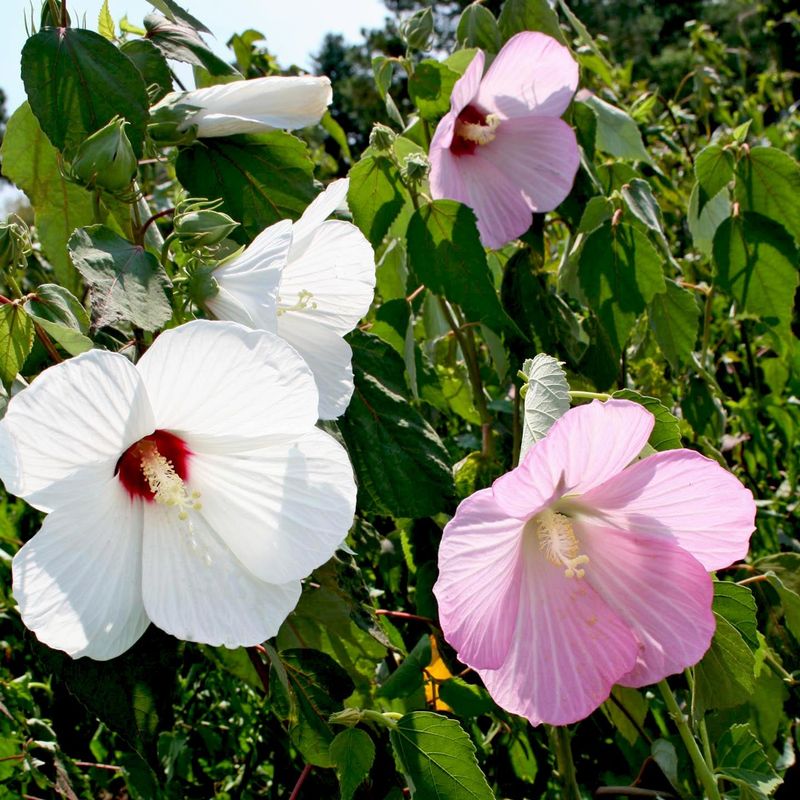
Nursery shopping for rose-mallow requires a moment of label scrutiny because several unrelated plants share similar common names. Tropical hibiscus – the container plant sold in bright orange and red at garden centers – is not cold-hardy in most of North Carolina and is not the same species.
Rose of Sharon (Hibiscus syriacus) is a woody shrub that is also distinct from the native rose-mallow and is considered invasive in some parts of the eastern United States. Buying either of those by accident will produce a very different plant from what this article describes.
The name to confirm is Muenchhusia moscheutosHibiscus moscheutos, which is the current accepted scientific name used by NC State’s Plant Toolbox. The former name, , is still widely used on nursery tags and in older references, and it refers to the same plant.
Either name on a tag, combined with common names like “swamp rose-mallow,” “hardy hibiscus,” or “wild cotton,” points to the correct species.
Cultivar selection adds another layer of complexity. Many of the rose-mallows sold at garden centers are cultivars or hybrids bred for shorter stature, larger flowers, or unusual colors.
Those traits can make a cultivar easier to fit into a residential border, but they do not make it ecologically identical to the straight species. NC State’s native plants chapter notes that cultivars and hybrids of native species may perform better, worse, or similarly for wildlife depending on their specific traits.
Double-flowered forms are the clearest example: the extra petals that make the flower look fuller can physically block bees from reaching pollen and nectar.
Heat and humidity tolerance do not make rose-mallow immune to pests or disease. Japanese beetles can cause significant foliage damage, and sawfly caterpillars are another documented pest.
Disease threats include leaf spots, blights, rust, and canker. Inspect plants at the nursery before purchasing, and monitor established plants through the season.
Good air circulation and appropriate site conditions reduce disease pressure, but they do not eliminate it entirely.
Choose rose-mallow when your yard can meet its conditions
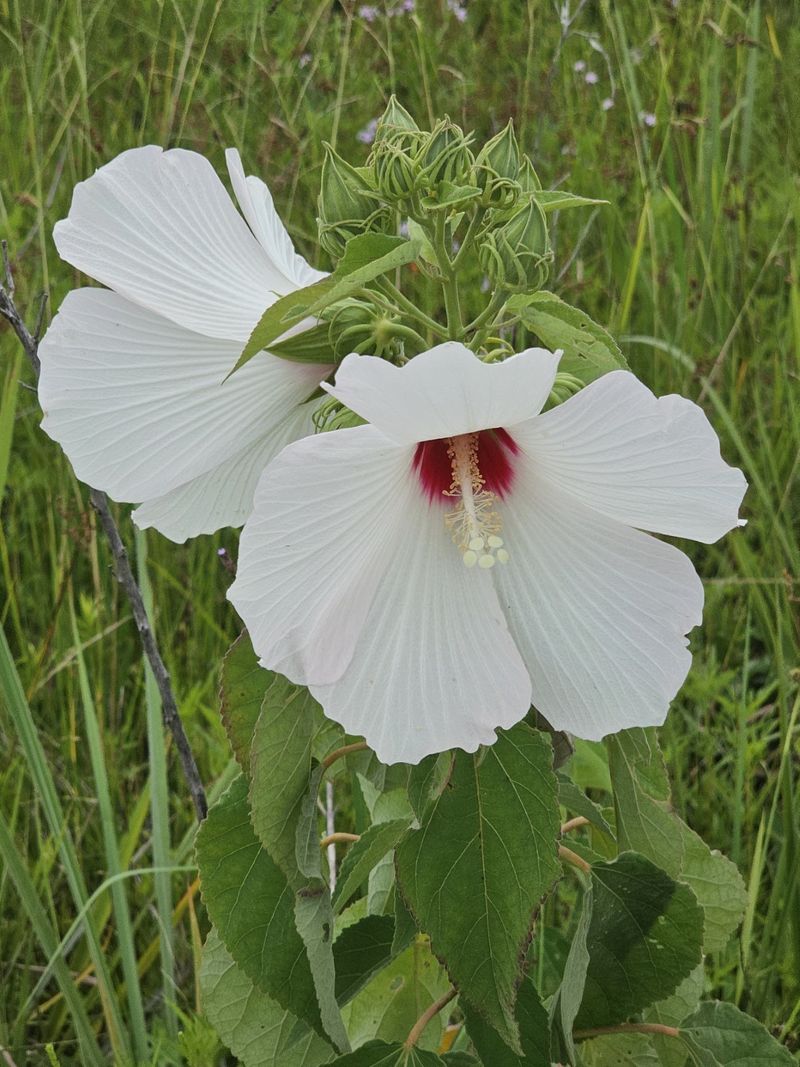
Swamp rose-mallow is a strong choice for a North Carolina homeowner who has a sunny spot with reliably moist or wet soil and room for a perennial that can reach 5 or 6 feet. Under those conditions, it produces large flowers in succession from midsummer into early fall, with August falling squarely within that documented bloom window.
The potential for pollinator visits – including specialist bees, butterflies, and hummingbirds – adds wildlife value that few late-summer natives can match at that scale.
The plant still needs consistent moisture after establishment, sensible mulching, adequate air circulation, and honest site assessment before planting. NC State’s profile and the NC State native plants handbook are both clear that native status does not replace those fundamentals in a residential landscape.
For a dry, sandy, or shaded yard, a different plant will serve better. But for the right site, rose-mallow offers something genuinely useful: a native perennial that holds up through North Carolina’s most difficult gardening month because its conditions are met, not simply because summer arrived.