
What It Really Means When Robber Flies Start Patrolling Your North Carolina Vegetable Beds
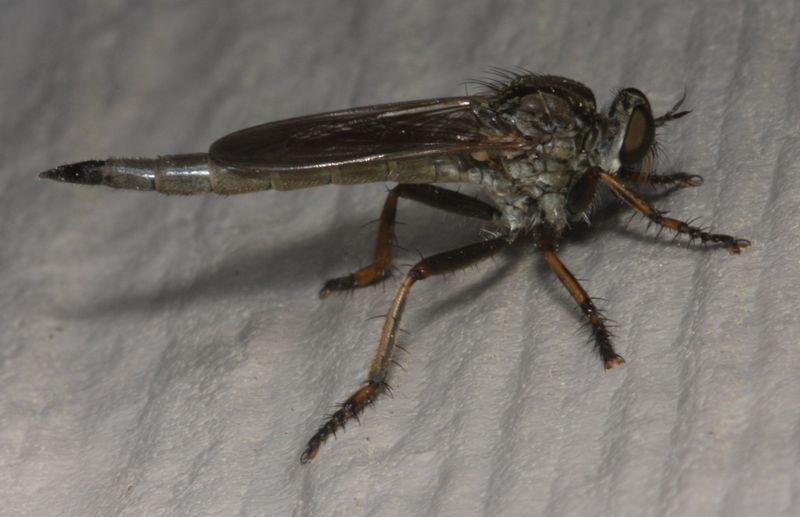
Spend enough time in a sun-drenched North Carolina vegetable bed on a July afternoon and you may notice a large, bristly fly hovering like a tiny hawk before launching off a tomato stake. That insect is a robber fly, and its presence raises a fair question: is it helping your garden, hurting it, or simply passing through?
Knowing what these predators actually do, and what their arrival cannot tell you, will make you a sharper observer and a more careful steward of your yard.
The bristly patrol belongs to a family of predatory flies
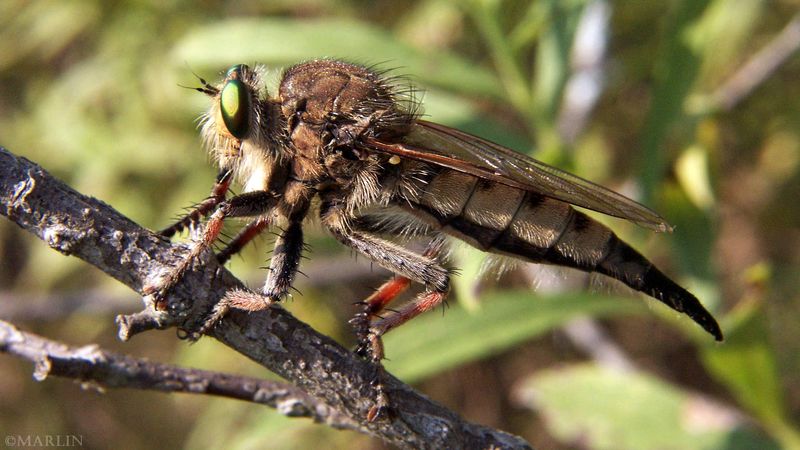
Spotting an unfamiliar insect hovering over your pepper plants can send a gardener reaching for a spray bottle before the creature even lands. Pause before doing that, because the big, bristly fly perched on your fence post almost certainly belongs to the family Asilidae, commonly called robber flies, and a few quick field marks will help you tell it apart from the insects it resembles.
Start with the face. NC State Extension’s profile of robber flies describes a characteristic beard or cluster of bristles on the face, combined with a noticeable hollow or depression between the large compound eyes.
That concave face, sometimes called the mystax, is one of the most reliable field marks you can find without a magnifying lens. Pair it with long, spiny legs, a single pair of wings (not two pairs like a wasp), and a long abdomen that often tapers to a point, and you have a working description of a robber fly.
One complication is that some robber fly species have evolved to look convincingly like bees or yellow jackets, complete with banded coloring and a buzzing flight. The mimicry is protective rather than aggressive, but it can fool a careful gardener.
Checking for that bristled face and single wing pair will usually clear up the confusion. A horse fly, which is also a true fly, has much larger eyes that meet or nearly meet at the top of the head and lacks the bristled face and tapered body shape.
Robber flies are flies, not wasps, and identifying them correctly matters because the right response to seeing one is observation rather than control. Misidentification leads to unnecessary spraying that can harm the natural predators and pollinators already working your yard.
Take a moment to look before you act.
Why hot, bright weather turns the garden into a hunting stage
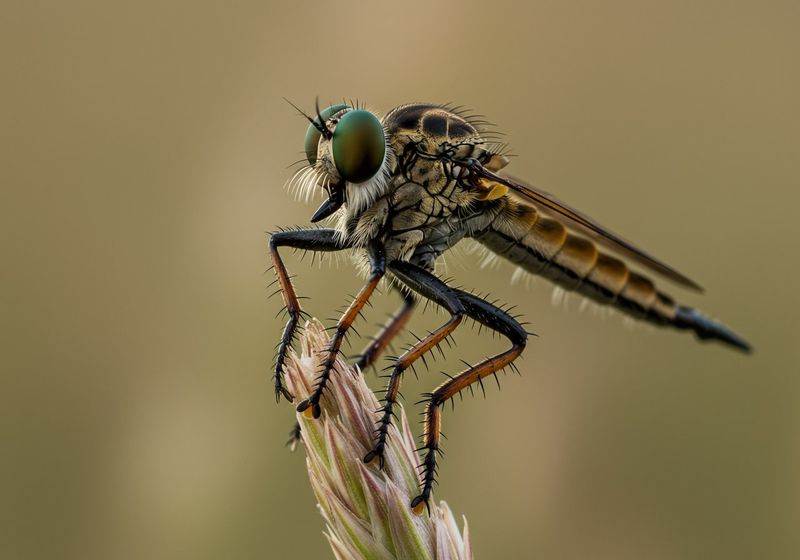
On a blazing August afternoon in the Piedmont or Coastal Plain, robber flies seem to appear from nowhere, darting off fence rails and tomato cages with surprising speed. Their sudden visibility on hot days is not a coincidence, and understanding the reason helps you interpret what you are actually seeing.
Adult robber flies are sit-and-wait predators. They choose an exposed perch, whether a stem, a twig, a fence wire, or a wooden stake, and scan the surrounding airspace.
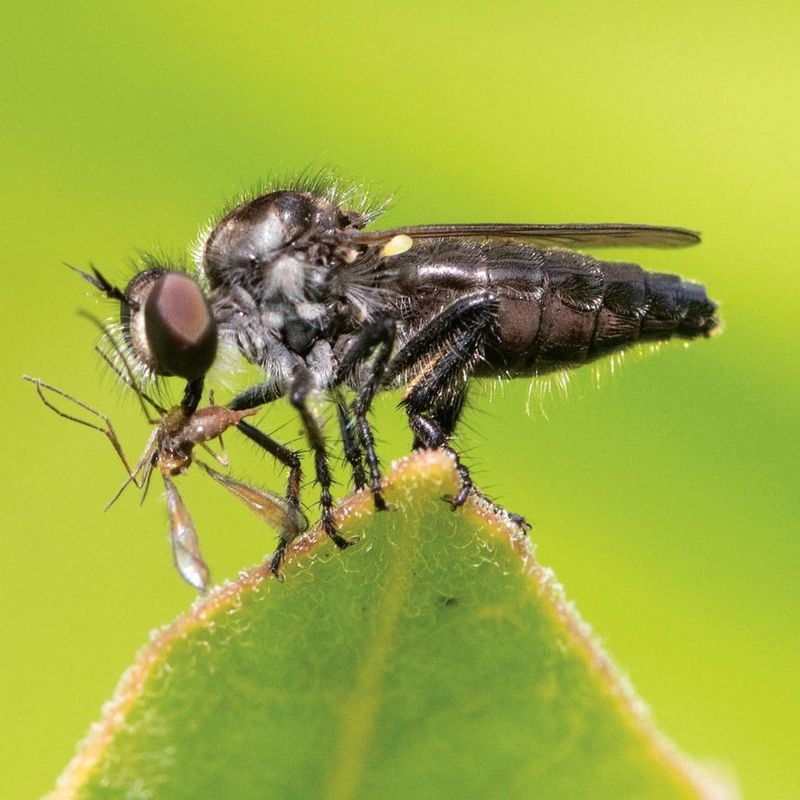
When a suitable insect flies past, they launch, intercept the prey in midair, and return to a perch or nearby vegetation. University of Florida IFAS Extension’s detailed account of Asilidae describes how robber flies inject captured prey with saliva containing neurotoxic and digestive enzymes.
Those compounds immobilize the victim quickly and begin breaking down its internal tissues, allowing the fly to consume the liquefied contents through its piercing mouthparts. The whole process can happen in seconds.
Sunny, open conditions amplify this activity in a specific way. Research published in Animal Behaviour on Efferia robber flies found that these insects adjust their perch height, body posture, and orientation relative to the sun to regulate their own body temperature.
On hotter days, those thermoregulatory adjustments keep them active and hunting rather than retreating to shade. Open, sunny garden beds provide exactly the kind of exposed structure that supports this behavior.
One practical point worth keeping in mind: robber flies hunting along the edge or above a vegetable bed are primarily intercepting insects that are flying through the airspace. They are not systematically searching vegetable leaves the way a ladybug hunts aphids.
The action you see from across the yard may look like a close patrol of the crop, but the flies may be hunting well above the foliage itself.
What does their arrival actually tell you?
Seeing a robber fly work the edge of your bean row is genuinely interesting, but resist the urge to read too much into it. Their presence carries real information, and it also carries real limits.
On the useful side, a robber fly hunting near the garden tells you the yard offers exposed, sunny perching space and enough flying or otherwise accessible insects to make the area worth visiting. University of Wisconsin Extension’s overview of Asilidae notes that robber fly activity may reflect prey availability in the area, as well as open habitat conditions that suit the insect’s hunting style.
A sunny raised bed surrounded by a mixed landscape fits that description well, whether you are gardening in the sandy soils of the Coastal Plain or on a mountain-side plot in western North Carolina.
What their presence cannot tell you is more important for decision-making. A robber fly perched on your squash vine does not prove that squash bugs are present, that aphid populations are climbing, or that any particular crop pest is being reduced.
Robber flies are generalist hunters. They respond to available prey and favorable conditions, not to a specific outbreak on a specific crop.
Their prey list is broad enough that the insect they just caught could have been a beneficial wasp, a passing moth, a leafhopper, or a hoverfly rather than a pest chewing your cucumbers.
Activity along the sunny edge of a bed can also reflect conditions in the surrounding landscape rather than conditions on the crop itself. A nearby woodland edge, a grassy margin, or a neighbor’s flowering shrubs can all produce the flying insects that draw robber flies into your yard.
NC State Extension specifically cautions that robber flies are not selective and do not manage specific pests, which means a sighting is a clue about hunting conditions, not a diagnosis of the vegetable bed.
“Beneficial” does not mean selective
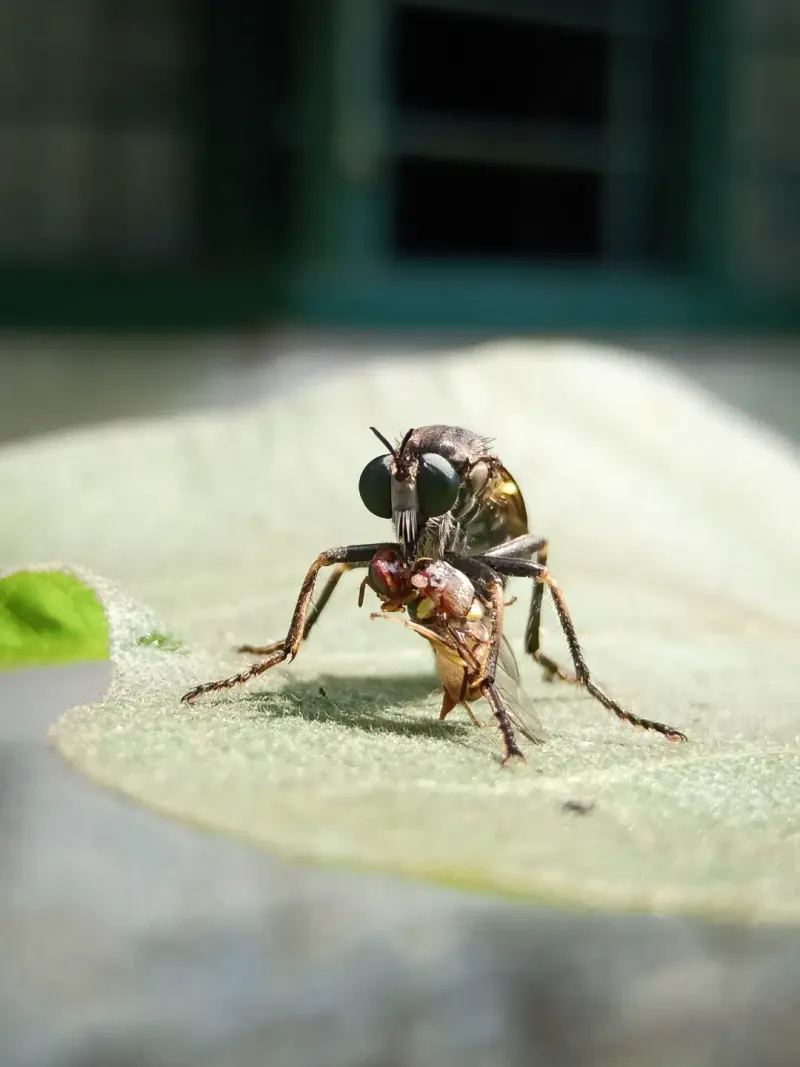
Calling robber flies beneficial is accurate, but the label can create a false sense of security if it leads you to assume they are quietly eliminating the insects damaging your crops. A broader look at what they actually eat explains why that assumption falls apart.
Robber fly prey includes a wide range of insects. The University of Florida IFAS Extension document on Asilidae lists flies, beetles, grasshoppers, leafhoppers, wasps, bees, moths, dragonflies, and other insects among recorded prey items.
That list covers both insects you would rather not have in the garden and insects you actively want there, including pollinators and other predators. A robber fly does not distinguish between a squash vine borer moth and a parasitic wasp that might have parasitized a caterpillar on your tomatoes.
Wisconsin Extension notes that the role of robber flies in natural pest control is poorly studied, meaning their specific crop-protection value is genuinely uncertain rather than simply underappreciated.
Their generalist appetite is why NC State Extension describes them as generally beneficial without recommending them as a targeted control strategy for any particular vegetable pest. Being broadly predatory makes them a real part of the garden’s natural predator community without making them a reliable tool against one named problem insect.
The larval stage adds another layer of complexity that rarely gets mentioned. Immature robber flies are almost never seen in a home garden because they live in soil, decaying wood, leaf litter, or similar organic habitats below or beside the visible landscape.
Larvae of some species prey on insect eggs, grubs, and other soft-bodied organisms found in those substrates. Development timelines and specific prey vary by species, and some robber flies take more than one year to complete their life cycle.
North Carolina spans enough geography, from Coastal Plain flatwoods to mountain hollows, that species composition and seasonal timing can differ meaningfully from one region to another, so no single life-cycle description covers every robber fly you might encounter across the state.
Let the vegetables—not the flies—set your next move
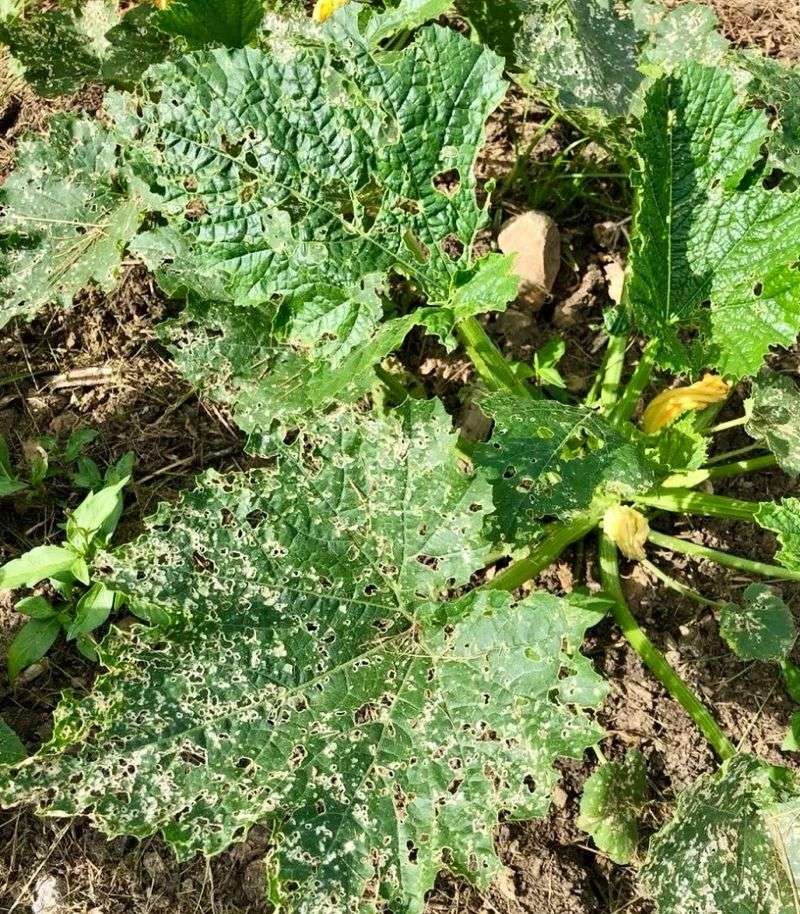
Watching a robber fly work your garden is satisfying, but the plants themselves are the real scorecard. Your next action after a sighting should be a close look at the crop, not a decision about the fly.
Walk the bed and inspect both surfaces of leaves, especially the undersides where many pests feed or lay eggs. Look for feeding damage, such as holes, stippling, wilting, or distorted growth, and try to match the damage pattern to the insect causing it.
An unidentified pest is hard to manage effectively, and treating for the wrong insect wastes resources and can harm non-target organisms. NC State Extension’s integrated pest management chapter lays out a practical sequence: monitor regularly, identify the pest accurately, compare the level of damage with a threshold that reflects your own tolerance and the plant’s stage of growth, and then choose the least disruptive effective response.
That sequence applies whether you are dealing with a handful of aphids on a bean plant or a more serious infestation of squash bugs.
A robber fly sighting is not a treatment trigger. The fly’s presence near the bed does not confirm that a pest is present, and the absence of robber flies does not mean pests are winning.
Those decisions belong to what you can actually document on the plant. NC State’s vegetable gardening guidance reinforces that consistent monitoring is the foundation of good garden management, because catching a problem early, before populations build, gives you the most options and typically requires the least intervention.
When you do find a real pest problem, the threshold question matters. A few aphids on a healthy tomato plant may not justify any response at all, while a heavy squash bug infestation on young plants could threaten the whole crop.
Set your own threshold based on crop value, plant age, and how much damage you can tolerate, then act on that number, not on the presence or absence of any predator flying overhead.
Protect the hunting space without trying to manufacture a patrol
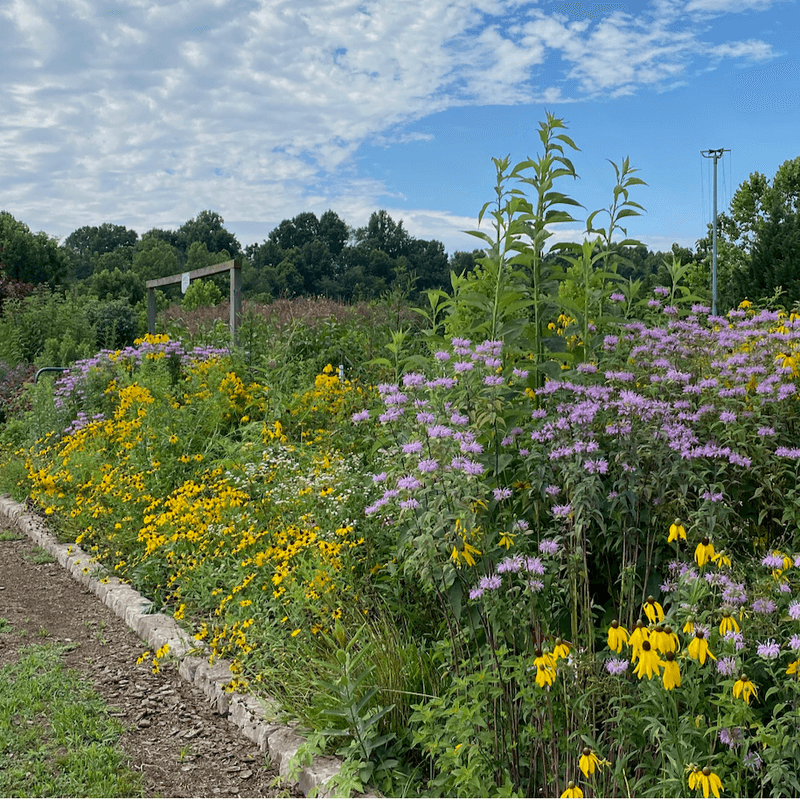
Once you understand what robber flies need, you realize that the best thing most North Carolina gardeners can do for them is simply avoid making the yard hostile. That is a goal worth pursuing regardless of whether robber flies are present.
Routine, broad-spectrum insecticide applications are the most direct way to reduce the natural predator community in a yard, including robber flies and the many other beneficial insects that hunt, parasitize, or outcompete crop pests. Keeping that community intact means reserving sprays for situations where a specific pest has crossed a damage threshold you have set, not using them as a precaution or a calendar treatment.
Washington State University’s Hortsense resource on predatory flies notes that maintaining a diverse landscape with locally appropriate plants can support wildlife and beneficial insects generally, though no single plant has been shown to reliably attract robber flies or make them control a particular vegetable pest.
That nuance matters for North Carolina gardeners, where advice needs to account for real regional differences. A native plant that thrives in the moist soils of a Piedmont yard may not suit a Coastal Plain garden or a mountain slope.
NC State Extension’s native plants chapter recommends matching plant choices to local ecoregion and site conditions rather than following a one-size recommendation. A diverse planting of locally appropriate native species supports the broader insect community, which in turn supports predators like robber flies, but the mechanism is general rather than targeted.
If a pest problem does require treatment, follow these principles. Target only the identified pest.
Read and follow the label completely, because the label is the law. Limit the treated area to where the infestation is actually occurring.
Avoid spraying blooming plants or areas where pollinators are actively foraging. North Carolina Department of Agriculture guidance for homeowners puts it plainly: if in doubt, do not spray.
As for the robber flies themselves, observe them from a comfortable distance. They are not blood-feeders and rarely approach people, but a fly that is grabbed or cornered can deliver a surprisingly painful bite, so admiration from arm’s length is the right posture.
Treat the patrol as a clue, not a crop-protection guarantee
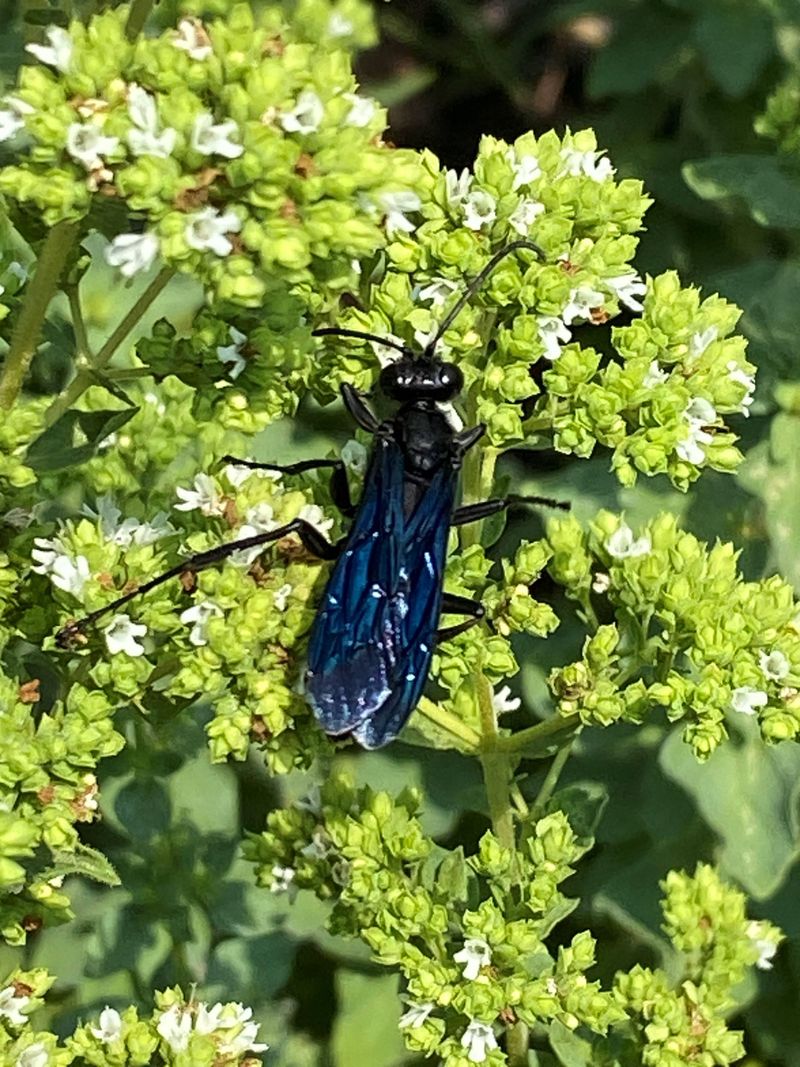
A robber fly hovering over the garden on a hot, sunny afternoon is a predator working in conditions that suit it well. That is genuinely good news for a stewardship-minded gardener, and it deserves a moment of appreciation rather than alarm or overconfidence.
What that fly cannot do is substitute for your own inspection of the plants. NC State Extension is clear that robber flies are generalists that do not manage specific pests, so their presence near the bed does not confirm that your squash bugs or caterpillars are being controlled.
Base any decision to treat on the pest you can identify and the damage you can measure, following the threshold-based approach NC State IPM guidance recommends.
Keep watching the plants, keep watching the flies, and let each one tell you what it actually knows. A yard that supports predators, pollinators, and a diverse insect community alongside a productive vegetable bed is the real goal, and a robber fly on a fence rail is one quiet sign that the habitat is doing something right.