
If You’ve Only Ever Tossed Garlic In The Pan, Here’s The Defense Weapon It Builds The Instant You Crush It
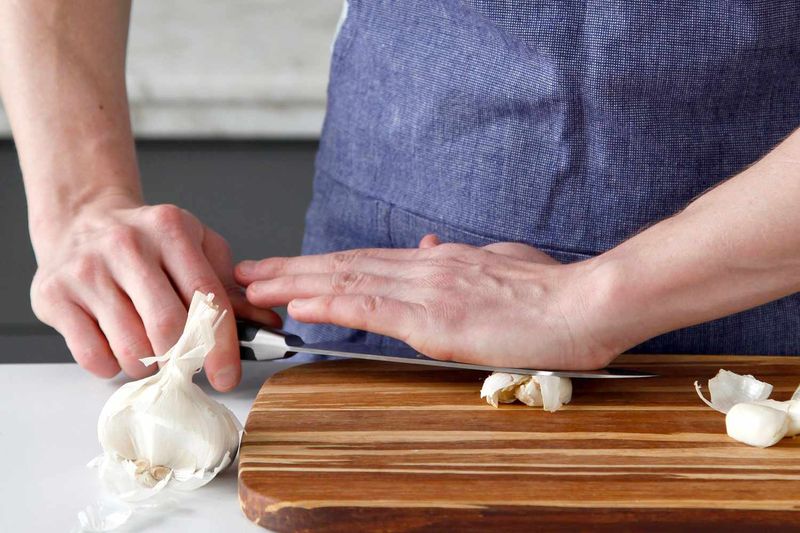
Most home cooks toss a whole garlic clove straight into a hot pan without a second thought, but something interesting happens the moment you crush it instead. Inside an undamaged clove, two ingredients that create garlic’s sharpest chemistry are stored in separate compartments, kept apart like two halves of a reaction waiting to happen.
Crushing breaks that separation and kicks off a rapid chemical process that a whole clove sitting in hot oil simply never gets the chance to start. Understanding what that process actually does, and what it does not do, can change the way you prep garlic every time you cook.
The clove keeps its defense ingredients apart
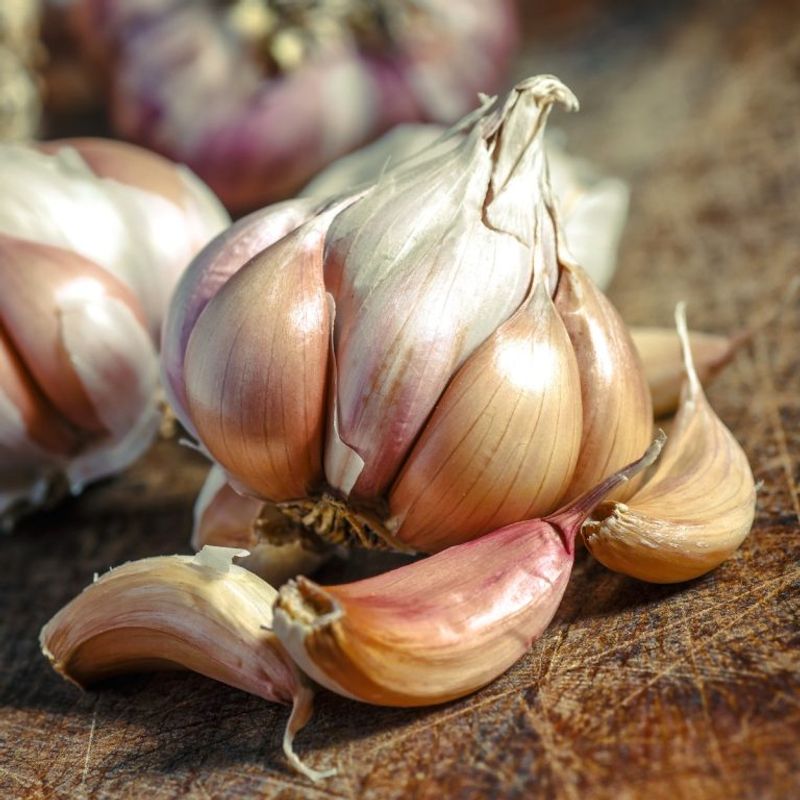
Peel back a garlic clove and you are looking at something that appears uniform all the way through, just pale, firm, slightly waxy flesh. What you cannot see is that the clove is running a careful storage system, keeping two reactive ingredients physically separated inside its cells so they cannot combine until the plant needs them to.
One of those ingredients is a sulfur-containing amino acid called alliin. It sits mainly in the cytoplasm, the fluid-filled body of the cell.
The other is an enzyme called alliinase, and structural analysis of alliinase from garlic shows it is compartmentalized inside vacuoles, including specialized cells clustered near the vascular bundles that run through the clove. Think of those vacuoles as sealed storage sacs.
As long as the cell walls stay intact, alliin and alliinase never meet in any meaningful amount.
This arrangement is not an accident of garlic biology. Many plants in the Allium family use a similar strategy, storing reactive precursors and their activating enzymes apart until something physically disrupts the tissue.
When a bug chews through a clove, or a fungal thread punctures a cell wall, the separation collapses and the chemistry begins. The plant does not need to sense the attack and send a signal; the damage itself is the trigger.
Because alliin and alliinase are kept apart, a review of allicin’s chemistry and cellular effects confirms that an intact clove contains no meaningful ready-made dose of allicin. The compound that gives freshly crushed garlic its sharp, eye-watering punch does not exist yet inside a whole, undamaged clove.
It has to be made, and making it requires breaking the tissue first.
Crushing starts the allicin reaction
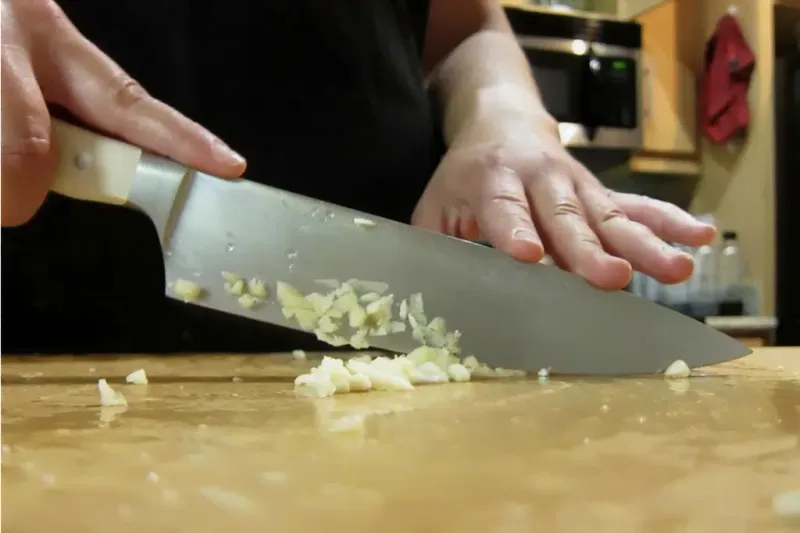
The moment a knife blade presses down on a garlic clove and the tissue gives way, the separation that kept alliin and alliinase apart is gone. Cell walls rupture, vacuoles burst, and the enzyme meets its substrate.
Alliinase begins converting alliin into allicin, the volatile sulfur compound responsible for that sharp, almost stinging aroma that rises off a freshly crushed clove.
According to a detailed review of allicin’s chemistry and biological effects, the reaction begins quickly after tissue damage rather than at a single measurable instant. The rate and the total amount of allicin formed depend on several interacting variables: the garlic variety, how thoroughly the tissue is disrupted, how much moisture is present, the local pH, the temperature, and how much time passes before the garlic is used or heated.
A press that fully crushes the clove exposes more cellular surface than a rough chop, and a fine mince exposes more still. Garlic varieties also differ in their starting concentrations of alliin, so two cloves of similar size from different varieties can yield noticeably different amounts of allicin from the same preparation.
Fresh, firm garlic tends to produce more than older cloves that have begun to dry out.
Research on allicin’s chemistry and biological properties notes that the compound itself is chemically reactive and relatively unstable, meaning it can begin breaking down into other sulfur compounds fairly quickly after it forms, especially at higher temperatures. That instability is part of what makes the timing and method of preparation matter.
The reaction is real and it starts fast, but the word “instantly” belongs to the poetry of cooking rather than the precision of chemistry.
Allicin acts like a plant-defense chemical
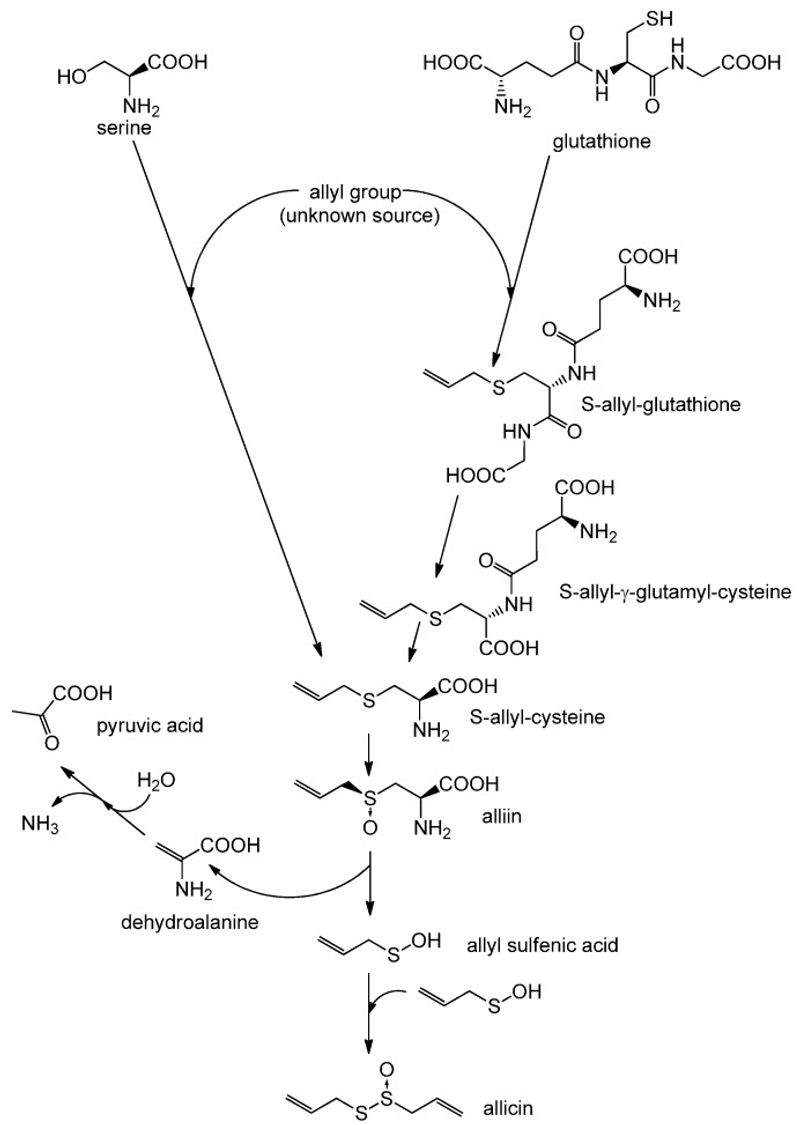
Calling allicin a defense weapon is a useful metaphor, but the actual mechanism is worth understanding on its own terms. Allicin works by reacting with thiol groups, which are chemical groups containing sulfur that appear in many proteins and enzymes.
When allicin latches onto those groups, it can interfere with how those proteins function.
A review of the antibacterial properties of garlic’s organosulfur compounds describes laboratory activity against both Gram-positive bacteria, like Staphylococcus aureus, and Gram-negative bacteria, like Escherichia coli. The breadth of that activity makes sense given the mechanism: thiol groups appear across many different bacterial species, so allicin does not need to target a specific bacterial protein the way a pharmaceutical antibiotic does.
It disrupts a more general chemical feature of living cells.
That broad reactivity is also why allicin is better understood as a plant-defense molecule than as a precise drug. A pharmaceutical antibiotic is designed to hit one specific target in one type of organism while leaving human cells alone.
Allicin reacts with thiol groups wherever it finds them, which means it can affect mammalian cells too at sufficient concentrations. At the amounts present in crushed garlic used for cooking, the exposure is low and the food is safe to eat, but the chemistry is not selective in the way a targeted medicine would be.
Beyond antibacterial activity, experimental research has also shown antifungal, antiparasitic, and membrane-disrupting effects, as well as some evidence for herbivore deterrence in plants. A review of garlic extracts in plant protection research notes that these effects are species-, formulation-, and dose-dependent.
That means the finding that allicin disrupts a particular fungal cell membrane in a laboratory dish does not automatically translate into a reliable spray treatment for every garden pest or plant disease you might encounter.
Laboratory antibacterial activity has a clear boundary
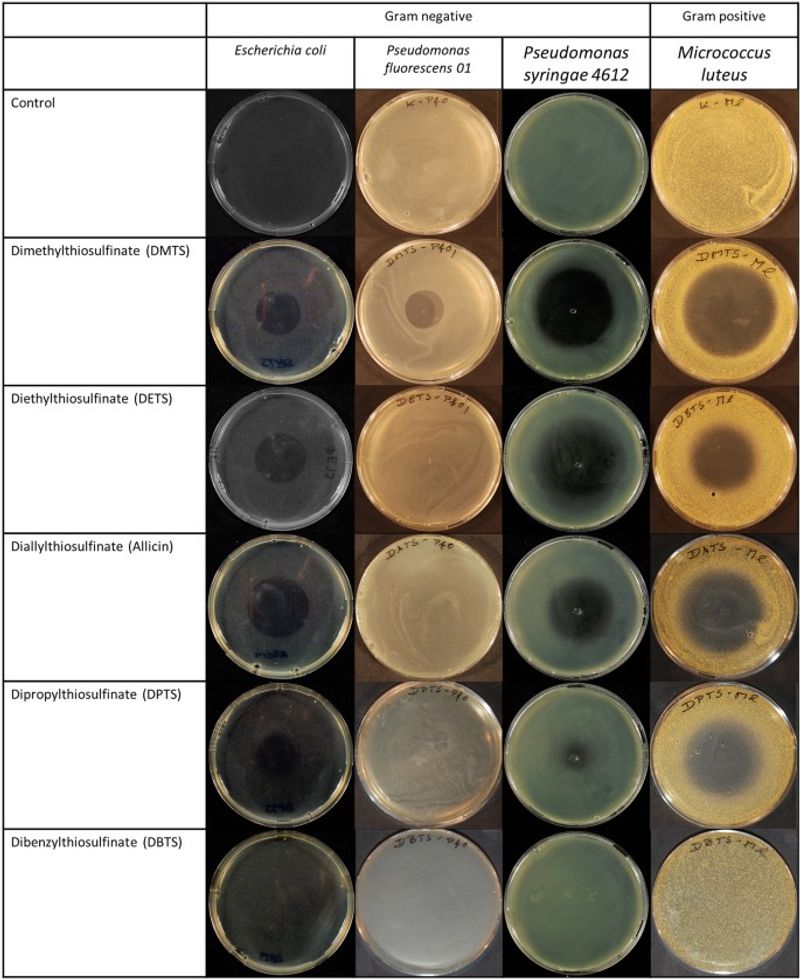
Lab results involving garlic are genuinely interesting, but they come with a context that matters as much as the findings themselves. When researchers test garlic’s antibacterial activity, they typically work with purified allicin or concentrated garlic extracts, applied directly to bacterial cultures under carefully controlled conditions.
That setup is far removed from eating a crushed clove sauteed in olive oil.
A study on the antibacterial potential of garlic-derived allicin found that authentic allicin was substantially less potent than several clinical antibiotics against the bacteria it tested. The study also showed that allicin’s activity could be cancelled by sulfhydryl compounds, which are thiol-containing molecules present in biological environments.
That detail matters because the human body is full of thiol-containing compounds that can react with allicin before it reaches any bacterial target.
The gap between a petri dish and a human body is significant. Digestion, absorption, and the chemistry of blood and tissue all affect what a compound actually does after you eat it.
Crushing garlic produces allicin, and allicin shows measurable antibacterial activity in controlled experiments. Those are accurate statements.
What those statements do not support is the idea that crushing garlic creates a medical-grade antibiotic, cures an active infection, or means that eating pan-cooked garlic will sterilize your food or treat an illness.
NCCIH guidance on garlic’s usefulness and safety states that evidence for many of garlic’s promoted health uses remains limited or uncertain. That is not a dismissal of garlic as a flavorful and nutritious food.
Garlic belongs in the kitchen. The point is simply that the laboratory chemistry and the clinical evidence are not the same thing, and treating them as equivalent can lead people away from treatments that actually work.
Heat changes the chemistry, not all of garlic’s chemistry
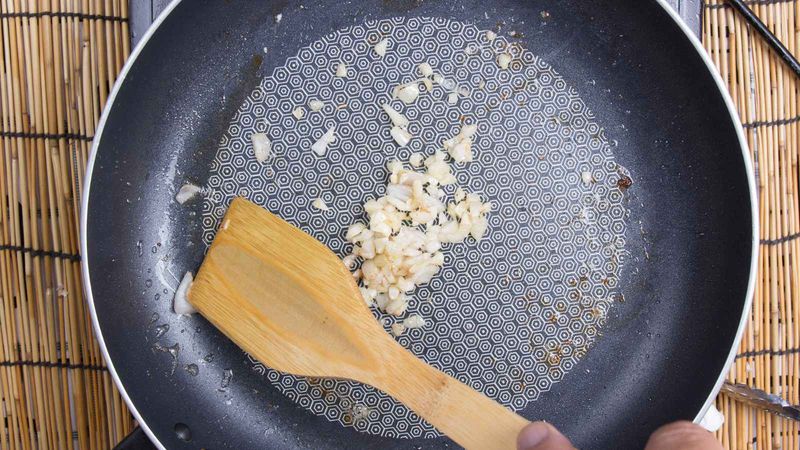
Once crushed garlic hits a hot pan, a new set of changes begins. Heat inactivates alliinase, the enzyme responsible for converting alliin into allicin.
That means the enzyme-driven reaction slows and eventually stops as temperature rises, and very little new allicin forms once the garlic is cooking.
Research on temperature cycling and alliinase activity in garlic confirms that the enzyme is sensitive to heat and loses activity as temperature increases. If garlic goes straight from whole clove to hot oil without any crushing or resting period, alliinase is denatured before it has a real chance to work, and much of the alliin remains unconverted.
The garlic still tastes good, but the alliin-to-allicin reaction barely had time to begin.
What heat does not do is wipe garlic’s sulfur chemistry clean. Cooking produces its own set of organosulfur compounds, including various sulfides and polysulfides, through different chemical pathways that do not depend on alliinase.
Research on boiling and garlic’s hydrogen sulfide-releasing activity found that boiling actually enriched certain linear polysulfides and increased hydrogen sulfide release, a result that underscores how different cooking methods push garlic’s chemistry in different directions rather than simply erasing it.
A study tracking organosulfur compounds in human milk and urine after garlic consumption detected allyl methyl sulfide and related compounds after both cooked and roasted garlic, confirming that the body absorbs sulfur compounds from garlic regardless of cooking method. The chemical profile shifts with heat and time, but cooked garlic is not chemically empty.
Roasted garlic, long-simmered garlic, quickly sauteed garlic, and raw garlic are four different chemical experiences in the same ingredient.
A brief pause may preserve more of the reaction
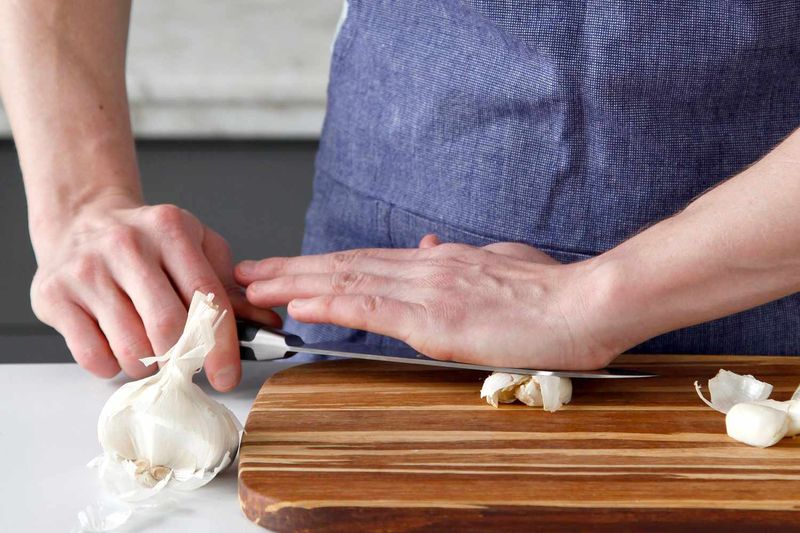
One practical habit that follows from understanding the alliin-alliinase reaction is simple: crush or mince the garlic before you add anything to the pan, and let it sit for a few minutes while you prep other ingredients. That short window gives alliinase time to work before heat shuts it down.
Research on the influence of heating on garlic’s anticancer-related properties found that garlic allowed to stand for 10 minutes before microwave heating retained activity that was lost when the garlic was microwaved immediately after crushing. That is a real and meaningful finding.
The catch is that it came from a specific experimental setup using microwave heating, and that result should not be stretched to cover every cooking method in your kitchen.
Sauteing, roasting, frying, and simmering all apply heat differently, at different temperatures and for different durations. A 10-minute rest before dropping garlic into a 400-degree roasting pan is a different situation than a 10-minute rest before microwaving.
A study on allicin bioavailability from garlic foods and supplements makes clear that allicin yield varies considerably with preparation conditions, reinforcing the idea that no single time threshold applies universally.
A separate study noted that 10 minutes after crushing was not always sufficient for complete alliin conversion under its own experimental conditions, which adds another reason not to treat that number as a magic rule. The useful takeaway is the habit, not the clock: damage the clove first, give it a few minutes if your recipe allows, then cook it as the recipe directs.
Research evaluating raw and steamed garlic’s anti-neuroinflammatory capacity also found differences based on preparation, further supporting the idea that how you handle garlic before heat matters, even if no single preparation is universally optimal.
Two garlic shortcuts create separate safety risks
Understanding that garlic has reactive chemistry can nudge some people toward using it in ways that carry real risks. Two shortcuts in particular are worth addressing directly, because both come up whenever garlic’s antimicrobial properties are discussed and both can cause harm.
The first involves applying fresh raw garlic to skin. Some people try this for acne, minor wounds, fungal patches, or insect bites, reasoning that if allicin disrupts microbial cells, it might help externally too.
NCCIH’s guidance on garlic safety warns clearly that fresh raw garlic can cause severe skin irritation and chemical burns. Allicin reacts broadly with thiol groups, and your skin cells contain plenty of them.
The same reactivity that makes allicin interesting in a lab dish makes it genuinely dangerous when held against living tissue for any length of time. Skip this one entirely.
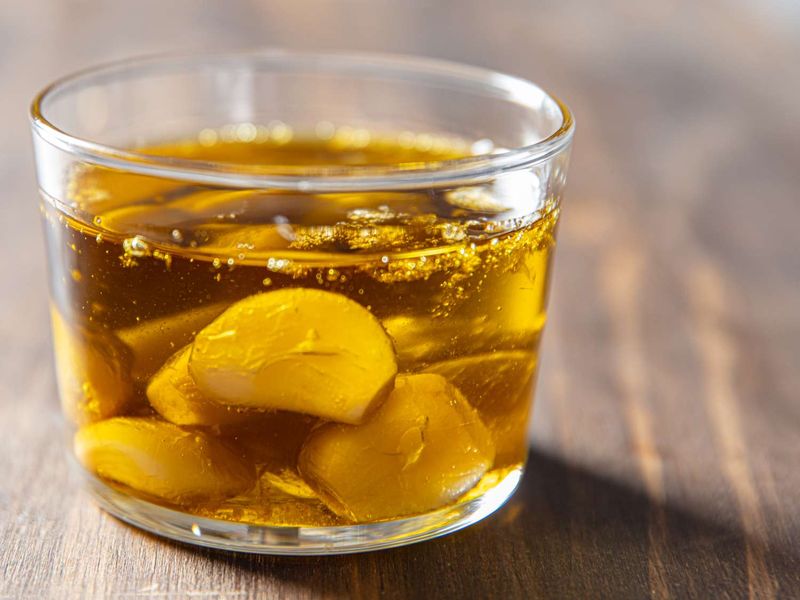
The second risk involves homemade garlic-in-oil mixtures stored at room temperature. Garlic submerged in oil sits in a low-oxygen, low-acid environment, and that combination can support the growth of Clostridium botulinum, the bacterium that produces botulinum toxin.
The oil does not have to look or smell bad for the toxin to be present.
University of Minnesota Extension guidance on oil-based products is explicit: homemade garlic-in-oil mixtures without a validated acidification or commercial-preservation process must be refrigerated and used within a short time. Room-temperature storage is not safe for these mixtures.
This is a different situation from garlic you add to a dish and cook promptly, or from commercially preserved garlic products that have been processed under validated food-safety conditions. If you make infused garlic oil at home, keep it cold and use it quickly.
Crush first, then cook with perspective
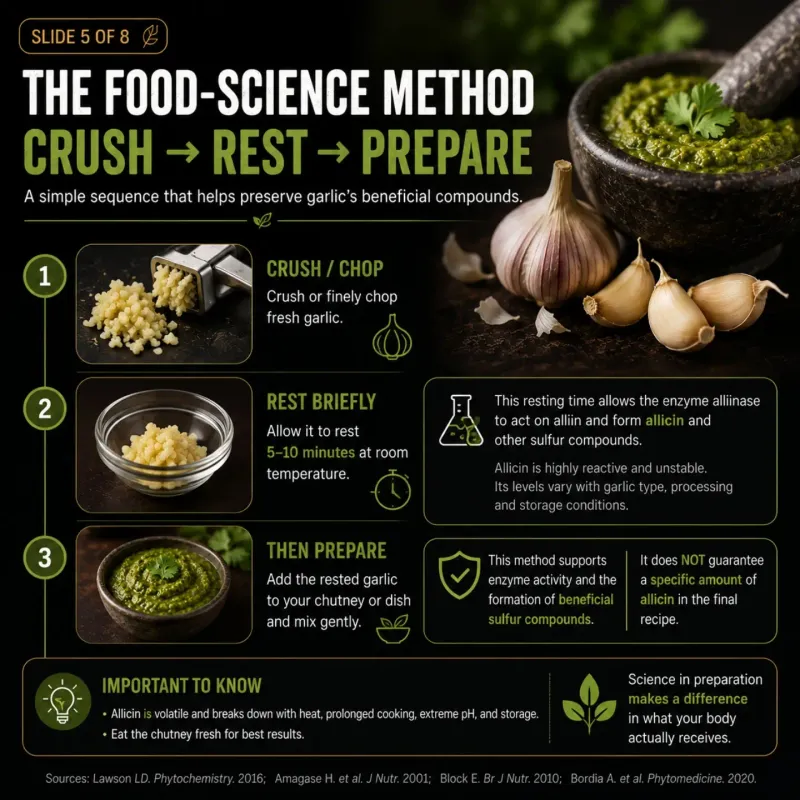
The practical habit here is straightforward: crush or mince the garlic before anything else, let it sit for a few minutes while you prep the rest of your ingredients, then add it to the pan when the recipe calls for it. That sequence gives alliinase a chance to work before heat slows it down, and it costs you nothing but a small shift in the order you reach for your knife.
The research on allicin’s chemistry makes clear that how much allicin forms depends on variety, disruption, moisture, temperature, and time, so no single pause length guarantees a specific result. A few minutes of resting is a sensible tactic, not a threshold that unlocks a fixed benefit.
The 10-minute finding came from a microwave-heating experiment and should not be treated as a universal rule for sauteing, roasting, or any other method.
Garlic’s laboratory antibacterial activity is real and interesting, but it does not make crushed garlic a treatment for infections or a proven spray for every garden pest. Cook with that knowledge in the background rather than as a headline claim.
The honest picture is this: crushing starts a defense chemistry that a whole clove tossed into hot oil never quite gets to build, and that chemistry is worth understanding even if it does not make your dinner plate a pharmacy.