
If You Toss Every Banana Peel, Here’s The Slow-Release Potassium Your Plants Pull Straight From The Rot
Banana peels have become a gardening shortcut that sounds almost too good to be true: toss one in the dirt, and your tomatoes or hydrangeas supposedly bounce back fast. The reality is more interesting and more useful than that promise.
Peels do contain potassium, and they can genuinely support your soil, but only after they break down and only when your plant actually needs what they offer. Understanding how that process works will save you from chasing a fix that may not match your plant’s real problem.
Potassium matters, but troubled leaves do not prove a deficiency
Potassium is one of the three major nutrients every plant depends on, and its jobs go well beyond simple feeding. According to Utah State University Extension, potassium helps regulate how plants use water, move sugars and starches from leaves to roots and fruit, develop strong root systems, and maintain quality in harvested produce.
It also plays a role in how well plants handle stress from heat, drought, and other environmental pressure.
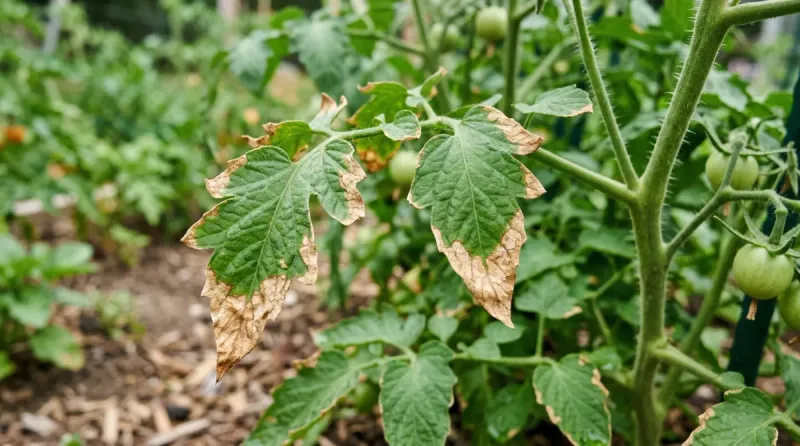
When potassium falls short, some general signs can appear. Older leaves may show browning or a scorched look along their edges, stems can seem weak or floppy, growth slows down, and fruit development may be reduced.
These are examples associated with deficiency, not a checklist that applies equally to every tomato, hydrangea, petunia, clematis, or geranium you grow. Each species has its own response, and University of Georgia Extension guidance on vegetable nutritional deficiencies makes clear that even within vegetables, symptoms vary considerably by crop.
The bigger issue is that drought, high soil salinity, root damage, fungal disease, poor drainage, pH imbalance, light problems, and other nutrient disorders can all produce leaf symptoms that look nearly identical to potassium deficiency. A plant wilting in July heat may be underwatered, not potassium-starved.
Browning leaf margins on a container geranium might reflect salt buildup from tap water or fertilizer residue.
Colorado State University Extension notes that visual symptoms alone are not a reliable way to diagnose which nutrient a plant is missing. That diagnostic uncertainty matters a great deal here: if you cannot confirm potassium deficiency from appearance alone, burying a banana peel beside a struggling plant is not a dependable first response.
You may be treating the wrong problem entirely while the real cause continues unchecked.
A raw peel is not a measured fertilizer dose
Picking up a banana peel from the kitchen counter and carrying it to the garden bed feels productive, but that peel is not a fertilizer product. It is a piece of raw organic matter with an unknown nutrient concentration and no predictable release schedule.
The potassium locked inside it becomes available only as the material decomposes and associated leaching moves nutrients into the soil, and the amount released and the timing of that release depend on moisture levels, soil temperature, microbial activity, and the condition of the peel itself.
Finished compost is a meaningfully different material. Oregon State University Extension’s guide to interpreting compost analyses reports a typical potassium range of about 0.5 to 1.5 percent of compost dry weight and describes compost potassium as equivalent to fertilizer potassium once it is present in finished material.
That range applies to analyzed, finished compost, not to individual fresh peels sitting in the soil. You cannot look at one peel, or a handful of peels, and calculate a dependable potassium dose from it.
Finished compost is more stable and easier to apply safely than raw scraps. The decomposition process that produces it reduces biological activity, breaks down plant material into more uniform particles, and results in something that behaves more consistently when you work it into a bed.
Even so, finished compost is still not a standardized fertilizer. Its nutrient concentration varies based on what went into the pile, how it was managed, and how long it cured.
The practical takeaway is that a fresh banana peel and a scoop of finished compost are not interchangeable. One is an input to a process; the other is the product of that process.
Treating them as the same thing is where most banana-peel fertilizer advice goes wrong, and it is the distinction that shapes every practical recommendation in this article.
Banana-peel studies show potential, not superiority
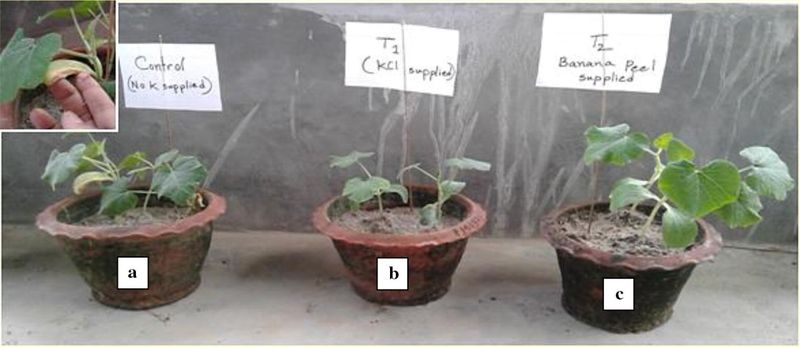
Controlled research on banana-peel compost does exist, and some of it is genuinely encouraging. A study published in PMC examining banana peel compost rates on Swiss chard growth found that compost derived partly from banana peels contained measurable potassium and was associated with improved crop performance at certain application rates.
Additional work published in journals focused on bioresource technology and agriculture has found similar results in controlled pot experiments using specific compost mixtures and non-US crops.
Those findings are worth knowing, but they come with firm limits. The experiments used particular feedstock blends, managed decomposition conditions, and crops that are not the same as a backyard tomato, hydrangea, or petunia growing in variable outdoor soil.
Results from a controlled pot study in a research setting do not transfer automatically to your raised bed or clay-heavy yard. The compost used in those studies was finished and analyzed; raw peels dropped into garden soil are a different starting point entirely.
The gap between promising research and reliable backyard results is especially clear when you look at popular shortcuts. University of Maryland Extension reviewed the claim that soaking banana peels in water creates a fertilizer-strength potassium solution and found no research supporting it.
Their assessment was direct: the nutrients available from food scraps alone are probably insufficient to fertilize plants, and the idea that banana water protects plants from drought has no scientific basis either.
Reading the research carefully means holding two things at once: banana peels can contribute to a potassium-containing compost, and that contribution has been observed under specific conditions. But no study establishes that raw peels reliably correct potassium deficiency in common garden plants, or that any banana-peel method outperforms a labeled commercial fertilizer applied at the right rate.
Finished compost gives banana peels a useful job
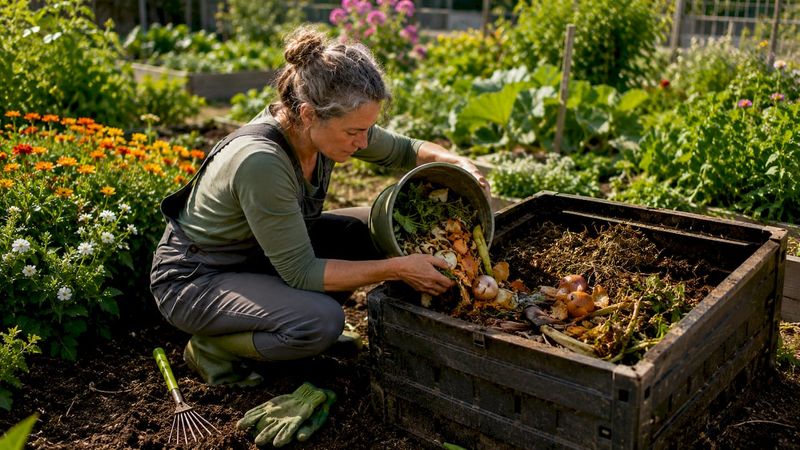
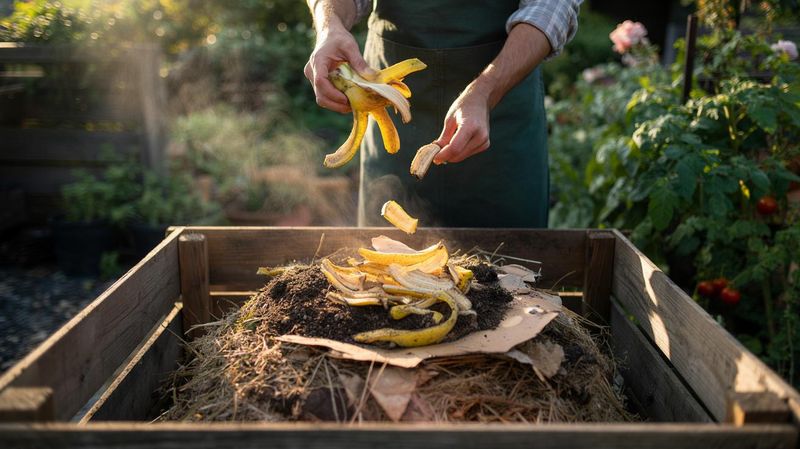
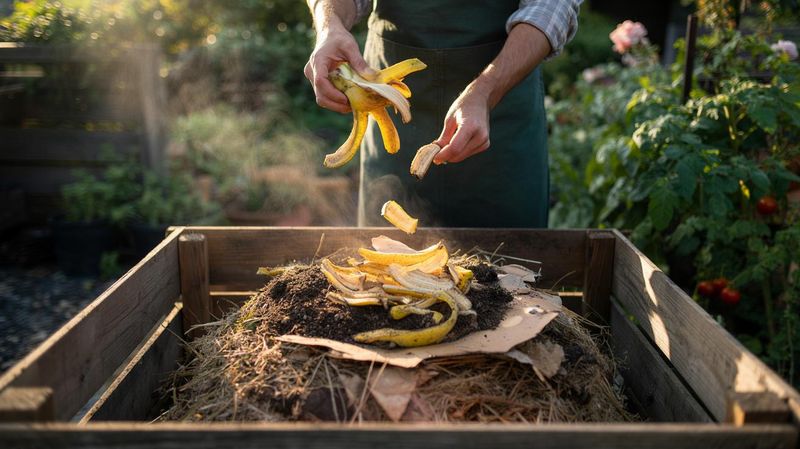
The best thing you can do with a banana peel is chop it up and add it to a compost pile. Chopping increases the surface area exposed to decomposition, which speeds breakdown and gets the peel through the process faster.
Toss the pieces into the pile with your other food scraps and yard waste, and you have given that peel a purpose it can actually fulfill.
Balancing your pile matters. EPA’s home composting guidance recommends roughly two to three parts carbon-rich brown materials to one part nitrogen-rich green materials by volume.
Browns include dry leaves, shredded cardboard, untreated wood chips, and shredded paper. Greens include fruit and vegetable scraps like banana peels, fresh grass clippings, and coffee grounds.
Cover each layer of food scraps with browns to reduce odors and discourage pests.
How long the pile takes to finish depends almost entirely on how much attention it gets. EPA notes that a well-maintained backyard pile, turned regularly and kept moist, may be ready in about three to five months.
An untended pile left to decompose on its own can take closer to a year. Turning the pile every week or two, keeping it about as moist as a wrung-out sponge, and maintaining the brown-to-green balance all push the process along.
Finished compost is dark, crumbly, and smells like earth rather than food. No recognizable scraps should remain.
Once it reaches that stage, you can work it into garden beds by incorporating two to four inches into the top six to nine inches of soil before planting, or spread a thinner layer on the surface as a mulch and keep it pulled back from plant stems. That guidance comes from general compost application recommendations, not from a banana-peel-specific potassium rate.
The goal is soil building over time, and banana peels contribute to that goal as part of a balanced pile, not as a shortcut to a measured nutrient dose.
OSU Extension’s compost analysis guidance reinforces this framing: the potassium in finished compost is a real contribution to your soil, but its concentration varies with every batch. Treat compost as a soil amendment with benefits that accumulate over seasons, and your banana peels will earn their keep.
Trench composting recycles peels without promising a quick fix
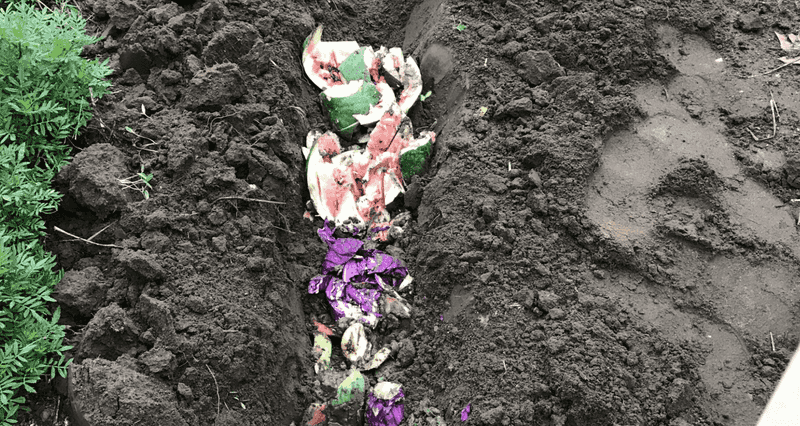
Not every gardener has space or motivation to maintain a compost pile, and that is where trench composting becomes a practical alternative. The method skips the bin entirely and lets decomposition happen directly in the ground.
University of Maryland Extension recommends burying fruit and vegetable scraps about eight to twelve inches deep, covering them thoroughly with soil or chopped leaves, and rotating trench locations across the garden over time so you are not repeatedly amending the same spot.
Chopping the scraps before burial speeds things along, just as it does in an above-ground pile. Smaller pieces decompose faster and are less likely to attract attention from animals looking for a meal.
Speaking of animals: raccoons, possums, and groundhogs are skilled diggers and will investigate buried food if the covering is shallow or incomplete. Eight to twelve inches of soil cover is not optional; it is what keeps the method from becoming a neighborhood wildlife buffet.
Trench composting is a legitimate approach, but it is slower and less predictable than applying finished compost you have already made. Direct burial means nutrients begin moving toward plant roots only after decomposition is well underway.
UF/IFAS extension guidance notes that buried banana peels may take five weeks or more before nutrients begin reaching plants. During that decomposition period, soil microbes may also draw on available nitrogen to break down the carbon-rich material, creating a temporary dip in nitrogen near the burial site.
That nitrogen drawdown is usually short-lived and localized, but it is worth knowing about if you are burying scraps close to actively growing plants. Trench composting works best when used as a seasonal practice between plantings or in garden paths, where the slow decomposition process can finish before a new crop goes in.
Think of it as a way to recycle peels responsibly, not as a way to deliver a timely nutrient boost to a plant that is struggling right now.
Banana water and exposed peels do not provide control
Soaking banana peels in water for a day or two and pouring the liquid on your plants sounds like a simple win. The problem is that the potassium concentration in that liquid depends on so many variables: the ripeness and size of the peel, how much water you used, the water temperature, how long you soaked it, and whether you boiled or blended the peels first.
None of those variables are controlled, and the result is not a labeled fertilizer with a known nutrient content. You cannot calculate a meaningful application rate from it.
University of Maryland Extension reviewed this practice directly and found no research supporting banana water as a fertilizer-strength potassium source. Their assessment also dismissed the claim that banana water helps plants resist drought, which circulates widely on gardening social media.
The nutrients that may leach into the soaking water are present in amounts too small and too variable to rely on as a fertilizer treatment.
Leaving peels on the soil surface is a separate but related problem. EPA composting guidance recommends covering food scraps with carbon-rich browns whenever you add them to a pile, specifically to reduce odors and discourage flies, rodents, and other pests.
An exposed peel sitting on top of garden soil creates exactly the conditions that guidance warns against: it stays wet, it smells as it breaks down, and it signals to animals that food is available.
Putting raw banana peels directly into a houseplant container carries similar concerns. Raw organic matter in a pot can stay biologically active for a long time in the confined, often moist environment of a container, potentially encouraging mold, fungus gnats, and unpleasant odors.
This is a practical inference drawn from extension guidance on immature compost, excess moisture, and pest management, not a finding from a study that specifically tested banana peels in pots. Finished compost or a tested, labeled fertilizer is a more predictable choice for container plants, as OSU Extension’s compost analysis guidance supports by emphasizing the value of stable, finished material over raw inputs.
A soil test helps determine whether potassium is needed
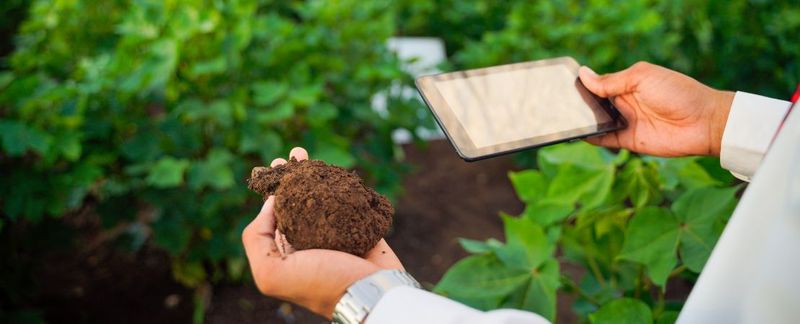
Before reaching for any amendment, including compost, it pays to find out what your soil actually contains. Colorado State University Extension recommends soil testing as the best way to determine whether your soil needs potassium fertilizer.
A basic test from a cooperative extension lab typically costs between ten and thirty dollars and tells you existing nutrient levels, pH, and often organic matter content. That information takes the guesswork out of what your plants are actually missing.
A soil test is a useful starting point, but it is not the only thing to investigate when a plant looks troubled. Check your watering habits first: inconsistent moisture causes wilting and leaf stress that can look like a nutrient problem.
Examine the roots if you can, because compacted soil, root rot, or circling roots in a container all limit nutrient uptake regardless of what is in the soil. Consider light levels, drainage, recent fertilizer applications that may have raised salt levels, and whether disease or insects are involved.
Symptoms and growing conditions together give you a fuller picture than either one alone.
When a soil test or investigation does confirm that potassium is low, CSU Extension’s fertilizer guidance explains the key practical advantage of labeled commercial fertilizers: they carry a guaranteed nutrient content on the label, which means you can calculate a dependable application rate. A bag of potassium sulfate or a balanced granular fertilizer tells you exactly how much potassium you are applying per square foot.
One banana peel, a handful of peels, or a jar of banana water cannot offer that assurance.
Compost, including compost made with banana peels, builds soil structure, supports organic matter, improves moisture retention, and encourages healthy microbial activity. Those are real and lasting benefits.
But soil-building is not the same as correcting a confirmed nutrient deficiency on a timeline that helps a struggling plant this season. University of Minnesota Extension cautions that applying too much compost or potassium over time can contribute to salt buildup and nutrient imbalances that create new problems.
More is not always better, and a soil test tells you when enough is enough.
Use banana peels to build soil, not to promise a rescue
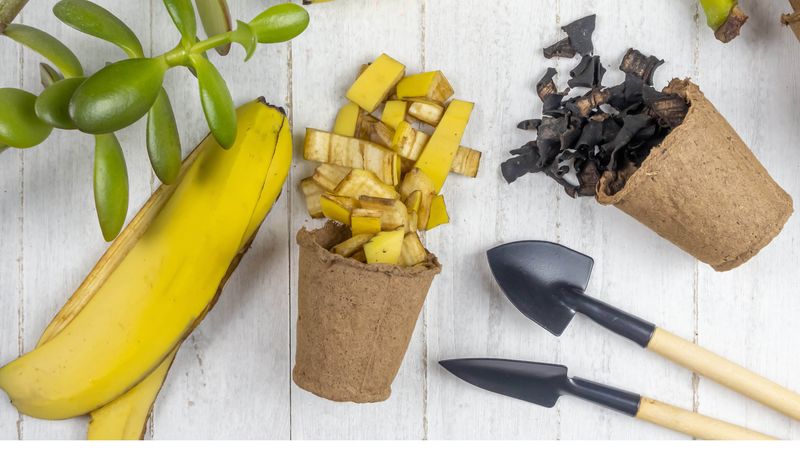
The clearest decision rule for banana peels is also the simplest: compost them or trench-bury them when your goal is recycling organic material and supporting soil health over time. Chop them, layer them into a balanced pile with carbon-rich browns, and let decomposition do its work.
That process can return some potassium to your garden, along with organic matter that benefits soil structure across many growing seasons.
Do not use a peel, peel tea, or direct burial as a way to diagnose or quickly correct a plant that appears to be struggling. OSU Extension’s compost analysis guidance makes clear that even finished compost carries variable nutrient concentrations; a raw peel offers even less certainty.
If your tomato has browning leaf margins or your hydrangea seems weak, investigate watering, roots, light, disease, and soil conditions before assuming potassium is the cause. A soil test gives you actual numbers to act on, and a labeled fertilizer gives you a calculable dose when supplementation is genuinely needed.
University of Maryland Extension’s review of banana-peel claims reinforces this: food scraps are a composting input, not a fertilizer replacement. A kitchen scrap composted well is a quiet, steady contribution to a healthier garden; it just works on the soil’s schedule, not yours.