
If A Peregrine Falcon Dives Over Your Yard, Here’s What Actually Keeps Its Eyes Sharp – Not A Bone Ridge
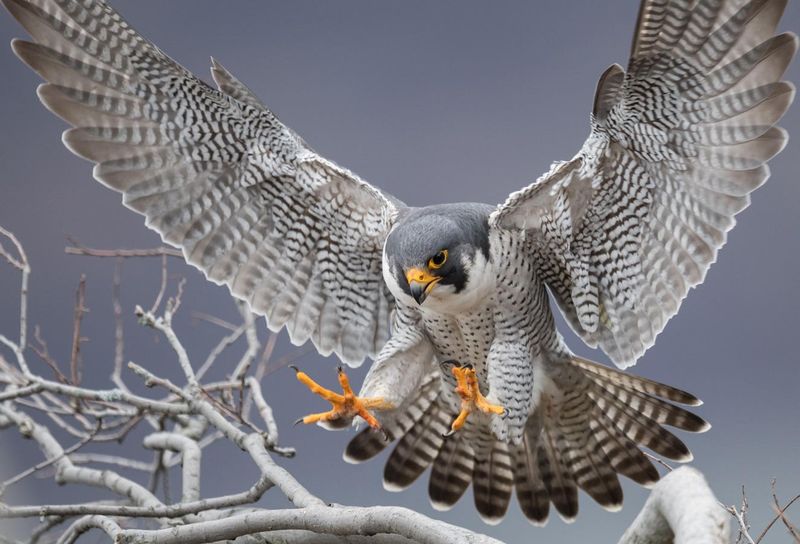
A dark streak rockets across your yard and vanishes before you can blink – what just happened? Many people who witness a peregrine falcon flyover immediately want to know how the bird pulls off such a breathtaking move, and a popular explanation credits a tiny bone ridge above each eye for keeping its vision sharp at speeds sometimes reported around 240 mph.
That claim turns out to be far more complicated than the headline suggests, and the real story involves a whole coordinated system that is even more impressive. This article examines what the evidence actually shows, corrects the bone-ridge premise, and tells you what to do if one of these birds passes over your yard.
A Fast Pass Over Your Yard Is Not Automatically a Hunting Dive
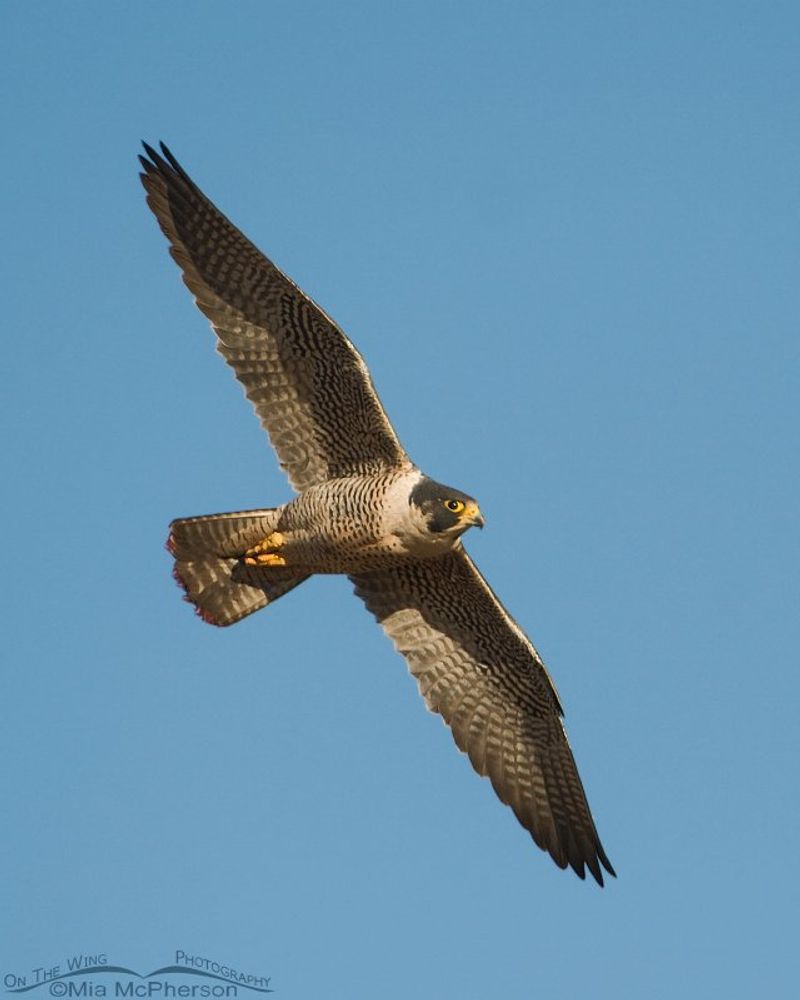
Something fast crosses overhead, and the instinct is to call it a dive. Before drawing any conclusions about what the bird was doing, though, it helps to know that peregrine falcons move through the world in several different ways.
Cornell Lab of Ornithology’s All About Birds profile of the peregrine falcon notes that these birds hunt primarily other birds and can attack from high altitude in a stoop, chase prey in level flight, or make low-altitude swoops. A bird passing over your yard may simply be traveling between perch sites or scanning the area without any intention of striking.
Identifying the bird correctly is the first step. Peregrines are roughly crow-sized, with long, pointed wings that taper toward the tips, a relatively compact body, and a distinctive dark hood that covers the top and back of the head.
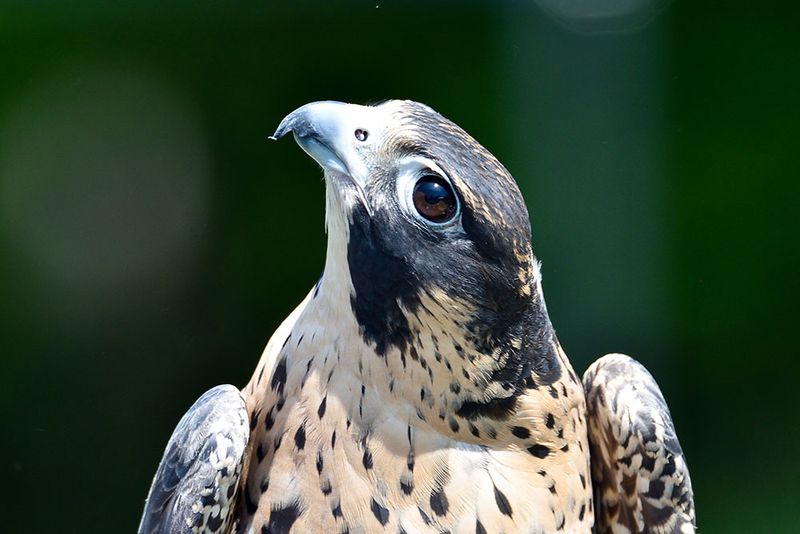
The most recognizable marking is the dark facial stripe below each eye, often described as a sideburn or mustache mark, which contrasts sharply against a pale cheek and throat. In flight, the wings beat with a stiff, shallow rhythm that looks purposeful rather than buoyant.
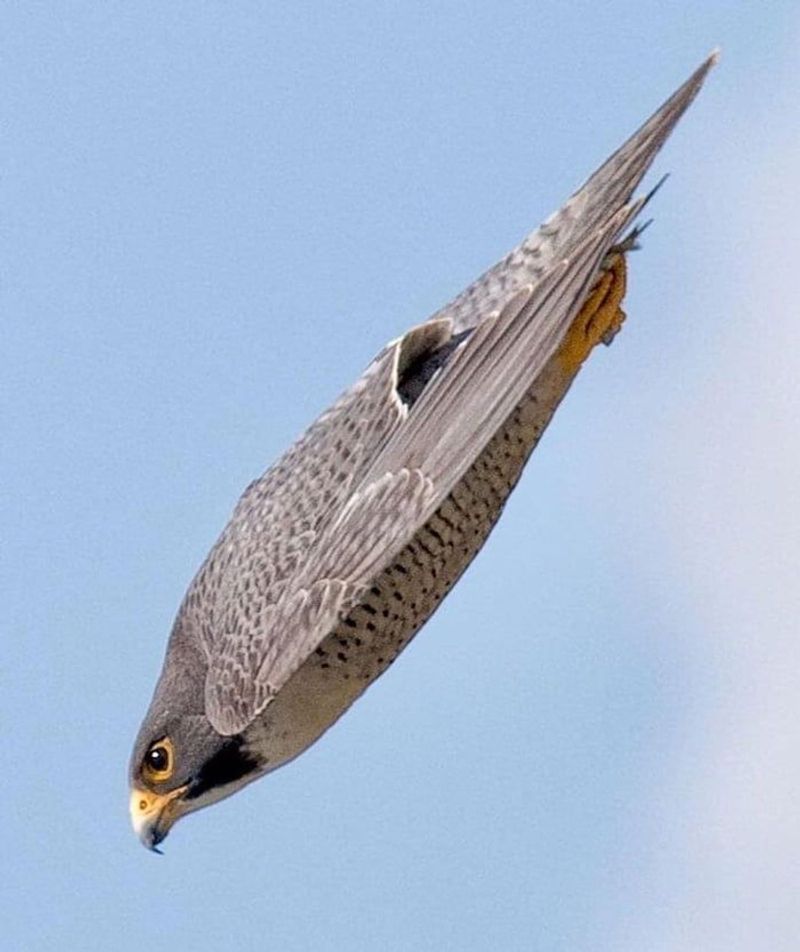
A true hunting stoop starts from altitude, with the bird folding its wings and accelerating downward in a controlled plunge. A low, fast pass at roughly rooftop height is more likely a level pursuit or a territorial sweep than a full stoop.
National Park Service reporting on peregrine falcon behavior emphasizes that these birds are highly adaptable hunters found in cities, coastlines, and open country alike. This article will examine, rather than endorse, the popular claim that a bone ridge above each eye is responsible for the peregrine’s remarkable performance at speed.
The 240-MPH Figure Needs a Speedometer-Sized Asterisk
Most people who have heard anything about peregrine falcons have heard the 240-mph figure, and it is genuinely dramatic. The honest version of that claim, however, carries significant qualifications that rarely make it into casual conversation.
Start with what peregrines actually do most of the time. Cornell Lab of Ornithology reports typical traveling flight for peregrines at roughly 25 to 34 mph, with direct pursuit of prey reaching about 69 mph.
Those numbers describe the bird you are most likely to see crossing your neighborhood. The famous high-speed figures apply only to the hunting stoop, a controlled, high-altitude power dive that the bird does not perform during ordinary movement.
Even within the stoop, the numbers get complicated. A peer-reviewed analysis in the Journal of Experimental Biology examining falcon diving and pull-out mechanics notes that while estimates of maximum stoop speed have reached figures equivalent to roughly 157 meters per second, those speeds had not been accurately measured at the time of publication.
A separate modeling study cited a maximum of around 122 meters per second as a modeled prediction, again without confirmed peer-reviewed field measurement. Cornell’s own description settles on “up to 200 mph” for the stoop rather than endorsing the higher figure.
The defensible formulation is this: the peregrine is the fastest known animal during a high-speed hunting dive, but the uppermost reported figures, including the often-repeated 240 mph, remain uncertain upper-end estimates rather than firmly measured facts. Treating 240 mph as a settled, routinely observed speed misrepresents what the science actually shows.
The bird is extraordinary enough without inflating the number.
The Supposed Eyebrow Is Not the Secret Weapon
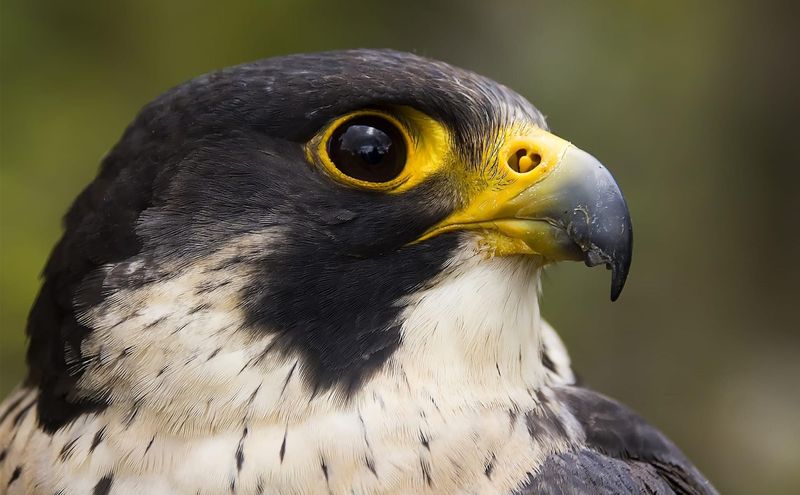
The idea that a bone ridge above each eye stabilizes a peregrine’s vision during an extreme-speed dive is a compelling story. The problem is that the anatomy does not hold up to scrutiny, and the causal claim has no support in the evidence.
The National Park Service’s profile of peregrine falcons at Cabrillo National Monument specifically states that peregrines lack the prominent bony eyebrow seen in some other raptors, such as certain hawks and eagles. Generalizing from those birds to peregrines gets the anatomy wrong.
Some raptors do have supraorbital ridges or bony projections above the eye that can provide shading or some physical protection, but that feature is not characteristic of the peregrine.
Even where a supraorbital structure exists in other species, shading an eye from sunlight and enabling sharp vision at high speed are two different functions. Physical protection or glare reduction is not the same as optical acuity.
The structures that actually support sharp vision in raptors are specialized regions of the retina, not bones above the socket.
Research on the malar stripe in peregrine falcons focuses on the dark facial marking below the eye rather than any bony ridge above it, with evidence suggesting that stripe may help manage solar glare during pursuit. That is a soft tissue feature, not a bone, and it relates to glare rather than to the mechanics of a high-speed dive.
No supplied evidence shows a peregrine brow ridge causing the stoop, stabilizing its sight during acceleration, or making the bird’s exceptional performance possible. The real explanation lies elsewhere.
Streamlined Wings and Vortices Power the Dive
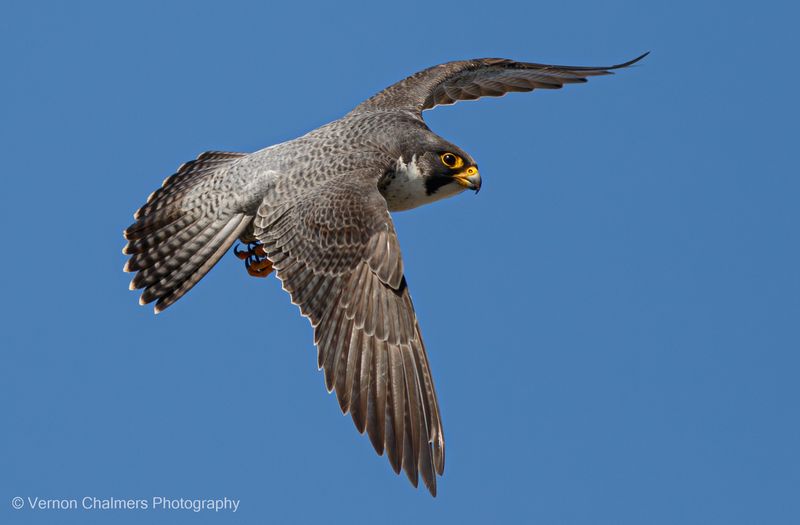
Once the bone-ridge explanation is set aside, the actual mechanics of the stoop are far more interesting and involve the entire body working as a coordinated aerodynamic system. When a peregrine begins its high-speed hunting dive, it folds its wings tightly against its body and draws its feathers flush, creating a compact, teardrop-like configuration that sheds air resistance.
This is not a passive collapse but a deliberate postural choice the bird makes and adjusts throughout the descent.
Research published in Communications Biology on the aerobatics of peregrine falcons links the bird’s extraordinary maneuverability to vortex-dominated flow and reduced induced drag. At the speeds reached during a stoop, the air moving over and around the bird’s wings and body forms swirling vortices that, when managed correctly by the bird’s wing shape and position, contribute to both stability and control.
Reducing induced drag, the drag created as a byproduct of generating lift, allows the bird to accelerate more efficiently during the descent and recover energy during the pull-out.
The pull-out phase deserves attention of its own. After the strike or near the bottom of the dive, the peregrine must redirect enormous kinetic energy without losing control or injuring itself.
It does this by adjusting its wing and tail configuration to generate the lift and braking force needed for a controlled arc. The Journal of Experimental Biology analysis of falcon diving and pull-out mechanics models how lift, drag, and trajectory interact during this recovery phase, showing that the bird’s wing geometry plays a central role in surviving the transition from maximum speed to controlled flight.
Speed and control during the stoop arise from a whole-body aerodynamic system, not from any single anatomical feature above the eye. The feathers, wing shape, body posture, and tail all contribute, and the bird adjusts each of them continuously throughout the dive.
Two Foveae Give the Peregrine More Than One Way to See Prey
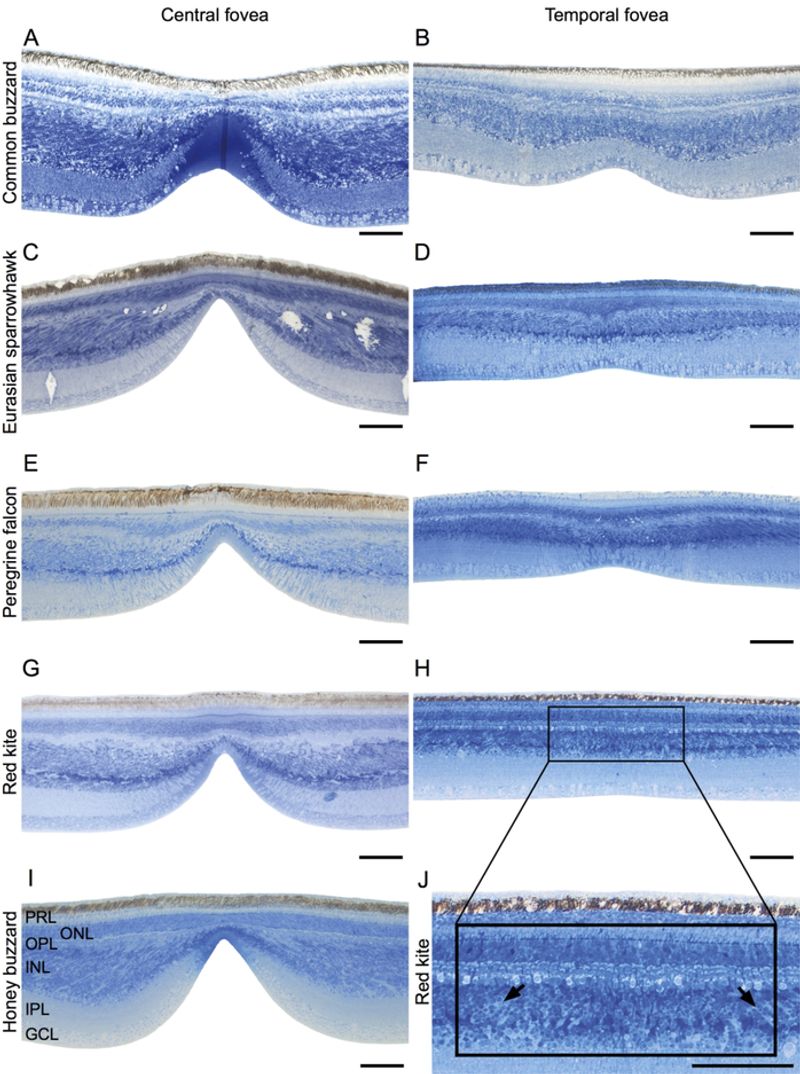
Peregrine vision is genuinely exceptional, and the structures responsible for it are inside the eye, not above it. Each peregrine eye contains two specialized regions of the retina called foveae, areas packed with photoreceptor cells that produce the sharpest, most detailed images.
Most animals with foveated vision have one per eye; peregrines have two, giving them more than one zone of acute focus.
The deep fovea, located near the center of the retina, provides the highest resolution and is used for long-range target detection. The shallow fovea, positioned toward the side, handles a wider field of view and may support tracking during pursuit.
A published study on curved flight paths and sideways vision in peregrine falcons reports that raptors may position prey at approximately 40 degrees to one side of their line of travel so the image falls on the deep fovea for maximum sharpness. This means the bird may be looking somewhat sideways at its target rather than straight ahead, even during a high-speed approach.
That sideways viewing strategy comes with a tradeoff. Turning the head to keep prey on the deep fovea adds aerodynamic drag during fast flight, which is part of why researchers have studied the curved flight paths peregrines use to maintain the optimal viewing angle without rotating their heads excessively.
Eye protection is a separate matter. Peregrines, like other birds, have a translucent third eyelid called the nictitating membrane that sweeps across the eye to clean it, keep it moist, and offer some physical protection during fast flight.
A review of the falcon’s stoop in PMC discusses the nictitating membrane’s role in eye care during high-speed flight. The membrane provides protection and maintenance, while the foveae provide acuity.
These are distinct functions, and research using animal-borne cameras on falcons pursuing prey confirms that visual motion cues play a key role in guiding attacks, underscoring how central active visual processing is to the stoop’s success.
Fast Visual Processing Helps, but It Is Not Literal Slow Motion
Beyond the foveae, peregrine vision operates at a temporal speed that most other animals cannot match. The relevant measurement here is flicker-fusion frequency, which describes how rapidly an animal’s visual system can detect separate events rather than blending them into a blur.
A higher flicker-fusion frequency means the eye and brain are processing visual information at a faster rate.
A comparative study measuring temporal resolution in raptors found a flicker-fusion frequency of at least 129 Hz in peregrine falcons, which was higher than the figures recorded for the saker falcon and Harris’s hawk tested in the same study. For reference, human vision typically fuses flicker somewhere around 60 Hz under bright conditions.
The peregrine’s visual system is processing updates at roughly twice that rate.
What that number means in practice is that the bird can detect fine-grained changes in a target’s position or movement more quickly than most predators, which matters enormously when closing speed is high and reaction time is short. However, a flicker-fusion frequency of 129 Hz does not mean the bird experiences the world as if it were a slow-motion film.
The measurement describes a processing rate, not a subjective experience, and the study does not claim the bird consciously perceives time as stretched out.
Rapid visual processing is one component of a larger system. It works alongside the dual-fovea structure, the nictitating membrane’s protective role, and the bird’s aerodynamic control to make the stoop possible.
No single measurement explains the whole performance.
Its Attack Path Resembles Missile Guidance Without Proving Mid-Air Math
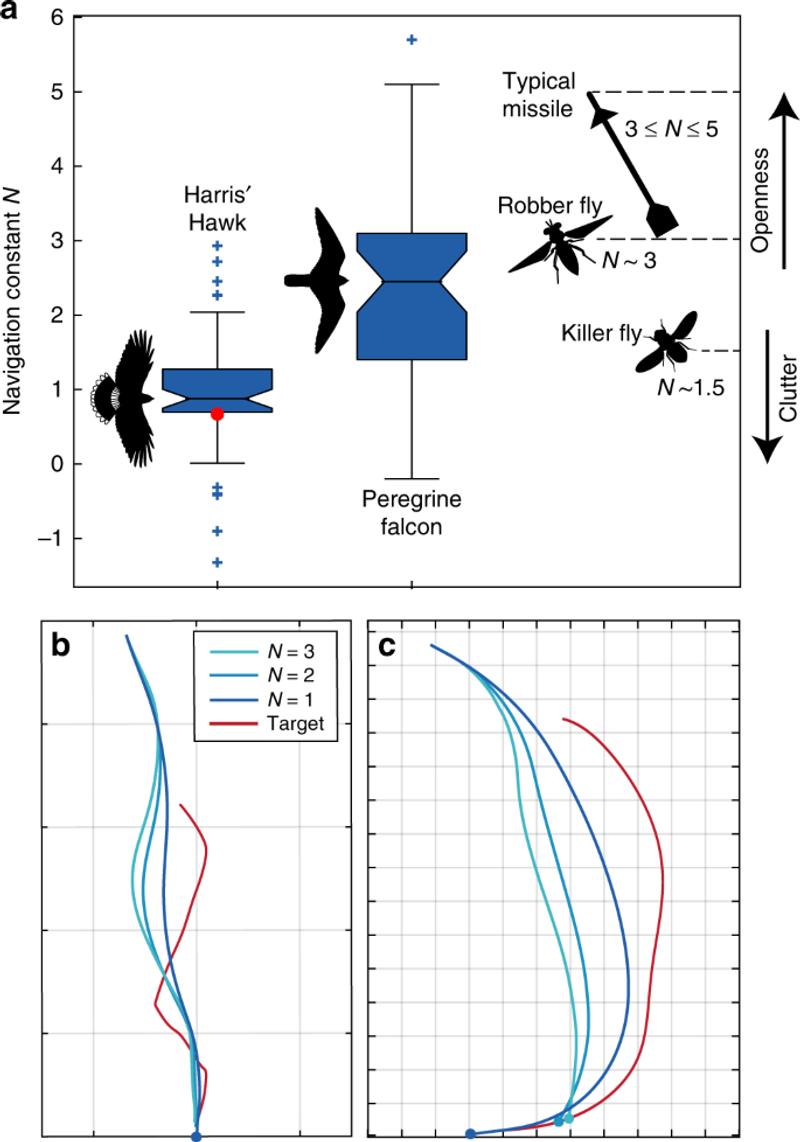
One of the most striking findings in recent peregrine research is that the terminal portion of their attack follows a pattern that mathematicians and engineers recognize from missile guidance systems. The pattern is called proportional navigation, and understanding what that means, and what it does not mean, is worth taking seriously.
Proportional navigation is a guidance strategy in which a pursuer adjusts its turning rate in proportion to how fast the line of sight between itself and the target is rotating. In plain terms: if the target appears to be drifting to the right in the pursuer’s field of view, the pursuer turns right faster to correct.
This keeps the line of sight stable and leads the pursuer toward an intercept point rather than chasing the target’s current position directly. It is an efficient strategy because it minimizes the energy and maneuvering needed to close with an evasive target.
A study published in PNAS examining the terminal attack trajectories of peregrine falcons used GPS loggers, onboard cameras, captive lure flights, and observations of live-prey interactions to analyze how peregrines approach their targets. Researchers found that the terminal portions of attacks were best described by the proportional navigation model, fitting the observed flight paths more accurately than simpler pursuit strategies like pure pursuit or constant-bearing approaches.
The key qualifier is that this is a mathematical model fitted to observed behavior. The finding means peregrine attacks look like proportional navigation from the outside, not that the bird consciously solves guidance equations or uses the exact internal mechanism a missile uses.
Describing it as “mid-air math” is a useful metaphor for how sophisticated the behavior is, but the bird is responding to visual cues in a way that happens to match the model, not running calculations in a cockpit sense. Aircraft and guided systems can exceed falcon performance in various ways; the scientific result is that falcon attacks resemble a known guidance law, which is remarkable on its own terms without claiming the bird outperforms every engineered system.
Watch the Bird From a Distance, Especially if It Keeps Diving
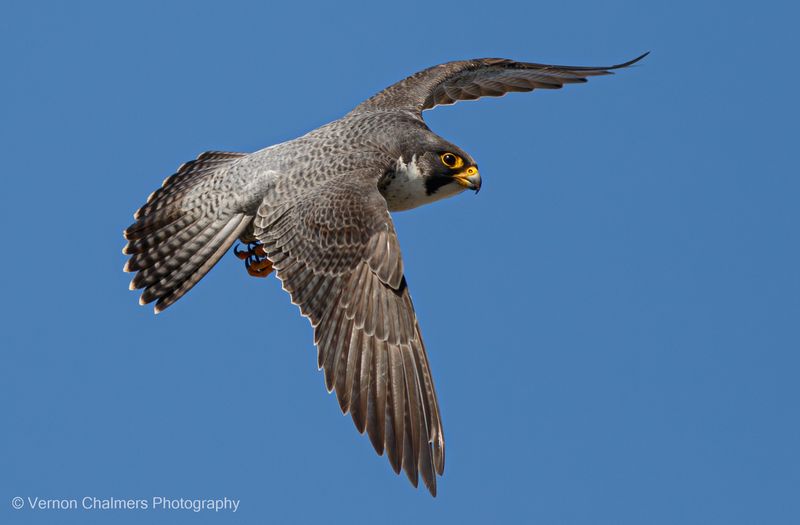
Seeing a peregrine falcon over your yard is a genuine privilege, and the best response is almost always to stay still and watch from where you are. National Park Service guidance on peregrine falcons at Acadia National Park is clear on the basic rule: if wildlife reacts to your presence, you are already too close.
For peregrines, especially near a nest, that reaction can be dramatic.
Practical yard behavior comes down to a short list. Observe from indoors or from a comfortable distance outdoors.
Do not approach the bird, attempt to feed it, chase it to get a better look, or fly a drone anywhere near it. If you suspect a peregrine is nesting on or near your property, treat the area as off-limits during the breeding season, which typically runs from late winter through midsummer depending on your region.
Repeated dives at a person are a specific situation worth understanding. A peregrine that keeps swooping low over the same spot, especially if it calls loudly or strikes at a hat or head, is almost certainly defending a nearby nest or a fledgling that has landed on the ground rather than treating the person as prey.
Adults can and do make contact with intruders near active nests. The right response is to back away calmly, avoid the area, and give the bird space.
If a peregrine appears to be injured, grounded without being a fledgling, or trapped, do not attempt to handle it yourself. Contact your state wildlife agency or a licensed local wildlife rehabilitator.
NPS guidance on watching wildlife safely applies here: the goal is to observe without altering the animal’s behavior, which means keeping your distance, keeping pets indoors or leashed, and letting the bird do what it came to do.
The Real Secret Is a Coordinated System, Not a Single Bone
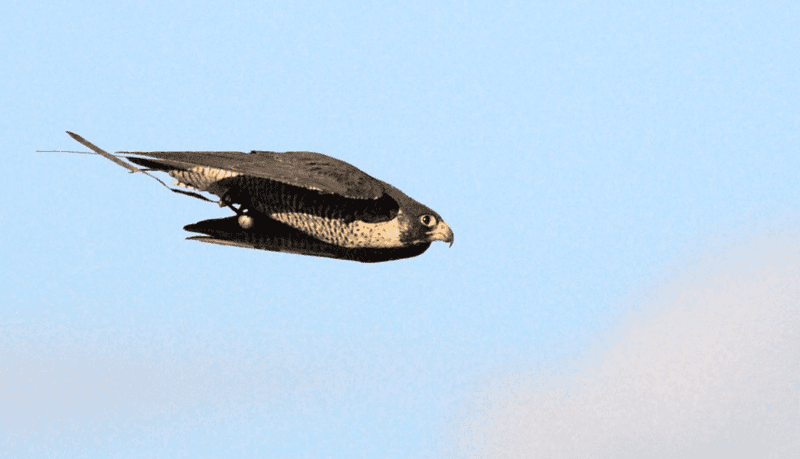
What actually makes a peregrine falcon’s stoop possible is not one structure above the eye but a coordinated system that runs from feather tip to retina. The bird streamlines its body and wings into a tight configuration to minimize drag during the descent, then uses its wing and tail geometry to manage the pull-out.
Research on vortex-mediated aerobatics in peregrine falcons shows that the bird’s maneuverability depends on how it manages airflow, not on any single anatomical shortcut.
Vision contributes through two foveae per eye, a nictitating membrane that protects and cleans without sacrificing acuity, and a visual processing rate measured at over 129 Hz. The attack trajectory follows a pattern consistent with proportional navigation, as trajectory research on peregrine attacks demonstrates, though that reflects behavior, not conscious calculation.
The often-cited 240-mph figure remains an uncertain upper-end estimate, and as the National Park Service notes about peregrine anatomy, the bird lacks the prominent bony eyebrow the popular explanation requires.
A fast pass over your yard may not even be a stoop. Admire the bird from a distance, skip the drone, and let it move on.
A peregrine crossing your sky is already doing something extraordinary without any help from a headline that overpromises.