
What It Really Means When Yellowjacket Swarms Suddenly Take Over Your North Carolina Yard In Fall
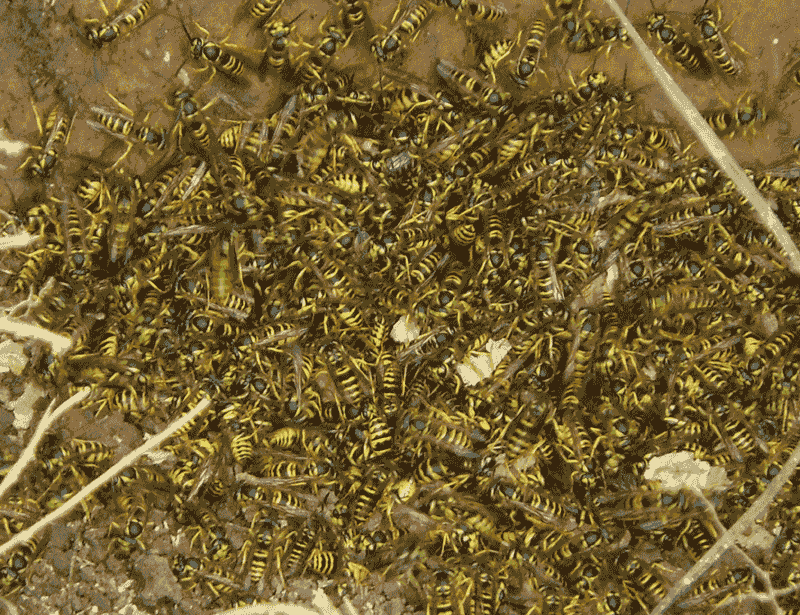
Most North Carolina homeowners have been there: you step outside on a warm September afternoon and realize your backyard is suddenly buzzing with yellowjackets. The numbers seem to have appeared out of nowhere, and it is easy to wonder if something has gone seriously wrong with your yard.
Understanding what is actually happening can help you stay calm, make smart decisions, and protect your family and pets without overreacting.
Fall Makes a Normal Colony Look Like a Sudden Invasion
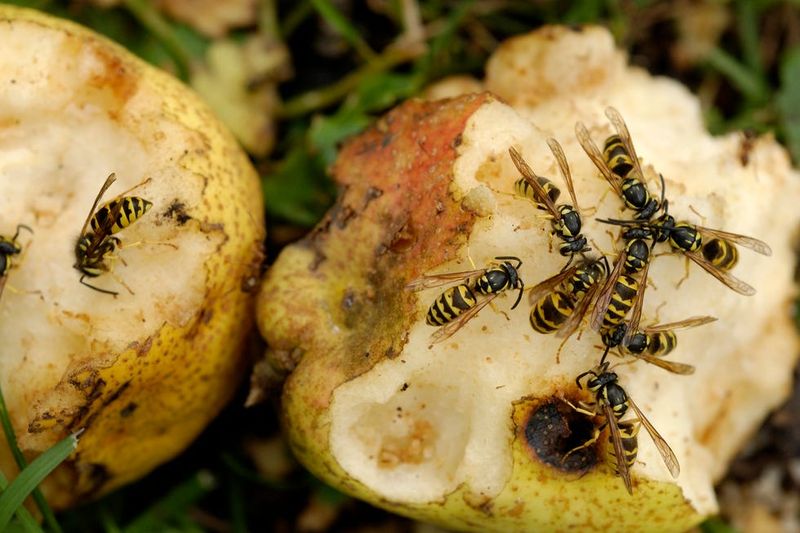
By the time September rolls around in North Carolina, a yellowjacket colony that started with a single queen in spring has spent months quietly growing. NC State Extension notes that colonies expand through summer and may reach roughly 600 to 800 workers by fall, which is often the first moment homeowners notice them in large numbers.
The insects were always there; the colony simply grew large enough to become visible.
At the same time, late summer brings a shift in what workers are eating. Earlier in the season, yellowjackets hunt other insects to feed protein-hungry larvae back in the nest.
As the colony matures and larval demand drops, adults turn toward sugars: ripe and fallen fruit, garbage, outdoor drinks, nectar, and other easy sources. That dietary pivot pushes them directly into the spaces where people spend time, which is why the yard can feel overrun almost overnight.
Weather, flowering cycles, fruiting schedules, and access to food or water all shape what you notice on any given afternoon. A warm fall after a productive fruit year, a leaky hose left running, or an uncovered recycling bin can all make a normal seasonal surge seem far more dramatic than it actually is.
Illinois Extension explains that this pattern is consistent across species and regions, driven by colony maturity and changing food dynamics rather than any single yard condition. None of this means your yard is unhealthy or neglected.
A fall surge of yellowjackets is a seasonal event, not a diagnosis.
Where They Gather Tells You What They Are Doing
Counting yellowjackets rarely tells you much. Watching where they go and what they do tells you almost everything.
The most useful thing a homeowner can do is observe the insects from a safe distance for a few minutes and ask one question: are they concentrating on a food or water source, or are they repeatedly flying into and out of a specific hole or opening?
A loose cluster of yellowjackets working over fallen pears, hovering around a hummingbird feeder, or circling a trash can is almost certainly a foraging group. Penn State Extension specifically notes that foraging insects may be visiting food or water even when their nest is located far away.
Seeing twenty yellowjackets on a compost pile does not mean the colony is underneath it.
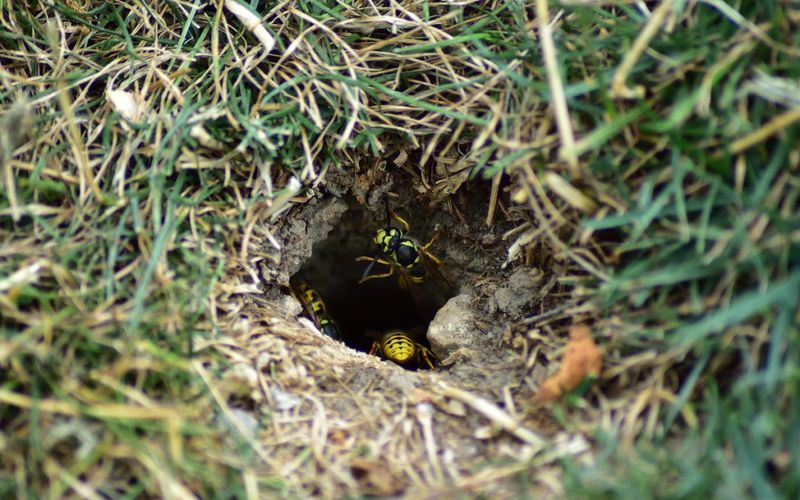
Sustained traffic into a single small opening is a different signal entirely. A hole in the lawn, a gap in a wall, a cavity in a landscape timber, a crack near a crawl space vent, or an attic louver with wasps entering and exiting in a steady stream suggests a nest is close by.
Defensive behavior, meaning workers that immediately orient toward anyone who approaches a particular spot, adds to that evidence. One or two of those signs together is far more meaningful than a large number of insects feeding elsewhere.
Identification matters here too. Yellowjackets are wasps, not bees.
They have relatively smooth, shiny bodies with sharp yellow-and-black markings and can sting multiple times without losing their stinger. Illinois Extension points out that honey bees, by contrast, are fuzzier and leave a barbed stinger behind in the skin.
Misidentifying the insect can lead to the wrong response, so take a moment to look before deciding what to do.
Your Yard May Be Offering an Easy Fall Buffet
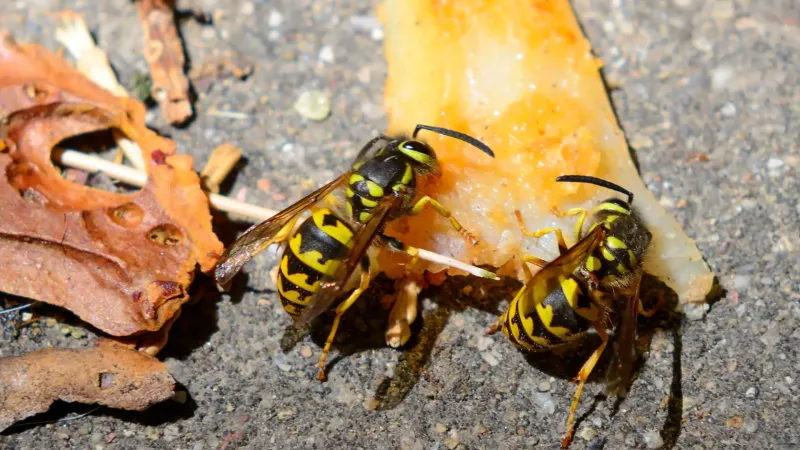
A sudden concentration of yellowjackets around the house usually means the yard is offering something they want. Before assuming you have a nest problem, walk the property from a distance and look for the most common attractants that pull foraging workers close to people.
Fallen or overripe fruit is the single biggest draw in most residential NC yards during September and October. Figs, apples, pears, muscadines, and persimmons that drop and begin fermenting are almost irresistible to yellowjackets.
Picking up fallen fruit regularly, harvesting ripe fruit before it drops, and removing any rotting produce from the ground can reduce foraging traffic noticeably. Uncovered garbage and recycling bins, spilled soda or juice, leftover alcohol from a cookout, and pet food left outside are equally attractive and just as easy to address.
Water sources matter too, especially during dry stretches. Leaking irrigation heads, dripping hose bibs, birdbaths with stagnant water, and clogged gutters holding moisture can all draw yellowjackets in.
Repairing leaks and refreshing or removing standing water eliminates one more reason for workers to linger near the house. NC State Extension recommends keeping outdoor food and drinks covered when not actively being used and removing sugary bird-feeder residue as part of a practical attractant-control routine.
Earlier in the season, these same yellowjackets were hunting caterpillars, flies, and other pest insects in your garden, providing some real pest-control value. The goal right now is not to eliminate every yellowjacket from the yard but to reduce the high-contact attractants that pull foragers directly into spaces where people and pets spend time.
Removing one attractant may not make the workers disappear entirely, but it lowers the daily encounter rate in the spots that matter most.
The Real Risk Depends on Nest Proximity
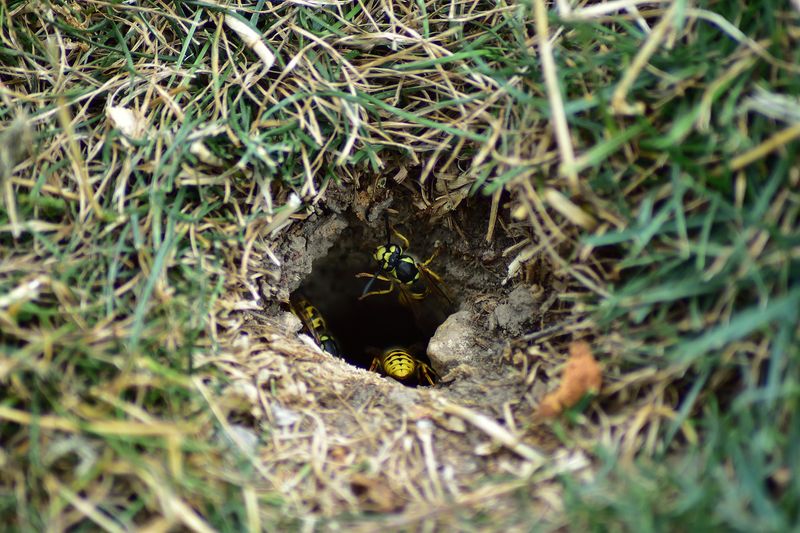
Not every yellowjacket concentration carries the same level of risk. A foraging cluster on the far edge of the property near a fig tree is a very different situation from a nest entrance beside the back door or underneath the swing set.
Converting observations into a safety decision starts with one honest question: where is the nest, and does its location put people or pets at regular risk?
Repeated in-and-out flight at a single entrance point is the clearest sign that a nest is nearby. Penn State Extension notes that sustained traffic at one hole, especially combined with workers that orient defensively toward anyone who approaches, provides much stronger evidence of nest proximity than simply seeing a large number of insects at a feeding site.
That distinction shapes everything that follows.
A nest tucked into a far corner of the yard, under a woodpile that nobody approaches, or in an overgrown area away from foot traffic may pose little day-to-day risk. A nest beneath a lawn panel you mow every week, near a walkway children use to reach the school bus, beside a pet door, or under a deck where the family eats is a legitimate hazard that deserves action.
Workers near a nest can be highly defensive, and an accidental disturbance, such as a lawnmower vibration or a child’s ball rolling near the entrance, can trigger a rapid response.
Until the situation is resolved, keep people and pets away from any suspected entrance. Skip mowing in that area, avoid digging or raking nearby, and do not send children or animals to investigate.
Mark the zone with a visible flag or object so no one wanders close by accident. Knowing the nest location and keeping distance is the most important protective step you can take right now.
When Leaving the Nest Alone Makes Sense
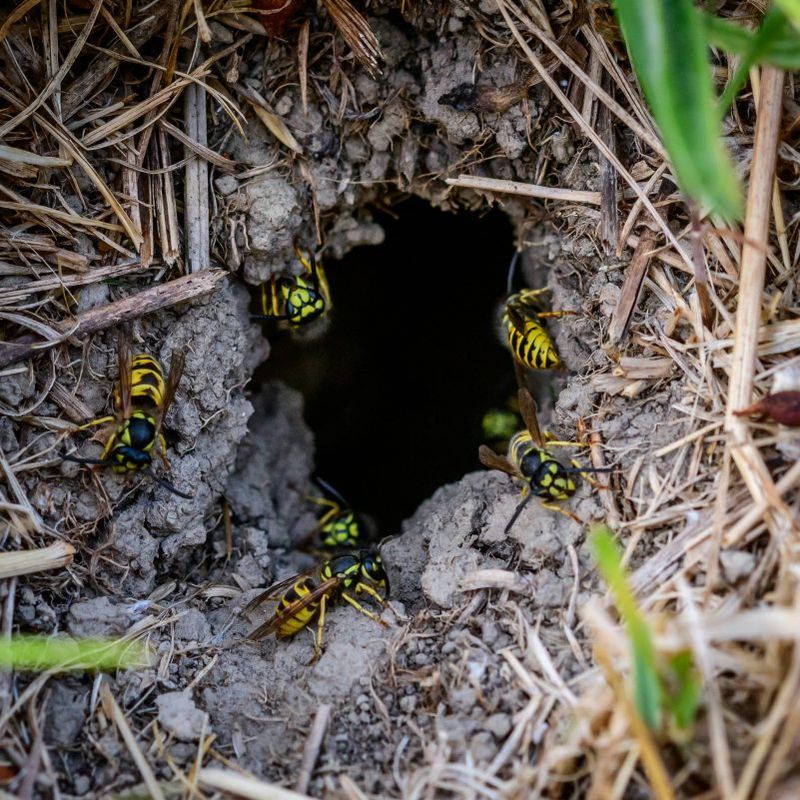
Reaching for a pesticide spray the moment you spot a nest is a common impulse, but it is not always the right call. Yellowjacket colonies are annual.
A queen starts a new nest from scratch each spring, the colony builds through summer, and then workers die out in late fall or winter. NC State Extension confirms that colonies die out annually and that nests are abandoned by wintertime, with only newly mated queens surviving to overwinter elsewhere.
That natural cycle means a secluded nest will resolve itself without any intervention on your part.
If the nest is in a location that people and pets genuinely do not approach, leaving it alone until the colony declines is a reasonable choice. The workers foraging from that nest have spent the summer hunting pest insects in your yard, and the nest structure itself will not be reused next year.
Tolerating a low-risk nest for a few more weeks costs very little.
The calculation changes when the nest sits near a doorway, a frequently used path, a patio, a children’s play area, a mowing route, or anywhere that regular human or pet traffic makes a surprise encounter likely. The timing of colony decline also varies with species, nest location, and weather, so avoid assuming a particular date when the nest will become harmless.
A warm fall can extend colony activity well past what homeowners expect.
Anyone with a diagnosed severe insect-sting allergy in the household should apply a lower threshold for action. In that situation, even a secluded nest within the yard warrants a conversation with a licensed pest management professional rather than a wait-and-see approach.
A professional can assess the nest location, species, and activity level and recommend treatment or monitoring that fits the specific risk.
Avoid Improvised Fixes That Increase the Danger
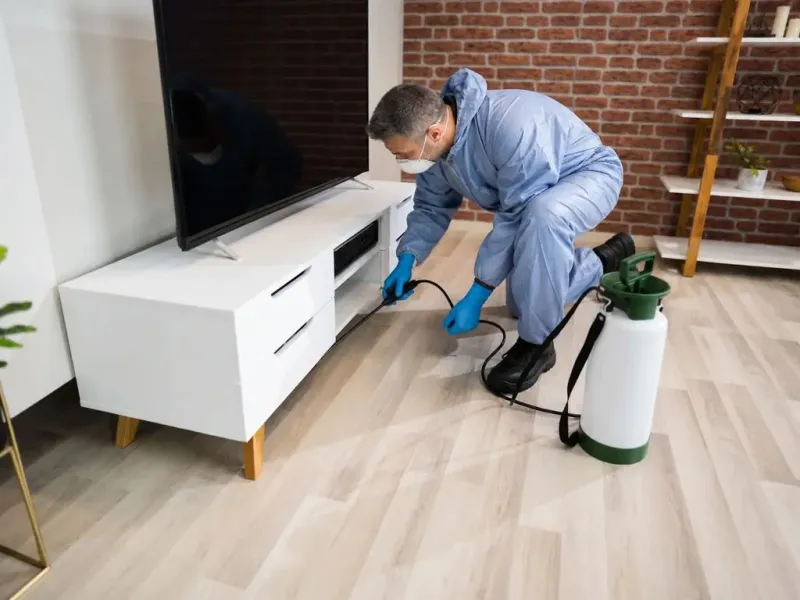
When yellowjacket activity feels threatening, the temptation to act fast and improvise is understandable. A few of the most common improvised responses, though, can make the situation significantly more dangerous rather than better.
Commercial and homemade traps may capture some foraging workers, but they generally do not eliminate a colony or solve a yard-wide problem. Penn State Extension has specifically noted that traps have not shown much value for reducing yellowjacket problems and that placing attractant-baited traps near patios, doorways, play areas, or pet routes simply draws more insects to exactly the spaces you are trying to protect.
If traps are used at all, follow product directions and keep them well away from high-traffic areas.
Two improvised approaches carry direct safety warnings. Sealing an active entrance in a wall or structure can force workers deeper into the building, potentially pushing them through interior walls and into living spaces.
Never pour gasoline or other petroleum products into a nest. NC State Extension describes this practice as extremely dangerous and environmentally damaging.
Homemade mixtures, essential oils, dish soap, smoke, and other unapproved treatments are not established as reliable or safe for an active yellowjacket nest, and the authoritative sources reviewed here do not support presenting them as proven alternatives.
If a homeowner decides to treat an accessible, ground-level nest, the current EPA-approved label for the product being used is the controlling document for every aspect of that application. Label information can change, so verify the applicable label through EPA’s current pesticide product label system immediately before treatment rather than relying on older printed instructions.
Following the label correctly still does not make approaching a defensive colony entirely safe. When the location, the colony’s defensive response, or any uncertainty about the nest structure makes self-treatment feel risky, calling a licensed pest management professional is the more protective choice.
A Sting Changes the Question From Yard Diagnosis to Medical Safety
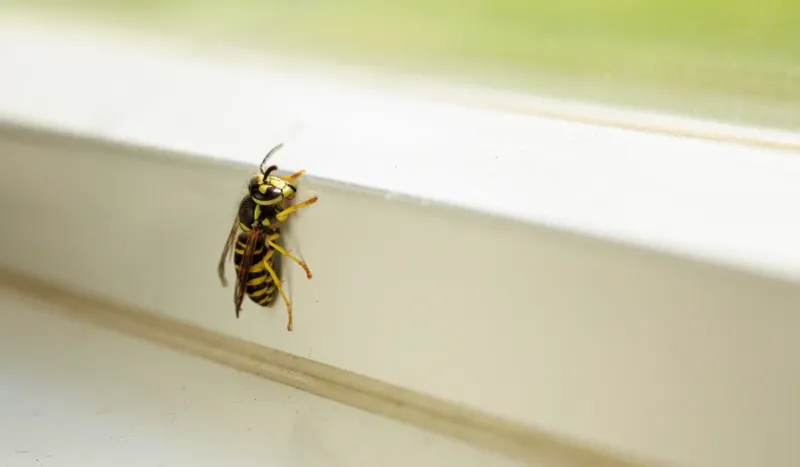
Yard management decisions and medical safety decisions are two separate tracks, and a sting moves you immediately onto the second one. Most yellowjacket stings cause localized pain, redness, and swelling that ease within a few hours.
Those reactions are uncomfortable but do not require emergency care for most people.
Certain symptoms after a sting are a medical emergency regardless of how many stings occurred. The American Academy of Allergy, Asthma and Immunology identifies trouble breathing, swelling of the throat or tongue, dizziness or fainting, widespread hives, and vomiting as signs of anaphylaxis that require immediate emergency care.
If any of these appear, call 911 and do not wait to see if they resolve on their own.
Anyone with a diagnosed severe insect-sting allergy should use their prescribed epinephrine promptly after a sting and still go to an emergency room even if symptoms seem to improve after the injection. Epinephrine can wear off, and a second wave of symptoms is possible.
Do not treat a self-administered injection as the end of the response.
Once the medical situation is handled, the yard question becomes straightforward. Identify the gathering site from a safe distance, remove accessible attractants like fallen fruit and uncovered garbage, keep people and pets away from any confirmed nest entrance, and escalate to a professional when the location or sting risk justifies it.
A yard full of yellowjackets in fall is a solvable problem. The clearest signal that it is time to stop observing and start acting is when someone gets stung near a spot that cannot easily be avoided.