
Screech Owls Calling At Dusk In North Carolina May Signal An Active Predator And Suitable Habitat Near Your Home
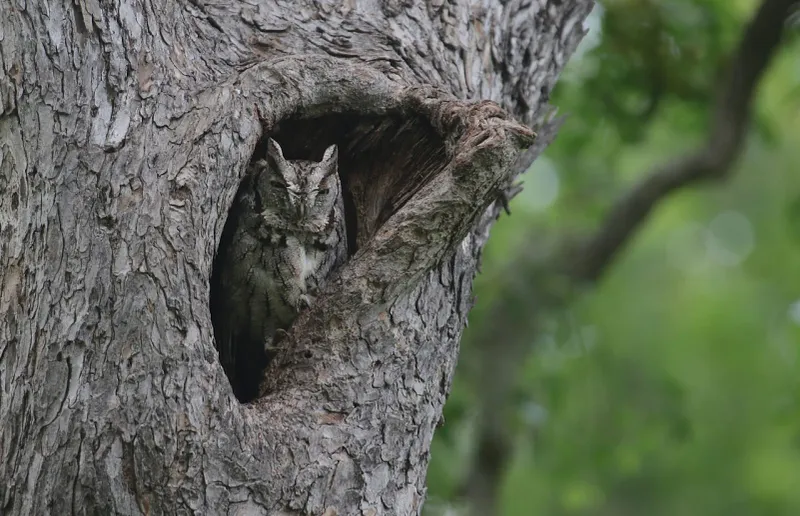
A trembling, horse-like whinny floating out of your darkening backyard trees is one of the more startling sounds a North Carolina homeowner can hear on a still evening. Many people assume it means something is wrong, or that the yard is suddenly overrun with mice.
The truth is more interesting and more useful: that call is most likely coming from an Eastern Screech-Owl, a small but capable nighttime predator that has been quietly working your neighborhood for years. Understanding what the sound actually tells you, and what it does not, can help you protect both your home and the wildlife living just outside it.
A dusk call can reveal a predator, not a rodent surge
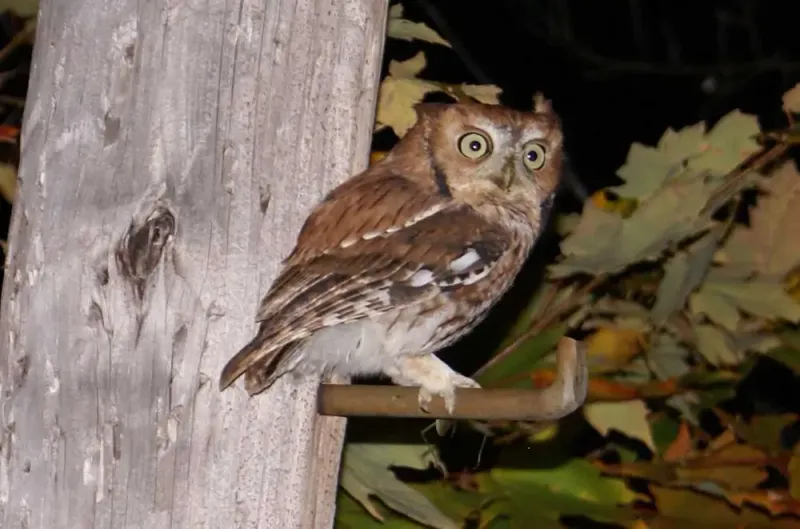
Stepping outside at dusk and hearing a trembling whinny or a steady, horse-like trill from the treeline is a genuinely good sign for your yard, though not for the reason many homeowners first assume. The sound almost certainly belongs to an Eastern Screech-Owl, a compact predator that Cornell Lab of Ornithology describes as common in wooded suburbs, parks, orchards, and residential yards across much of the eastern United States, including all three of North Carolina’s major regions.
Dusk activity fits perfectly with the owl’s normal schedule: it is primarily a nighttime hunter that typically becomes active right around sunset.
What draws a screech-owl to a particular yard is a combination of features: mature trees with natural cavities or nest boxes for shelter, open hunting areas, suitable perches at low to mid height, and a diverse array of prey. That last point is worth holding onto.
The owl’s presence reflects habitat quality and prey availability in general terms, not a sudden spike in any single animal. A USDA Forest Service species review classifies the Eastern Screech-Owl as an opportunistic generalist, meaning it takes whatever prey is accessible rather than targeting one species exclusively.
The call itself adds another layer of nuance. Cornell’s sound documentation makes clear that screech-owl vocalizations serve communication purposes: defending territory, maintaining contact with a mate or family members, or responding to seasonal breeding cues.
Hearing one at dusk tells you a nighttime predator is active nearby and that your yard likely offers what the bird needs. It does not tell you that the mouse population under your deck is growing.
The sections ahead will help you identify the sound confidently, understand the owl’s diet honestly, and check your home and yard for actual rodent activity without disturbing the bird.
Learn which owl sound you are hearing
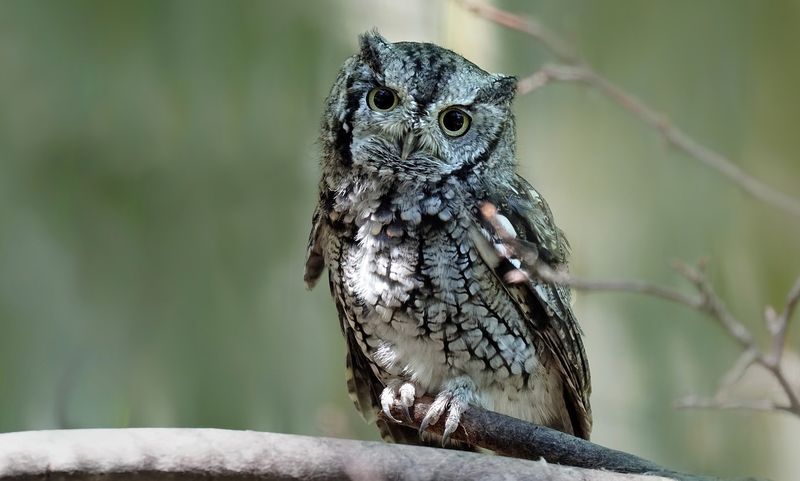
Before drawing any conclusions about your yard’s wildlife, spend a few evenings simply listening. The Eastern Screech-Owl produces several distinct sounds, and knowing which one you are hearing can tell you something about what the bird is doing at that moment.
Cornell Lab identifies two signature calls: a long, descending whinny that carries a wavering, almost mournful quality, and an even-pitched tremolo that sounds like a soft, steady trill. The whinny tends to function as a territorial signal, while the tremolo serves as a contact song that pairs or family groups use to stay in touch across the dark.
Those two calls are the ones most North Carolina homeowners are likely to recognize. However, screech-owls also produce alarm calls, a sharp bark when startled, occasional true screeches when threatened, and an audible bill-clacking sound.
These are less common and usually brief. Published species accounts note that vocal activity tends to increase during courtship and territory establishment in late winter and early spring, during the nesting period generally spanning March through June, and again in late summer and early fall when juveniles are dispersing and learning their own ranges.
Seasonal timing can shift across the Piedmont, Coastal Plain, and mountain regions of North Carolina, so a calling owl in September is not necessarily doing something unusual.
One caution worth keeping in mind: not every nighttime sound belongs to a screech-owl. Barred Owls produce a loud, rhythmic “who cooks for you” call that echoes through wooded areas.
Great Horned Owls deliver deep, resonant hoots. Barn Owls hiss and rasp in ways that can sound almost human.
Frogs, insects, and even some mammals vocalize after dark in ways that can confuse a first-time listener. The NC Wildlife Resources Commission maintains species pages that can help with regional identification.
For any call you cannot place with confidence, recording it on a phone and comparing it to verified audio, or submitting it to a local birding group, will give you a much firmer identification than a guess in the dark.
The owl hunts a broad and changing menu
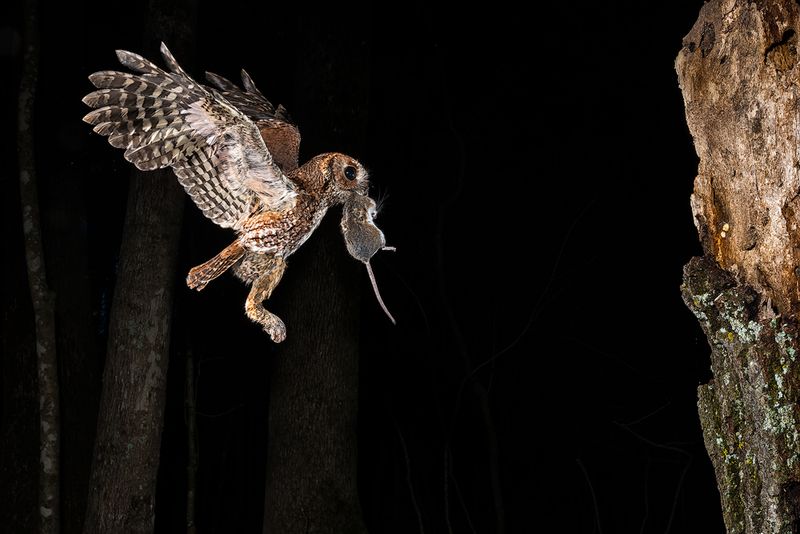
Watching a screech-owl hunt is a quiet, efficient thing. The bird typically sits on a low perch, a fence post, a low branch, or the edge of a shrub, and watches the ground below with large, light-gathering eyes.
When prey moves, it drops in a short, fast flight, seizes the animal, and returns to the perch or carries the meal to a sheltered spot. USDA Forest Service research on screech-owl hunting behavior confirms this low-perch, short-flight strategy, which makes open lawn edges, garden borders, and brushy margins particularly useful hunting habitat for the species.
Mice, voles, rats, and shrews do appear regularly in the Eastern Screech-Owl’s diet, and that part of the bird’s reputation is accurate. What often gets left out is how much else the owl eats.
The USDA Forest Service species review describes a seasonally shifting, opportunistic diet that includes insects, earthworms, crayfish, frogs, salamanders, lizards, snakes, and small birds in addition to mammals. In warmer months, insects can make up a substantial portion of what the owl catches, especially soft-bodied moths and beetles that become active at night.
In winter, when insects are scarce, small mammals become more central to the diet.
That flexibility is part of why screech-owls thrive in suburban environments. Cornell’s life history account notes that the species tolerates a wide range of conditions as long as trees and prey are available.
This also means that a screech-owl hunting your yard is contributing to a functioning local food web, taking pressure off multiple prey populations at once, not just mice. One owl cannot be expected to eliminate a rodent population or serve as a reliable substitute for building exclusion, but it is a genuinely useful part of the ecosystem working around your home every night.
Check the yard and building for actual rodent activity
Curiosity about the owl is natural, and there is a right way to act on it. Watch from a distance of at least 20 to 30 feet, use binoculars or a camera with a zoom lens, and resist the urge to walk up to a tree cavity or suspected roost.
Cornell’s overview of the species encourages passive observation rather than close approach, and that guidance protects both the bird and your ability to keep watching it over time. An owl that feels repeatedly disturbed near its roost or nest will relocate.
One indirect clue worth looking for is owl pellets, the compact bundles of fur, bone, and insect parts that a screech-owl regurgitates after digesting a meal. Pellets collect beneath a regular roost tree or post and can give you a rough sense of what the bird has been eating.
Keep in mind, though, that pellet analysis tends to undercount soft-bodied prey like insects and earthworms, which leave little behind, so what you find is an incomplete picture of the owl’s actual diet.
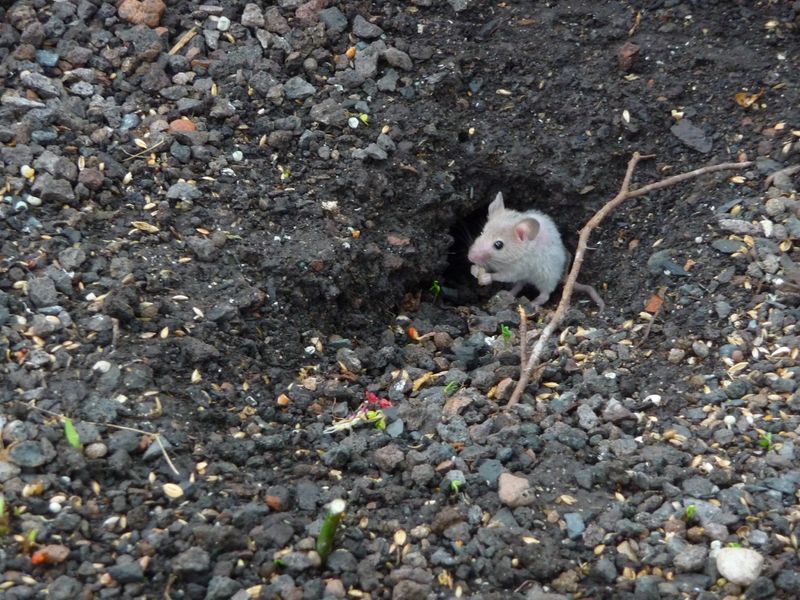
Separate from watching the owl, a practical check of your home and yard for rodent activity is a reasonable next step if you have any concern. CDC guidance on rodent control points to specific signs worth looking for: droppings along walls or in cabinets, gnaw marks on food packaging or wood, greasy rub marks along baseboards, and nesting material tucked into corners or insulation.
Integrated pest management principles emphasize that finding one sign does not tell you how many animals are present or whether they are entering the structure. A thorough inspection of the building’s exterior, checking crawl spaces, attic vents, utility penetrations, and foundation gaps, is the only way to assess whether rodents are actually getting inside.
Use exclusion and sanitation to protect the home
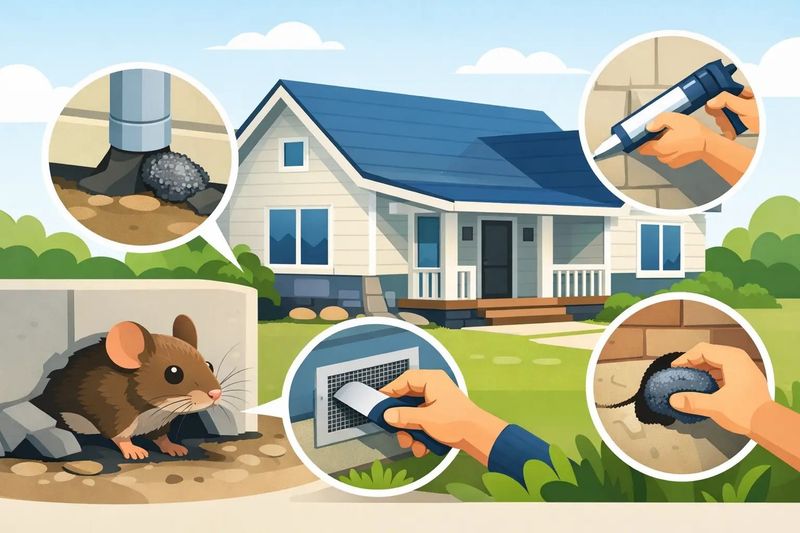
Confirmed or suspected rodent activity around a home calls for a straightforward, layered response. The goal is to make the building unattractive and inaccessible to rodents without disrupting the food web that includes the screech-owl hunting nearby.
CDC’s seal-up guidance for rodent control is specific about entry points: mice can squeeze through a gap roughly one-quarter of an inch wide, which is about the diameter of a pencil. Rats need a bit more room, but not much.
Any gap around a pipe, vent, utility line, door frame, or foundation crack that meets that threshold is a potential entry point and should be sealed with hardware cloth, steel wool packed tightly and secured with caulk, or a proper construction patch.
Sanitation around the exterior of the house matters just as much as sealing gaps. Spilled birdseed, uncovered compost, pet food left outside overnight, unsecured garbage cans, and open bags of animal feed are all reliable attractants.
Removing those food sources reduces the reason for rodents to linger near the building in the first place. Keep firewood stacked away from the house, clear dense ground cover close to the foundation, and fix any dripping outdoor faucets or drainage issues that create standing water near the structure.
Inside, integrated pest management guidance recommends storing dry goods in hard-sided, sealed containers, keeping kitchen areas clean of crumbs and grease, and removing clutter from basements and garages that could serve as nesting cover. These steps address the conditions that support rodent activity rather than just reacting to animals already present.
Protecting the building through exclusion and sanitation is entirely compatible with wildlife stewardship: you are not trying to eliminate every small mammal from the surrounding landscape, only keeping them out of the structure where they cause real problems. The screech-owl hunting your yard at night is doing its own part on the landscape side of that equation.
Keep rodenticide away from the owl’s hunting ground

Outdoor rodent poison and a hunting screech-owl are a dangerous combination. When a rodent consumes a toxic bait, it does not die immediately.
It may move slowly and behave abnormally for hours or days, making it far easier for a predator to catch. EPA’s pesticide safety review for rodenticides specifically identifies this as a secondary exposure risk: predators and scavengers that eat a poisoned rodent can absorb the same toxic compound.
Second-generation anticoagulant rodenticides are particularly concerning because they accumulate in tissue and can remain at harmful levels in a carcass long after the rodent dies, creating an exposure risk for any owl, hawk, fox, or other wildlife that feeds on it.
If a rodent problem inside or immediately adjacent to a structure is serious enough that trapping alone feels insufficient, and you decide to use a rodenticide as a last resort, EPA guidance on safe rodenticide use is clear: use only an EPA-registered consumer product, follow the label exactly as written, place bait stations where children and pets cannot reach them, and check stations frequently to remove any dead rodents before scavengers can find them. Prompt carcass removal is one of the most practical steps a homeowner can take to reduce secondary poisoning risk.
For targeted control inside a home or outbuilding, spring-loaded snap traps are the option most consistent with protecting wildlife. CDC guidance on hantavirus prevention, outlined in their hantavirus prevention brochure, recommends snap traps for active rodent control and provides specific cleanup procedures for droppings, urine, nests, and carcasses.
Before handling any contaminated material, ventilate the area for at least 30 minutes, wear gloves and a properly fitted respirator, and wet the material with a disinfectant spray before wiping or bagging it. Additional CDC animal health guidelines reinforce the importance of careful disposal and hand washing after any contact with rodent material.
Keeping the control method targeted and contained protects the food web the owl depends on while addressing the genuine hazard inside the building.
Preserve useful habitat without manufacturing prey
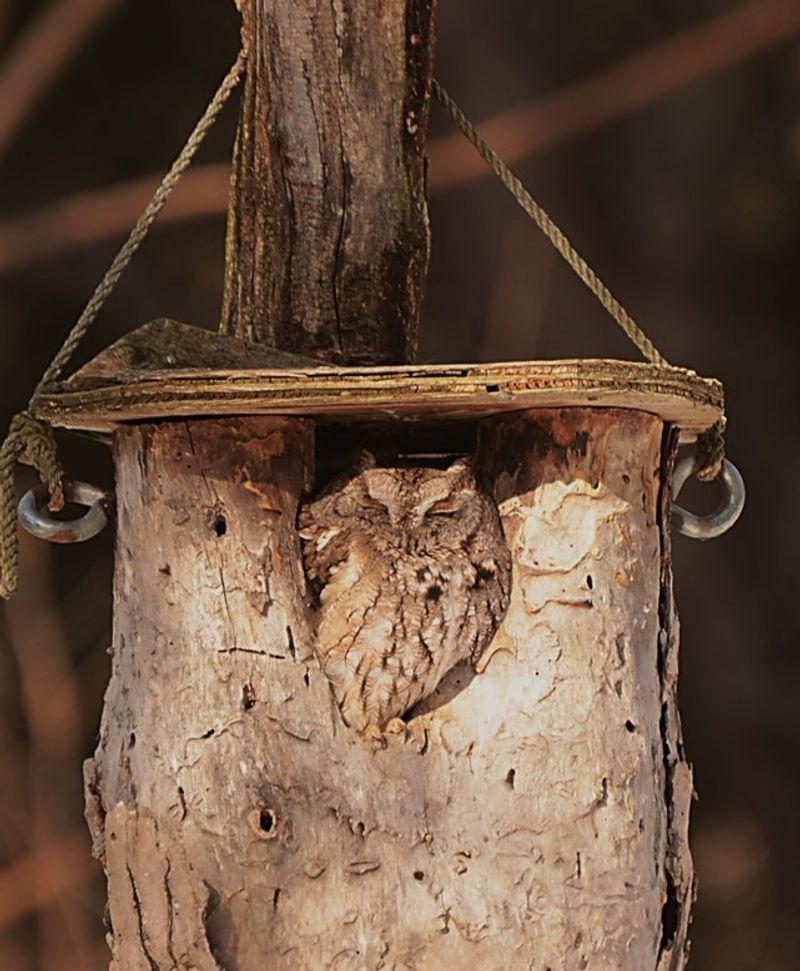
Supporting a screech-owl does not require stocking the yard with mice or doing anything that increases rodent pressure around the house. The habitat features that matter most to the species are structural: mature trees with rough bark and natural cavities, open areas where the bird can hunt without obstruction, and low perches at the edges of lawn or garden beds.
Yards that already have large oaks, pecans, or other established hardwoods are often already providing what the owl needs most.
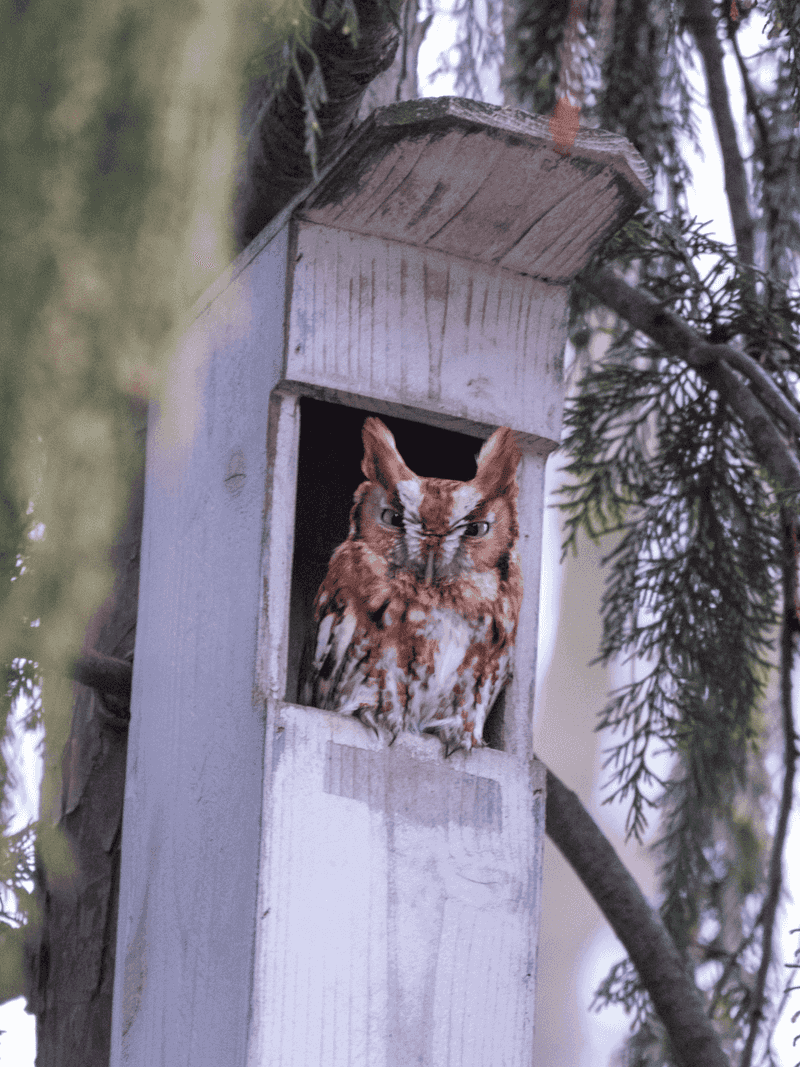
A properly designed nest box can supplement natural cavities, particularly in neighborhoods where older trees have been removed or where cavities are scarce. Cornell’s species overview recommends installing a box well before breeding season begins and including a predator guard, typically a cone or baffle on the mounting pole, to reduce access by raccoons and rat snakes.
NC State Extension’s guide to managing backyards for birds lists screech-owls among the cavity-nesting species that may use a well-placed box, and their woodland wildlife nest box publication provides dimension and placement details. Occupancy is never guaranteed: whether an owl uses a box depends on local territory, competition, prey availability, and the presence of natural cavities nearby.
One thing worth leaving alone is a natural tree cavity that appears usable by wildlife, even if it seems like a pest or mosquito concern. CDC guidance on tree holes notes that cavities which do not hold standing water can provide nesting habitat for birds and other wildlife and should not be filled simply to eliminate a perceived problem.
If a cavity holds water and you are concerned about mosquito breeding, consult a certified arborist before taking any action that could damage or seal a structure that screech-owls or other species might use.
Treat the call as an observation, not a diagnosis
A screech-owl calling from your trees at dusk is worth paying attention to, but it is an observation, not a warning. Cornell’s sound documentation is clear that the whinny and tremolo serve communication functions: territory, contact, breeding behavior.
The call does not measure what is happening on the ground beneath the owl, and it is not a reliable signal that rodent numbers are climbing.
What the call does tell you is that a capable nighttime predator has found your yard suitable. That is worth protecting.
Watch from a distance, use binoculars, and let the owl work without disturbance. If you have genuine concerns about rodents, look for direct signs inside and around the building, inspect entry points, and address any gaps or food sources that could be drawing animals toward the structure.
CDC’s seal-up guidance and integrated pest management principles give you a practical, targeted path that protects the home without poisoning the food web the owl depends on.
Skip the outdoor rodenticide where the owl hunts. EPA’s rodenticide safety review makes the secondary exposure risk plain, and a snap trap inside the building does the same job without that tradeoff.
A yard that hosts a hunting screech-owl is already doing something right. The best response to that dusk call is to observe carefully, inspect honestly, and protect the home in a way that keeps the whole system working.