
Chickadees Keep Returning to One Shrub: Could It Be Loaded With the Caterpillars They Feed Their Young?
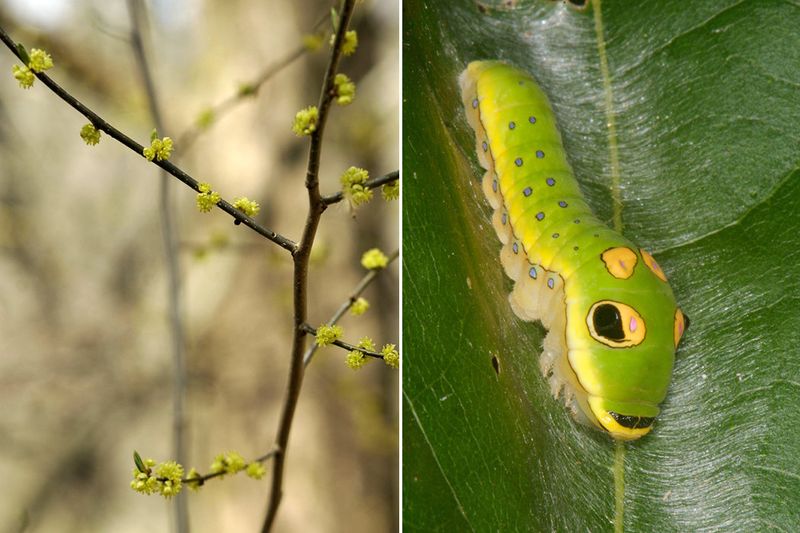
A chickadee zipping back and forth through the same shrub over and over is one of those backyard moments that makes you stop and wonder what is really going on. The bird may be hunting caterpillars to feed its nestlings, but it could also be using the plant for cover, perching, or other food sources entirely.
Understanding the difference between what you see and what you can actually conclude matters, because it shapes how you care for your yard and the wildlife that depends on it. Native plants are often central to this story, and knowing why can help North Carolina homeowners make smarter choices about what to grow and what to leave alone.
Repeated Visits Offer a Clue, Not a Diagnosis
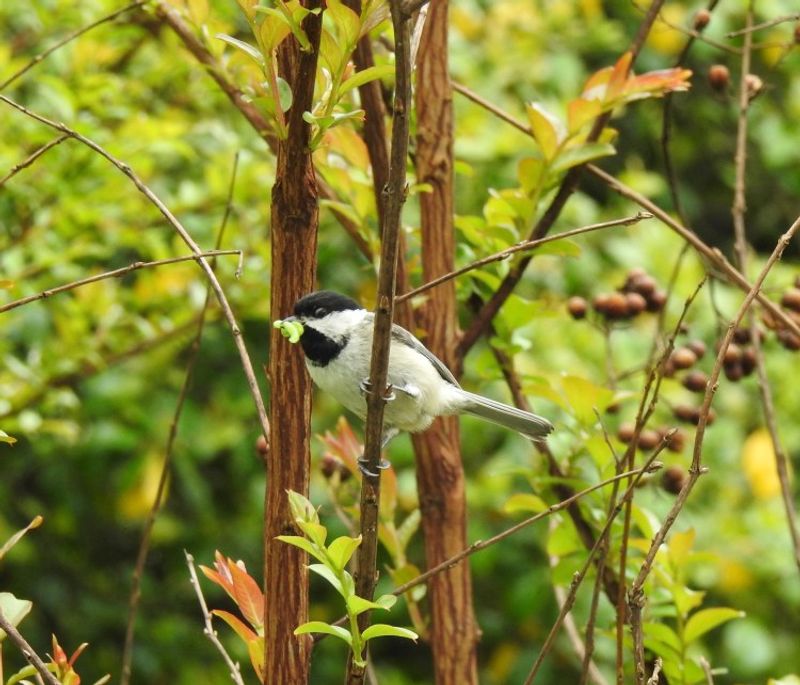
Watching a small bird work the same shrub again and again feels like a puzzle begging to be solved. The temptation is to declare the case closed: the plant must be packed with caterpillars, and the bird must be collecting them for its young.
That conclusion is appealing, but it skips several steps that matter if you want an accurate picture of what is happening in your yard.
A chickadee visiting one shrub repeatedly could indeed be exploiting a concentrated patch of prey. Caterpillars, beetles, aphids, spiders, and other small arthropods can cluster on particular plants at particular times, and a bird that finds that patch will return until the supply runs out.
However, the same shrub might also be offering the bird a sheltered perch, a lookout point for territorial display, or access to berries or other plant material. None of those possibilities can be ruled out just by counting visits.
Separating observation from inference is not a minor technicality. Smithsonian research on Carolina Chickadee foraging shows that these birds use a range of plant types and forage at multiple heights, which means a single shrub may be just one stop among many rather than a special destination.
Without identifying what the bird is picking up, confirming it is actually swallowing prey, and documenting whether it travels to a nest afterward, the caterpillar explanation stays an inference, not a finding.
Species identification adds another layer of caution, especially for readers in western North Carolina. Cornell Lab of Ornithology’s Carolina Chickadee profile notes that Black-capped Chickadees occur in or near portions of the mountains and can be genuinely difficult to tell apart from Carolina Chickadees without a close, careful look.
Assuming every chickadee in the yard is a Carolina Chickadee is reasonable in the Piedmont and Coastal Plain but less certain at higher elevations.
The shrub visit is still worth paying attention to. It may point toward a plant that is quietly doing useful ecological work in your yard.
The key is to treat it as a starting point for observation rather than a finished explanation.
Nestlings Depend on Insects, but Visits Do Not Prove Food Delivery
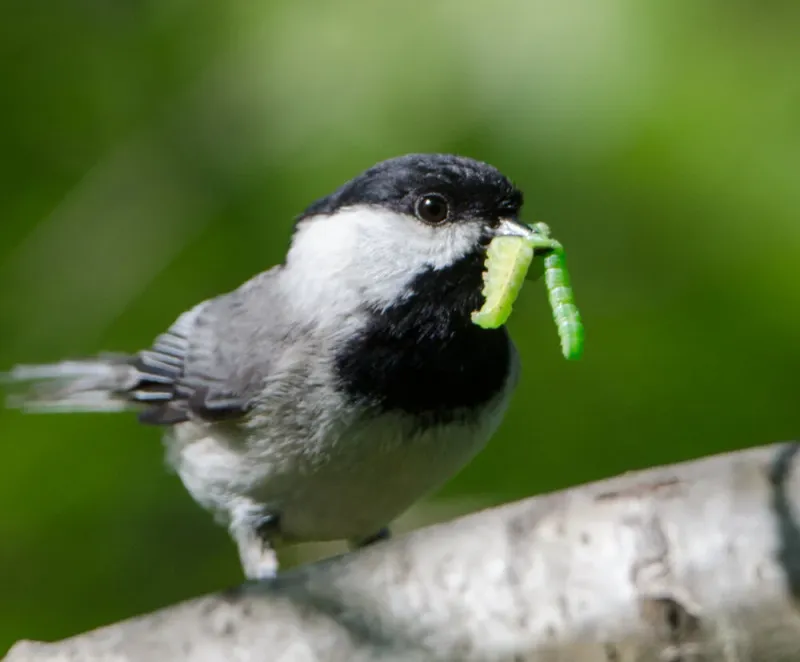
Carolina Chickadees are insect-eating machines for most of the year. Cornell Lab of Ornithology reports that roughly 80 to 90 percent of the Carolina Chickadee’s diet outside winter consists of animal matter, primarily insects and spiders.
Seeds and berries become more important in cold months, but when the weather warms and nesting begins, the birds shift hard toward protein-rich prey.
Nestlings push that demand even higher. Baby chickadees cannot digest seeds or hard-shelled insects well, so parents concentrate on soft-bodied prey.
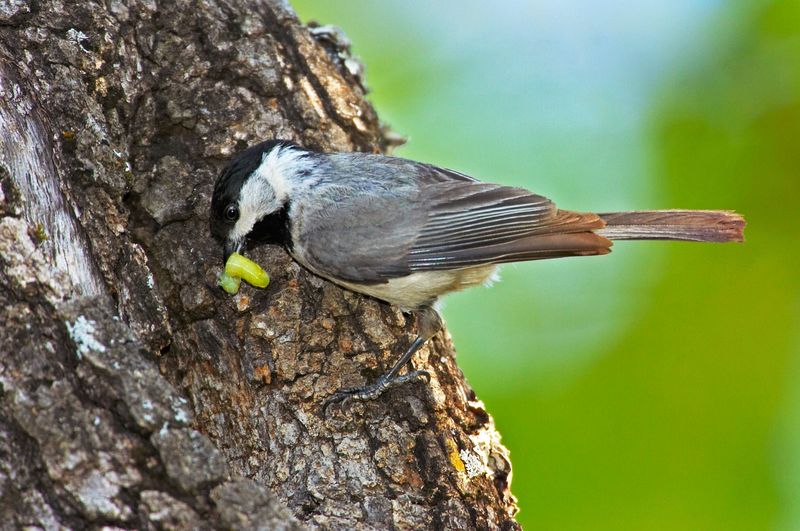
Smithsonian’s National Zoo notes that nestling chickadees rely heavily on caterpillars and spiders brought by both parents throughout the nestling period. The sheer volume of prey required during those weeks is striking.
One commonly cited figure suggests a chickadee brood may consume somewhere between 6,000 and 9,000 caterpillars before the young birds fledge. University of Illinois Extension frames this as an illustrative estimate rather than a fixed biological requirement.
The actual number varies with clutch size, how long the nestling period lasts, the size of individual prey items, and how researchers calculate the total. A brood fed mostly large caterpillars needs fewer individual prey items than one fed mostly tiny ones.
The point of the estimate is to convey scale, not to set a precise target.
What that demand does not tell you is whether a specific shrub in your yard is supplying any part of it. A bird perched in a plant during nesting season might be hunting caterpillars to carry home, or it might be resting between trips to an entirely different foraging site.
Prey capture and nest delivery are two additional steps beyond a simple visit, and confirming them requires watching the bird pick up prey, retain it in its bill, and fly directly to a nest. Most casual observations stop well short of that.
The ecological need is real and well documented. The connection between that need and any one shrub in your yard is something you can reasonably suspect but not easily confirm from the back porch.
Native Plants Often Support More of the Prey Chickadees Seek
The general pattern in the research is clear enough to be useful, even though it comes with real caveats. Native woody plants tend to support more caterpillar biomass and a greater variety of leaf-feeding insects than many commonly planted nonnative ornamentals.
That difference has measurable consequences for birds like chickadees that depend on insects to raise their young.
A Smithsonian-affiliated study on native plants and insectivorous bird breeding found that Carolina Chickadees preferentially foraged in native plants that supported more caterpillars. The same research, also available through ScienceDirect’s full study record, showed that chickadees were less likely to breed successfully as nonnative plant dominance increased in suburban yards.
That is a meaningful finding, and it connects plant choices to real reproductive outcomes rather than just foraging preferences.
A separate study pushed the question further by modeling what level of native plant biomass might sustain a local chickadee population. The PubMed-indexed study on nonnative plants and chickadee population growth found that yards dominated by nonnative plants had fewer arthropods, caused chickadees to shift toward less-preferred prey, and were associated with lower reproductive success.
In that study’s modeled analysis, population sustainability appeared to require that native plant biomass exceed roughly 70 percent of total yard plant biomass. That result came from residential sites in the Washington, D.C., region, though, and should not be treated as a precise prescription for North Carolina yards in the Piedmont, Coastal Plain, or mountains.
The variation within those averages matters just as much as the averages themselves. Recent Ecosphere research on arthropods across native and nonnative woody plants confirms that native plants support more caterpillar occurrence on average, while also documenting substantial differences among plant species, geographic regions, and seasons.
Some native plants host relatively few caterpillar species. Some nonnative plants do host insects.
The native-plant advantage is real and consistent enough to guide decisions, but it is not an automatic guarantee that any native shrub will outperform any nonnative plant in any yard.
For North Carolina homeowners, the practical takeaway is that shifting toward native plants in general, rather than chasing one particular species, gives birds like chickadees a better chance of finding the prey they need throughout the breeding season.
Spicebush Is a Useful North Carolina Example, Not a Proven Chickadee Magnet
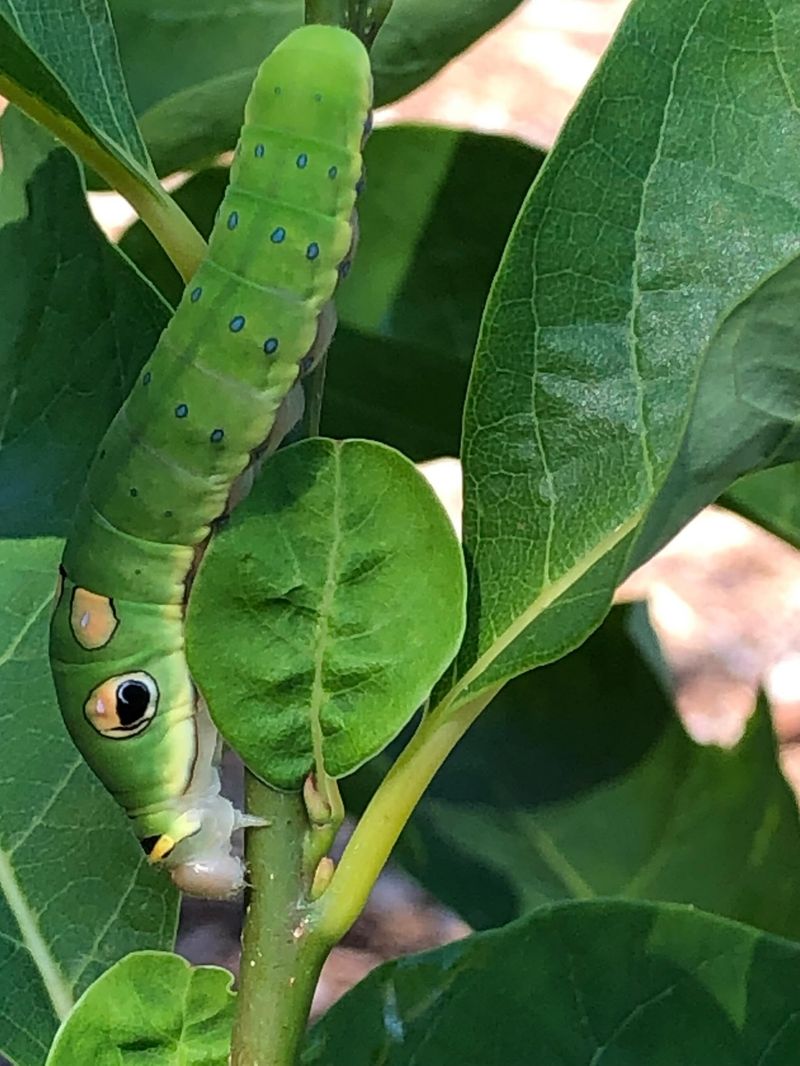
Spicebush, known botanically as Lindera benzoin, makes a reasonable case study for what a caterpillar-supporting native shrub can offer in a North Carolina yard. It grows naturally across all three of the state’s major regions – the Piedmont, the Coastal Plain, and the mountains – which means it is a genuinely local option rather than a plant borrowed from a different climate zone.
The North Carolina Wildlife Federation’s native pollinator shrub list recognizes spicebush as a host plant for spicebush swallowtail and Palamedes swallowtail caterpillars. Both are butterfly species, and their larvae feed on spicebush leaves.
That host-plant relationship means a healthy spicebush can support caterpillar production during the months when birds most need soft-bodied prey.
What that relationship does not establish is that chickadees preferentially seek out spicebush or that a bird seen repeatedly in one of these shrubs is necessarily there for the caterpillars. A bird might visit for cover beneath the dense branching, for the small red-orange berries the plant produces in fall, or simply because the shrub sits near a reliable nest site.
Host-plant value and bird visitation are related but not identical concepts.
Matching the plant to your yard’s specific conditions matters as much as choosing a native species. NC State Extension’s native plants handbook recommends selecting plants native to the local ecoregion and suited to the site’s light, soil type, and moisture levels.
Spicebush generally prefers partial shade and tolerates a range of moisture conditions, including wetter soils along stream edges. Planting it in full sun or dry, compacted soil will stress the shrub and reduce its ability to support insects of any kind.
Other native shrubs worth considering alongside spicebush include American beautyberry, Virginia sweetspire, inkberry, and arrowwood viburnum, all of which appear on NC State’s recommended lists. The goal is not to identify one plant that solves the caterpillar problem but to build a yard where multiple species together support a functioning food web.
Spicebush is a solid piece of that puzzle, not the whole picture.
Build a Layered Habitat Instead of Chasing One Magic Shrub
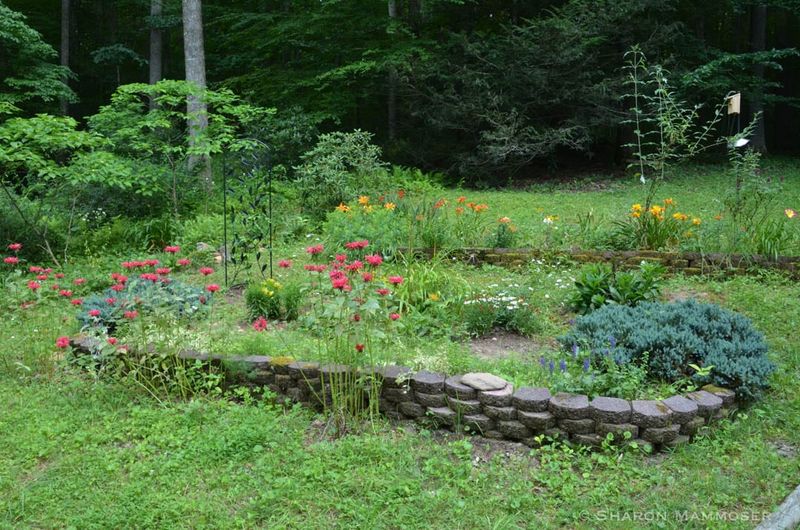
One shrub can do real ecological work, but it cannot carry the full weight of a yard’s food web on its own. Chickadees and other insectivorous birds forage, roost, and nest at different heights throughout the day and the season.
A yard that offers only one layer of vegetation leaves large gaps in what birds can actually use.
NC State Extension’s guide on landscaping for wildlife with native plants recommends combining ground-level plants, shrubs, understory trees, and canopy trees so that different species can find what they need at different heights. Chickadees often nest in cavities in larger trees and forage across all vertical layers depending on where prey is concentrated at a given moment.
A yard with only shrubs misses the foraging opportunities that taller vegetation provides.
Canopy trees deserve particular attention. Oaks, cherries, maples, and elms are among the woody plants most often cited in research on bird-supporting vegetation because their large leaf surface area and long-established relationships with native insects translate into high caterpillar production over a long growing season.
A single mature oak can support hundreds of moth and butterfly caterpillar species. That is not a promise that every oak in every yard will produce the same result, but it reflects the general advantage of larger, older native trees over any single shrub specimen.
NC State Extension’s native plants handbook lists a range of shrub options suited to North Carolina conditions, including buttonbush, sweet pepperbush, winterberry, wax myrtle, yaupon holly, and downy serviceberry. Each of these supports different insects, fruits at different times, and grows best under different moisture and light conditions.
Planting several of them alongside understory trees like native viburnums or dogwoods, and beneath a canopy tree or two, creates the kind of overlapping habitat that sustains birds across the full breeding cycle.
Smithsonian fieldwork on Carolina Chickadee habitat use reinforces the idea that these birds are not tied to a single plant type but range across a mosaic of vegetation depending on what is available. Designing for that range – rather than planting one specimen and waiting – gives the birds a yard they can actually use from spring nesting through the winter months.
Treat Leaf Damage as Food-Web Evidence Before Treating It as a Pest Emergency
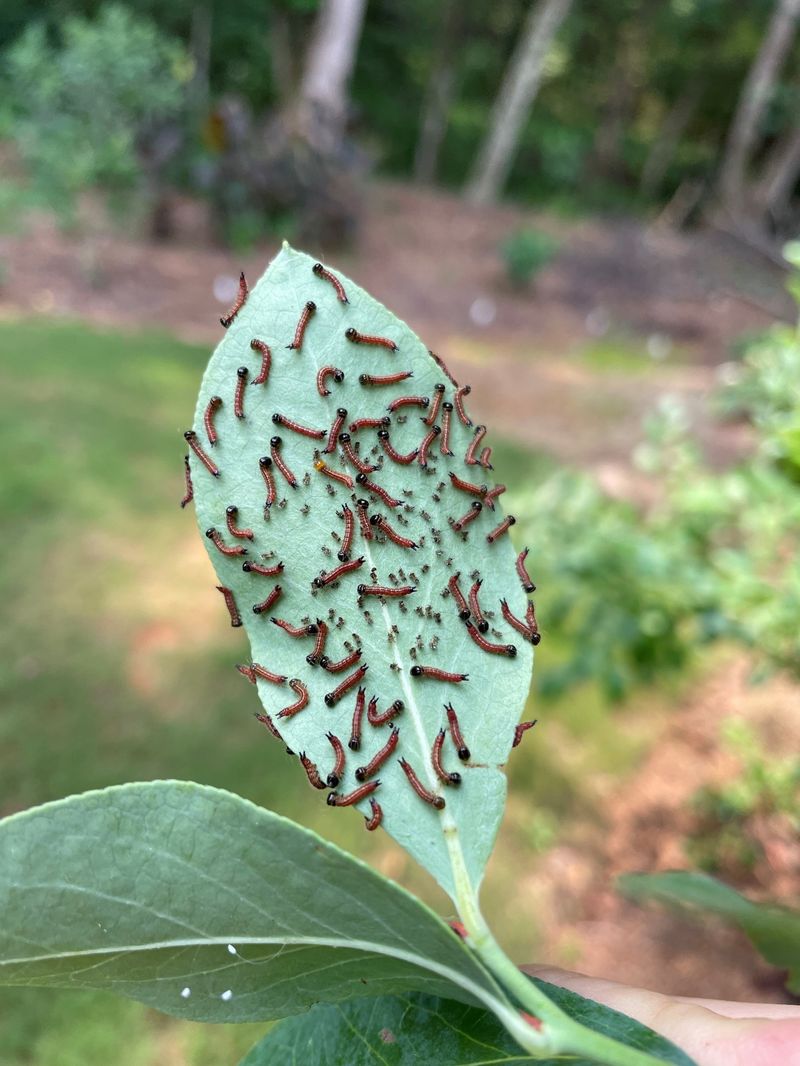
Finding chewed leaves on a shrub is the moment many gardeners reach for a spray bottle or head to the hardware store. Before doing either, it helps to reframe what that damage actually represents.
A plant with caterpillar feeding on it is, in most cases, a plant that is working as part of a food web rather than failing as a garden specimen.
UC Integrated Pest Management’s guidance on leaf-feeding caterpillars recommends handpicking or tolerating damage when practical before considering any insecticide. A healthy shrub can sustain moderate leaf loss without suffering lasting harm, and natural predators – including birds, parasitic wasps, and ground beetles – often bring caterpillar populations down on their own if given time to respond.
Spraying before that process plays out removes the prey that birds like chickadees are looking for and disrupts the natural controls that cost you nothing.
Identifying what is actually eating the plant matters before deciding how serious the problem is. Not all caterpillars are the same.
Moth and sawfly larvae cause the majority of leaf damage in most yards, and while some can defoliate a shrub under severe infestation, most cause cosmetic damage that the plant recovers from without intervention. Butterfly caterpillars, including the swallowtail species that feed on spicebush, are rarely present in numbers large enough to threaten the plant.
When damage is genuinely severe and the plant’s health is at risk, targeted approaches are safer for the broader yard than broad-spectrum sprays. EPA guidance on reducing pesticide impacts on wildlife advises using pesticides only when necessary, treating only the affected areas, and following label directions carefully to minimize harm to birds, pollinators, pets, and children.
The label is not optional; it governs lawful use and provides the precautions that protect nontarget species.
Products like Btk, a naturally occurring bacterium that targets caterpillars, break down relatively quickly and are more selective than synthetic broad-spectrum insecticides. Even so, Btk will kill any caterpillar that ingests treated foliage, including species that would otherwise become butterflies or moths.
Spinosad, another option sometimes described as low-impact, can harm some beneficial insects. Neither product should be applied routinely or without confirming a genuine need.
The shrub covered in caterpillars may be exactly what your yard needs right now.
Let the Chickadee Point You Toward a Healthier Yard
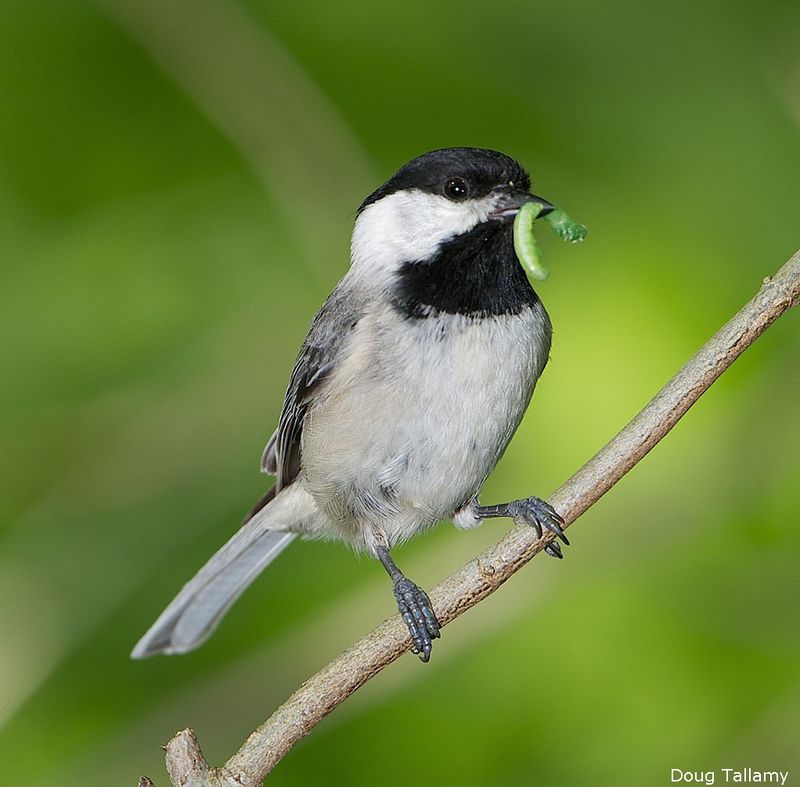
A chickadee working one shrub repeatedly is worth watching closely, but the bird is offering you a hypothesis, not a confirmed answer. The shrub may be hosting a temporary flush of caterpillars or other arthropods that the bird has learned to exploit.
It may also be providing cover, a perch, or something else entirely. Both possibilities can be true at the same time, and distinguishing them takes more observation than a single morning in the yard.
The more useful response is to treat the visit as an invitation to look more carefully at what your yard is producing. NC State Extension’s wildlife landscaping guide and UC IPM’s caterpillar guidance both point toward the same practical sequence: observe before intervening, tolerate reasonable leaf damage, and choose plants suited to your specific North Carolina region and site conditions.
Adding habitat layers over time – native groundcover, shrubs, understory trees, and canopy plants – gives birds more of what they need across the full year.
Avoiding pesticides that wipe out the insect supply is at least as important as choosing the right plants. Cornell Lab’s chickadee life history notes make clear how thoroughly these birds depend on insects across the breeding season.
A yard that keeps its insect community intact gives chickadees something genuinely useful. The bird in your shrub may not be delivering proof of anything, but it is pointing toward a yard that is quietly doing its job.