
North Carolina Beautyberry Feeds Songbirds And Turns Purple While Invasive Nandina Poisons Them
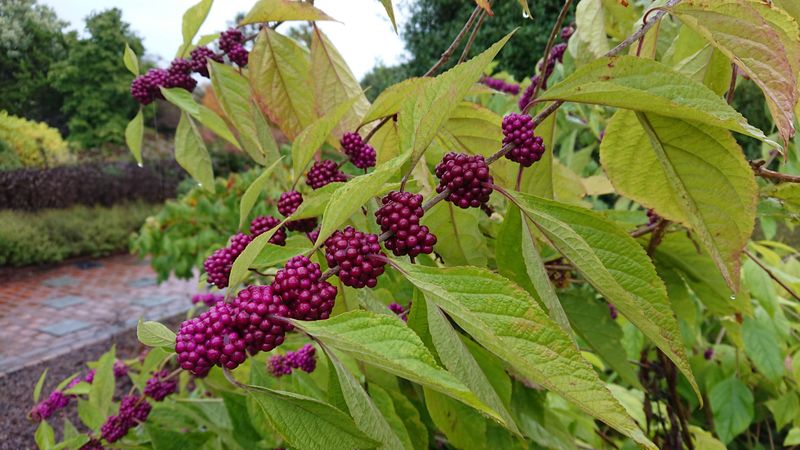
Every fall, a native shrub called American beautyberry lights up North Carolina yards with clusters of vivid purple-to-magenta fruit that several songbirds rely on when other food runs low. At the same time, a common landscape plant called nandina is spreading into wild areas across the state and has been linked to documented bird deaths when cedar waxwings consumed large quantities of its berries.
Understanding the difference between these two plants helps North Carolina homeowners make choices that genuinely support the birds and native ecosystems in their own backyards. This article explains what beautyberry actually offers, what nandina’s risks really are, and how to make the swap responsibly.
American beautyberry makes the fruit—not the foliage—the autumn show
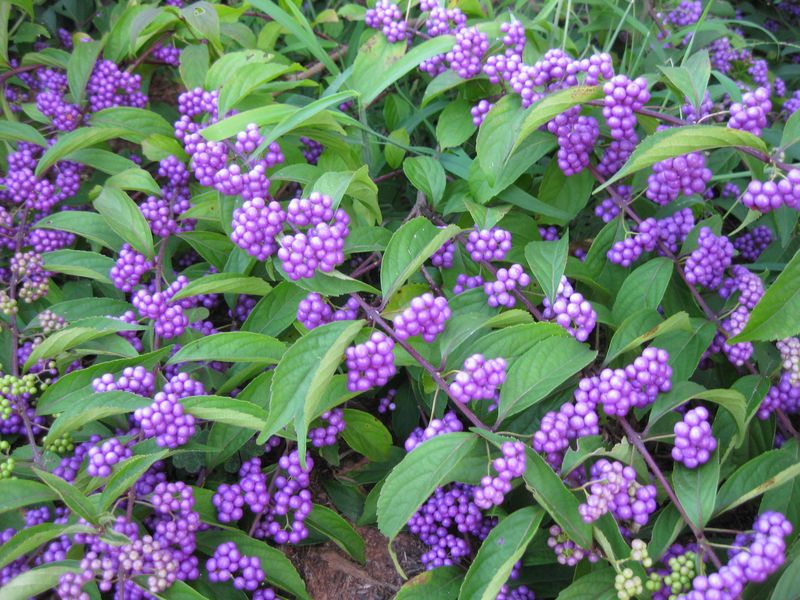
Walk past a mature Callicarpa americana in late August and the first thing you notice is not the leaves. Tight clusters of purple-to-magenta berries ring the woody stems like stacked bracelets, so bright they look almost artificial against the green foliage.
NC State Extension confirms that American beautyberry is native to North Carolina and produces its distinctive fruit from roughly August through October, with some clusters persisting into early winter when birds need food most.
The leaves themselves stay green through the growing season and drop in fall, so the purple display you are seeing comes entirely from the fruit. Calling it a shrub that “turns purple” is a bit misleading because the color belongs to the berries, not a whole-plant transformation.
The stems remain brown and the plant goes fully dormant once the leaves fall, leaving those jewel-bright clusters as the final seasonal statement before winter sets in.
Size-wise, American beautyberry typically grows about 3 to 8 feet tall and 3 to 6 feet wide, making it a mid-sized deciduous shrub rather than a tidy evergreen hedge. That growth habit matters when you are deciding where it fits in a border.
It works beautifully as a naturalized accent or wildlife-garden specimen, but it will not replicate the dense, year-round screening that an evergreen plant provides.
One more identification note worth making before you buy: not every plant labeled “beautyberry” at a nursery is the native species. Japanese beautyberry (Callicarpa japonica) is an introduced species that also produces purple fruit and is listed separately by NC State.
Ask for the scientific name Callicarpa americana to confirm you are getting the North Carolina native rather than an introduced relative that looks similar on the tag.
Which birds use beautyberry, and when?
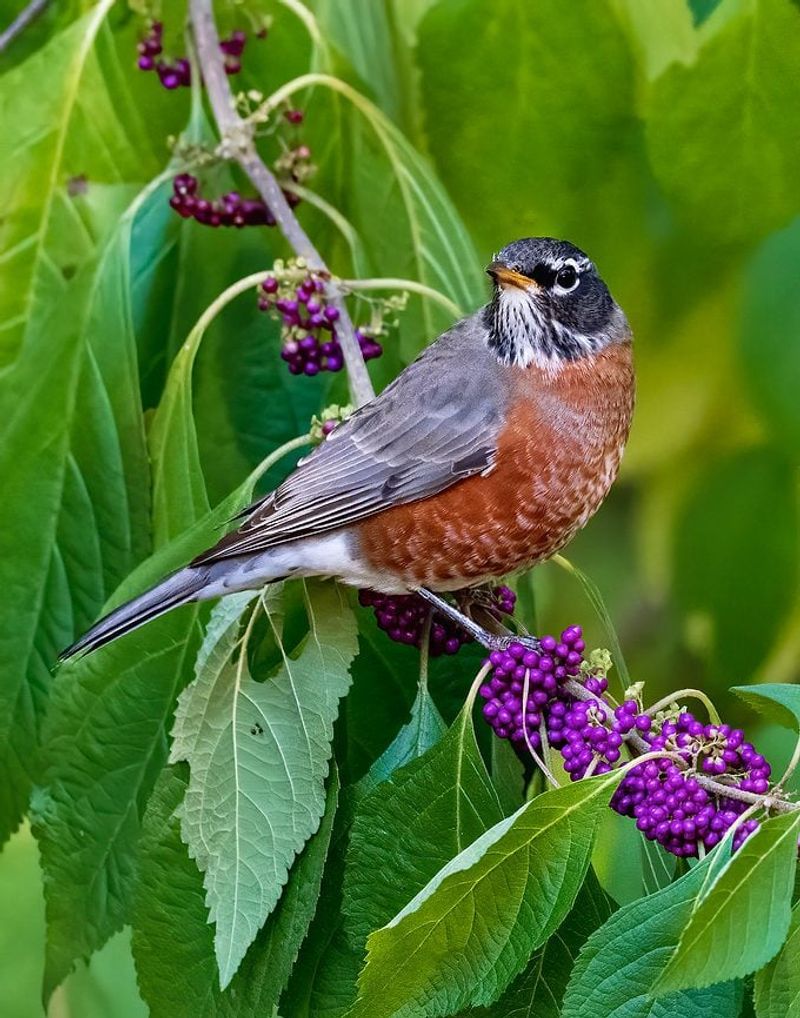
Several songbirds that North Carolina homeowners already recognize by name show up at beautyberry shrubs once the fruit ripens. NC State Extension specifically identifies American robins, brown thrashers, purple finches, and eastern towhees as birds that eat the berries.
Other sources add mockingbirds and quail to the list, suggesting that the plant draws a reasonably broad mix of fruit-eating species during the fall season.
Here is the part that surprises many gardeners: birds do not always rush to the berries the moment they ripen. NC State Extension notes that birds may leave beautyberry fruit untouched through much of fall and return to consume it later in winter when other food sources become scarce.
That delayed feeding pattern means a shrub that looks ignored in October might be actively stripped by December or January.
Treat beautyberry as a seasonal food resource rather than a guaranteed, high-traffic feeding station. It is not a feeder in the traditional sense, and planting one shrub will not automatically bring every fruit-eating bird in the neighborhood to your yard on a predictable schedule.
What it does offer is a documented native food source that fits into the natural foraging rhythms of birds that already live in and move through North Carolina landscapes.
The practical takeaway is straightforward. Plant beautyberry where it suits the site, let it fruit without interference, and watch what visits over the full season rather than judging its wildlife value by a single October afternoon.
Some years the fruit disappears fast; other years it lingers. Either outcome reflects normal bird foraging behavior, not a problem with the plant.
Nandina brings two separate problems to a North Carolina yard
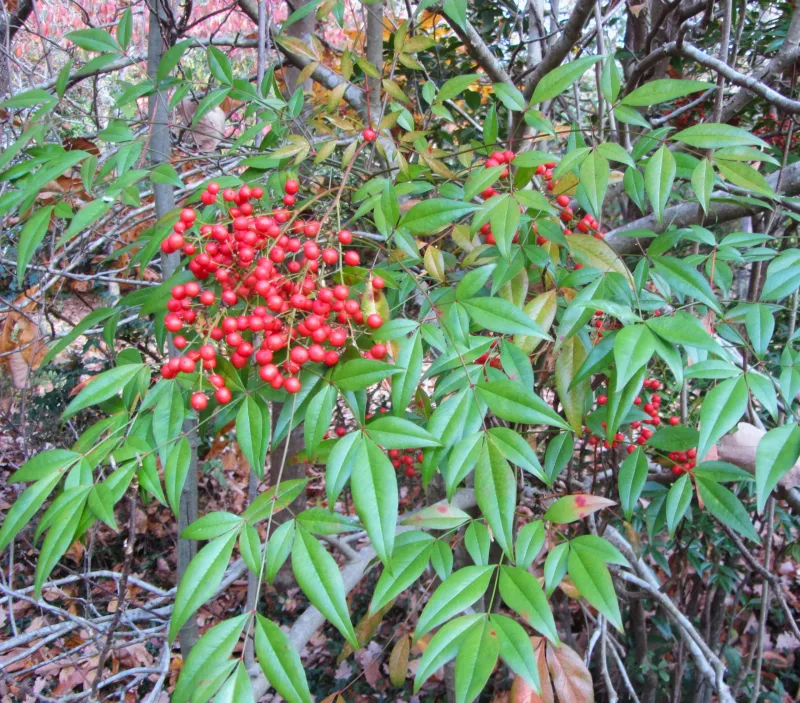
Nandina (Nandina domestica) originated in China and Japan, not North Carolina, and NC State Extension classifies it as invasive in the state. That classification matters because invasive plants do not stay where you put them.
Birds eat nandina fruit and deposit viable seeds in natural areas, roadsides, and woodland edges far from the original planting. Root-related growth and sprouting from fragments also help established plants spread or regenerate after incomplete removal.
NC State’s plant profile recommends considering native alternatives, including American beautyberry, native viburnums, buttonbush, and winterberry, in place of nandina. The invasive-spread concern applies to any fruiting nandina, regardless of whether a bird ever shows signs of distress after eating the berries.
Seed dispersal into natural areas is a problem on its own terms.
Separate from the spread issue, nandina leaves and fruit contain cyanogenic compounds, meaning they can produce hydrogen cyanide under certain conditions. University of Georgia Extension’s invasive plant catalog notes that the plant’s toxicity is a documented concern, particularly for fruit-eating birds.
These two problems, invasive spread and potential toxicity, are related in the sense that fruiting plants cause both, but they are distinct issues with different mechanisms and different practical responses.
Understanding that distinction helps homeowners prioritize. Even if toxicity risk were somehow eliminated, a fruiting nandina that disperses seeds into a North Carolina woodland would still be a problem worth addressing.
And even if a nandina never produced a single berry, it would still be a nonnative plant occupying space that a native shrub could fill more productively for local wildlife.
The cedar waxwing cases explain the warning without making it absolute
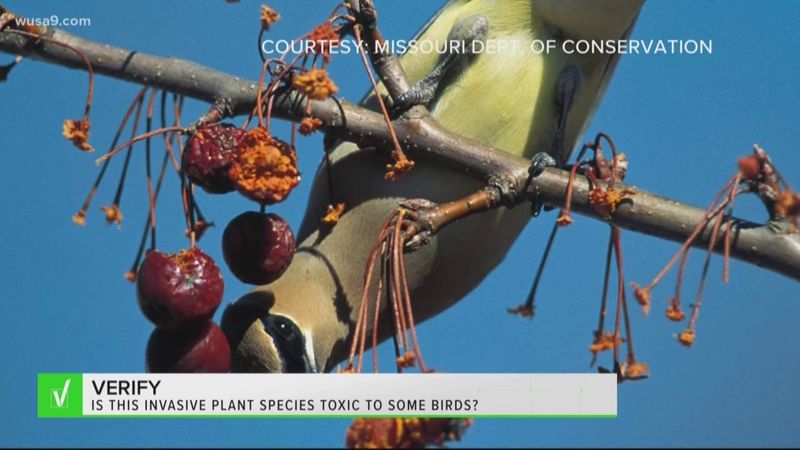
Cedar waxwings are fruit-eating specialists. Unlike birds that pick at berries one at a time between other activities, waxwings often descend on a fruiting plant in flocks and consume large quantities of fruit in a single feeding bout.
That behavior matters because the documented evidence linking nandina to bird deaths centers specifically on this species and on heavy consumption.
A University of Georgia College of Veterinary Medicine investigation examined dead cedar waxwings whose digestive tracts contained intact and partly digested nandina berries. The veterinary findings were consistent with cyanide toxicity.
The case involved multiple dead birds and represented a genuine, documented event, not a theoretical concern. It is the strongest piece of evidence behind the warning that fruiting nandina poses a risk to birds in a residential yard.
What the case did not establish is that every nandina berry is equally dangerous or that any bird eating one berry will die. A later survey by researcher Scott Zona looked at cyanogenic activity across nandina fruit samples and found meaningful variation.
That research found that green fruit was strongly cyanogenic, many ripe fruits were weakly or slowly cyanogenic, and some tested negative. Fruit generally became less cyanogenic as it remained on the plant through the season.
The practical conclusion sits between two extremes. Fruiting nandina deserves serious caution in a bird-friendly yard, especially where cedar waxwings are present and berry crops are large.
At the same time, the evidence does not support the claim that every berry is uniformly lethal or that a single fruit ordinarily kills any bird that eats it. The risk is documented and real, but it is also situation-dependent, shaped by the bird species involved, how much fruit is consumed, and the cyanogenic level of the specific plant and its fruit at a given stage of ripeness.
A native swap changes the winter structure of the border
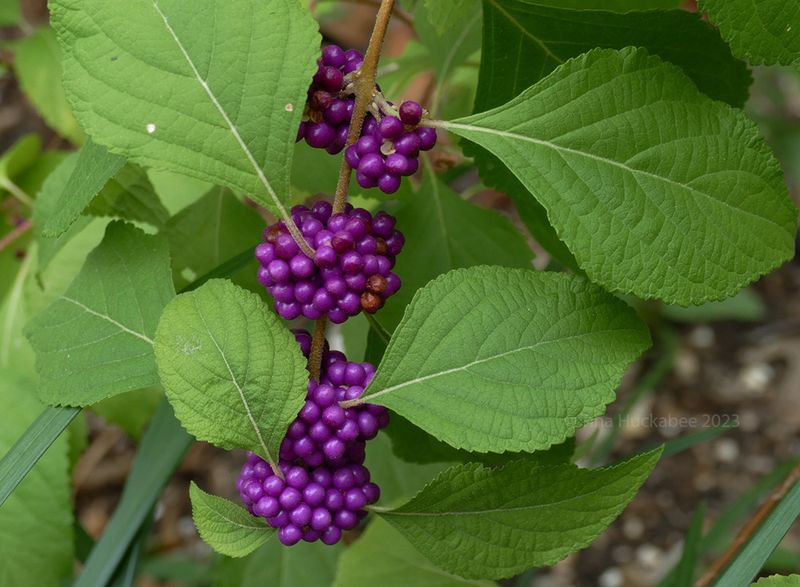
Replacing nandina with beautyberry is a sound stewardship decision, but it comes with a visual trade-off that is worth understanding before you dig anything up. Nandina is generally evergreen, holding its foliage and red berries through winter and providing year-round structure in a border.
American beautyberry is deciduous, meaning it drops its leaves in fall and spends the winter as a network of bare stems with no fruit left by mid-winter in most years.
That change affects how a border looks and functions from November through March. If you are using nandina as a privacy screen, a foundation planting, or a year-round visual anchor, NC State’s comparison of the two plants makes clear that beautyberry will not replicate that role.
The swap is a wildlife-and-stewardship choice with its own spectacular purple-fruit payoff in fall, not a one-for-one visual replacement. Plan the replacement with that seasonal difference in mind.
Before purchasing, verify the scientific name at the nursery. NC State’s plant toolbox lists American beautyberry as Callicarpa americana and notes that Japanese beautyberry is a separate introduced species.
Several nonnative Callicarpa cultivars also produce purple fruit, so confirming the species name protects you from accidentally planting another introduced plant in place of the invasive one you just removed.
NC State recommends other native alternatives to nandina as well, including native viburnums, buttonbush, and winterberry. Some of those options offer more winter presence than beautyberry, so if year-round structure matters in a particular spot, they are worth considering alongside or instead of beautyberry for that specific location.
Plant American beautyberry where North Carolina conditions suit it
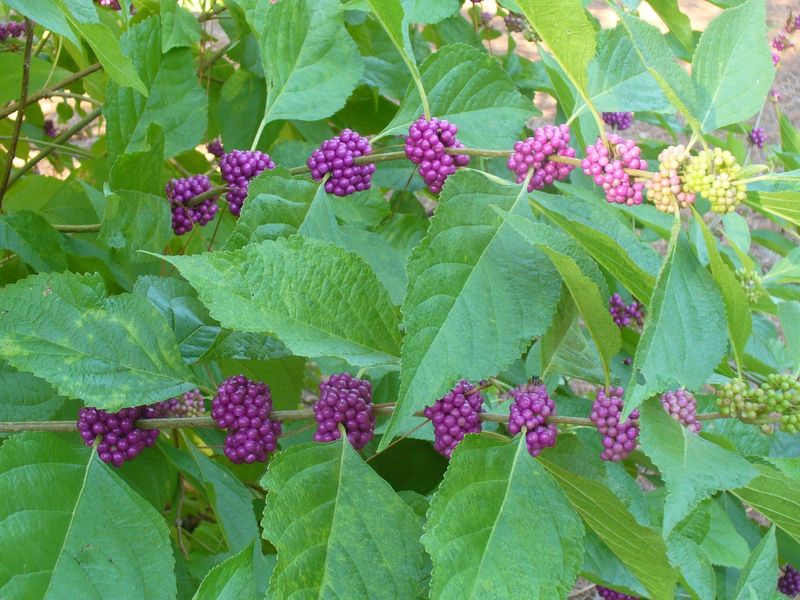
Getting American beautyberry established successfully comes down to matching the plant to the right spot rather than fighting the site. Full sun to part shade both work well, and the shrub handles the range of light conditions common in a typical North Carolina backyard border, from open sunny edges to spots that get a few hours of afternoon shade.
Well-drained soil is the main soil requirement; beautyberry is not suited to consistently wet or waterlogged ground.
NC State Extension lists appropriate uses for this shrub as naturalized areas, borders, wildlife gardens, pollinator gardens, and winter gardens. That range reflects its adaptability, but it also signals that beautyberry is at its best when given room to grow rather than forced into a tight formal space.
At a mature size of roughly 3 to 8 feet tall and 3 to 6 feet wide, it needs spacing that lets it arch outward naturally without being constantly cut back to fit a narrow spot.
Pruning timing is one of the most useful things to know before you plant. Beautyberry flowers and fruits on new growth produced in the current season, which means late-winter pruning is both safe and beneficial.
NC State’s woody ornamentals guidance supports late-winter pruning for shrubs that bloom on new wood, and cutting beautyberry back hard before spring growth begins encourages vigorous new stems that will carry the heaviest fruit clusters come August.
Skip the fertilizer-heavy approach. Beautyberry is a native plant adapted to the moderately fertile soils common across the North Carolina Piedmont and Coastal Plain, and it does not need heavy amendment to thrive.
Water it through the first growing season to help roots establish, then let the plant find its own footing in the landscape.
Remove nandina completely, then watch the site
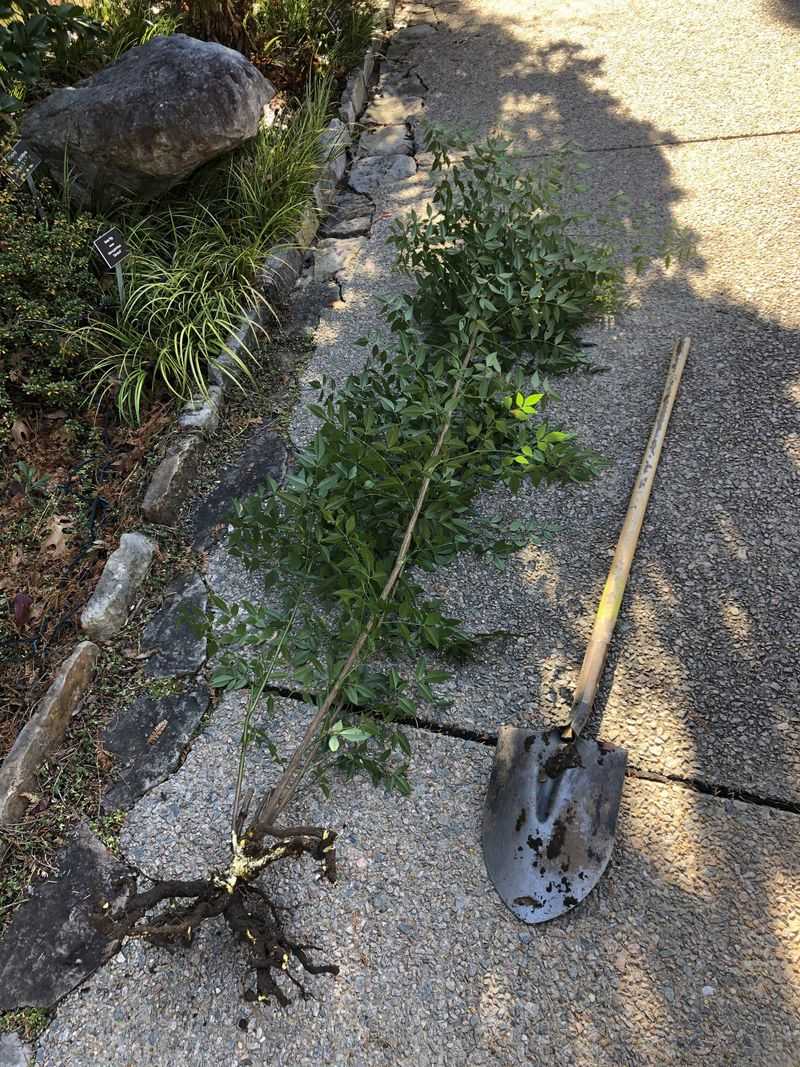
Pulling nandina out of a yard sounds straightforward, but the plant has a few habits that make incomplete removal a real possibility. For small plants in moist soil, hand-pulling can work, provided the entire root system comes out with the stem.
Leaving root fragments behind is a common mistake, and those fragments can regenerate new shoots that return to fruiting size faster than a seedling would.
Larger, established nandina plants almost always require digging rather than pulling. University of Georgia Extension’s invasive plant catalog recommends thorough root removal and follow-up monitoring for any nandina removal project.
Plan to check the site regularly for resprouts, suckers, and new seedlings, because even a careful removal often misses something. Catching regrowth early, when plants are small, is far easier than waiting until stems have hardened again.
If a plant is fruiting when you remove it, stripping the berries before you disturb the plant reduces the chance of scattering viable seeds across the yard during the removal process. UGA Extension Forsyth County notes that berry removal before disturbance is a practical step to limit seed dispersal.
Bag the berries and dispose of them in the trash rather than composting them, since nandina seeds can remain viable through a typical home compost pile.
Berry removal does not replace full plant removal, and it does not eliminate the cyanogenic compounds already present in the plant’s roots and remaining stems. For large plants where digging is not practical, a targeted cut-stump herbicide treatment applied to freshly cut stems is an option, but only where the specific product is labeled for that use on that site.
NC State Extension warns that glyphosate can severely injure desirable plants through contact or drift, so targeted application matters. The EPA is clear that pesticide labels are legally enforceable documents, and following the exact label directions for your product, site, and target plant is not optional.
Do not rely on a general dilution rate or brand recommendation found online; read and follow the label that comes with the specific product you purchase.
One beautyberry helps, but a bird-friendly yard needs more than one shrub
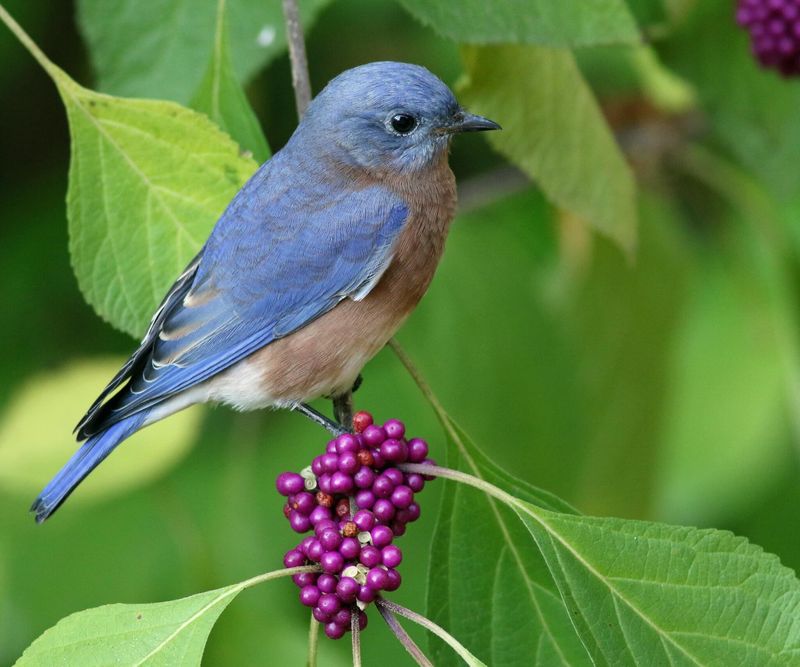
A single beautyberry shrub is a genuine contribution to a North Carolina yard’s wildlife value, but it covers only part of the picture. NC State Extension’s guidance on managing backyards for birds recommends combining food, cover, and other habitat resources, including a succession of fruiting and seed-producing plants that provide something across multiple seasons rather than just one window in late summer and fall.
Beautyberry’s fruit window runs from roughly August into early winter, which is genuinely useful. But birds need food in spring, summer, and the depths of winter too.
Native viburnums, winterberry, and other fruiting shrubs NC State recommends as nandina alternatives can extend that seasonal coverage. Adding native seed-producing plants and plants that support insect communities gives birds protein sources alongside fruit, which matters especially during nesting season when adults are feeding nestlings.
American beautyberry fits best when it is treated as one seasonal component of a more diverse planting rather than a standalone solution. Remove nandina thoroughly, choose correctly identified Callicarpa americana where the site suits it, and build around it with other native plants that fill different seasonal roles.
The purple fruit clusters are a vivid, reliable payoff every fall, and they are most valuable when the rest of the yard gives birds somewhere worth staying year-round.