
Does a Tiny Frog in a Tarantula’s Burrow Guard Its Eggs From Ants? What Researchers Actually Saw
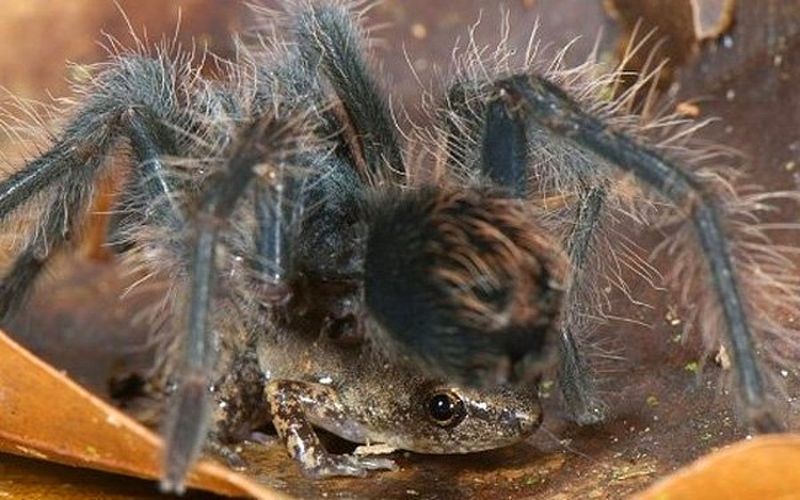
Deep in a Peruvian rainforest, a thumb-sized frog spends its days tucked inside the burrow of a big hairy tarantula. Spiders like that usually eat anything small enough to grab.
So why does the frog stay alive? A popular story says the frog eats ants that threaten the spider’s eggs, but the real findings are more careful and more interesting.
A rainforest burrow held an unexpected pair
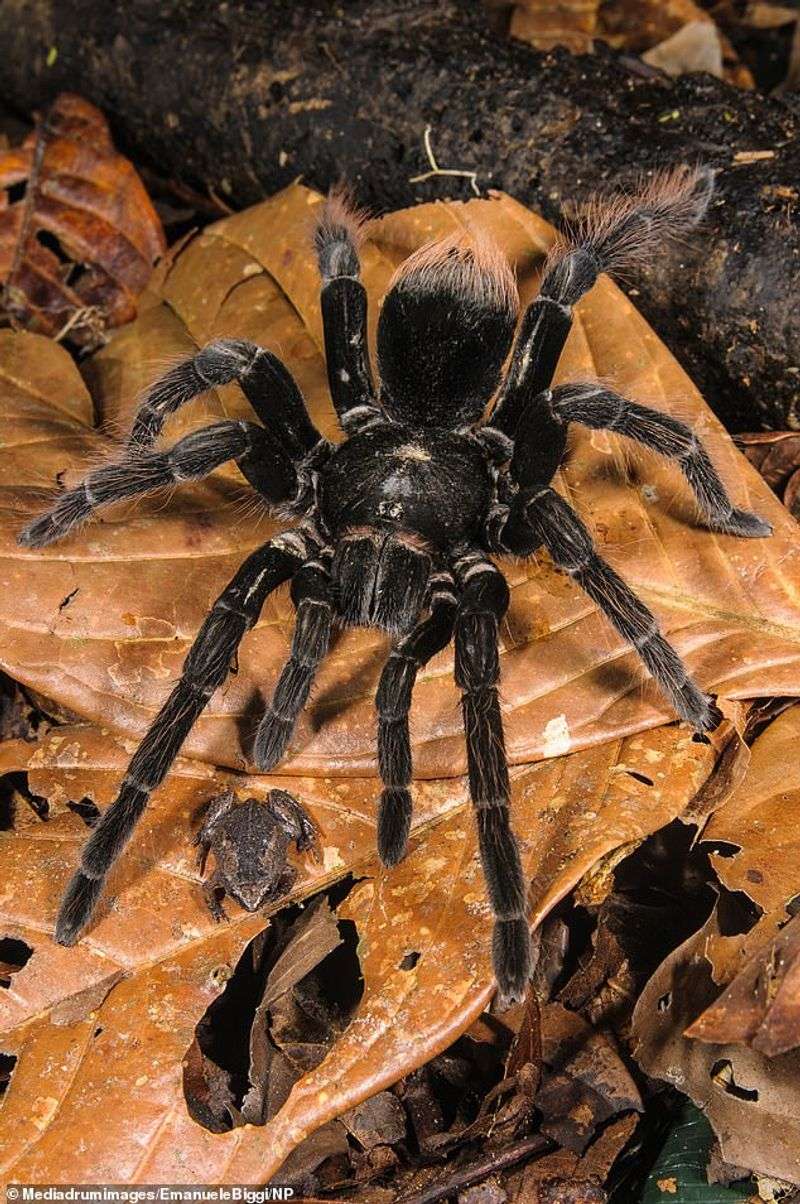
Picture the forest floor at Tambopata, in southeastern Peru. Leaves pile up, the air hangs heavy, and a burrow dug by a large tarantula opens in the soil.
Inside, researchers found something odd: a tiny frog sharing the space.
In a 1989 field study, two biologists followed a small microhylid frog and a big burrowing tarantula for three months. They saw the frogs and spiders using the same daytime retreats.
They also saw the two animals foraging in overlapping areas, so they were not just bumping into each other by accident.
The striking part is the close, tolerated cohabitation. A frog that small would look like a snack to a spider that size, yet the frogs kept turning up in the burrows.
You may have heard a tidier version of this story, where the frog earns its keep as a bodyguard that eats ants raiding the spider’s eggs. That is not what was documented here.
The researchers recorded who lived where and how the spiders behaved. They did not record a frog defending an egg sac.
So the real question is what the spider’s behavior actually shows. The next section looks at the feeding trials that gave the first clues.
The spider responded differently to its burrow-mates
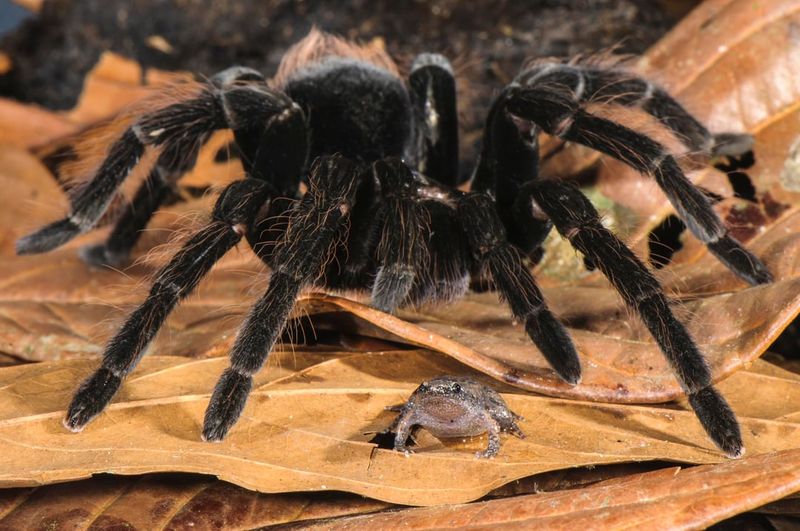
Sharing a burrow could just mean the spider had not noticed the frog. To test that, the researchers ran feeding trials.
They offered frogs to the spiders and watched what happened.
According to the 1989 paper, the spiders ate several other frog species. The resident frogs of the focal kind, however, drew no predatory response at all.
There was a wrinkle. Some young spiders did grab the resident frogs, then let them go.
That detail matters, because it shows the frogs were not invisible to the spiders.
What do these trials show? The spiders reacted differently to these frogs than to other frogs.
That fits with tolerated cohabitation.
What they do not show is just as important. They do not prove the spider knows the frog, welcomes it, or keeps it as a pet.
They also do not prove the frog is safe from being eaten in every situation. Trials are a snapshot of behavior, and a spider that skipped a meal in a test is not making a promise.
Think of it like a dog that ignores one cat but chases another. You learn the response differs, but you have not learned why.
Does the frog really guard the eggs from ants?
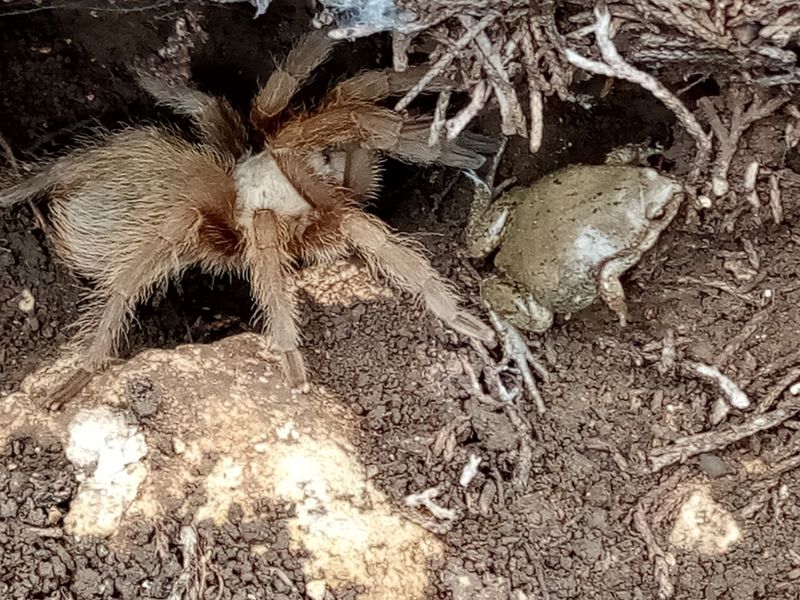
Short answer: nobody has verified it for the Peruvian pair. No one reported watching that frog eat ants or defend an egg sac.
So where does the ant story come from? In the original paper, the authors pointed to an earlier report about a different partnership.
That one involves the North American narrow-mouthed toad, Gastrophryne olivacea, and the tarantula Aphonopelma hentzi.
In that earlier case, the idea was that an ant-eating toad might reduce ants that threaten spider eggs. It was a hypothesis, a possible explanation, not a demonstration.
The 1989 researchers borrowed the idea as something worth considering. They did not present it as proof that their Peruvian frogs protected eggs.
Over time, retellings have smoothed that careful wording into a confident claim, and that is how a maybe becomes a headline.
Here is a simple way to sort it out. Observed: frogs and spiders shared burrows, and spiders reacted differently to the frogs.
Proposed: frogs might help by eating ants. Only the first part comes from the Peruvian fieldwork.
Ants are plausible egg raiders in a rainforest, so the idea is not silly. It just still needs evidence.
Why the tarantula releases the frog is still a mystery
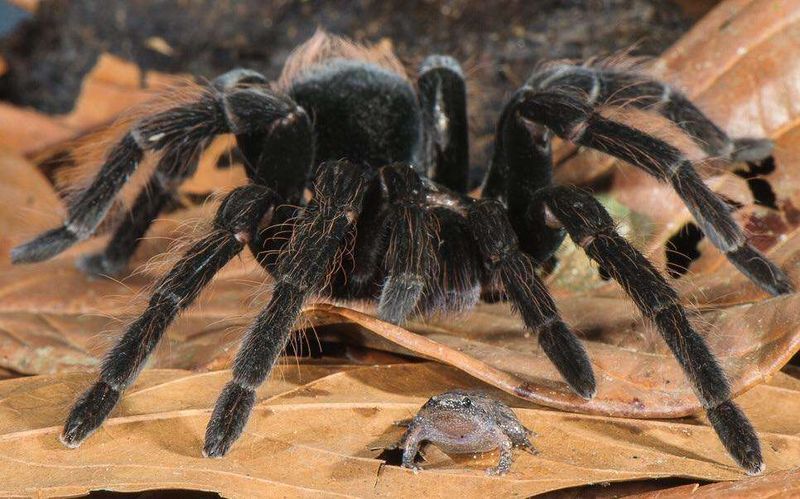
If the spider lets the frog go, something must be telling it to. Researchers have a guess, but it is only a guess.
In the 1989 study, the authors suggested that chemical cues might explain why spiders released the frogs. Maybe the frog carries a scent or a surface chemical that changes how the spider reacts.
They said the mechanism needed further study.
Notice what that does not say. The work did not establish that the frog’s skin is toxic.
A spider can drop a grabbed animal for many reasons, and poison is only one possible story.
It also does not say either animal planned anything. The spider is not striking a deal, and the frog is not signing a contract.
Talking that way is fun, but it adds motives nobody measured.
Here is where things stand. We know what happened in the trials: no predatory response from the spiders toward the resident frogs, and a few grab-and-release moments from young spiders.
We do not know the trigger behind it.
That gap is the honest heart of the story. A good mystery is one where the clues are real but the answer is still out in the forest.
A tolerated roommate is not automatically a mutualist
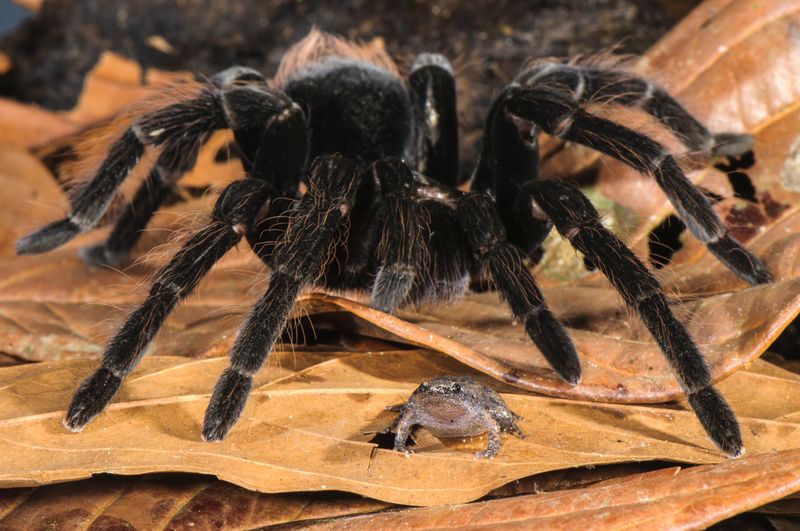
Biologists use two handy terms here. Mutualism means both species benefit.
Commensalism means one species benefits while the other is not shown to gain or lose anything.
The 1989 researchers favored commensalism. As their paper explains, they saw clear advantages for the frog, but they knew of no benefit to the spider.
Think of a houseguest who gets free lodging while the host seems unaffected.
A tolerated roommate is simply that: tolerated. It does not turn into a partner just because the story would be nicer that way.
Later work has widened the conversation. A 2024 review of tarantula associations discusses possible mutual benefits across various frog and tarantula pairings.
It also describes varied interactions, including tolerated cohabitation and occasional predation involving associated frogs.
Those possibilities are not proof for this case. Saying some pairings may help both sides is different from showing that the Peruvian frog guards eggs.
The ant-defense idea remains a hypothesis.
A practical clue for reading any wildlife headline: look for the word benefit, then ask who measured it. If no one measured the spider’s side, the claim is still open.
Later sightings do not settle every species name
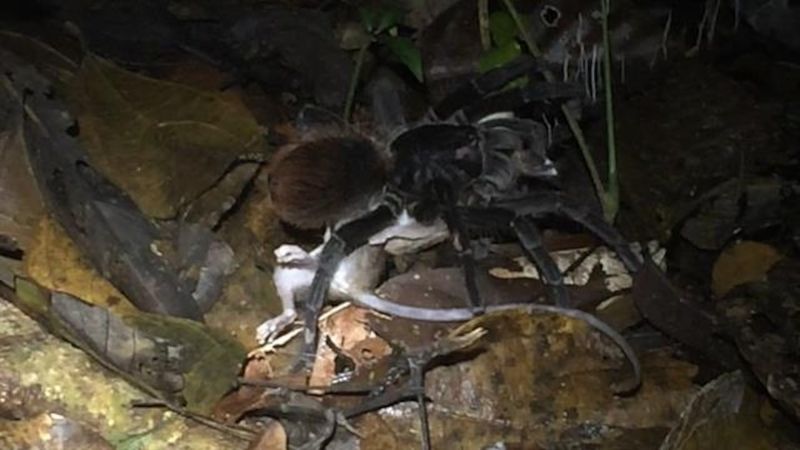
Names can get tangled in stories like this. The 1989 paper named the pair Chiasmocleis ventrimaculata and the spider Xenesthis immanis.
Later, a 2024 review described the studied spider differently. It refers to it as an unidentified Pamphobeteus species that was originally reported under the Xenesthis name.
In other words, the spider’s identity is less settled than the old label suggests.
Then there is a separate sighting. A 2019 paper documented another frog and tarantula association in Peru at a different site.
It identifies those animals as Chiasmocleis royi and a Pamphobeteus tarantula. It also summarizes the earlier evidence that the spider can eat other frogs but releases the associated microhylid.
So we have different places, different papers, and different names. Treating them as one confirmed species pair would be a mistake.
The takeaway is practical: when you read about the frog and the tarantula, check which sighting is being described. A new observation adds to the picture, but it does not automatically confirm what an older one suggested.
The backyard takeaway is a wildlife curiosity, not ant control

If ants keep marching across your patio or through your tomato bed, this story might tempt you to look for a helper. Resist that.
The observations come from South American rainforest fieldwork, not U.S. gardens.
Nothing in the Peruvian research gives a reason to bring in frogs or tarantulas to protect plants or manage household ants. Releasing either animal could also harm local wildlife.
What you can take home is the curiosity. Two animals shared a burrow, and the spider reacted to the frog differently than it did to other frogs.
Why the spider holds back, and whether it gains anything, remains unresolved.
Sometimes the best part of a wildlife story is the question it leaves standing.