
The Mushrooms In Your Lawn Are Just The Tip: Here’s The Hidden Fungal Growth Beneath Your Grass
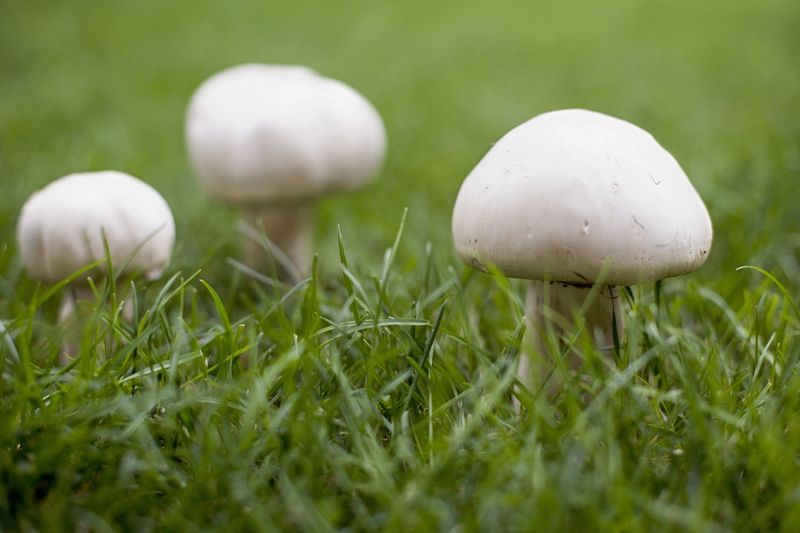
You spot a cluster of pale mushrooms on your lawn after a rainy week, and you wonder what is going on under the grass. Those mushrooms are only the part of a fungus you can see.
The rest may be thin threads of hidden fungal growth in the soil, thatch, or buried wood. Knowing what is down there helps you decide when to relax, when to be careful, and when your lawn really needs attention.
The mushroom is the fungus’s visible fruit
Picture an apple tree. The apple is what you notice, but the tree is the living thing that made it.
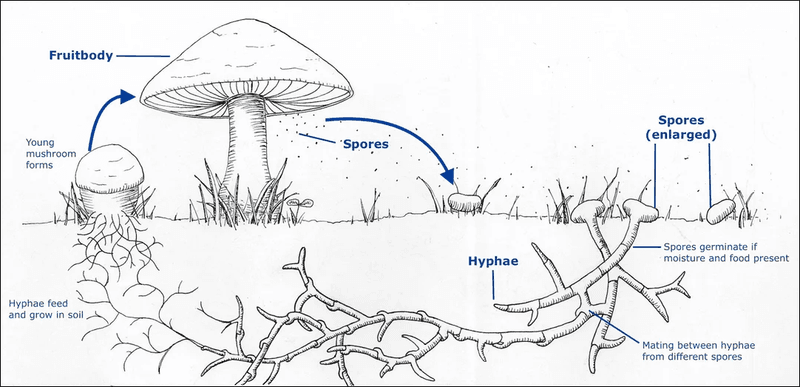
A lawn mushroom works much the same way. It is the visible, usually short-lived reproductive structure of a fungus, built to release spores.
The rest of the fungus often stays out of sight. It grows as mycelium, according to University of Maryland Extension, a mass of branching filaments.
Each tiny filament is called a hypha, and together they spread through whatever material the fungus is feeding on.
That is why a mushroom can pop up and fade within a day or two while the fungus itself carries on. You are seeing a brief appearance, not the whole organism.
The UC ANR Soil Biology Primer describes these filaments as a normal part of soil life.
It is tempting to imagine one giant web tying your whole yard together, but that is not what a mushroom tells you. Mushrooms in different spots may come from different fungi, each growing in its own patch of food.
Even the presence of mycelium by itself does not show that fungi are linking your plants or passing nutrients between them.
So think of each mushroom as a clue to hidden fungal growth nearby, not a map of one lawn-wide network.
What the fungus is growing through
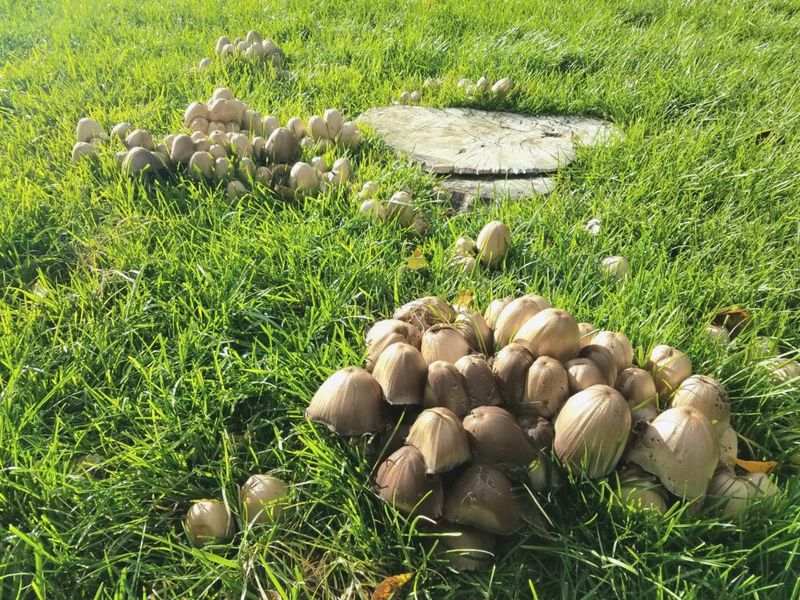
Fungi need something to feed on, and under a lawn there is plenty. Old grass roots, a spongy layer of thatch, fallen leaves, and a buried stump or tree root can all feed hidden fungal growth.
A mushroom often marks the spot where one of those food sources sits below the surface.
Many common lawn fungi break down dead material and recycle nutrients. University of Minnesota Extension notes that most lawn mushrooms are not a sign of lawn disease.
That is a real and useful job, much like a compost pile working quietly in your yard.
Still, a mushroom sighting is not a soil report card. The old saying that mushrooms mean good soil is too broad.
They show that a fungus found enough moisture and organic matter to fruit, and Washington State University Extension lists this among common lawn myths. Compacted, thin, or poorly drained soil can grow mushrooms too.
Fungi also relate to plants in different ways. Some feed on dead matter, some partner with roots, and a few can cause plant disease.
Seeing a mushroom does not tell you which kind you have, so treat it as a curious clue rather than good or bad news.
What rain changes—and what it doesn’t
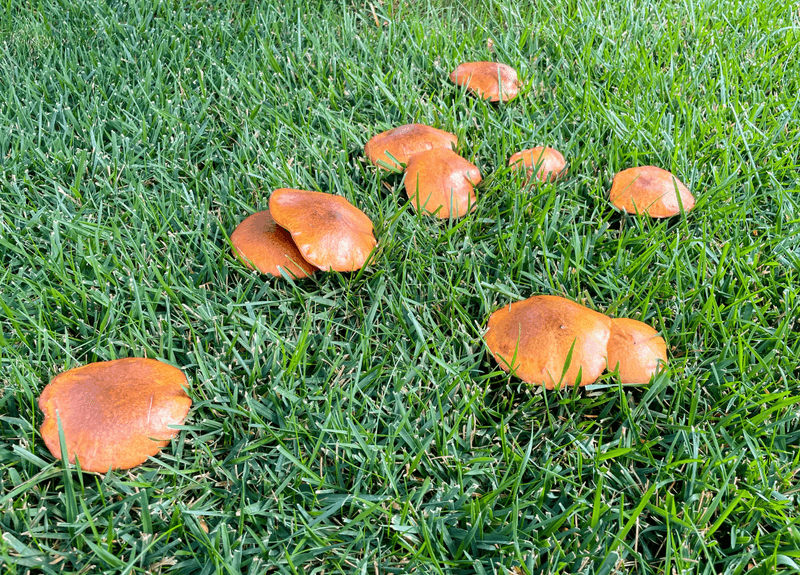
Walk out after a few damp days and the mushrooms seem to appear overnight. Moisture is a common trigger.
University of New Hampshire Extension explains that wet weather favors mushrooms showing up, and heavy irrigation can do the same.
What changes is visibility. Wet conditions can push the reproductive structures up into view.
They do not prove the fungus just arrived, and they do not mean a huge new network spread across your yard with each storm.
The fungus was likely already feeding below ground. Rain simply helped it fruit.
Timing is also unpredictable. Iowa State University Extension points out that mushrooms depend on conditions and on the particular fungus, so there is no set number of days after rain.
One spot may sprout in two days, another may stay bare all season.
A practical clue: if mushrooms keep showing up near a sprinkler zone, a downspout, or a shady low spot, check how much water that area gets. You do not need to dry out the whole lawn, but it helps to know where moisture collects.
Fairy rings form as some fungi grow outward
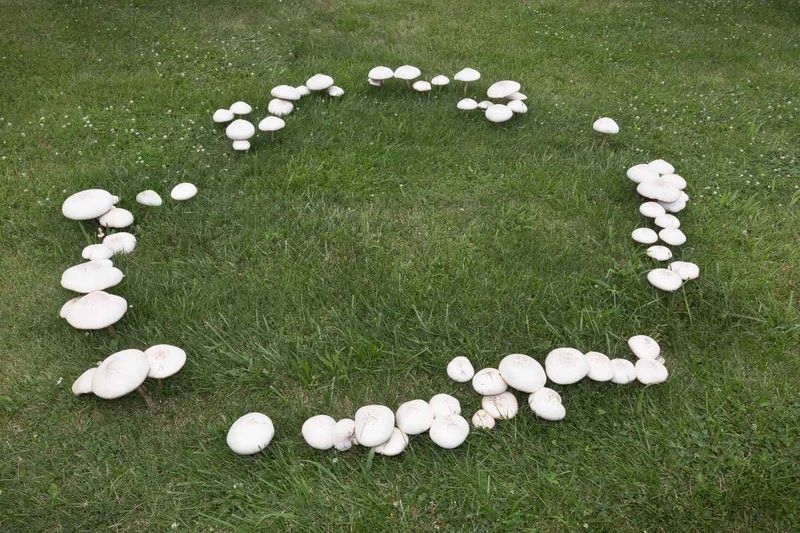
Sometimes mushrooms line up in a circle, and folklore called these fairy rings. The real story is less magical but still neat.
Certain fungi grow outward through buried organic matter, using up food in the center and moving on, which often creates a roughly circular pattern.
As University of Wisconsin Extension describes, several different fungi can cause rings or partial arcs. So fairy ring names a pattern, not a single species.
That matters because the pattern does not tell you exactly what the fungus is or what it will do to your grass. One ring might show only a band of lush growth.
Another might show mushrooms, and another might show a stressed strip of turf.
Rings can also be incomplete. Buried obstacles, mowing paths, or overlapping rings can turn a neat circle into an arc or a wavy line.
If you see a curved band in your lawn, you may be looking at the same kind of growth.
Keep in mind that a single mushroom, or a few scattered ones, is not a ring. A ring needs a clear shape that grows season after season.
A ring can green grass or leave it stressed
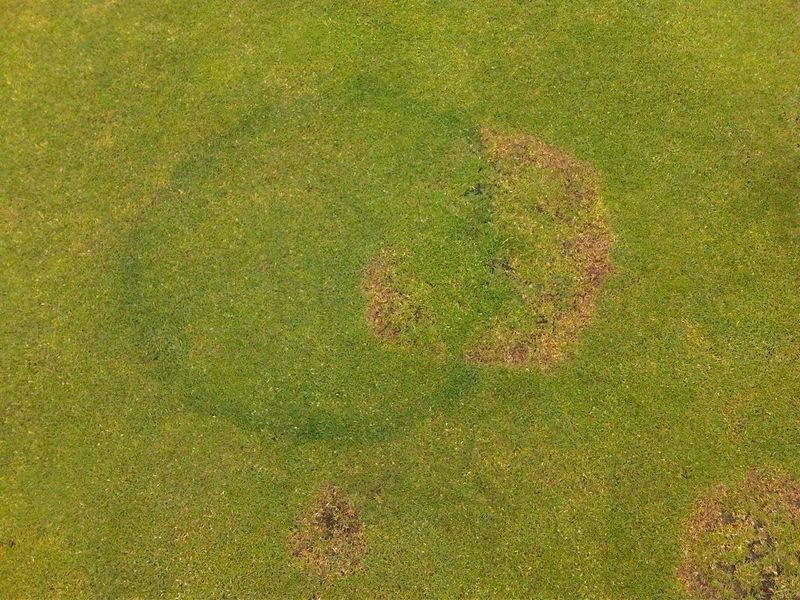
Two lawns can have fairy rings that look nothing alike. In one, a band of grass looks darker and grows faster than the rest.
In another, a ring of brown, dead turf stands out in summer heat. Both can happen, and neither contradicts the other.
The green band often comes from decomposition releasing nitrogen, which grass loves. University of Wisconsin Extension notes that this can produce faster, greener growth along the ring.
Other rings behave differently. According to UMass Amherst Extension, some fairy-ring fungi can make soil water-repellent, so rain and irrigation bead up instead of soaking in.
The grass then dries out and may die in patches.
Mushrooms may appear along a ring after wet weather, but not every ring produces them. A ring with no mushrooms at all is still a fairy ring.
Here is a quick diagnostic clue. Push a screwdriver into the dry ring and into healthy turf nearby.
If the ring soil feels hard to penetrate and water runs off it, water repellency may be part of the problem.
What should you do with lawn mushrooms?
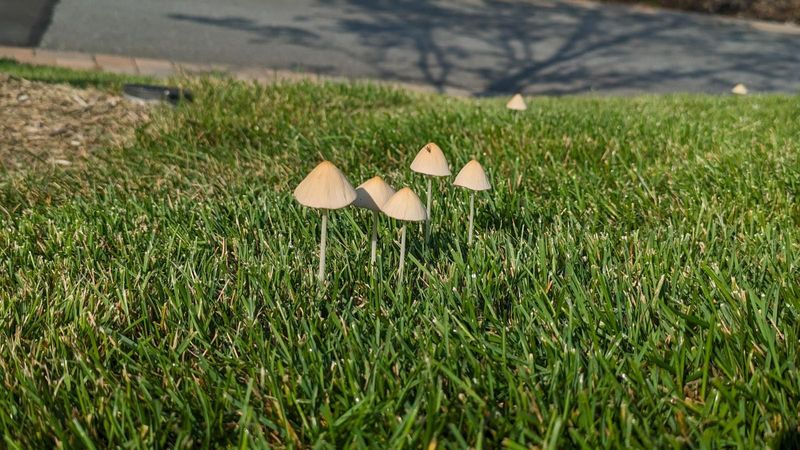
If mushrooms are only unwelcome, you can usually leave them alone. They fade on their own, and a few mushrooms do not mean your grass is sick.
If you dislike the look, you can pick them and toss them in the trash.
Picking helps only with appearance. University of Maryland Extension makes clear that removing the mushrooms does not remove the fungus underground, so more can come back when conditions suit.
Safety is a separate matter. Never eat an unidentified lawn mushroom, and do not trust a photo or a general description to tell you it is safe.
Penn State Extension advises keeping children and pets away from wild mushrooms.
If kids or pets play in your yard, check after wet weather and remove any mushrooms they could reach. Wear gloves or wash your hands afterward.
If someone has eaten a mushroom, call poison control or your vet right away.
Not all fungi are harmless decomposers, either. Some can cause plant disease.
But mushrooms alone are not a sign that your lawn is diseased, so keep the safety steps and the lawn-health question apart.
Manage turf symptoms, not the mushroom’s appearance
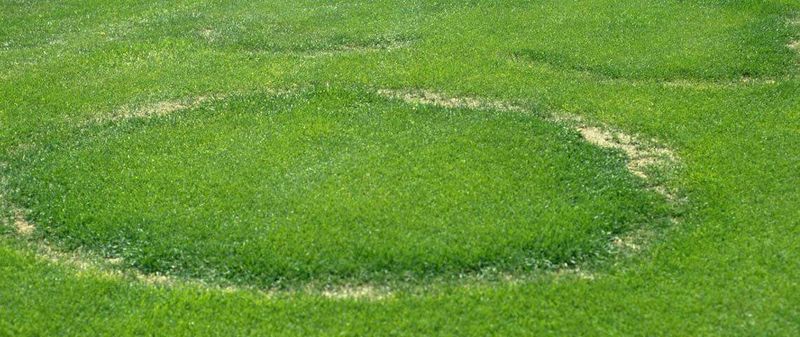
Save your effort for real turf stress, such as a dry or dead ring, rather than mushrooms alone. If the grass looks fine, you can skip treatment.
For a stressed ring, University of Maryland Extension suggests watering and fertilizing only as needed to help the grass, with fertilizer guided by a recent soil test. Extra water or fertilizer without a lawn-specific reason will not clear mushrooms.
Core aeration can help water enter soil made water-repellent by fungal growth. These steps manage symptoms and may not eradicate the fungus or cure the ring.
The fungus works quietly, and your lawn can usually live alongside it.