
Praying Mantises Can Eat Beneficial Insects As Well As Garden Pests
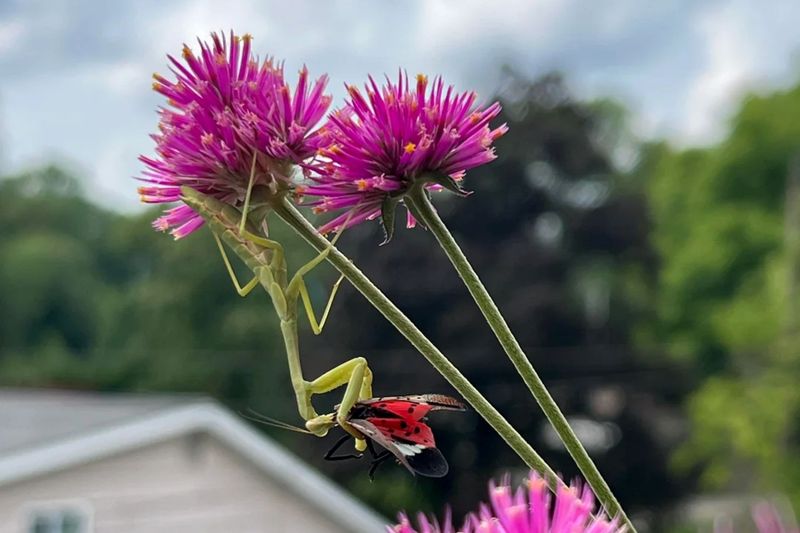
That green mantis posing on your tomato cage looks like a tiny bodyguard for your plants. But mantises are ambush hunters that grab whatever insect wanders close, and that can include helpful ones.
Knowing how they really hunt can save you from counting on the wrong kind of help. Here is what research says, and what it leaves open.
Mantises hunt broadly, not just for garden pests
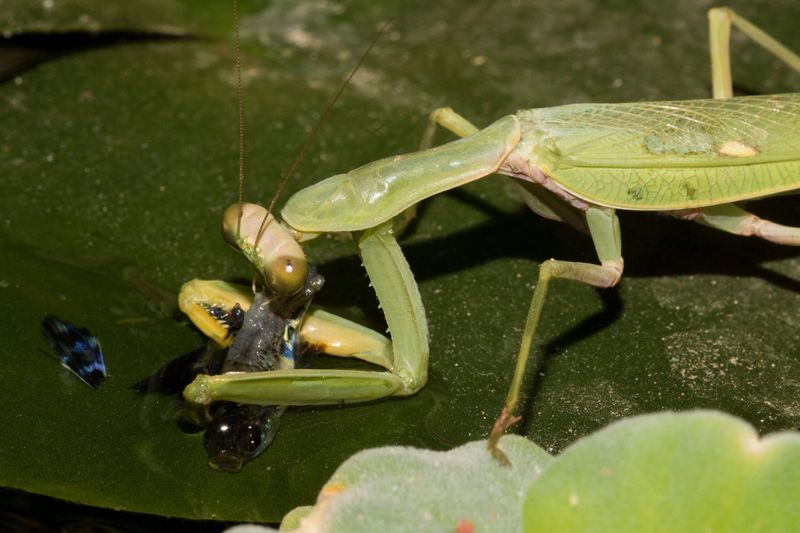
Picture a mantis on a tomato plant, front legs folded like a tiny prayer. It is not praying.
It is waiting for something to come within reach, and then it strikes fast.
A mantis does not sort insects into pests and helpers the way a gardener does. To the mantis, anything of the right size that moves is a possible meal.
That is what makes it a generalist ambush predator.
According to UC IPM’s mantid guide, their prey can include bees, butterflies, and syrphid flies, along with other insects. Syrphid flies, also called hover flies, are good pollinators, and their larvae often eat aphids.
So a mantis can take a pest one day and a helpful insect the next.
Calling a mantis a garden helper leaves out half the picture. It is a hunter that works with whatever shows up, and what shows up depends on your flowers, your plants, and the time of day.
That does not make a mantis a villain. It is simply doing what ambush predators do.
The catch is that if you are hoping it will clear your beans or roses of one particular bug, the mantis has no idea what your plan is.
Think of it as a wildcard. It may eat a few of the insects you dislike, and it may eat some you would rather keep.
Nobody can predict which from a single sighting.
Research documents bee prey, not equal preference
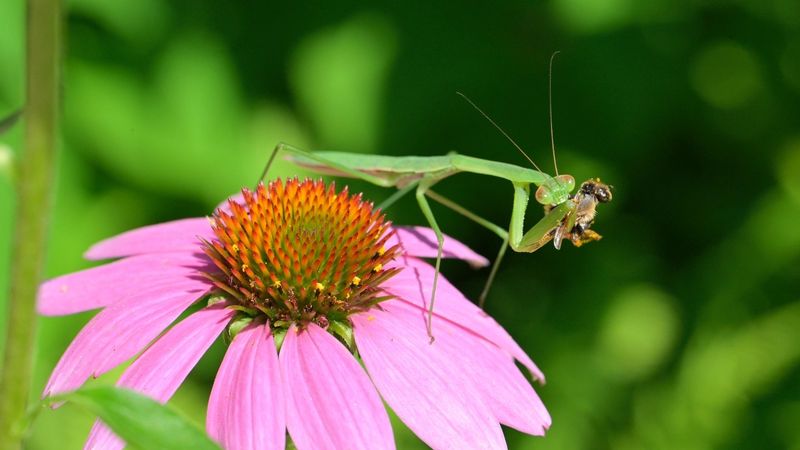
Flowers are a smart hunting spot for a mantis. Insects come to them all day, and a patient predator can wait right there.
Bees are among the visitors.
A peer-reviewed study on pollen feeding and fitness in praying mantids documents mantids eating bees on flowers. So bee predation is a real, recorded part of the story, not a rumor.
Here is where the hook needs a reality check. Finding that mantids eat bees does not show that they love bees, choose them over pests, or catch them often in a home garden.
Nobody can say that a mantis on your zinnias is working through your bee population.
The same UC IPM page lists bees as one kind of prey among many. The fair reading is that bees are on the menu, along with plenty of other things.
If you want a practical clue, watch where the mantis sits. One camped on a flower head is in a place where pollinators gather.
One tucked in a leafy shrub is more likely to meet other kinds of insects.
Either way, a single mantis is not a pollinator crisis. It is a reminder that this predator does not check whether a bug is welcome before it strikes.
Lady beetles can also enter the prey mix
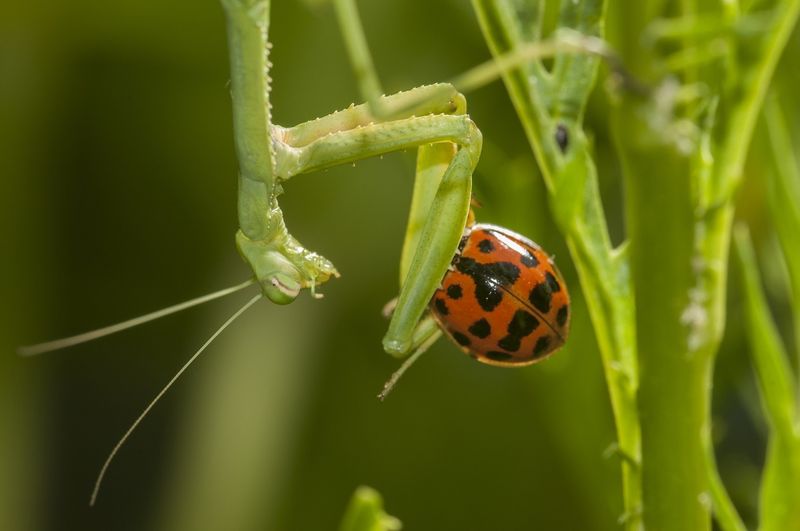
Here is the twist gardeners tend to find funny. Lady beetles are predators too, and many gardeners welcome them because they eat aphids and other soft-bodied pests.
Cornell’s biocontrol program describes lady beetles as garden predators in their own right. So when a mantis eats one, a predator is eating a predator.
Research on two introduced mantis species, published as a study of their diets across ecological roles, reports lady beetles among the groups of prey they ate. That is a useful clue about how wide a mantis diet can be.
It is not a forecast for your yard, though. Those findings do not tell us how often a backyard mantis catches a lady beetle, or whether ladybugs make up a big share of any mantis’s meals.
Plenty of mantises may never meet one.
A fair way to hold this fact is as a possibility. If you grow plants that attract aphids and lady beetles, a mantis hanging around could run into both.
For a gardener, the lesson is simple. A predator that eats other predators is not adding up to tidy, targeted pest control.
Eating pests does not make a mantis reliable pest control
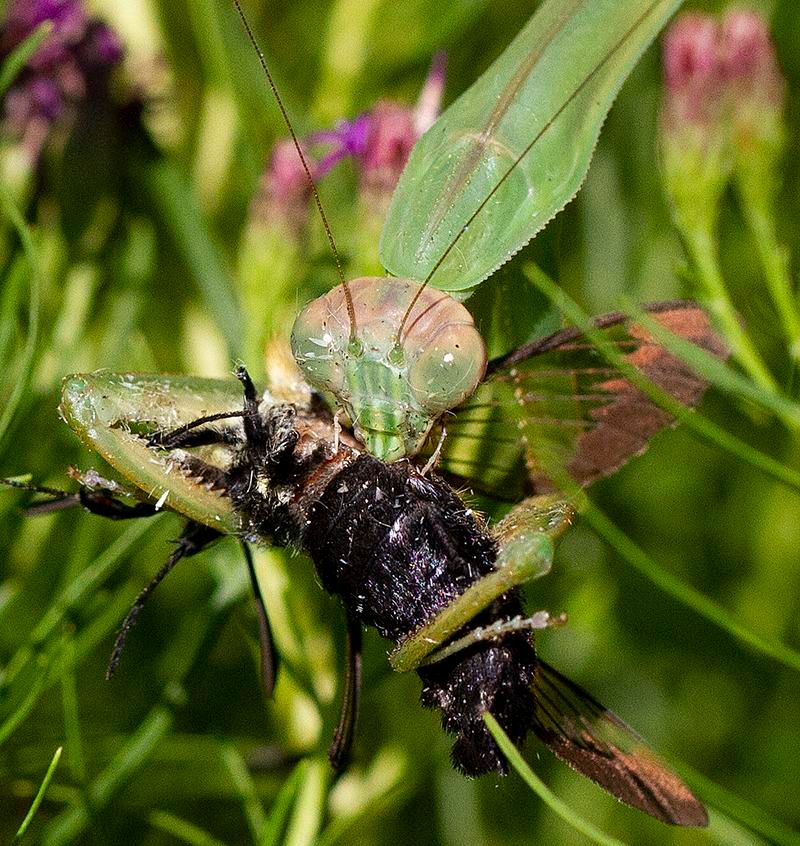
So does a mantis ever eat the bugs you want gone? Sure, it can.
Aphids, flies, and caterpillars are all the sort of thing a hungry mantis might grab.
The trouble is reliability. UC IPM notes that an individual mantid eats relatively few insects, and it does not aim for a pest you pick.
One mantis cannot knock down a growing infestation.
A 2025 expert reply on Ask Extension says mantises are not considered reliable garden control. That matches what many growers see: some bugs disappear, others do not, and damage keeps going.
Extension advice is not perfectly uniform. UC IPM says mantids are of no benefit for biological control, while Utah State Extension says egg cases may give some pest control but that mantids are not the most effective agents.
Put those together and the fair label is unreliable and nonselective. It does not say never.
It says you cannot count on a mantis to protect your roses or squash.
If your tomato plants are chewed, a mantis nearby is a nice bonus, not a plan.
One mantis does not prove your garden is in trouble
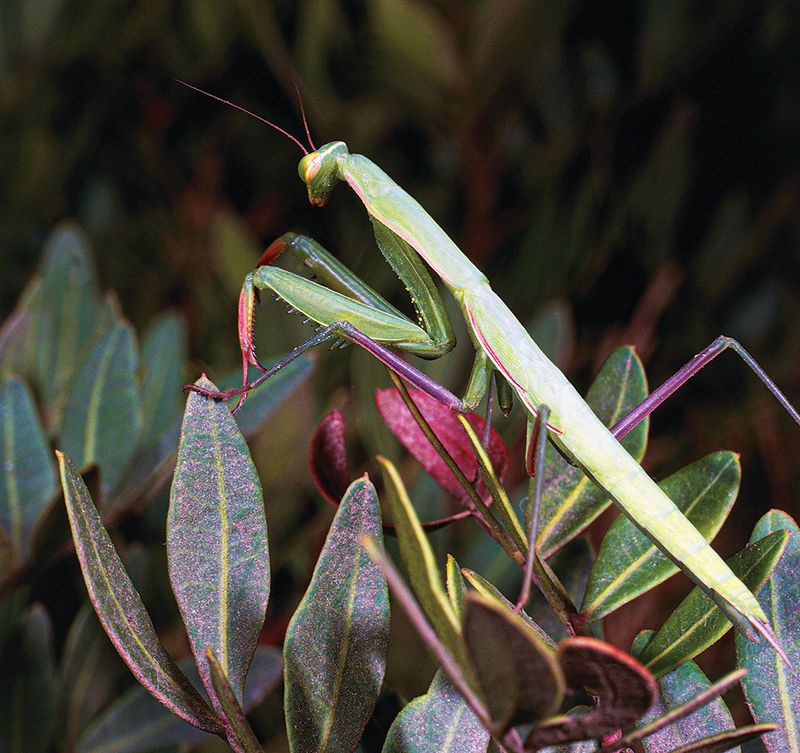
After all this, you might be eyeing that mantis with suspicion. Hold on.
Seeing one does not mean your garden is losing its helpful insects.
A meta-analysis called Community effects of praying mantids pulled together many experiments. It found that effects on other arthropods varied by mantis species and by how the study was set up.
Effects were often weak, though stronger for some groups.
That is a mixed picture, not a warning label. It also means nobody can promise what a mantis will do in your own yard.
Iowa State Extension describes the overall garden impact of mantises as probably negligible. In plain terms, they are not likely to make or break a garden.
So two easy mistakes are worth skipping. One is thinking every mantis is harmless to every insect.
The other is thinking mantises wipe out pollinators or wreck a garden’s variety of life.
The more useful habit is watching your own plants. If bees are still working your blooms and pests are staying manageable, the mantis is just another resident.
Species and setting matter
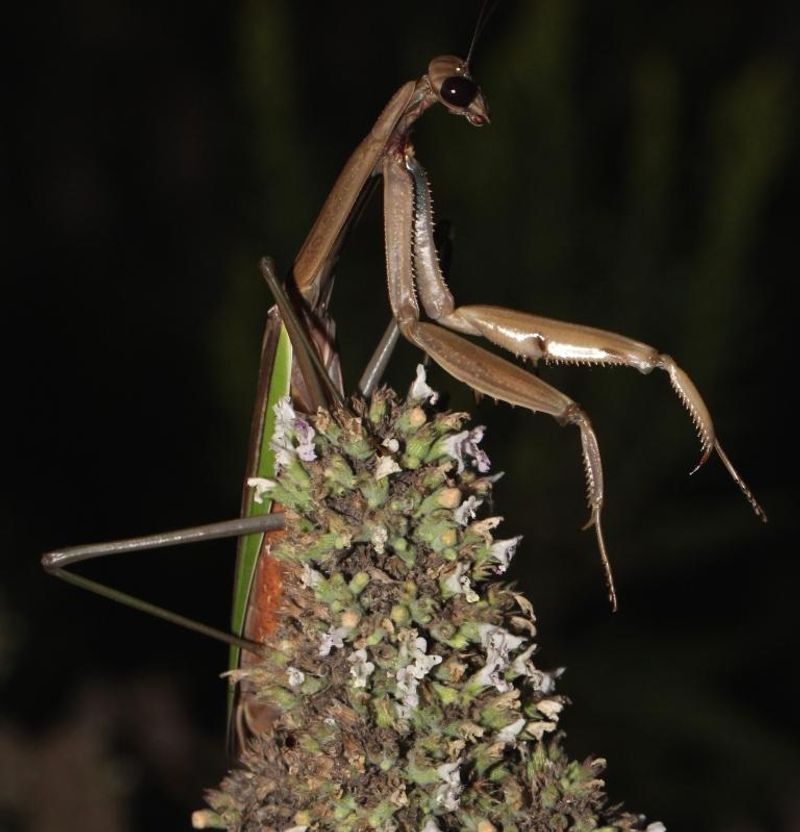
“Praying mantis” is a family nickname, not one animal. In the United States, some mantises are native and others were introduced.
UC IPM’s page on mantids lists both native and introduced species found in California. So it is wrong to assume that every mantis in your yard is an invader.
The Chinese mantis is one well-known introduced species. The Missouri Department of Conservation says it has been here a long time and that its overall ecological impact is difficult to determine.
That is a good reminder to be careful with big claims.
The same agency describes the Chinese mantis as harmless to humans. A mantis may defend itself if you pick it up, but an ordinary garden sighting is nothing to fear.
Identification can still be handy. Knowing which species you have helps you read what is local to your area, and it keeps guesses in check.
It does not call for squashing anything. A mantis on the porch rail or the bean trellis does not need to be removed.
Keep the visitor; choose a targeted plan for pests
Enjoy the mantis if it shows up. It is an interesting neighbor, and spotting one is not an emergency.
What you should skip is buying or releasing egg cases to fight a pest. Extension experts do not consider mantises reliable garden control, and UC IPM points out how few insects each one eats.
If something is chewing your tomatoes or roses, start by figuring out what it is. Check leaves, undersides, and stems, then choose a targeted step, such as hand picking or a method matched to that pest.
A mantis is a visitor, not a pest plan. Let it hunt, and let your own eyes do the real work.