
That Dragonfly Over Your Patio Catches Flying Prey With Its Legs, Not Its Mouth: Here’s How It Works
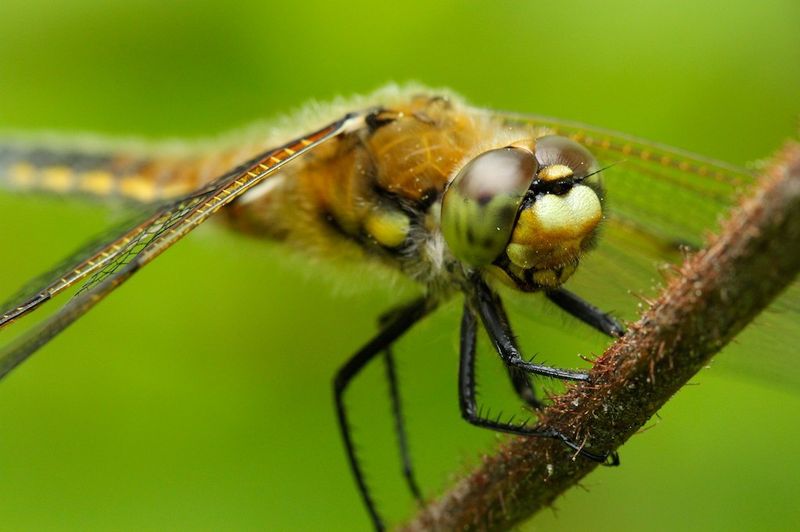
Next time a dragonfly zips past your tomato cage or hovers over the patio, look closer at how it hunts. Adult dragonflies grab flying insects with their legs first, and the mouth comes into play only afterward.
Scientists who study particular species have also found some surprising steering tricks in their flight. Here is what the research shows, and what it cannot tell you about the one buzzing around your yard.
The legs make the first catch
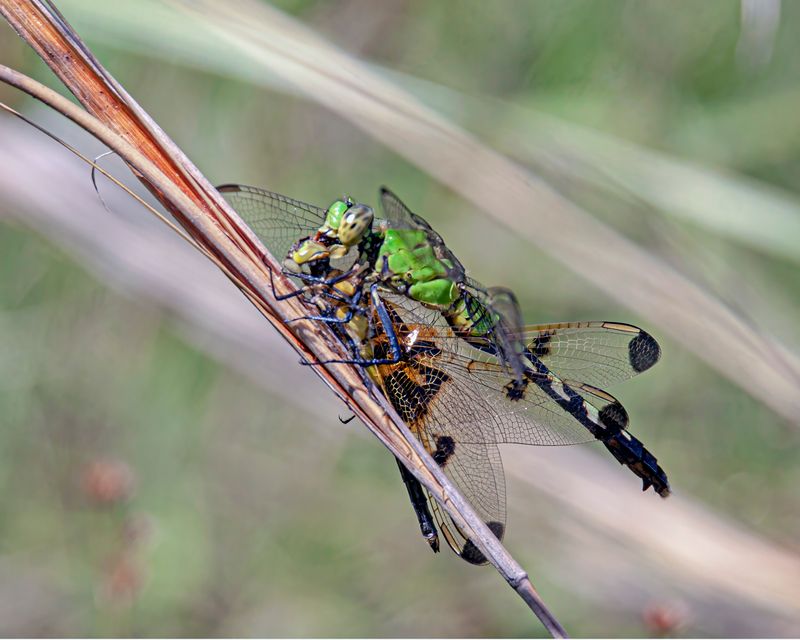
Picture a tiny aerial catcher’s mitt. According to Iowa State Extension, adult dragonflies have bristly, spiny legs that can form a basket beneath the head.
When a flying insect comes within reach, the legs sweep it in.
That basket is the capture tool. Once the prey is held, the dragonfly uses its jaws to chew it, often while perched or still on the wing.
So the phrase “not its mouth” only describes the first grab, not the whole meal.
NC State Extension agrees that adult dragonflies scoop insects with their legs. Those legs are not built for walking much.
They are better suited to perching and snagging, which is why a dragonfly often rests on a plant stem or a tomato stake between flights.
Think of it as a two-step process. First the legs net the target in midair.
Then the mouthparts do the chewing. Getting the legs to the right spot at the right moment takes some clever flying, which is where the next section picks up.
It aims for where the prey will be
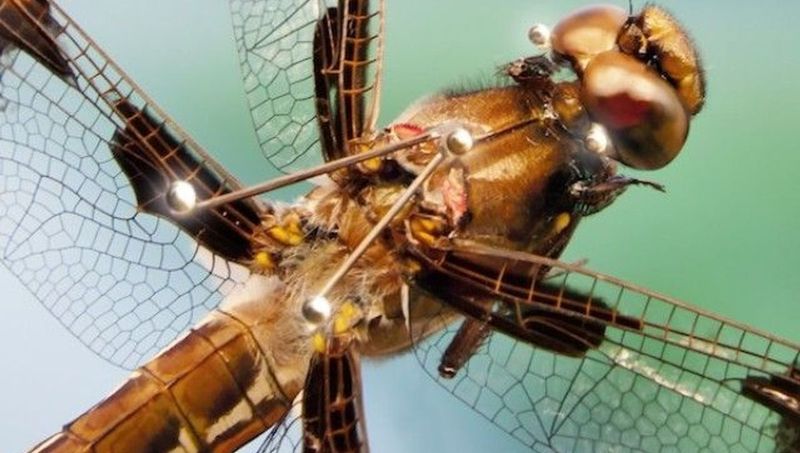
A moving target is hard to hit if you aim where it is right now. Studies of particular dragonflies suggest they do something smarter.
In a 2000 study of prey pursuit, researchers found the insects steered toward an interception point instead of simply chasing the prey’s current spot.
Later work looked deeper. A 2015 Nature paper described internal models that help direct that steering, using what the dragonfly sees of the prey’s movement.
In plain terms, the nervous system uses visual cues to estimate where the prey is heading and adjusts the flight to meet it.
Timing matters even before takeoff. A 2017 study of perched dragonflies found that takeoff timing related to a prediction of when prey would pass overhead, along with rules that influence which prey gets chosen.
Here “predict” is shorthand. It does not mean a dragonfly thinks things through or does math on purpose.
These are built-in sensory and steering rules, measured in certain species under certain conditions. Other dragonflies may use different tactics, so treat it as a well-studied pattern, not a law for every one you see.
Some pursuits rise from below
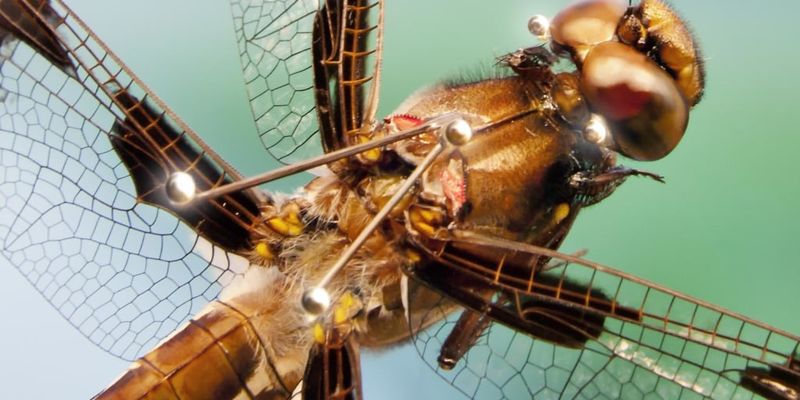
Here is a detail that surprises most people. A 2016 review of dragonfly and damselfly flight reports that studied dragonflies often approach from behind and below, then rise to intercept the prey.
That angle fits the leg-basket story nicely. A dragonfly coming up from underneath can bring its legs forward and scoop the target as it closes in.
It also lets the hunter keep the prey outlined against the brighter sky above, which may make the target easier to track.
Still, this is a pattern seen in particular species and particular pursuits. It is not a rule for every dragonfly or every attack.
Some hunts start from a perch, some happen on patrol, and the approach can change with the prey and the setting.
The same review also shows why one famous number should be handled with care. Reported capture rates vary by species, prey type, and study conditions, so there is no single success rate that fits every dragonfly in your yard.
Adults and nymphs hunt in different worlds
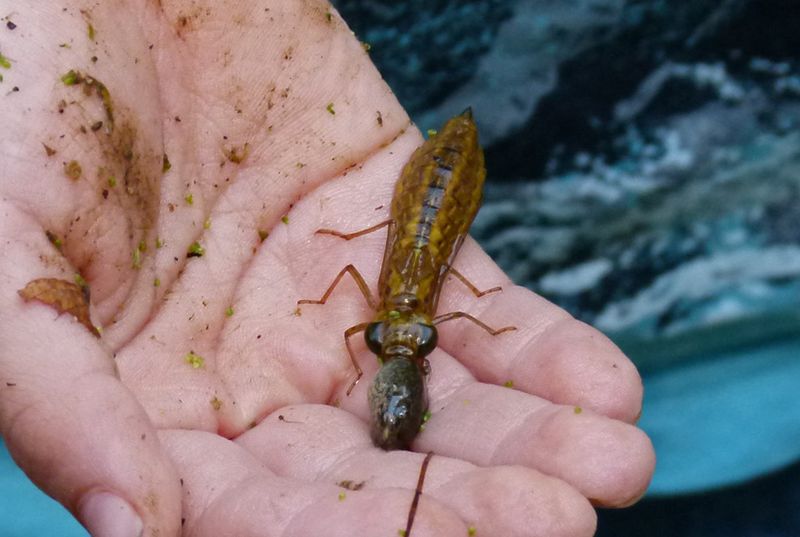
Dragonflies live two very different lives. The winged adult you see hovering near the hydrangeas is the second act.
Before that, the young dragonfly lives in water as a nymph.
Adults catch flying insects with their legs, as Iowa State Extension describes. Nymphs hunt underwater prey with specialized mouthparts.
According to NC State Extension, that prey can include mosquito larvae.
This split matters whenever people link dragonflies with mosquitoes. A nymph eating larvae in a pond is a different event from an adult snatching something in midair, and the tools involved are different too.
It also means that a nymph eating mosquito larvae does not prove adults control the mosquitoes biting you on the patio. Nymphs need water to live, and where they develop depends on the pond or wetland nearby.
Treat the two life stages as separate stories, each with its own hunting method.
A patio sighting does not identify the prey
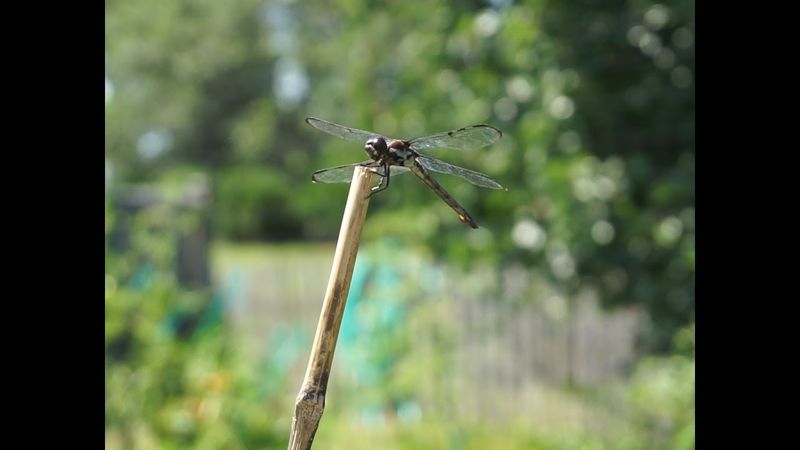
Spot a dragonfly swooping over your patio and it is tempting to cheer, “Mosquito patrol!” But from a lawn chair you cannot tell what it caught. Gnats, small flies, and other tiny flying insects are all possible targets, and a mosquito might be one of them, or might not.
Dragonflies do eat mosquitoes, but eating them is not the same as keeping a yard free of them. A 2019 review of dragonflies and damselflies notes that mosquitoes are seldom found in adult diets in numbers that suggest they hold mosquito populations down.
Lab-style results add another wrinkle. A 2023 meta-analysis found substantial larval predation in experimental containers.
That is a useful finding, but containers are not backyards, so it does not show the same effect around your patio.
So enjoy the show and keep expectations modest. A dragonfly overhead is a good sign of a lively yard, not a promise of fewer bites.
The reliable takeaway is the leg-basket catch
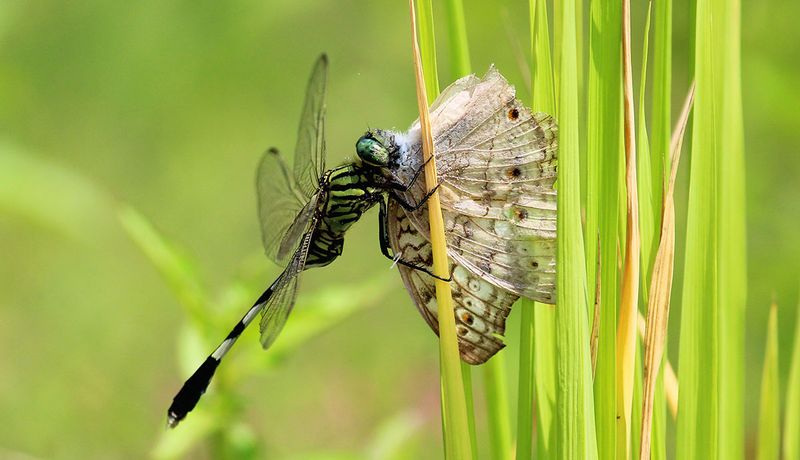
What you can count on is the mechanism. Adult dragonflies typically snag airborne prey in a basket of spiny legs, as Iowa State Extension explains, then chew the catch with their mouthparts.
Studied species can also steer toward a predicted meeting point, as shown in early pursuit research.
What you cannot read from a sighting is the menu. The dragonfly outside your window is a skilled aerial netter, and what it caught stays its own secret.