
If A Hummingbird Weaves Her Nest On Your Wind Chime, Here’s The Walnut-Sized Cup That Stretches As Her Chicks Outgrow It
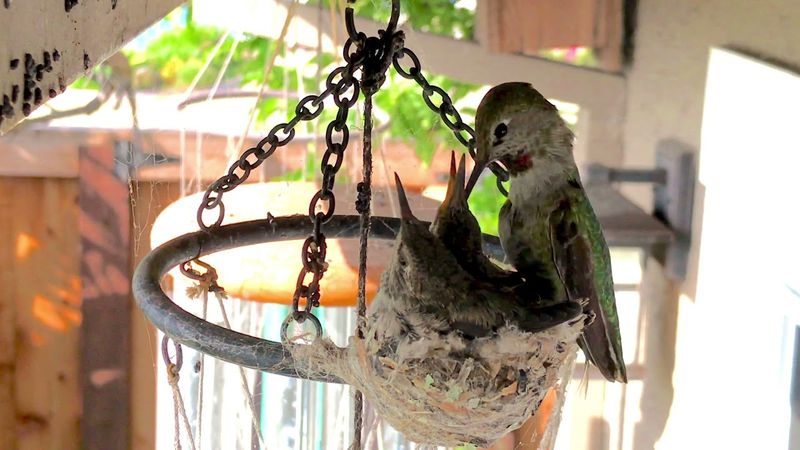
Somewhere between the hanging tubes and ceramic ornaments of a backyard wind chime, a hummingbird occasionally decides she has found the perfect building site. The nest she constructs there is no bigger than a walnut shell, yet it holds two eggs, two growing chicks, and a surprising amount of engineering.
Understanding what she built, and what you should do next, can make the difference between a successful fledging and an accidental disaster.
A Wind Chime Is an Unusual Nest Site, Not a Hummingbird Preference
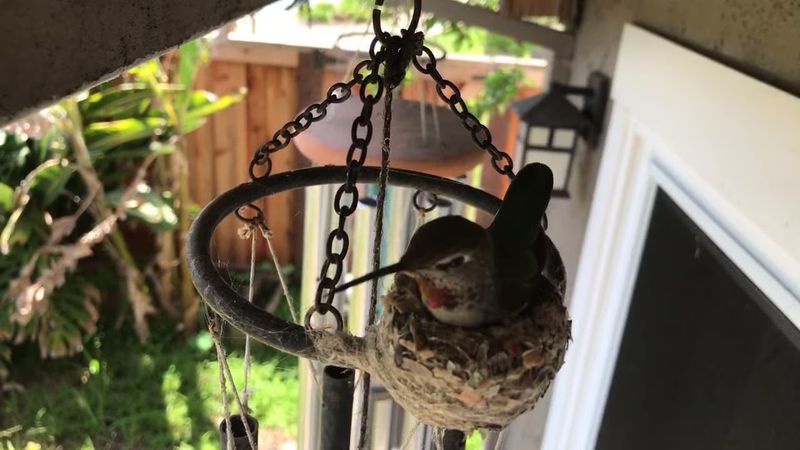
Most hummingbird nests sit quietly in a shrub or along the fork of a slender branch, tucked away from foot traffic and casual glances. Wind chimes are a different story entirely.
A few documented cases confirm that some hummingbirds do occasionally build on artificial supports, including wires, chains, extension cords, and porch ornaments, but the key word is occasionally.
One account from the Georgia Department of Natural Resources describes a Ruby-throated Hummingbird building directly on the ceramic ornament of a porch wind chime, a striking example of how adaptable the species can be. A published British Columbia nest-record report also logs Rufous and Anna’s Hummingbirds nesting on wind chimes, adding further weight to the idea that the behavior, while rare, crosses multiple species.
What those accounts do not show is that wind chimes attract hummingbirds or that the sound, motion, or color of a chime plays any role in the bird’s decision. The structure may simply have offered a surface that felt stable and sheltered on the day the female was ready to build.
Cornell Lab’s Ruby-throated Hummingbird profile places typical nests on small horizontal branches, often over water or clearings, while the Anna’s Hummingbird account notes trees, shrubs, and vines as standard choices.
Calling a wind chime a common or preferred nesting site would go well beyond the evidence. Treat any nest you find there as a remarkable exception, not a sign that your porch is a hummingbird magnet.
The Tiny Cup Is a Composite Built Around Spider Silk
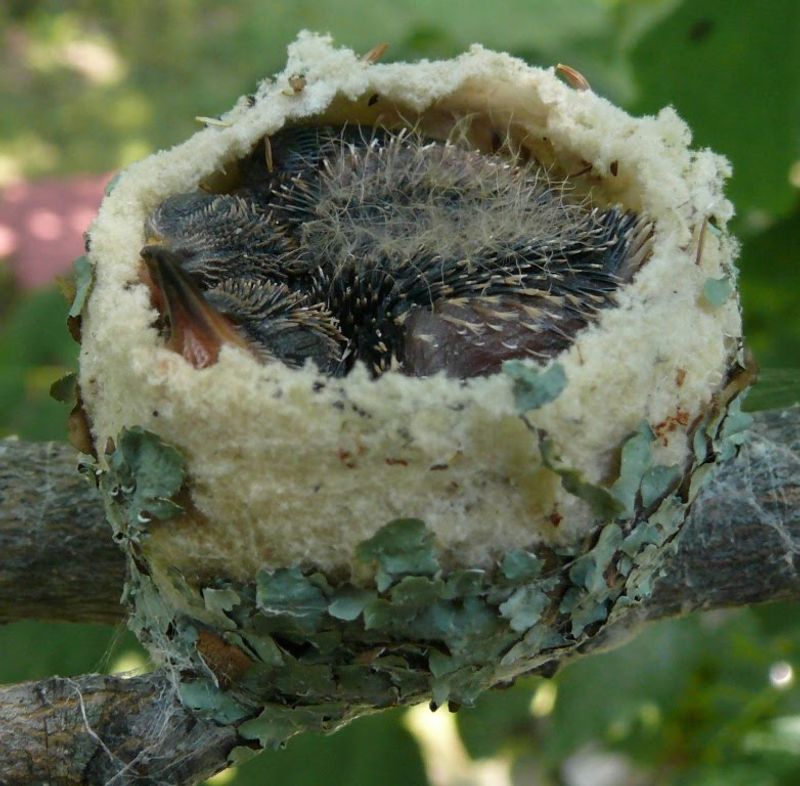
Pull up a close photograph of a hummingbird nest and you will see something that looks more like a piece of living bark than a bird’s home. The outer shell is often coated in lichen flakes and tiny bark fragments, which help the nest blend into its surroundings.
Beneath that camouflage layer lies a soft interior of plant down, thistle or dandelion fibers, and small feathers that cushion the eggs and keep the chicks warm.
Holding all of it together is spider or insect silk. According to Cornell Lab’s Ruby-throated Hummingbird life history, the female collects silk from spider webs and uses it to bind the plant materials into a cohesive structure.
The Anna’s Hummingbird account notes that some builders also incorporate insect cocoons. Silk is not the nest’s only ingredient; it is the thread that ties a composite structure together and, critically, keeps the walls pliable rather than rigid.
Audubon has described how spider silk functions like a natural elastic binding in small bird nests, allowing the structure to flex without falling apart. That flexibility is not incidental; it becomes essential as the chicks grow larger over the following weeks.
The female alone builds the nest and, in most hummingbird species, handles incubation and chick-rearing without a partner. That said, you should only refer to the builder as female once you are confident the bird is actually a hummingbird.
A small bird seen near the nest is not automatically the builder, and sex cannot be inferred from an unidentified visitor. Cornell Lab’s nest-material guidance also reminds observers that the nest is entirely her own engineering, assembled without any help from well-meaning people nearby.
Flexibility Lets the Nest Change Shape as Chicks Grow
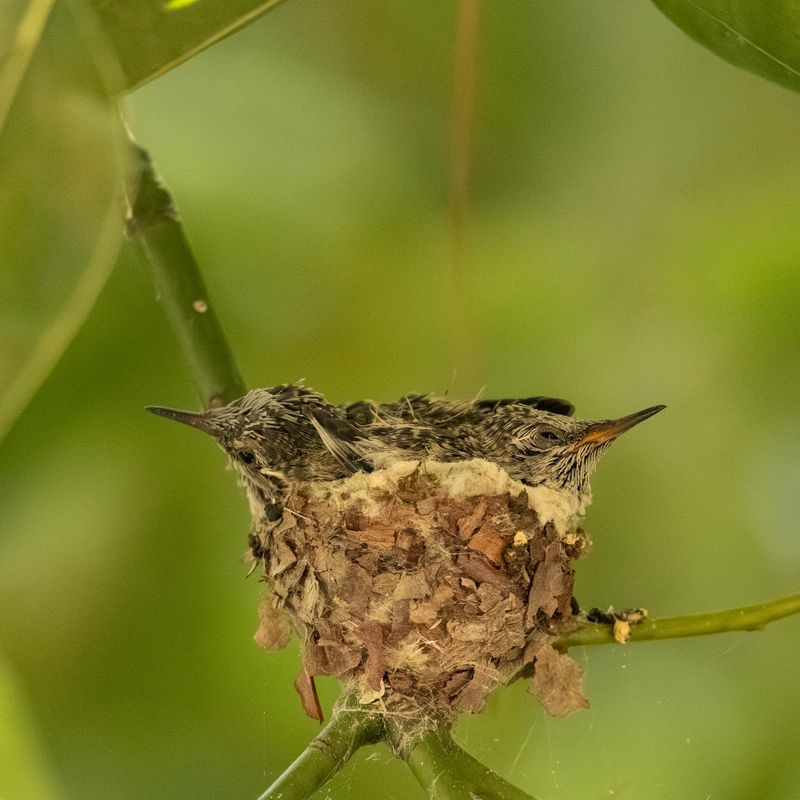
A hummingbird nest does not arrive pre-sized for the chicks that will eventually fill it. When eggs are first laid, the cup is snug and deep, barely wider than a large marble.
As the nestlings grow over the following weeks, the silk-bound walls gradually give way, and the cup begins to change shape in response to the pressure from inside.
The result is not a rigid container that pops open like a manufactured product. According to Cornell Lab’s Ruby-throated Hummingbird life history, the nest walls remain pliable enough to accommodate the growing nestlings, which means the cup can stretch outward, become shallower, or take on a flatter, more platform-like profile as the chicks near fledging.
The Broad-tailed Hummingbird account similarly describes a nest that adjusts as the young birds develop.
A USGS image of a Black-chinned Hummingbird nest captures this transformation well: what began as a tidy cup now holds two chicks whose bodies press against the softened walls in every direction. The nest looks almost flattened compared with how it appeared during incubation.
Expansion is real but bounded. The silk and fibers can only stretch so far, and the exact degree of shape change varies from nest to nest and species to species.
Thinking of the nest as a self-expanding container with unlimited capacity would overstate what the materials can do. A more accurate picture is a flexible bowl whose walls yield gradually under steady biological pressure, accommodating growth without ever truly doubling in size.
“Walnut-Sized” Depends on the Species and the Measurement
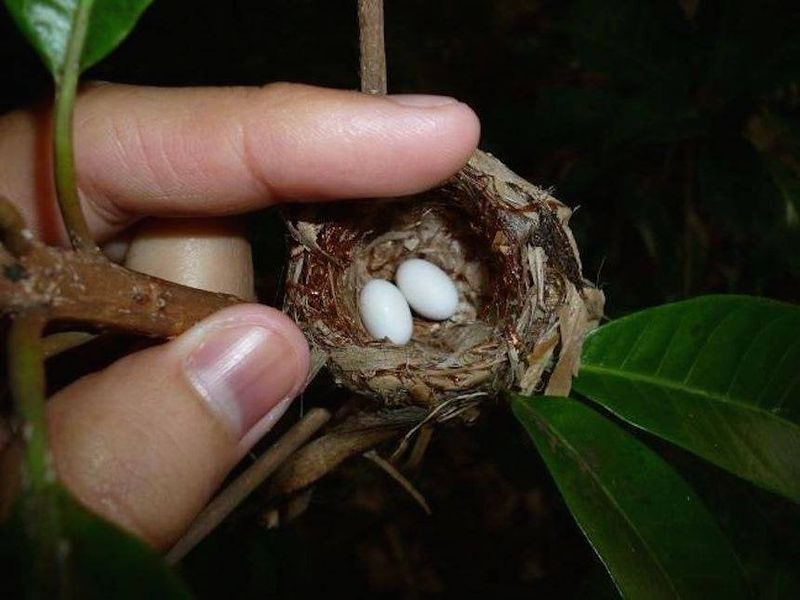
Calling a hummingbird nest “walnut-sized” is a useful way to help someone picture it, but the comparison has real limits. A walnut in its shell runs roughly 1.5 to 2 inches across, which does overlap with documented hummingbird nest measurements.
The problem is that those measurements differ by species, and the number changes again depending on whether you are measuring the outer nest or the inner cup.
According to Cornell Lab’s Anna’s Hummingbird profile, that species builds a nest about 1.5 inches in outer diameter. The Ruby-throated Hummingbird account places the nest at roughly 2 inches across.
The Broad-tailed Hummingbird entry describes an outer diameter near 2 inches as well, but the inner cup, the space where the eggs actually rest, is noticeably smaller.
That inner-versus-outer distinction matters more than it might seem. When someone describes a nest as walnut-sized, they usually mean the overall cup from the outside.
The egg chamber inside is considerably tighter, barely wide enough to hold two pea-sized eggs side by side. Confusing the two measurements can lead to a serious underestimate of how small the hatching space really is.
The practical takeaway is straightforward: identify the species before attaching any precise number to the nest, and treat “walnut-sized” as a starting image rather than a specification. What you find on your wind chime could be slightly smaller or slightly larger, and both possibilities are well within normal range.
If You Find One, Freeze the Fixture and Watch From Away
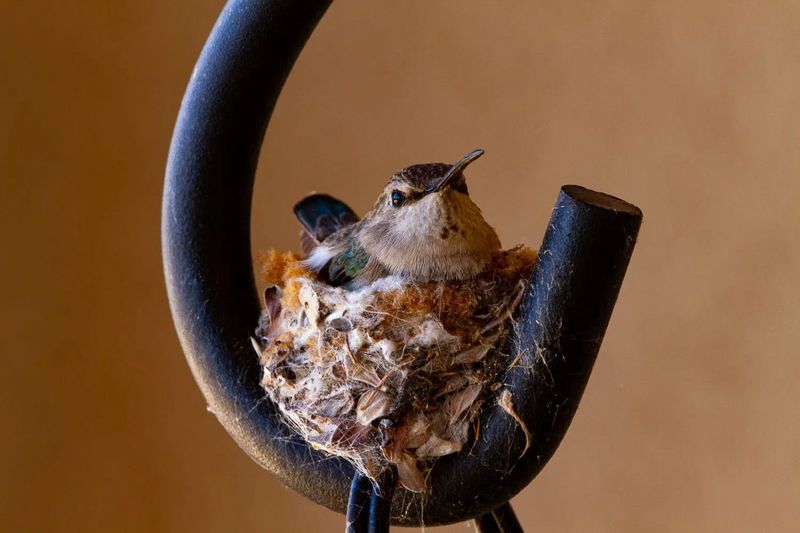
The moment you spot a nest on your wind chime, the single most useful thing you can do is stop touching the fixture entirely. That means no ringing it, no swinging it, no adjusting its height for a better photograph, and no moving it to a different hook.
The nest was built on that specific spot, and any shift in the fixture’s position can damage the cup, dislodge eggs, or startle the female off the nest at a critical moment.
Cornell Lab’s nest-observation guidance recommends keeping visits brief, staying as far back as possible, and avoiding the area entirely when the female is sitting on the nest or actively feeding chicks. The goal is to reduce the total amount of disturbance, not just individual interactions.
One common misconception is that touching a nest forces the parent to abandon it because of human scent. Birds have a limited sense of smell, and scent alone is unlikely to trigger abandonment.
The real risks are physical: you might crack an egg, collapse a wall, flush the female during cold weather, or draw the attention of a predator who follows your path to the nest. Audubon’s ethical bird photography guide and its nest photography guidelines both emphasize that prolonged disturbance and habitat exposure are the primary threats, not a single brief touch.
A swinging fixture is a genuine hazard. Wind chimes move in the breeze under normal conditions, and a nest attached to one is already navigating more motion than a branch would provide.
Audubon’s guidance on nests in difficult locations is clear: do not attempt relocation yourself. If the spot presents an immediate safety hazard, contact your state wildlife agency or a licensed wildlife rehabilitator for qualified advice before taking any action.
The Best Help Is a Safer Porch, Not Extra Nest Material

Once you have stopped moving the fixture, the next priority is making the surrounding environment as safe as possible. Cats are among the leading causes of wild bird mortality in the United States, and a hummingbird nest at porch height is dangerously accessible to a cat that is allowed outside.
Keep cats indoors for the full nesting cycle, and prevent dogs or other pets from approaching the area where the nest hangs.
Resist the urge to tidy up around the nest. Nearby shrubs, leafy vines, and overhanging vegetation provide shade, wind protection, and visual cover from predators.
Trimming that growth to get a cleaner view of the nest removes the very shelter that helps keep it safe. Audubon’s ethical observation guidance specifically warns against altering the habitat around a nest for the convenience of the observer.
Adding decorations near the nest, repositioning the wind chime for better photographs, or hanging new items on the same fixture all count as disturbance. The female chose that spot under the conditions that existed when she built; changing those conditions after the fact introduces unpredictable stresses.
Audubon’s hummingbird-friendly yard resource also points out that adults feed nestlings insects and spiders, not only nectar, which makes pesticide use near the nesting area a real concern. Avoiding sprays in the immediate area gives the female a better chance of finding the arthropods her chicks depend on.
Well-meaning people sometimes leave out cotton balls, yarn, dryer lint, string, or fishing line as nest-building aids. Cornell Lab’s nest-material guidance explains why those offerings are unsafe: synthetic fibers stay dangerously strong when wet, long strands can wrap around legs or necks, and lint breaks down into a soggy mass that chills eggs.
Leave the nest-material collecting entirely to the bird. She has been doing it far longer than any of us.
Let the Nesting Cycle Finish Before You Make Any Change
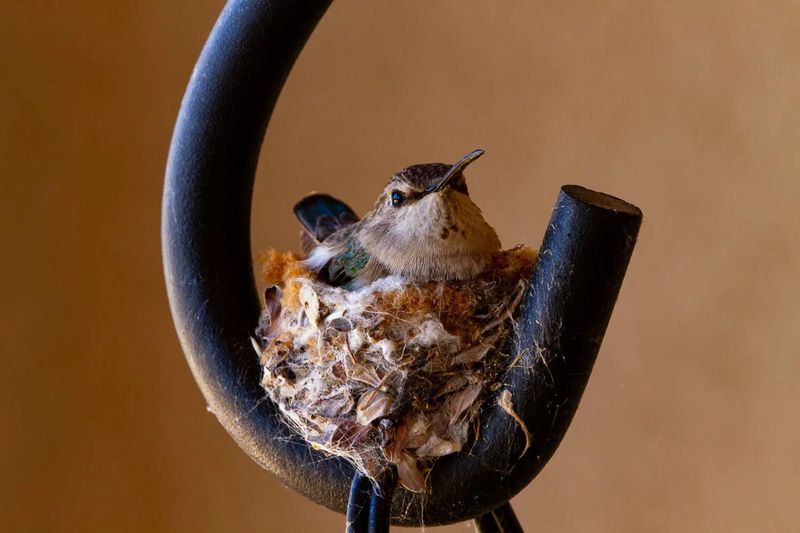
Patience is the most practical tool available to anyone hosting an accidental wind-chime nest. The nesting cycle is shorter than most people expect, but the exact length varies by species, which makes identification useful before you start counting days.
For Ruby-throated Hummingbirds, incubation lasts roughly 12 to 14 days, followed by a nestling period of about 18 to 22 days before the young birds fledge. Anna’s Hummingbirds incubate for approximately 16 days, with nestlings remaining in the cup for about 20 days.
Rufous Hummingbirds incubate for roughly 15 to 17 days, and their nestlings stay in the nest for about 15 to 19 days. Add those two phases together and most wind-chime nests will be fully vacated within five to six weeks of the eggs appearing, sometimes less.
Federal law adds another layer of context. Under U.S.
Fish and Wildlife Service guidance, an active nest is one that contains viable eggs or chicks, including fledged young that are still dependent on the parent. Destroying an active nest or its contents is prohibited under the Migratory Bird Treaty Act.
A more detailed USFWS nest memo clarifies that protections for inactive nests are more limited and fact-specific, and that state or local rules may also apply in your area.
None of that legal framework gives you a clear green light to move or dismantle the nest yourself once the chicks have fledged. If the wind chime location presents an ongoing hazard, contact your state wildlife agency or a licensed wildlife rehabilitator rather than acting alone.
They can advise on timing, legality, and safe next steps based on the specific situation in front of you.
The Smallest Porch Guest Has Already Done the Engineering
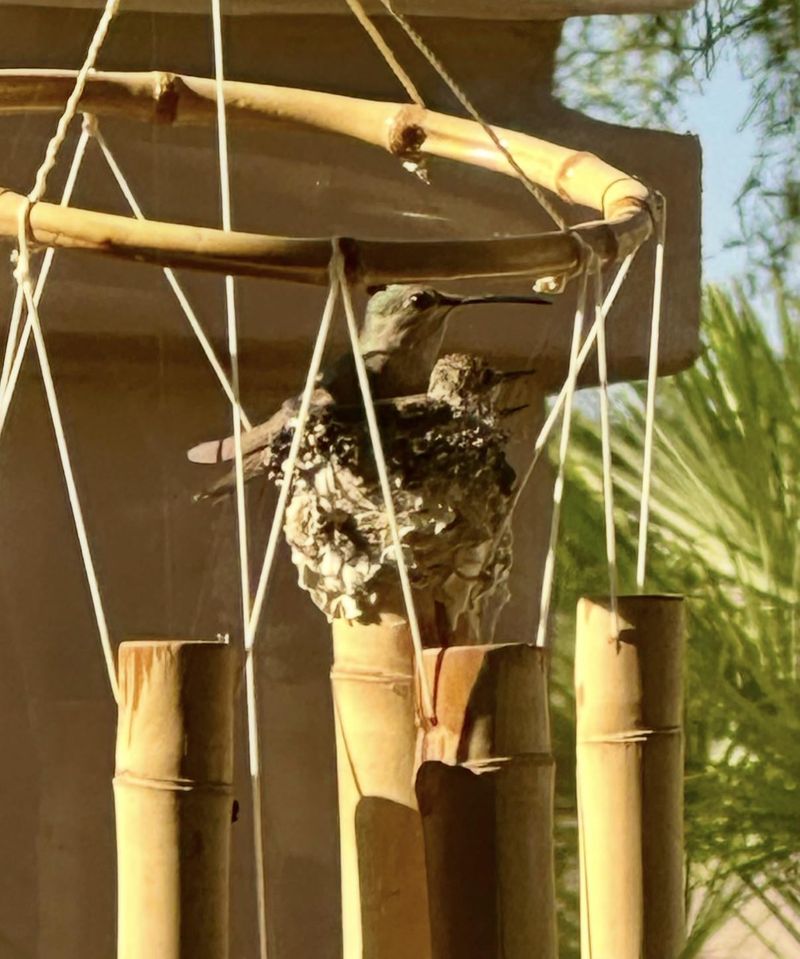
A hummingbird nest on a wind chime is, by any honest measure, an unusual event. The bird did not choose the spot because of the chime’s sound or appearance; she found a surface that worked on the day she needed it, and she built something extraordinary from silk, plant fibers, moss, lichen, and down.
That composite structure, flexible enough to change shape as her chicks grow, required no human assistance and no manufactured materials.
As Cornell Lab documents for multiple species, the silk-bound walls keep the nest pliable through the entire nestling period, accommodating the chicks without ever needing to be replaced or reinforced. Your most useful contribution is simply to leave the fixture alone and give the family room to finish what was started.
Cornell’s observation guidance puts it plainly: distance and restraint protect the nest better than any intervention.
The chimes will ring again when the season is over. For now, the engineering belongs to the bird.