
If You Mount A Staghorn Fern On A Board, Here’s The Soil It Quietly Builds Out Of Thin Air
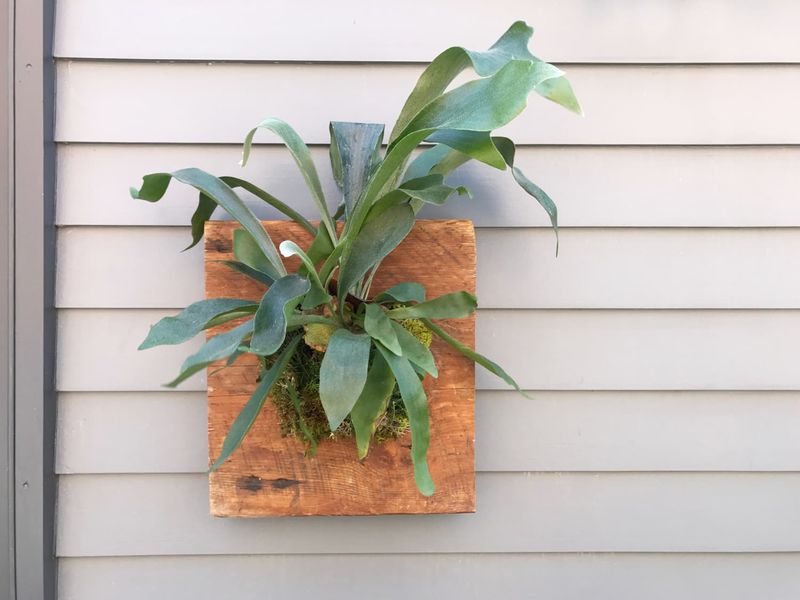
Mounting a staghorn fern on a board is one of those plant moves that looks like a magic trick. The fern hangs on bare wood with no pot, no soil, and no obvious reason it should thrive.
What makes it work is a pair of flat brown fronds pressed against the board that most gardeners mistake for dead tissue and want to pull off. Understanding what those fronds are actually doing changes everything about how you care for this plant.
The brown shields are the fern’s hidden infrastructure
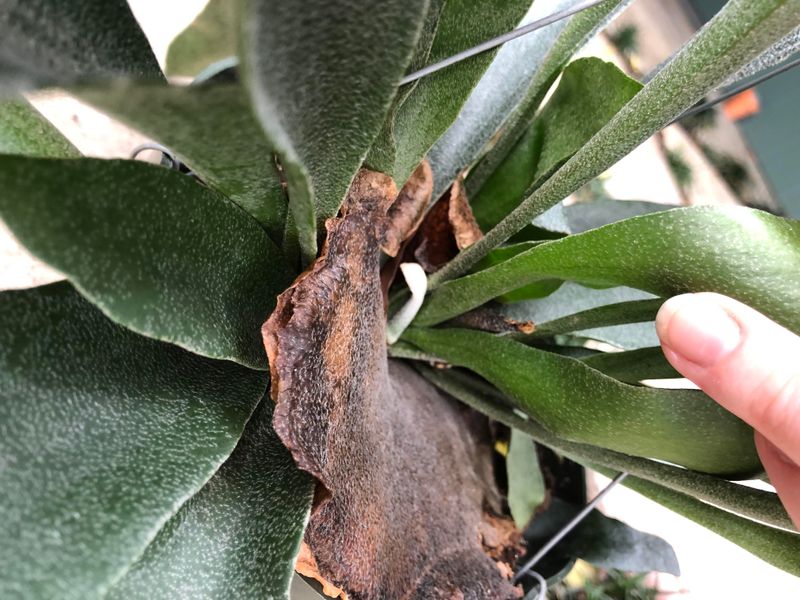
Pressed flat against the board, those rough, papery brown layers look like the fern is quietly dying from the back end. Many gardeners reach for them instinctively, wanting to peel away what looks like old, spent material.
Leaving them alone turns out to be one of the most important things you can do for a mounted staghorn.
Those brown structures are called basal fronds or shield fronds, and they are not dead waste. NC State Extension’s Platycerium profile describes them as sterile fronds that cover and protect the root structure, collect water, and gather plant debris over time.
They become brown and papery as they age, but while they remain attached, they are still doing real work: anchoring the plant to its mount, shielding the root mass from drying out, and positioning themselves to catch whatever falls or drips nearby.
Shield fronds are completely different from the dramatic, forked growths extending outward from the plant’s center. Those are the fertile fronds, sometimes called antler or foliar fronds, and they are the ones that carry spores on their undersides.
A healthy staghorn produces both types, and each has a distinct job. The fertile fronds handle photosynthesis and reproduction; the shield fronds handle protection and resource collection at the mounting surface.
The practical takeaway is simple: do not peel away brown shield fronds just because they look dry. University of Wisconsin-Madison Extension recommends leaving them in place until they fall away on their own.
Removing them early strips the fern of its anchoring layer, exposes the root mass to drying and damage, and removes the very structures that make the mounted growing habit possible. A brown shield frond still attached to the plant is doing its job quietly, even when it no longer looks green.
A staghorn needs a support surface, not ordinary ground soil
Staghorn ferns belong to a group of plants called epiphytes, meaning they naturally spend their lives attached to trees rather than rooted in the ground. The tree provides physical support, nothing more.
The fern is not a parasite drawing nourishment from the tree’s tissues; it simply uses the bark as a surface to hold onto while it gathers what it needs from its surroundings.
That distinction matters because it explains why a board works as a substitute. Wisconsin Extension’s staghorn fern guide notes that in the wild, these ferns anchor to tree trunks and branches, where their roots have access to moisture and decomposing organic material rather than mineral soil.
A wooden board mimics that bark surface, giving the roots something firm and slightly porous to grip.
Skipping ordinary garden soil does not mean the fern can skip a root-supporting environment entirely. A newly mounted plant still needs something between its root mass and the board, because bare wood alone cannot hold enough moisture to keep the roots alive, especially indoors where humidity is lower than in a tropical canopy.
UF/IFAS’s staghorn mounting tutorial explains that epiphytes obtain moisture and nutrients from their surrounding environment rather than from mineral soil, but that phrasing should not be read as “from clean air alone.” Water still needs to reach the roots, and a suitable growing medium holds that moisture in place between waterings.
The fern also needs ongoing nutrients. In nature, decomposing debris supplies much of that nutrition.
On a board indoors, those inputs have to come from the gardener in the form of regular watering and occasional fertilizing. Understanding the epiphytic habit sets the right expectations: no ground soil is needed, but a thoughtfully prepared mount and consistent care absolutely are.
Water and fallen litter gather inside the fern’s nest
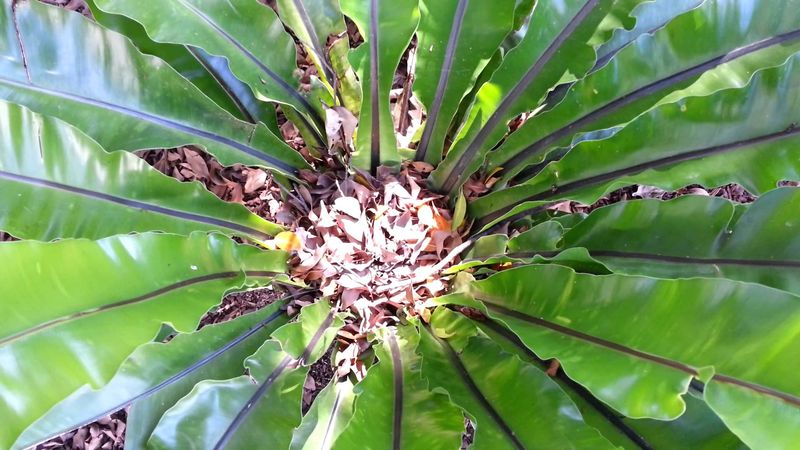
Watch a staghorn fern in a forest long enough and you start to notice that it collects things. Leaves drift down and lodge in the cup formed by the basal fronds.
Rain runs off nearby branches and pools where the fronds meet the bark. Over time, those materials pile up, get wet, and begin to break down into a soft, dark, humus-like layer around the roots.
That process is not accidental. A behavioral ecology study of wild staghorn colonies on Lord Howe Island found that large, lobed nest fronds positioned at the tops of colonies captured leaf litter more effectively than flatter fronds lower down.
The lower fronds, by contrast, were more sponge-like and better at retaining water. The two frond types divide the work: upper fronds gather organic material, lower fronds hold moisture.
That measured division of labor in wild, multi-plant colonies gives the strongest documented support for the debris-trapping mechanism.
What accumulates over time is not mineral soil in any geological sense. The material is better described as trapped organic debris and decomposed litter, a suspended, humus-like accumulation that supports the roots much the way forest floor compost supports ground-dwelling plants.
NC State Extension describes this as the fern collecting water and plant debris that nourishes it in lieu of ground soil.
One important boundary: the Lord Howe Island research documents what happens in large, established wild colonies, not on a small board indoors. A solitary houseplant on a modest-sized mount may never accumulate enough debris to fully replace its starting medium.
The mechanism is real, but the scale of accumulation depends on the species, the environment, and how much organic material is actually available to fall into the nest. Gardeners should treat debris capture as a beneficial bonus rather than a guarantee that the initial sphagnum will eventually be replaced.
The board starts the habitat but does not create it
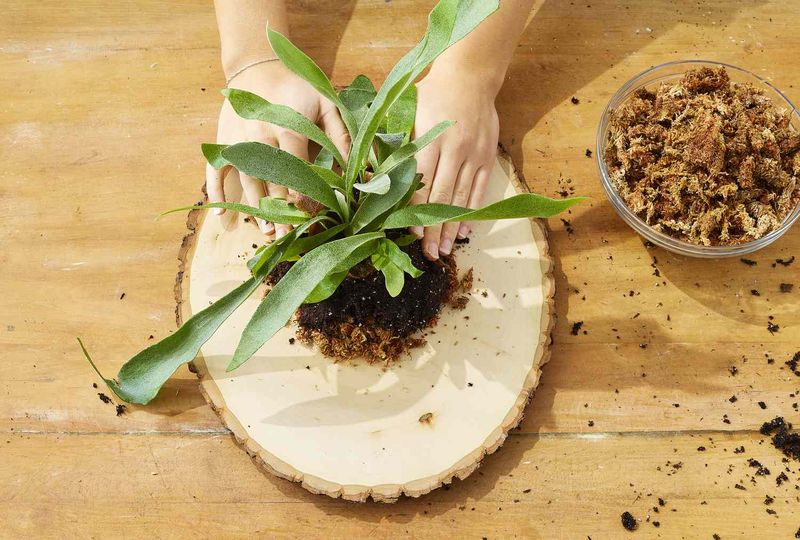
Choosing the right board matters before anything else. Untreated wood is the safest option because pressure-treated lumber can leach chemicals that harm the roots.
Cedar and hardwoods are popular choices because they resist rot longer than softer woods, which is important given that the mount will be regularly wetted. The board should be large enough to support the plant as it grows, since staghorns can become substantial over several years.
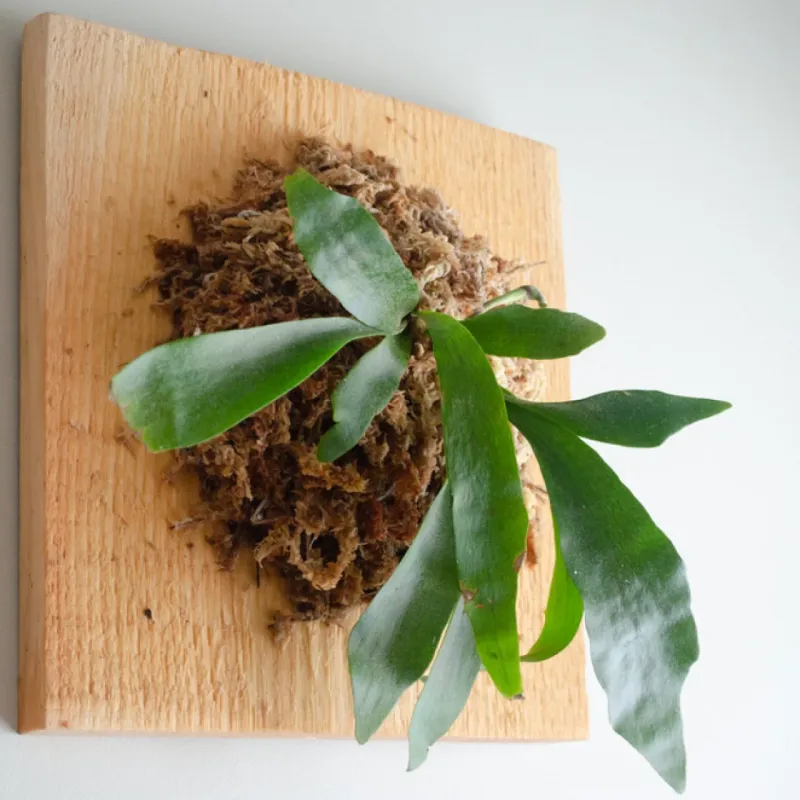
Before placing the fern, cover the center of the board with a generous layer of damp sphagnum moss or another open, well-drained organic medium. That layer is the fern’s initial root-supporting environment.
UF/IFAS’s staghorn mounting tutorial recommends setting the fern over the damp sphagnum with the basal fronds pressed flat against the mount, then securing the plant until new growth anchors it naturally. The moss should sit between the board and the root mass in a loose, open layer, not packed down into a dense, waterlogged ball that traps too much moisture against the roots.
Securing the plant gently is the next challenge. Soft materials such as pantyhose strips work well because they hold without cutting into tissue.
Fishing line, plastic mesh, or appropriate wire are also used, but the material should never be wrapped over soft green frond tissue. Wisconsin Extension cautions against using copper wire, which can be toxic to the plant.
The goal is to hold the root mass and basal fronds steady against the board until the fern’s own roots grip the surface, at which point the securing material becomes less critical.
Think of the board and the initial moss layer together as the starting habitat. The board imitates the tree surface that gives the fern something to grip, and the sphagnum holds moisture while the roots establish.
Over time the fern may add to that environment through debris capture, but it cannot create a root-supporting habitat from a bare board alone. Setting it up properly at the beginning gives the plant the best chance of thriving long-term.
Care for the nest as a living, drying root environment
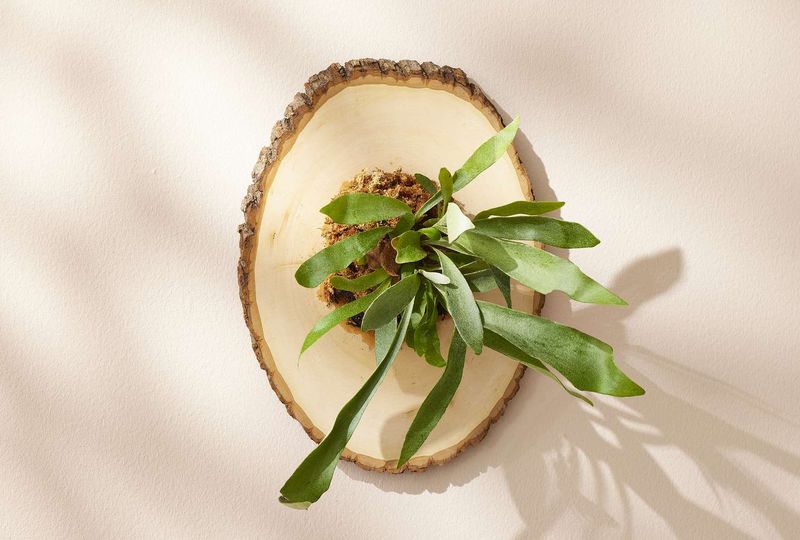
Bright indirect light is the starting point for good staghorn care. Direct sun for extended periods can scorch the antler fronds, while too little light slows growth and can weaken the plant over time.
A spot near a window that receives strong ambient light without hours of direct midday sun is usually a good fit indoors. Outdoors, a shaded position under a tree canopy or on a covered porch works well in warm climates.
Watering a mounted staghorn is different from watering a potted plant, and that difference trips up a lot of gardeners. NC State Extension’s Platycerium care guidance emphasizes that water should reach both the basal fronds and the growing medium, not just the visible antler fronds.
Misting the outer fronds lightly does not deliver enough moisture to the root environment where it is actually needed. Soaking or thoroughly wetting the moss and basal frond area, then allowing the medium to dry somewhat before watering again, is a more reliable approach than constant surface misting.
Mounted plants can dry out faster than potted ones, especially indoors with heating or air conditioning running. How often you water depends on the size of your mount, the amount of sphagnum, the ambient humidity, the temperature, and the light level.
No fixed schedule works for every setup. Checking the moss with a finger and looking at the basal fronds for signs of stress is more useful than counting days.
UF/IFAS’s mounting guide notes that overwatering and poor drainage are common causes of rot in mounted ferns, so erring toward slightly drier between waterings is safer than keeping the mount constantly wet.
Feeding the plant with a diluted balanced fertilizer during active warm-season growth gives it the nutrients that decomposing debris alone may not fully supply on a small indoor mount. Follow the product label for dilution rates, and reduce or skip feeding during slower winter growth.
Young plants generally benefit from more frequent light feeding than mature, well-established specimens.
The self-filling story has important limits
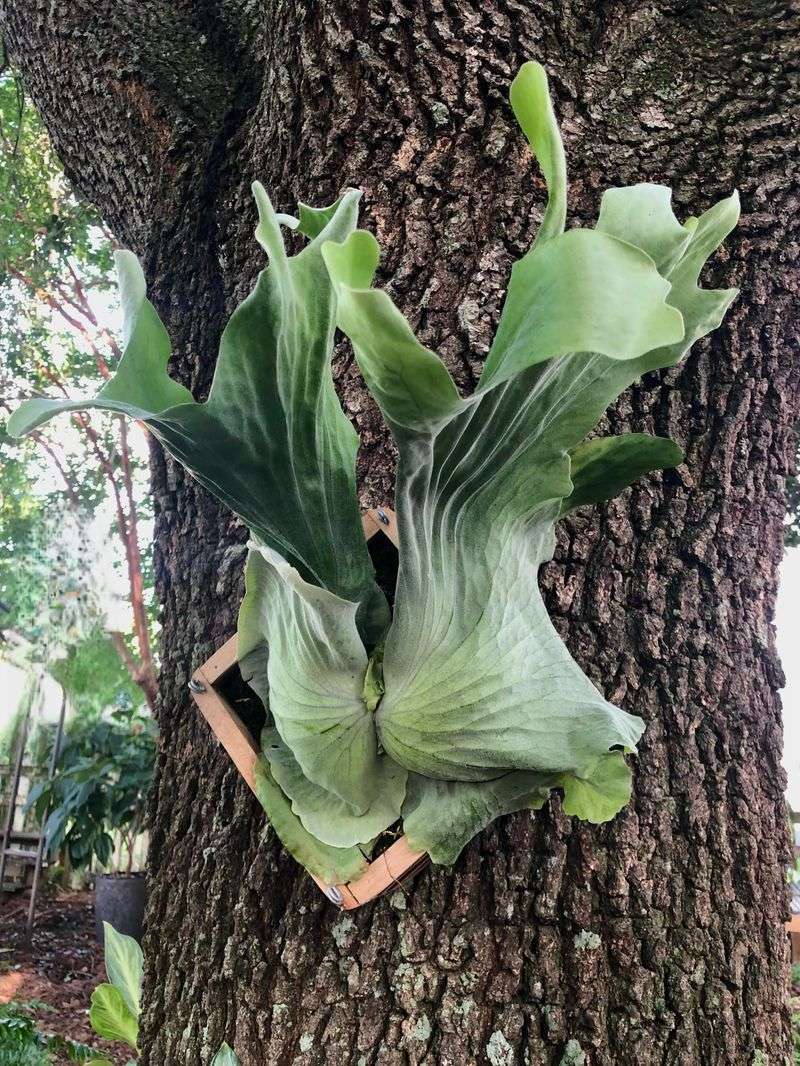
Not every staghorn fern builds the same kind of nest. The genus Platycerium includes species with very different basal-frond shapes, sizes, and growth habits.
Wisconsin Extension’s staghorn fern resource notes that some species have upright basal fronds well-suited to trapping falling organic matter, while others have flatter shields that collect debris less efficiently. Assuming that every staghorn sold at a garden center will develop a large, self-filling soil basket overstates what the biology guarantees.
The Lord Howe Island research that documented litter capture and water retention involved large, wild, multi-plant colonies where many fronds at different heights were working together. That colony-scale study is strong evidence for the general mechanism but does not show that a single houseplant on a modest board will accumulate enough debris to replace its starting medium.
The scale of accumulation matters, and a small indoor mount simply receives less falling litter than a tree-hosted colony in a subtropical forest.
Airborne dust is sometimes mentioned as a potential nutrient source for epiphytes. Decomposing organic debris and water captured by the nest are the well-documented contributors.
Dust may play a minor role, but the available research does not establish it as sufficient nutrition on its own, and it has not been conclusively ruled out as a minor contributor either. Gardeners should not rely on dust as a substitute for fertilizing.
NC State Extension supports supplemental fertilizing during active growth for exactly this reason.
Brown frond identification also deserves a second look here. Brown shield fronds that are still attached should stay.
Fully withered, papery antler-type fertile fronds that have died back completely can be trimmed for appearance without harming the plant. Finally, UF/IFAS and other extension sources classify staghorns as tropical or subtropical plants that need protection from frost.
Moving outdoor mounts inside before nighttime temperatures approach the low 40s Fahrenheit is a reliable safeguard for most species.
A board-mounted fern can build a nest, not a maintenance-free soil system
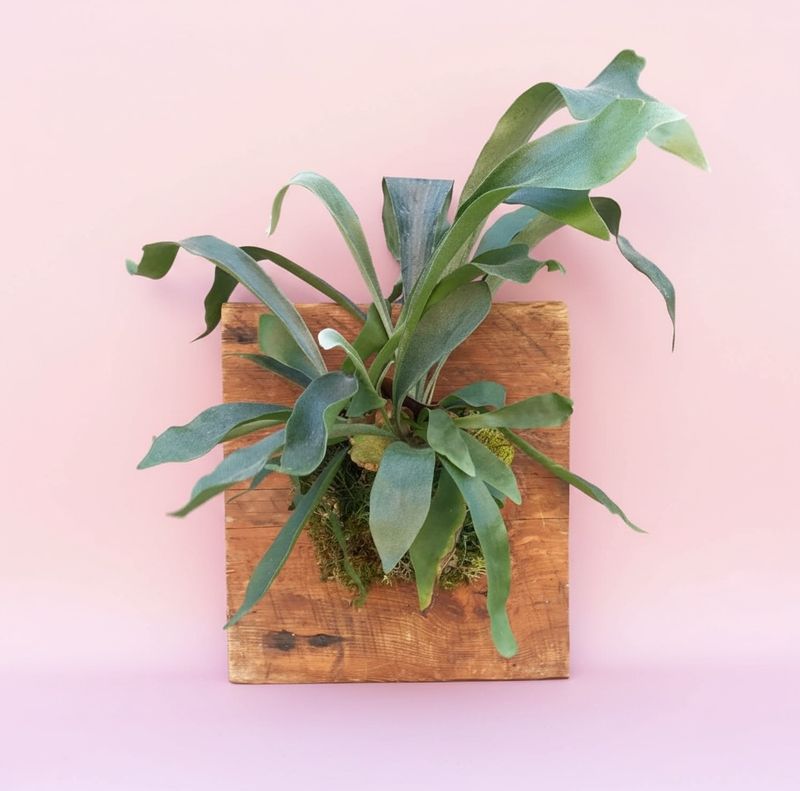
A staghorn fern does not manufacture mineral soil from atmospheric gases. What it does is something genuinely clever: its shield fronds position themselves to catch water and organic litter, and over time that material can decompose into a suspended, humus-like environment around the roots.
That is a real biological process, and it is part of what makes this plant so well-adapted to life without ground soil. Calling it “soil from thin air” is a vivid shorthand, but the actual inputs are water, fallen debris, and a suitable starting medium, not clean air alone.
Preserving the brown shield fronds is the single most important hands-off habit a staghorn owner can develop. Those fronds protect the root mass, anchor the plant, and set up the conditions for debris capture.
Starting with a good layer of damp sphagnum between the board and the root mass gives the fern what it needs while it establishes and begins building its own nest over months and years. NC State Extension and UF/IFAS both support this approach as the foundation of healthy mounted care.
From there, consistent watering that reaches the basal fronds and growing medium, appropriate light and humidity, seasonal fertilizing, and climate-aware cold protection keep the system running. The mount does not eliminate any of those needs; it just changes the form they take.
A well-tended board-mounted staghorn gradually develops a debris-catching root habitat that improves with age, which is a genuinely remarkable thing for a plant to do on a piece of wood hanging from a wall. The fern earns its keep, but only if the gardener shows up regularly to water it.