
If Your Lawn Feels Hard And Water Just Runs Off Before Fall Sets In, Compacted Soil Is Blocking The Roots
Walking across your lawn and feeling concrete underfoot is a frustrating sign that something is off below the surface. When water pools on top or sheets away instead of soaking in, many homeowners assume the grass is dry and simply water more, but the real problem may be hiding in the soil itself. Compacted soil, thatch buildup, poor grading, or even how fast the sprinkler runs can all produce the same symptoms, and sorting out which one is causing the trouble will save you time and money. Getting a clear read on what is actually going on before fall growth begins gives your lawn its best shot at a strong recovery.
Hard footing and runoff may signal compaction—or another infiltration problem
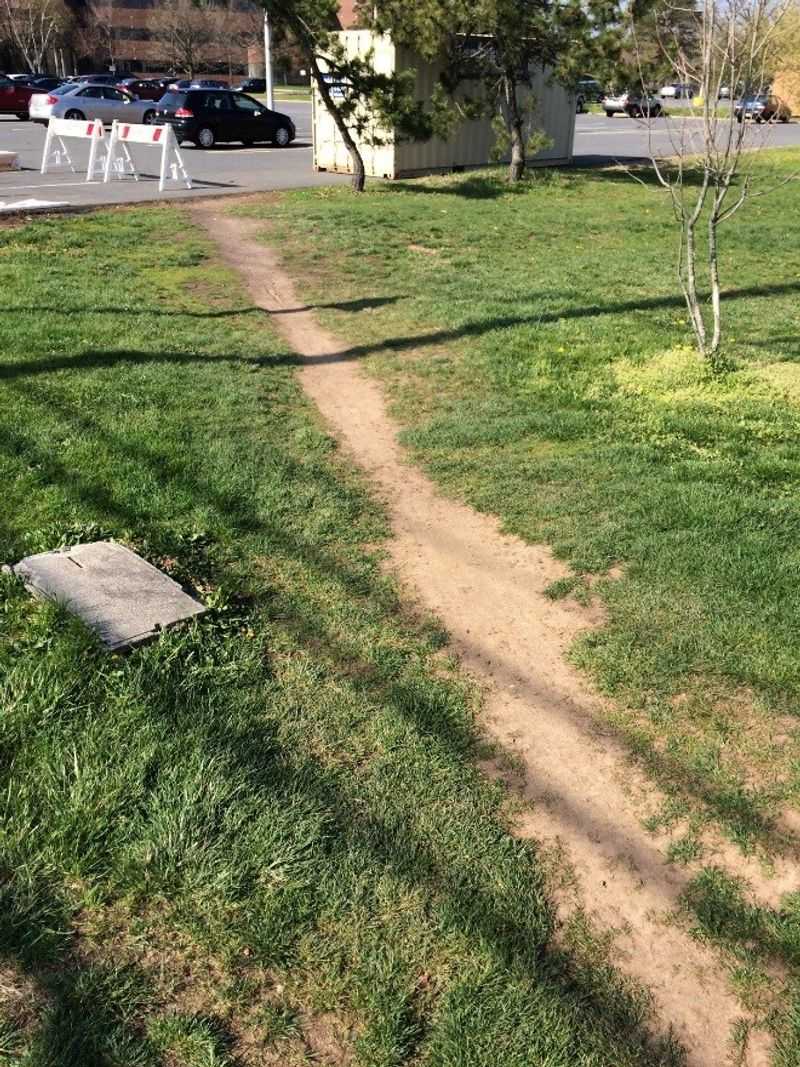
Walking your yard and noticing that the ground feels like packed dirt under your shoes, or watching water bead up and roll toward the street instead of soaking in, are clues worth paying attention to. Those symptoms are consistent with soil compaction, particularly in areas that get heavy foot traffic, repeated mowing passes on the same path, vehicle weight, or construction activity. Clay-heavy soils and spots that were driven over or worked when wet are especially prone to compaction because water acts as a lubricant between soil particles, making them easier to press together. University of Minnesota Extension guidance on soil compaction explains how those conditions press particles tighter and reduce the open spaces soil needs to move air and water.
The tricky part is that compaction is not the only explanation. Dry or hydrophobic soil can feel just as hard underfoot and resist water just as stubbornly. A thick thatch layer sitting between the grass blades and the soil surface can act like a spongy mat that sheds water before it ever reaches the ground. Poor grading, low spots, soil layering from old construction fill, drainage problems, and irrigation applied faster than the soil can absorb can all produce runoff that looks exactly like a compaction symptom.
Oregon State Extension’s practical lawn care guide notes that runoff has multiple causes and that identifying the right one matters before choosing a fix.
One more thing worth correcting right away: a lawn that sheds water is not automatically a lawn that has enough water. Compaction can restrict roots to a shallow zone, making turf more vulnerable to drought stress even when some moisture is present. UMN’s guidance on flooded and waterlogged lawns reinforces that surface behavior does not always reflect what roots are actually experiencing below ground. Treat hard footing and runoff as a reason to investigate, not as definitive proof of any single problem.
Compaction reduces pore space and disrupts air and water movement
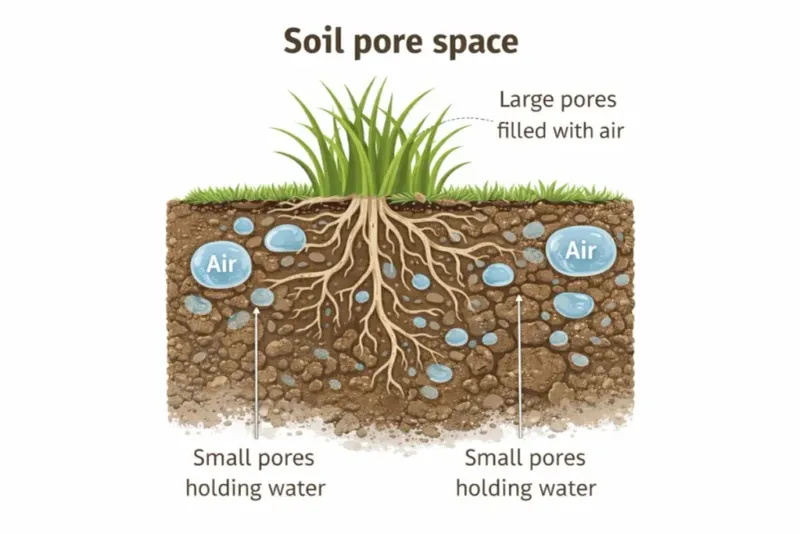
Healthy soil is not just dirt – it is roughly half solid particles and half open space. Those pores, especially the larger ones, are what allow rainfall and irrigation to move downward, oxygen to reach roots, and carbon dioxide from root respiration to escape upward. When traffic, equipment weight, or repeated pressure presses soil particles closer together, those larger pores collapse. What remains is a denser matrix that slows infiltration, reduces oxygen availability, and makes it physically harder for roots to push through.
UMN Extension’s soil compaction overview describes this pore-space loss as the central mechanism behind compaction’s effects on plant health.
Penn State Extension’s review of compaction effects explains that roots in compacted soil tend to stay shallow and spread laterally rather than growing down toward moisture reserves. A shallow root system leaves grass more exposed during dry stretches because it cannot reach water stored deeper in the profile. The problem is not simply that compacted soil holds less water in an absolute sense – it is that impaired water movement and restricted root access make it harder for the plant to use whatever moisture is available.
Surface runoff is the visible consequence of that impaired movement. When water cannot enter the soil fast enough, it moves sideways across the surface and leaves the lawn. Meanwhile, the roots below may be sitting in a low-oxygen zone with limited access to usable water, even if the soil particles themselves are not completely dry. Aeration creates channels through the compacted layer, but it reaches only the depth the tines penetrate – typically the surface and upper root zone.
Deep subsoil compaction or problems below the tine depth will not be resolved by a single aeration pass, which is why diagnosing the problem accurately before renting equipment matters. Oregon State’s lawn care publication reinforces that matching the remedy to the actual cause saves effort and avoids disappointment.
Inspect the turf before renting an aerator
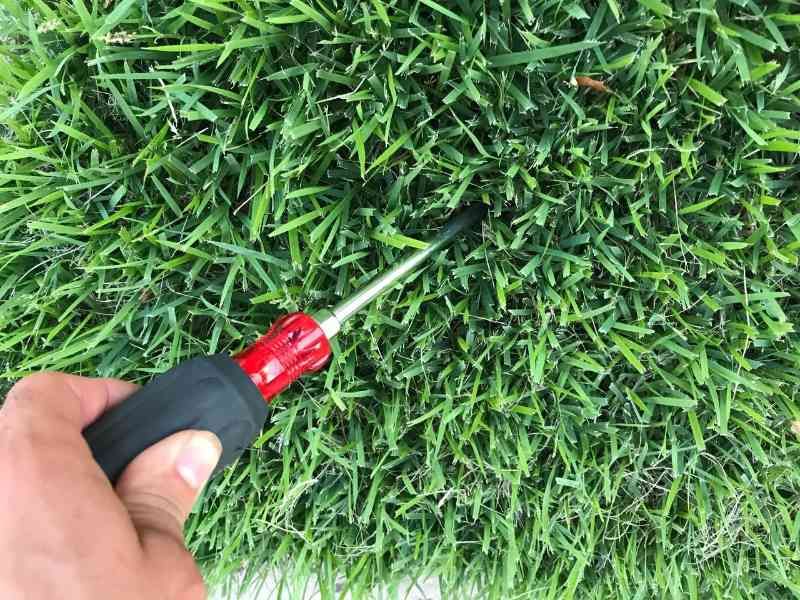
Before committing to any equipment rental, spend fifteen minutes doing an informal site check. Grab a standard flathead screwdriver and push it into the soil in the area that feels hard or sheds water. Then do the same thing in a spot nearby that seems healthier – a bed edge, a less-traveled corner, or a strip along a fence line. If the screwdriver slides in easily in one spot and barely moves in the other, that contrast is worth noting.
Oregon State Extension’s lawn maintenance guidance recommends this kind of side-by-side comparison as a practical first step.
One important caveat: very dry soil can resist a screwdriver just as stubbornly as compacted soil. If the lawn has gone without significant rain or irrigation for a week or more, water the area thoroughly and wait a day before repeating the test. That will help separate drought-hardened surface soil from genuinely compacted ground. OSU’s practical lawn care guide notes that dry and compacted soils can look nearly identical from the surface, making moisture-adjusted testing more informative.
Next, cut a small wedge of turf a few inches deep and look at what you find. Check how far roots extend – shallow, stubby roots that barely reach an inch or two can suggest restricted conditions. Also look at the layer of dead grass material between the green blades and the soil surface. UMN Extension’s thatch management guide treats a thatch layer greater than about one-half inch as commonly excessive, and thick thatch can slow water entry on its own regardless of what the soil below is doing.
Finally, watch where water goes during a short irrigation cycle or after rain. If it ponds in a specific low area and stays there, that spot may have a grading or drainage problem rather than a compaction problem. UMN’s flooded lawn resource recommends addressing depressions and, in persistent cases, installing subsurface drainage – steps that aeration alone will not accomplish.
Match aeration timing to the grass and its condition
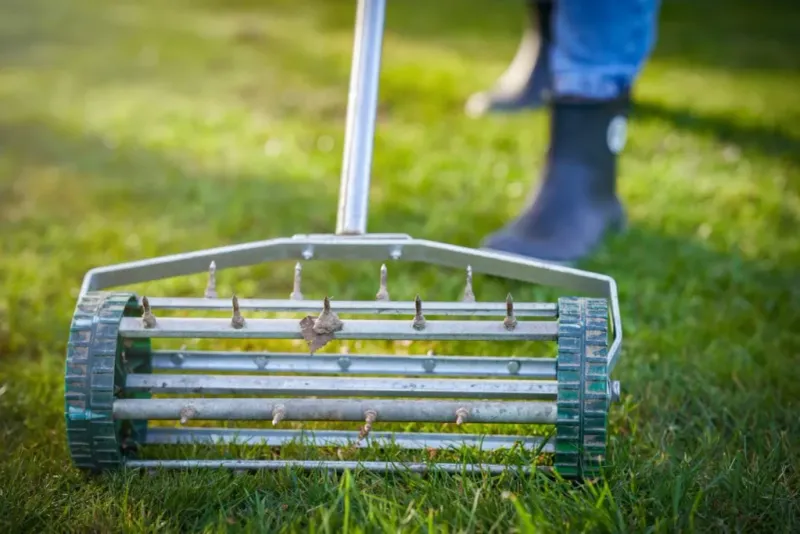
Timing aeration correctly matters as much as using the right equipment. For cool-season grasses such as Kentucky bluegrass, tall fescue, perennial ryegrass, and fine fescue, late summer to early fall is generally the preferred window. Those grasses are entering their active fall growth period, which means they have the energy to recover from the physical disturbance of aeration and can take advantage of improved air and water movement in the upper root zone. University of Maryland Extension’s lawn aeration guide recommends this window for cool-season lawns and explains that fall conditions – moderate temperatures and typically more reliable moisture – support recovery better than the heat of midsummer.
Warm-season grasses follow a different schedule entirely. Bermudagrass, zoysiagrass, and St. Augustinegrass are generally aerated during active summer growth or according to local extension guidance for your specific region. Oklahoma State Extension’s turfgrass management fact sheet addresses warm-season timing and reinforces that a fall aeration schedule designed for cool-season turf does not transfer automatically to warm-season lawns. If you are unsure which type you have, your local cooperative extension office can help identify it.
The calendar is a starting point, not an override. Turf condition on the day you plan to aerate matters more than the date. Do not aerate a lawn that is dormant from summer heat, severely stressed from drought, or saturated from recent heavy rain. OSU’s drought preparation guidance cautions against working stressed turf, and the same logic applies here – disturbing roots when the plant cannot recover adds injury rather than relief.
The goal is a lawn that is actively growing, showing normal color, and rooted in soil that is moist but not soggy.
Use a hollow-core aerator to remove soil plugs
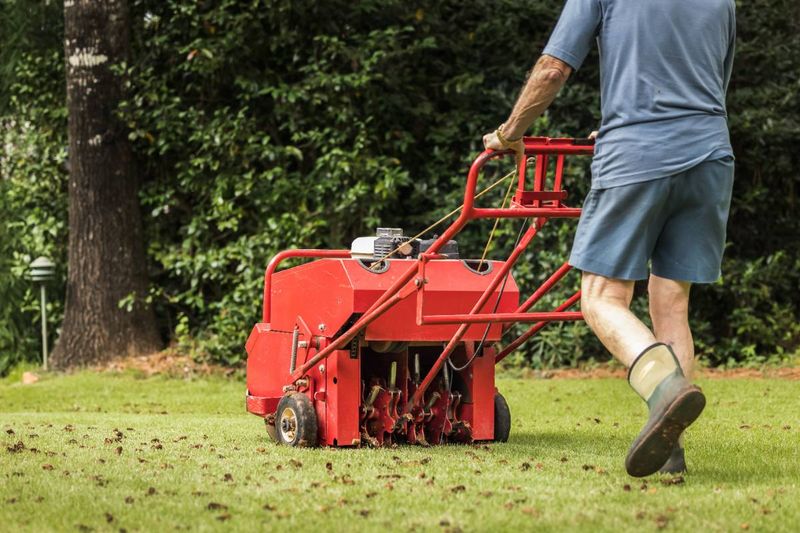
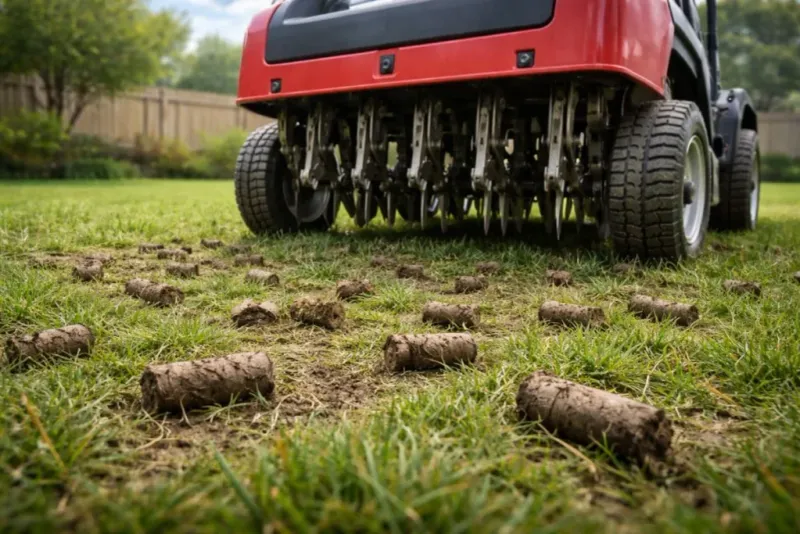
Not all aeration tools work the same way, and the difference matters for compacted turf. Spike or solid-tine tools push into the soil and displace it sideways, which can actually increase lateral compaction around each hole. A hollow-tine or core aerator uses hollow metal cylinders to pull a small column of soil out of the ground entirely, leaving an open channel. That physical removal of material is what creates room for air, water, and roots to move.
University of Maryland Extension’s aeration resource recommends hollow-core equipment for established home lawns and explains why plug removal outperforms simple puncturing for persistent compaction.
Plug depth is the next practical question. Common extension guidance targets roughly 2 to 3 inches, which reaches the surface and upper root zone where compaction from foot and mower traffic typically concentrates. Some guidance, including an Illinois Extension response on typical home-lawn conditions, suggests that plugs of 3 to 4 inches are achievable when equipment and soil moisture conditions allow, and deeper penetration can reach more of the root zone. Either range is reasonable; what matters most is that the tines are actually pulling full plugs rather than crumbling or smearing the sides of the holes.
Hole spacing affects how much of the lawn benefits from the treatment. Colorado State Extension’s turf management guidance references approximately 2-inch spacing as a practical target, and CSU’s lawn care basics notes that making more than one pass over heavily compacted areas improves coverage. Running the aerator in two directions, similar to mowing in a grid pattern, increases the number of holes without requiring a second rental day.
Soil moisture on the day of aeration is critical. The soil needs to be damp enough that tines can penetrate cleanly and pull intact plugs, but not so wet that the tines smear the hole walls or the machine sinks and tears the turf. A day or two after moderate rain or a thorough irrigation cycle is usually about right. Once the pass is complete, leave the extracted plugs where they fall on the lawn surface.
They will dry, break apart, and filter back into the turf over the following one to two weeks – no raking required in most cases. Oklahoma State’s turfgrass guidance supports leaving plugs in place as a standard post-aeration practice.
Let the plugs break down and use the openings for overseeding when appropriate
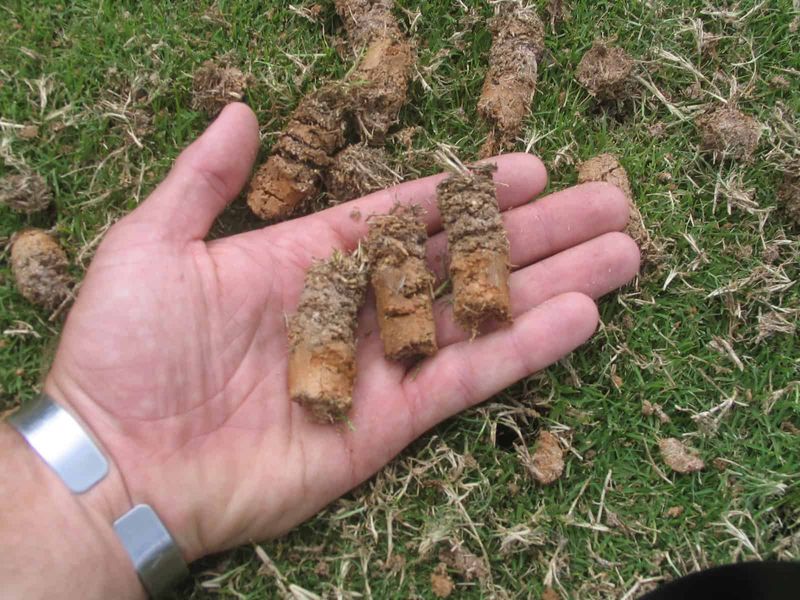
Those lumpy brown cylinders scattered across the lawn after aeration can look messy, but removing them is usually unnecessary work. As they dry over the following week or two, they crumble and their soil filters back down through the grass canopy. University of Maryland Extension notes that plug material helps the soil make contact with the thatch layer as it breaks down, which can support natural decomposition of that organic buildup over time. Running a mower over the dried plugs can speed up the crumbling process if the appearance bothers you.
The open channels left behind are also a practical opportunity for overseeding, particularly for cool-season lawns that have thin or bare patches. Seed dropped into or near aeration holes has better direct contact with soil than seed scattered over an intact grass surface, which improves germination odds. University of Illinois Extension’s fall lawn care tips recommend pairing core aeration with overseeding as part of a cool-season renovation sequence, and Colorado State Extension’s lawn care basics supports the same combination. The key is matching seed variety to your existing grass type so the new plants blend in rather than creating a patchy mix.
Keep expectations grounded about what aeration alone will deliver. Improved physical conditions – better air movement, easier water entry, a little more room for root growth – are the realistic benefits. UMN’s thatch control guidance acknowledges that aeration supports thatch management as part of an overall program, not as a standalone cure. A lawn recovering from compaction will still need appropriate watering, fertilization on schedule, and protection from the same traffic that caused the problem in the first place.
Aeration creates a better starting point; the grass has to do the growing.
Prevent recurring compaction and recognize problems aeration cannot fix
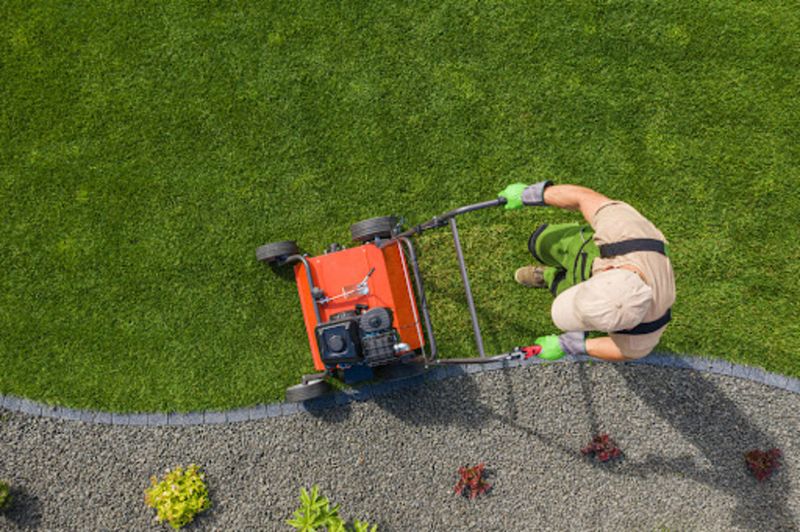
Aeration improves conditions temporarily, but the pressure that caused compaction will recreate it if nothing changes. USGA turf management guidance identifies wet-soil traffic as one of the most damaging compaction causes, because saturated particles slide against each other and pack far more easily than dry ones. Keeping foot traffic, mowing equipment, and any vehicle weight off the lawn when the soil is soaked is one of the most effective compaction-prevention habits a homeowner can build. Even a few passes on a soggy morning can undo weeks of recovery.
Mowing routes are another overlooked factor. Running the mower in the same direction every week concentrates wheel and roller pressure on the same narrow strips repeatedly. Varying the pattern distributes that load across more of the lawn and reduces the chance of worn tracks becoming chronically compacted lanes. Oregon State Extension’s lawn maintenance resource supports route variation as a simple preventive habit that costs nothing extra.
How often to aerate is not a fixed answer. University of Maryland Extension suggests every one to two years for heavily trafficked lawns and every two to four years for typical home lawns, but actual frequency should follow what the lawn is telling you – probe resistance, slow infiltration, thin growth in high-traffic zones – rather than a rigid calendar. Soil type, grass variety, and seasonal traffic patterns all shift the right answer for a specific yard.
Some problems aeration simply cannot solve. Research on deep core aeration of compacted clay sports fields found measurable infiltration improvement but also concluded that results vary with soil type and that repeated cultivation may be needed – and that study involved conditions more intensive than a typical home lawn. Deep subsoil compaction, a perched water table, incompatible soil layers from old construction fill, and chronically low spots that pond after every rain are all situations where aeration addresses symptoms without correcting the source. UMN’s flooded lawn guidance recommends grading corrections and, where necessary, subsurface drainage installation for those cases.
Aeration is the right tool when inspection suggests surface or upper root-zone compaction, the grass is an established cool-season type that is actively growing, and the soil is moist but workable. When those conditions are not all present, waiting or choosing a different approach will serve the lawn better than forcing the treatment.