
If Your Petunia Leaves Feel Sticky And Gummy, Here’s What They’re Quietly Warning You About
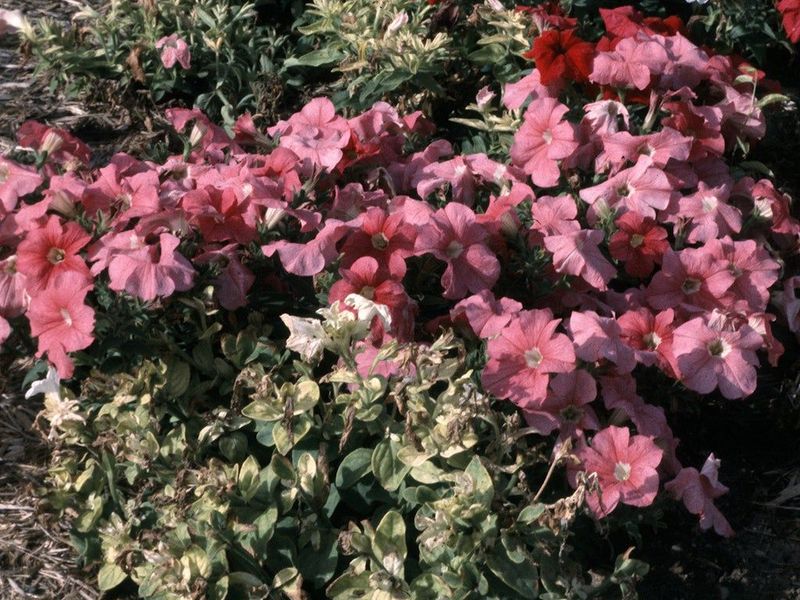
Running your hand along a petunia stem and feeling something gummy is enough to make any gardener stop and wonder what went wrong. The good news is that sticky petunia foliage does not automatically mean your plant is in trouble.
Petunias naturally produce a tacky, hairy surface, and some varieties feel noticeably stickier than others. Knowing the difference between normal plant texture and a new, unusual residue is the first step toward figuring out whether your petunia needs attention or just a closer look.
Sticky Petunia Foliage Can Be Normal
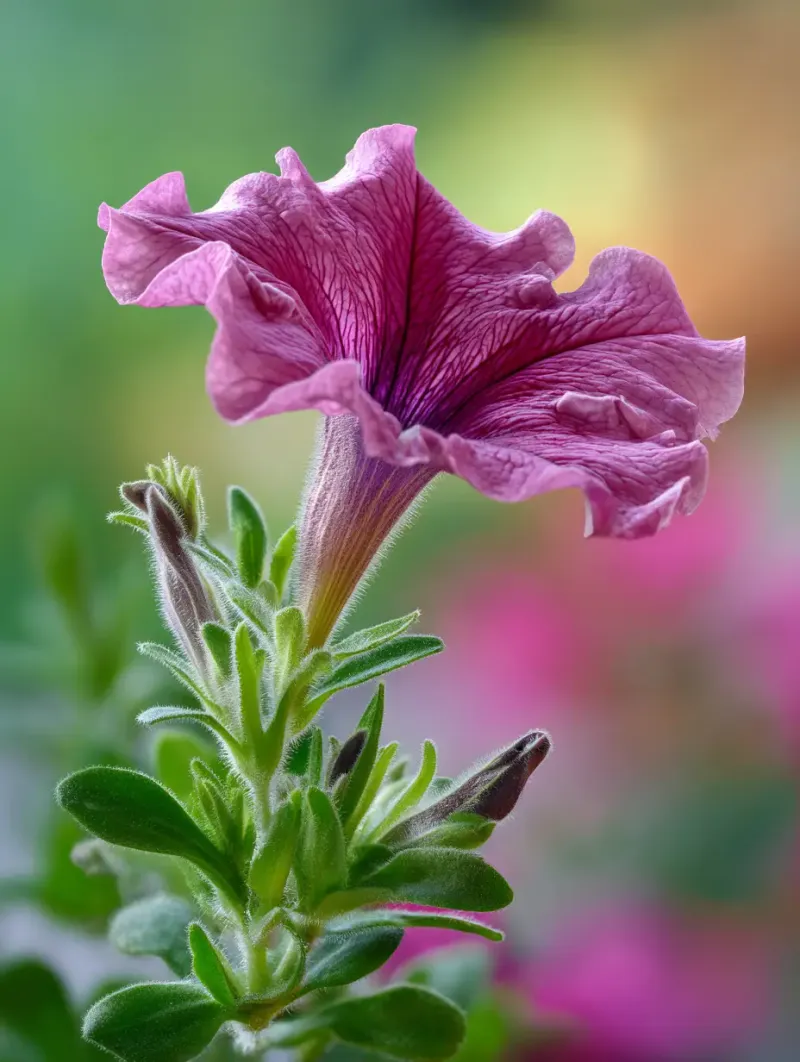
Most gardeners are surprised to learn that petunias are naturally sticky plants. The leaves, stems, and even flower buds are covered with tiny glandular hairs that produce a slightly tacky coating as a normal part of the plant’s biology.
UC IPM’s petunia resource notes that this sticky, hairy texture is a characteristic trait of the species, not a sign of disease or pest damage.
Cultivar differences matter here. Some petunia varieties feel considerably stickier than others, so a plant that seems unusually gummy compared to a neighbor’s may simply belong to a tackier-by-nature type.
Ask Extension’s petunia FAQ confirms that uniform stickiness across otherwise healthy growth is a well-documented petunia trait, and the NC State Extension plant profile for Petunia x hybrida similarly describes the foliage as sticky and pubescent.
A practical baseline for “normal” looks like this: relatively even tackiness across the leaves and stems, no new pattern of residue, no shiny or wet-looking coating concentrated in one spot, and no visible decline in growth or color. The plant feels sticky when touched, but it looks healthy overall.
The first diagnostic fork comes when that baseline changes. Stickiness that appears suddenly on a plant that did not feel that way before, residue that is unusually heavy or wet-looking, a glossy coating concentrated on lower leaves or below certain stems, or stickiness that keeps returning after rain or rinsing all warrant a closer look.
That kind of change is not proof of a problem, but it is a reasonable reason to inspect the plant more carefully before drawing any conclusions.
New Glossy Residue May Be Honeydew
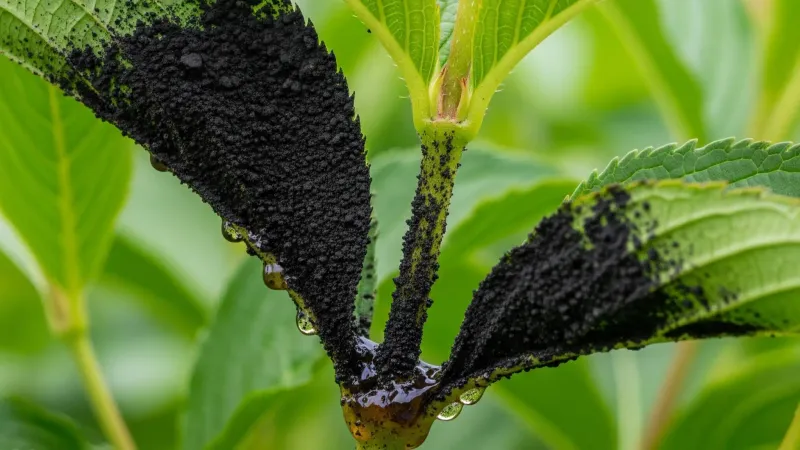
When a sticky coating appears on a petunia that previously felt normal, or when the residue looks glossy and wet rather than just lightly tacky, honeydew is a reasonable explanation to consider. Honeydew is a sugary waste product that sap-feeding insects excrete as they feed, and it can land on leaves, stems, flowers, nearby plants, and objects sitting below an infested area.
It is not the plant’s own sap leaking from its tissues.
University of Maryland Extension’s honeydew and sooty mold guide describes honeydew as a sticky, sugary secretion produced by piercing-sucking insects, and the UC IPM Pest Notes on sooty mold explain that this residue accumulates on surfaces beneath feeding insects, which is why lower leaves and objects under the plant are often the first places it shows up.
Several different insects can be responsible. Aphids are frequently cited, but whiteflies, mealybugs, soft scale, psyllids, and leafhoppers all produce honeydew as well.
Identifying stickiness alone is not enough to name the culprit. A glossy residue concentrated beneath affected growth differs from the petunia’s naturally tacky surface in two key ways: it tends to appear in a localized area rather than evenly across the plant, and it often has a shinier, wetter quality than ordinary petunia fuzz.
Treat the residue as a clue that something may be feeding on the plant, not as a confirmed diagnosis. A new or concentrated glossy coating warrants an inspection of the plant, particularly the undersides of leaves and new growth where sap-feeding insects commonly hide.
The stickiness points toward a question worth asking, not an answer worth acting on before checking further.
Inspect Undersides, New Growth, and Nearby Plants
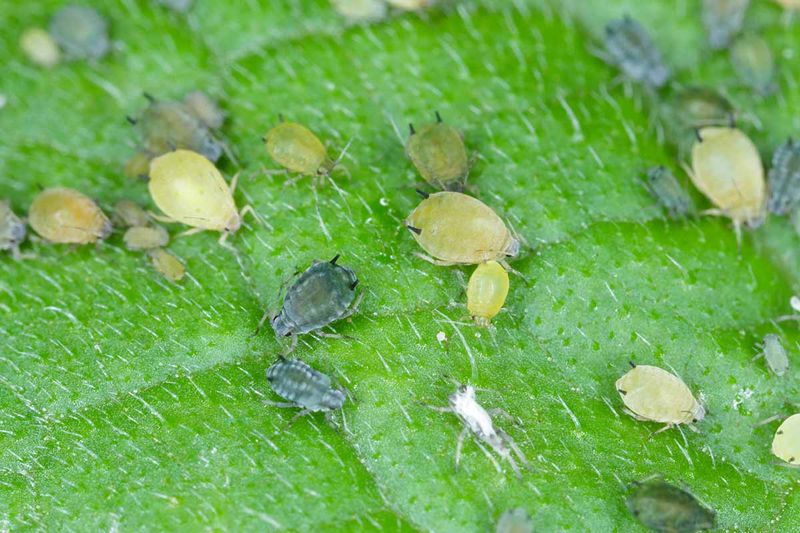
Checking the top of a petunia leaf tells you very little. The more useful inspection happens underneath.
Turn leaves over carefully and look at the undersides, especially on younger foliage and tender shoot tips where sap-feeding insects tend to concentrate. Also examine the stems near growing points, flower buds, and any plants growing close by, since honeydew-producing pests can spread across a garden bed.
Each pest type leaves slightly different visual clues. University of Minnesota Extension’s aphid guide notes that aphids often cluster on new growth and leaf undersides, and they may appear in a range of colors including green, yellow, black, or pink depending on the species.
Whiteflies tend to flutter up in a small cloud when the plant is disturbed, which makes them easier to spot. Scale insects can look like small bumps or raised spots on stems and leaves, while mealybugs often appear as white or grayish cottony masses tucked into joints and crevices.
Iowa State University Extension’s sticky-substance FAQ points out that the location of residue on lower leaves and nearby surfaces is itself a useful diagnostic clue, since it reflects where insects are feeding above. Pay attention to cast skins, which look like translucent papery shells left behind as aphids molt, because their presence suggests an active or recent population even when live insects are hard to spot.
Ants moving up and down the petunia’s stems are worth noting as well. University of Maryland Extension explains that ants are attracted to honeydew and sometimes actively protect aphids and other honeydew-producing insects from predators, which can make pest populations harder to reduce naturally.
Finally, note whether the residue is spreading to new leaves or recurring after rain, because that pattern suggests ongoing insect activity rather than an old, resolved episode.
Use Pest Activity, Spread, and Plant Symptoms to Judge Action
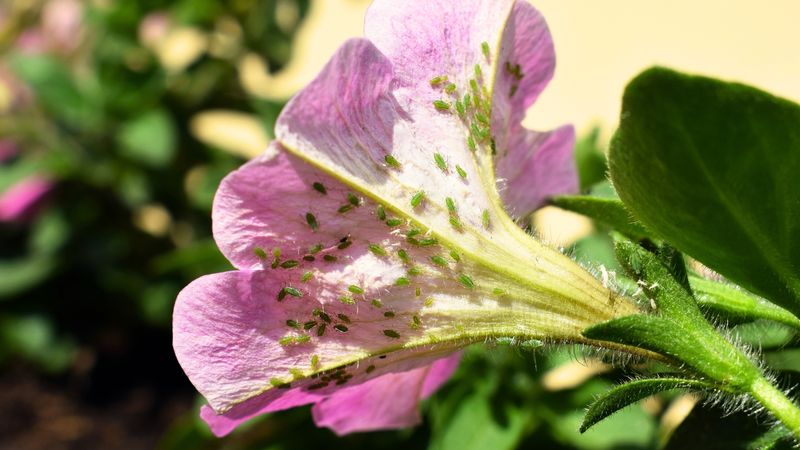
Finding an insect on your petunia does not automatically mean the plant needs treatment. The more useful question is whether the pest population is growing, whether the plant shows signs of actual stress, and whether the infestation is spreading to new growth or nearby plants.
UC IPM’s aphid management resource and University of Minnesota Extension both note that established plants can often tolerate light or moderate aphid populations without meaningful harm, and that management may be unnecessary if the plant stays healthy and the infestation remains limited. Visible pest numbers, recurring honeydew, expanding colonies, and plant decline together form a more complete picture than stickiness or insect presence alone.
Symptoms worth watching for include curled or twisted leaves, yellowing, stunted shoots, poor overall growth, and distorted or malformed flowers. These can suggest heavier feeding pressure.
At the same time, a few aphids clustered on one shoot tip with no other symptoms does not carry the same urgency as a plant whose newest leaves are cupping inward, yellowing rapidly, and coated in fresh honeydew every morning.
Not every petunia pest produces honeydew, and it helps to keep that distinction in mind. Thrips, for example, can damage petunias and cause pale silvery scars, distorted leaves, or streaked flowers, but they are not honeydew producers.
UMass Amherst’s thrips resource and Penn State Extension’s petunia disease guide both address thrips as a distinct concern from sap-feeding honeydew producers. When the primary complaint is sticky residue, the inspection should focus on insects that excrete honeydew rather than forcing every petunia pest into the same category.
Monitoring is a reasonable first response when pests remain limited and the plant looks healthy; a spreading infestation or visible plant decline is what tips the balance toward intervention.
Start With Water, Pruning, and Beneficial Insects
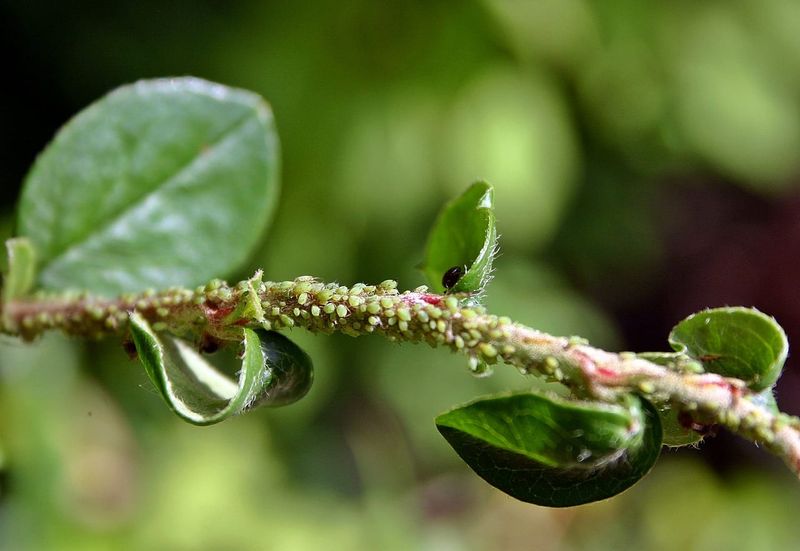
Before reaching for any product, a firm stream of water is a reasonable first step for an outdoor petunia that is healthy enough to handle it. Directing the spray at leaf undersides and growing tips can dislodge aphids and wash away some of the honeydew on the surface.
The key word is “some.” University of Minnesota Extension explains that water can knock insects off the plant but does not prevent surviving pests from reproducing, so the same stems may need rinsing again in a few days if the population rebounds.
Check the plant after rinsing rather than assuming the job is done. If honeydew reappears on the same leaves within a day or two, live insects are likely still feeding.
Rinsing improves appearance and can reduce numbers temporarily, but it works best as part of an ongoing monitoring routine rather than as a one-time fix.
When the infestation is confined to a few shoots or a small cluster of leaves, removing those sections is another low-risk option. UC IPM’s aphid guide and University of Nevada Reno Extension’s aphid management publication both suggest pruning heavily infested growth as a targeted way to reduce the affected area, followed by monitoring to confirm the problem does not spread.
Dispose of removed plant material away from the garden rather than leaving it nearby.
Lady beetles, lacewings, syrphid-fly larvae, and parasitic wasps are natural allies that feed on aphids and other soft-bodied pests. University of Maryland Extension’s aphid resource for home gardens notes that preserving these beneficial insects matters because broad-spectrum insecticides can harm them along with the target pests.
If you spot small wasps, lacewing eggs, or orange-and-black larvae near your petunias, that is a sign that natural suppression may already be working in your favor. Give it time before escalating to a spray.
Apply Labeled Sprays Carefully When Necessary
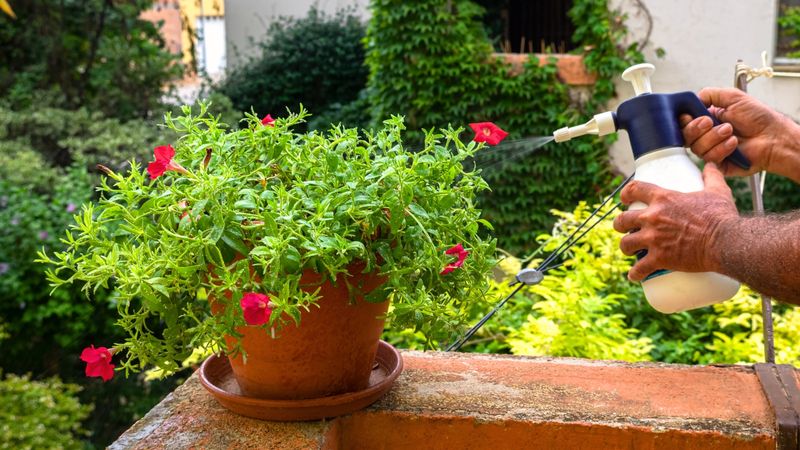
When monitoring confirms a persistent, expanding, or clearly damaging infestation, a labeled product may be warranted. The appropriate choice for most home garden situations is a commercially labeled insecticidal soap or horticultural oil selected for the identified pest and plant.
These are not interchangeable with household dish detergent or homemade soap mixtures. Colorado State University Extension’s insecticidal soap guide specifically warns that household soap products can injure plant foliage and are not formulated or tested as pesticides, so they should not be substituted for labeled products.
University of Connecticut Extension’s insecticidal soaps fact sheet explains that these products work primarily through direct contact with the insect’s body, which means coverage is the critical factor. Spraying only the top surface of leaves will leave most of the population untouched.
The product needs to reach the insects directly, including those clustered on leaf undersides, stem joints, and growing tips, to have any effect.
Before treating the whole plant, apply the product to a small section and wait 24 to 48 hours to check for leaf damage. UC IPM’s aphid resource recommends testing on a small area first, and cautions against applying soaps or oils to drought-stressed plants or during periods of unsuitable heat.
Product labels carry specific temperature guidelines that vary by formulation, and those instructions take priority over general advice.
Repeat applications may be necessary because a single treatment rarely reaches every insect or prevents eggs from hatching. Follow the product label for timing and frequency rather than reapplying on a personal schedule.
University of Maryland Extension also advises against routine use of systemic insecticides on flowering petunias because of concerns about pollinator exposure through plant tissues and flowers. Insecticidal soap and horticultural oil, used correctly and according to label directions, offer a more targeted approach with a narrower risk profile when treatment is genuinely needed.
Black Coating Often Points to Honeydew
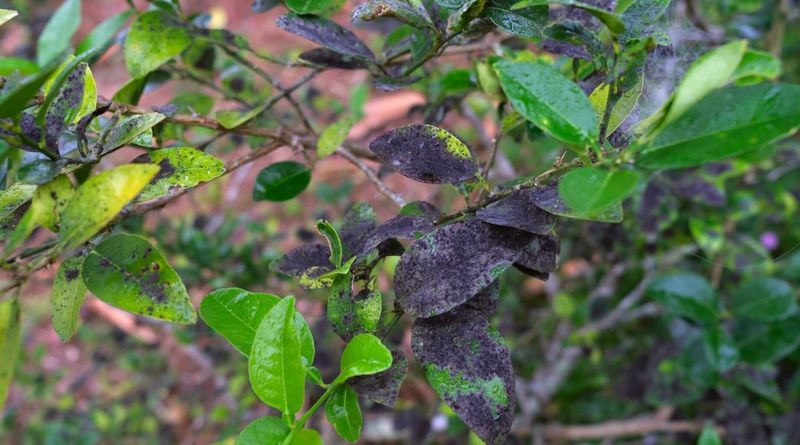
A black, soot-like coating on petunia leaves can look alarming, but understanding what it is helps put it in perspective. Sooty mold is a fungal growth that develops on honeydew deposits rather than by directly infecting the petunia’s tissue.
University of Maryland Extension’s honeydew and sooty mold guide explains that the mold uses the sugary residue as a food source, which means its presence signals that honeydew was deposited on the surface at some point, not necessarily that sap-feeding insects are still active right now.
The practical implication is that black coating calls for inspection rather than immediate treatment. Check the plant for live insects, fresh sticky residue, and any signs that the population is still active or growing.
UC IPM’s sooty mold Pest Notes describe the mold as a secondary problem tied to the underlying pest, and the primary corrective action is reducing or eliminating the insect producing the honeydew. Washing the black coating off without addressing active insects will not prevent new mold from forming if honeydew continues to accumulate.
Heavy sooty mold coverage can block light from reaching the leaf surface, which may reduce the plant’s ability to photosynthesize efficiently. That effect is worth watching on plants with extensive coverage, though the mold itself is not the original disease or the root cause of the problem.
Once pest activity stops and no new honeydew is deposited, the coating typically fades and weathers away over time. Controlling the pest is what breaks the cycle.
Treat Stickiness as a Clue, Not a Crisis
Even, mild tackiness on healthy petunia growth is normal. Petunias are sticky plants by nature, and that texture alone is not a warning.
A new or concentrated glossy residue, especially when localized, recurring, or accompanied by ants, insects, cast skins, distorted growth, or a black coating, is what justifies a closer look.
When inspection turns up active insects and the plant shows signs of stress or spreading infestation, address the pest rather than just washing the leaves. Rinsing, targeted pruning, and preserving natural predators are good starting points.
A labeled insecticidal soap or horticultural oil, applied carefully and according to label directions, is appropriate when those steps are not enough. Monitor after any rinse, pruning, or treatment to confirm whether the problem is resolving.
Sticky petunia leaves do not mean the plant is dying. They mean it is worth a few minutes of your attention, and most of the time, a calm inspection will give you the answer you need.
A petunia that has been growing well all season has a lot going for it.