
If Your Petunias Are Getting Leggy And Weak, Here’s The Watering Habit Quietly Doing It
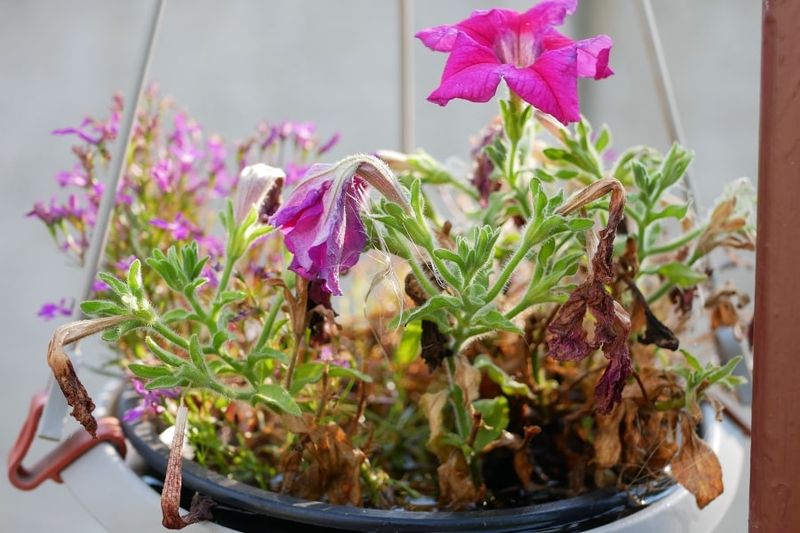
Petunias are one of the most rewarding flowers you can grow, but when the stems start stretching out and the blooms thin out, it is easy to panic and wonder what went wrong. A fixed watering routine, the kind where you reach for the hose at the same time every day without checking the soil first, can contribute to weak, stretched growth under the right conditions.
However, watering is rarely the whole story, and blaming the hose before you check the light, the drainage, and the plant itself can send you chasing the wrong fix. This guide walks you through how to figure out what is actually going on and what to do about it.
The Habit to Question Is Watering by the Calendar
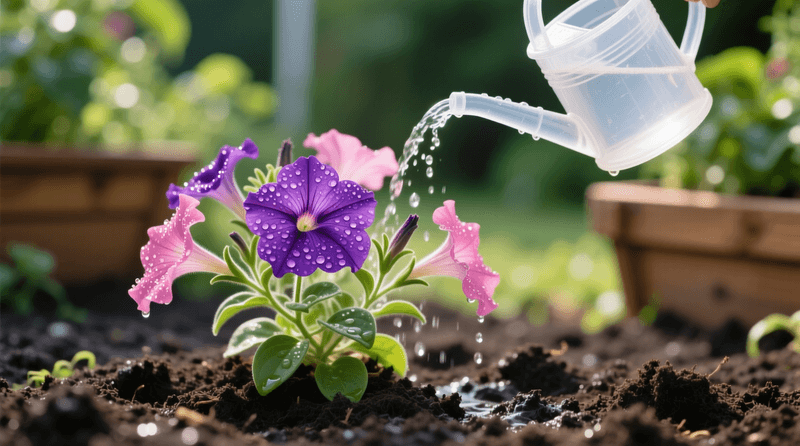
Grabbing the hose at the same time every morning, rain or shine, feels like responsible gardening. The problem is that a fixed schedule ignores everything that actually controls how much water a petunia needs: the temperature that day, how much rain fell overnight, how fast the soil drains, and how actively the plant is growing.
When low-volume sprinkles arrive on a set clock regardless of those variables, the growing medium can stay persistently damp without the roots ever receiving a thorough, deep drink.
Colorado State University Extension notes that petunias can become leggy when given too much water, and UF/IFAS adds that light, frequent watering encourages shallow rooting. The real trouble is not the word “daily” by itself.
A small hanging basket on a hot porch may genuinely need water every single day. The issue is applying water automatically, without confirming the plant actually needs it.
Before you water again, pause and treat it as a diagnostic moment. Look at the leaves: are they limp and pale, or are they firm and green?
Push a finger or a wooden chopstick several inches into the growing medium. If it comes out damp, the plant does not need more water yet.
Check whether the pot or bed drains freely, since even a reasonable watering schedule can saturate soil that has nowhere to go.
The habit worth breaking is unexamined, autopilot watering, not watering on any particular day of the week. Stopping the automatic routine and inspecting the plant, the growing medium, and the drainage before you water costs nothing and gives you real information to work with.
Three Different Water Problems Can Look Similar
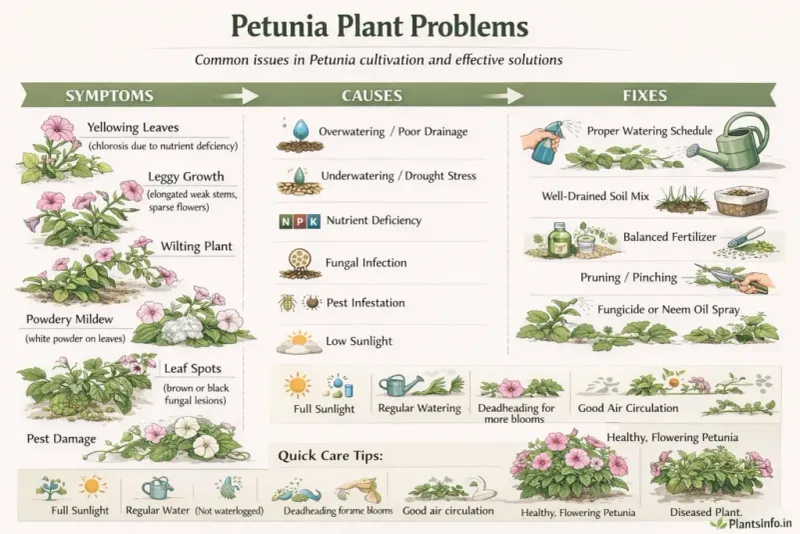
Stretched stems and sparse blooms on a petunia can come from very different moisture situations, and the fix for one can make another worse. Grouping all of them under “overwatering” and cutting back on water entirely may help one plant while harming another.
The first step is figuring out which moisture condition you are actually dealing with.
Shallow, frequent watering is the first scenario. When only the top layer of soil gets wet, roots have little reason to grow downward.
UF/IFAS Gardening Solutions specifically warns that this practice encourages shallow rooting, which can limit the plant’s ability to access nutrients and anchor itself during heat or wind. Shallow-rooted petunias may look acceptable for a while, then decline quickly when conditions get harder.
Persistently saturated media is the second scenario and a more urgent one. When the growing medium stays wet for extended periods, oxygen gets pushed out of the pore spaces around the roots.
UC IPM’s guidance on aeration deficit explains that excess moisture displaces oxygen in the root zone and can lead to root decline, stunting, wilting, and eventually plant death. Roots in saturated media may look brown, mushy, or water-soaked when you pull the plant from its pot.
Insufficient water is the third scenario, and it is worth naming because it produces some of the same surface symptoms. Research published in HortScience found that restricted water reduced flower number, plant height, and flower size in petunias, meaning that telling a water-stressed plant to dry out further would be counterproductive.
Wilting that does not recover in the cool of the evening, very dry and crumbly soil, and stunted new growth all suggest the plant needs more water, not less.
Weak stems and fewer blooms are nonspecific symptoms. They do not point automatically to one moisture problem.
Identifying which condition is present, by checking the actual state of the root zone, is the only reliable way to choose the right response.
Inspect Moisture Below the Surface
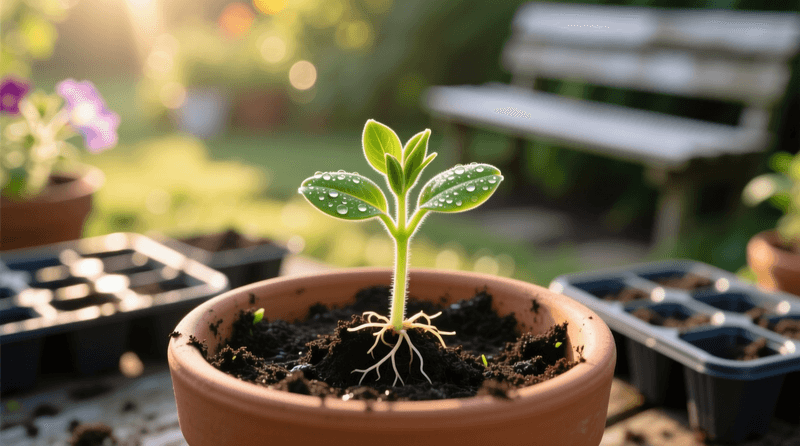
Surface soil can fool you. On a sunny afternoon, the top half-inch of a container or garden bed can feel bone dry while the root zone several inches down is still quite wet.
Watering based only on what the surface looks or feels like is one of the most common ways a fixed routine causes trouble without the gardener ever realizing it.
Illinois Extension’s watering guidance recommends checking soil moisture several inches down rather than relying on surface appearance or a calendar. Push your finger, a wooden skewer, or a moisture meter probe into the growing medium to the depth where most of the roots are active.
In a six-inch pot, that might be three to four inches down. In a garden bed with established plants, it could be five or six inches or more.
Specific signs of excess moisture in the root zone include soil or potting mix that feels wet and compacted rather than moist and crumbly, water that pools on the surface and drains very slowly, and roots that appear brown, soft, or water-soaked when you gently ease the plant from its container. UC IPM notes that slow drainage and poor aeration in the root zone are the direct causes of oxygen deficit, not overhead watering by itself.
Signs of genuine dryness include soil that pulls away from the sides of the pot, a very light pot when lifted, or leaves that stay limp even after the temperature cools in the evening. Both conditions require action, just opposite actions.
Avoid setting a universal dryness threshold for every situation. Soil type, pot size, plant maturity, heat, and drainage all change how fast moisture moves through the root zone.
The practical rule is simple: water when the plant needs it, not when the schedule says so.
Water Slowly at the Root Zone
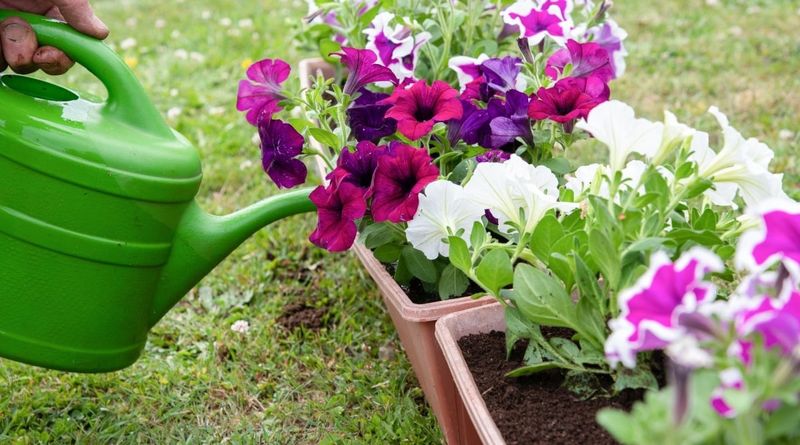
Once you know the root zone actually needs water, how you apply it matters. Directing water onto the soil around the base of the plant, rather than spraying it across the leaves and blooms, puts moisture where the roots can use it.
Petunias grown in garden beds benefit from a slow, steady application that wets the soil to the depth of the root zone rather than a quick sprinkle that only dampens the surface.
UF/IFAS Gardening Solutions recommends watering at the soil surface or root zone rather than routinely wetting foliage and flowers, noting that this practice can lower the risk of some foliar diseases, including petal blight and other moisture-favored problems. Wet flowers and leaves are not the direct cause of root problems, but they do raise the risk of fungal issues on the plant’s surface.
For established in-ground petunias, extension guidance commonly references roughly one to two inches of water over seven to ten days as a general landscape benchmark. Illinois Extension’s guide to caring for annuals supports this kind of adjusted, need-based approach rather than a rigid daily routine.
Treat that range as a starting point and adjust it based on rainfall, soil type, temperature, plant size, and how fast your specific soil drains. A heavy clay bed holds moisture much longer than a sandy raised bed, and a stretch of 95-degree days changes the math entirely.
Morning watering is a reasonable habit because it gives foliage time to dry as the day warms. University of Minnesota Extension notes that prolonged leaf wetness increases disease risk in warm conditions, so timing water to allow drying is sensible.
However, morning watering does not prevent leggy stems and is not a cure for stretched growth. Legginess comes from other causes, and shifting your watering time without addressing moisture, light, and drainage will not change the plant’s shape.
If water runs off quickly or pools at the surface, the soil may be compacted or hydrophobic. Slow down the application and consider whether amending the soil or switching to a soaker hose would help water reach the root zone more effectively.
Containers Change the Watering Equation
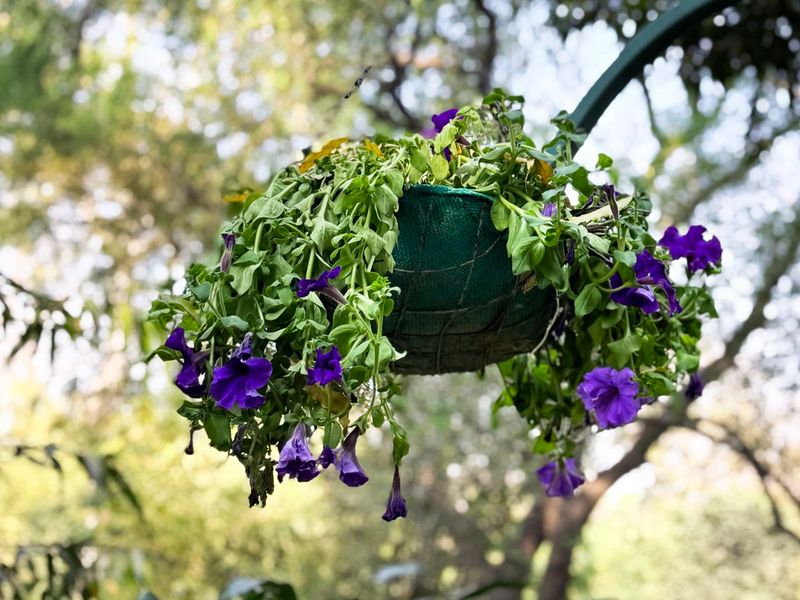
Pots, window boxes, and hanging baskets behave very differently from in-ground garden beds, and advice written for one situation can backfire in the other. A garden bed has a large volume of soil that buffers moisture for days.
A six-inch hanging basket in full sun can go from adequately moist to dangerously dry within 24 hours on a hot afternoon. Treating both situations with the same watering frequency is one of the most common mistakes container gardeners make.
RHS container watering research found that petunias in containers performed well with small daily applications, while applying enough water to saturate the compost produced poorer-quality plants and unnecessary waste. This is an important finding: daily watering is not the enemy.
Saturating a container that does not drain freely is the problem.
The critical variables for container watering are container size, drainage hole quality, potting mix composition, sun exposure, and air temperature. A large pot with coarse, well-draining mix and a generous drainage hole will hold moisture longer and need less frequent attention than a small, dense-mix pot in direct afternoon sun.
Check the mix throughout its depth, not just at the top, before adding more water.
UF/IFAS notes that container plants may need more frequent checks during heat waves. Rather than banning a particular schedule, the practical approach is to evaluate what you find each time: if the mix is still moist through most of its depth, wait.
If it is dry below the surface and the plant looks thirsty, water thoroughly until it drains from the bottom.
One practical test for hanging baskets is to lift them. A light basket almost always needs water; a heavy one usually does not.
That simple check takes seconds and is far more reliable than any fixed-day routine.
Check Light, Cultivar, Spacing, and Feeding
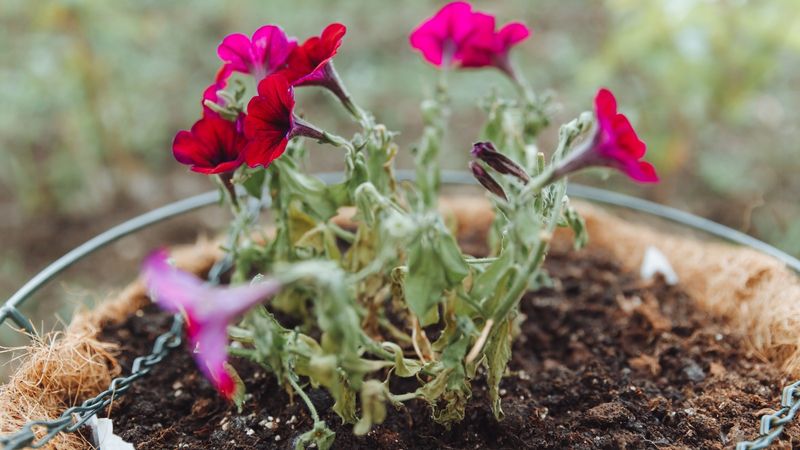
Correcting your watering routine is a good move, but it will not fix every leggy petunia. Before you conclude that moisture was the culprit, take a few minutes to assess the other conditions that shape how petunias grow, because some of them may be doing more damage than the watering schedule ever did.
Light is the factor most likely to be underestimated. UF/IFAS Gardening Solutions states that petunias perform best in full sun or very bright conditions and that low light can produce stretched, weak stems and fewer flowers.
A petunia sitting in four hours of morning sun and then shifting into shade for the rest of the day is not getting what it needs. If the stems are reaching toward a light source, or if the plant looks pale and thin despite good soil moisture, shade is likely playing a larger role than water.
Moving a container to a sunnier spot or trimming overhanging branches can change the plant’s growth pattern more quickly than any watering adjustment.
Cultivar growth habit is worth checking before you decide something is wrong. MSU Extension’s guide to fertilizing annual flowers notes the wide variation among petunia types.
Trailing and cascading varieties are bred to produce long, arching stems. A Wave or Supertunia that sprawls across a hanging basket is doing exactly what it was selected to do, not signaling distress.
Check the plant tag or the variety name before concluding that length equals weakness.
Crowding limits airflow and forces plants to compete for light and nutrients, which can push stems upward and thin out blooms. If petunias are packed tightly together or surrounded by taller plants, spacing them out or removing some plants may help more than changing the watering frequency.
Feeding deserves careful thought rather than an automatic response. Research published in HortScience found that high substrate moisture combined with high fertilizer rates reduced flowering in potted petunias.
If the plant is already sitting in consistently moist soil and receiving heavy fertilizer, adding more fertilizer will not fix the legginess and may worsen it by pushing soft vegetative growth at the expense of blooms. Assess what the plant has already been receiving before reaching for a fertilizer bottle.
Prune Leggy Growth After Fixing the Conditions
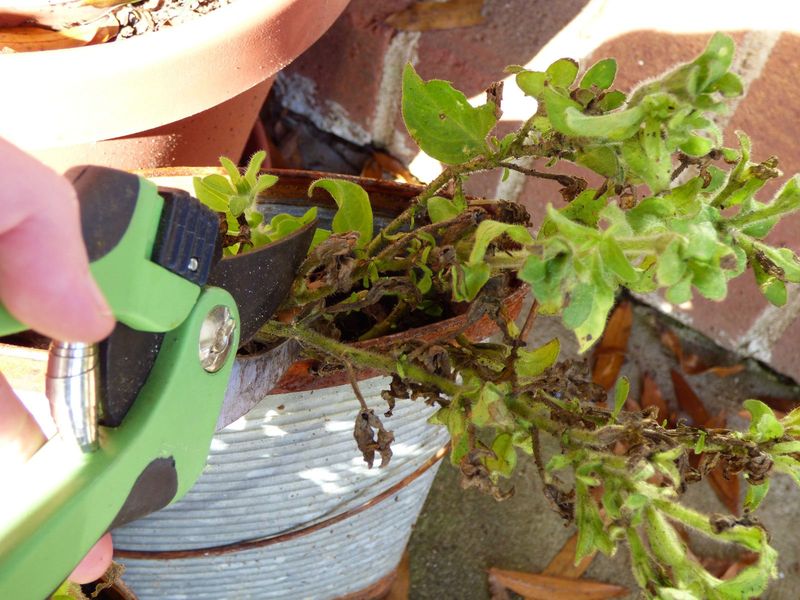
Once you have corrected the moisture situation, improved drainage where needed, and assessed light and feeding, the plant itself may still look stretched and sparse. Pruning is the recovery step that reshapes the plant and encourages new branching, but it works best after the underlying conditions have been addressed, not instead of addressing them.
Penn State Extension’s guide to pruning herbaceous plants recommends cutting annuals back to roughly three to five inches, leaving several nodes from which new shoots can develop, and specifically lists many petunia varieties as responsive to this treatment. The plant redirects energy into those lower nodes, producing multiple new stems rather than continuing to extend a single long one.
New growth that emerges under better light and moisture conditions will be more compact and productive than what it replaces.
Missouri Extension recommends cutting leggy, nonblooming petunias back to a few inches from the base and correcting nutrition as part of a rescue approach. This is a practical reset, not a sign that watering caused the original problem.
Pruning reshapes the plant while new conditions give the fresh growth a better start.
The sequence matters. Cutting back a petunia that is still sitting in saturated soil or deep shade will produce new growth that faces the same stressful conditions.
Fix the environment first, then prune.
Resist the urge to pair every cutback with a dose of fertilizer. Research on potted petunias showed that high moisture combined with high fertilizer rates can reduce flowering and push soft vegetative growth.
If the plant has been well-fed all season, it may not need additional fertilizer at all. Follow the product label, and let the plant’s response over the next two to three weeks guide any further feeding decisions.
Use Plant Demand Instead of a Fixed Schedule
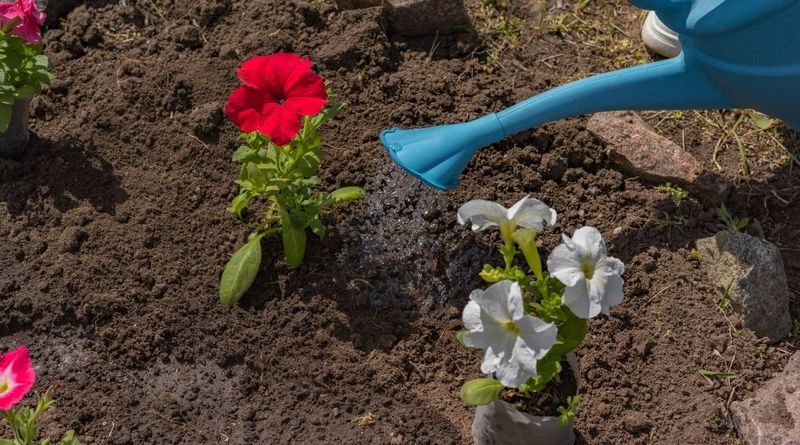
The repeatable routine that actually works is not tied to a day of the week or a time of day. Check the active root zone before you water.
Factor in whether it rained recently, how hot the past few days have been, and how fast your specific soil or potting mix drains. Water the soil when moisture has fallen enough that the plant genuinely needs replenishment, then confirm that excess water can exit freely through drainage holes or into the surrounding soil.
UF/IFAS Gardening Solutions emphasizes moist but well-drained soil as the consistent target for petunias, which means neither saturated nor bone dry. RHS container research supports matching water volume to plant demand rather than applying a fixed amount on a fixed schedule, with small daily applications working well in containers when they match actual use.
Illinois Extension reinforces checking moisture several inches down rather than watering by appearance or routine alone.
If you do all of this and the plant is still stretching, reassess the light exposure, consider whether the cultivar simply grows tall or trails by nature, evaluate spacing, and review your fertilizer history before adding more. Better moisture management gives the plant a solid foundation, but it is not a substitute for adequate sun, appropriate spacing, or a growth habit that fits your space.
The gardener who stops watering on autopilot and starts reading the plant instead will consistently grow stronger petunias, even if a few other adjustments still need to follow.