
Owls Keep Roosting In One North Carolina Oak Because The Yard Below Is Full Of Prey
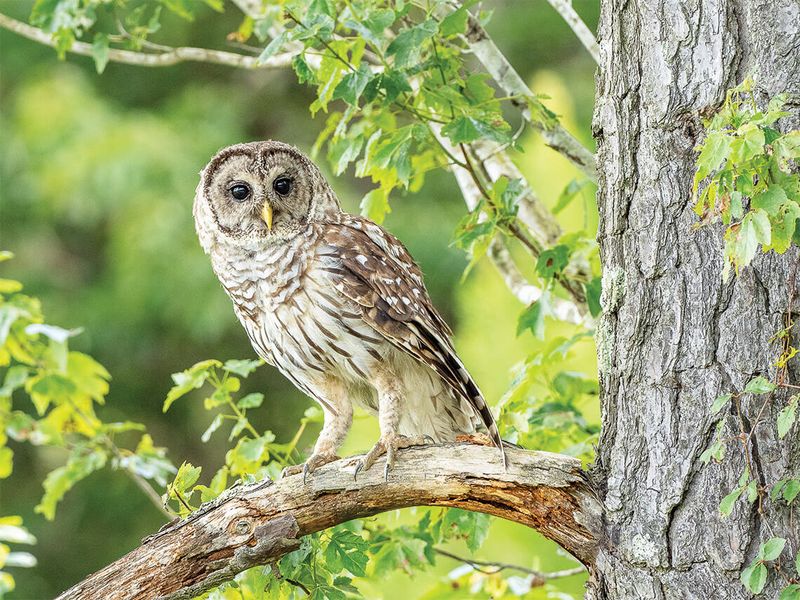
A large owl settling into the same oak tree at dusk, night after night, is one of those sightings that makes a North Carolina homeowner stop and wonder what is really going on in their yard. The repeated visits are almost certainly meaningful, but the explanation is more layered than a simple “your yard is full of mice.” Understanding why the bird keeps coming back starts with knowing which owl you are looking at and what that mature tree actually offers.
The answers reveal as much about your broader landscape as they do about the bird itself.
The visitor is probably a Barred Owl
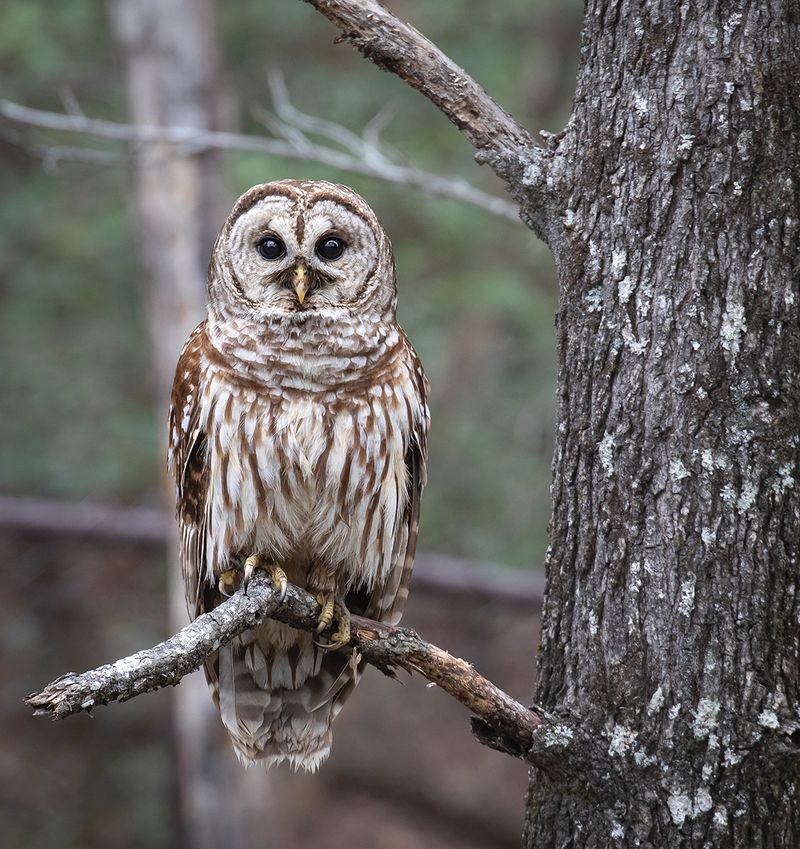
Putting a name to the bird before drawing any conclusions is the most important first step. Cornell Lab’s Barred Owl identification guide describes a stocky, medium-to-large owl with a rounded head and no ear tufts, dark brown eyes that look almost black, a pattern of horizontal brown-and-white barring across the upper chest, and vertical brown streaking running down the belly.
The back and wings are mottled brown and white, and the face shows a pale disc with concentric brown rings.
The call is the easiest field mark of all. Barred Owls produce the familiar phrase commonly written as “Who cooks for you?
Who cooks for you-all?” a rolling, emphatic hoot that carries well through wooded neighborhoods at night and sometimes in early morning. The Carolina Bird Club’s Barred Owl species account confirms the species as a widespread and year-round resident of wooded habitats across North Carolina, from mountain coves to Piedmont stream corridors and coastal swamp forests.
If the owl you are watching fits that description and uses that call, a Barred Owl is the most likely candidate by a wide margin.
Two other large owls sometimes cause confusion. Barn Owls are pale, heart-faced birds most at home in open farmland, grasslands, and old barns, not wooded residential oaks.
Great Horned Owls are broadly adaptable, hunt along woodland edges and open areas, and carry prominent ear tufts that Barred Owls completely lack. Getting the identification right matters because each species uses habitat differently, and the explanation that fits a Barred Owl in a mature wooded yard will not apply equally to the others.
The oak is a daytime refuge, not proof of constant hunting
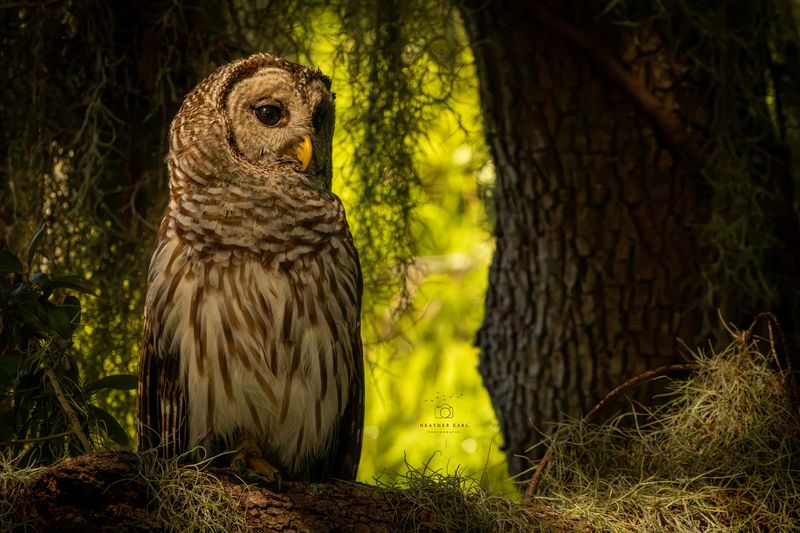
Watching an owl sit motionless in the same oak for hours does not mean it is hunting below the tree. Barred Owls are primarily nocturnal, and Cornell Lab’s Barred Owl life history notes that the species roosts in forest trees during the day and becomes active mostly after sunset.
The daytime sighting is almost always a bird resting, digesting a night’s catch, or simply waiting for darkness before it moves again.
A mature oak offers exactly what a roosting owl needs. Wide horizontal limbs provide a stable platform that smaller trees cannot match.
Dense canopy hides the bird from crows, jays, and other species that will mob a resting raptor if they spot it in the open. The rough bark and cavity-prone structure of older oaks can also offer enclosed roosting spots and potential nesting sites.
Cornell notes that Barred Owls typically nest in natural cavities or in old stick nests left by other large birds, usually 20 to 40 feet above the ground, and that nest boxes in mature forested settings can occasionally substitute.
None of that means the owl is feeding in the yard below. The tree may be chosen entirely for its shelter value, its concealment from disturbance, its protection from wind and rain, or its proximity to a cavity the bird has used before.
A homeowner who sees the owl perched low and alert near dusk may be catching the moment it wakes and prepares to leave for hunting grounds that could be a field edge, a creek bottom, or a neighbor’s property entirely separate from the oak where it rested all day. The roost and the hunting site are often two different places.
The surrounding landscape may support the hunt
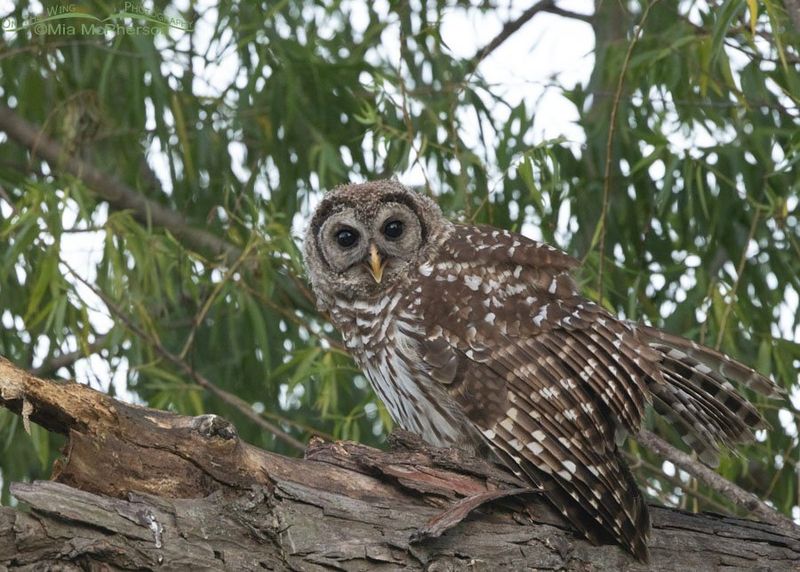
Zoom out from the oak and the picture gets more interesting. Barred Owls are strongly associated with mature mixed forests, swamp edges, streamsides, and wooded uplands, and a study published in Ornithological Applications on urban Barred Owl home ranges and habitat selection found that the species favored forested fragments within developed landscapes and could persist where mature trees and sufficient prey remained available.
That finding matters for North Carolina homeowners because it means a bird roosting in a suburban oak is not necessarily an oddity; it may be using a connected patchwork of wooded lots, creek corridors, and park edges as a functional territory.
The features that make a hunting landscape useful to a Barred Owl include wooded edges where forest meets open ground, brushy cover that shelters small mammals and amphibians, streams and ponds that support frogs, crayfish, and fish, and open grassy areas where voles and mice move at night. Cornell’s life history account lists a remarkably varied diet: mice, voles, squirrels, rabbits, birds, amphibians, reptiles, crayfish, fish, and invertebrates.
No single yard needs to supply all of those; the owl assembles its diet across a territory that can encompass roughly a square mile in some studies.
That scale is worth keeping in mind when interpreting a repeated visit. Cornell’s Barred Owl nest cam FAQ confirms that the species is generally resident rather than migratory and that home ranges are large.
Prey observed moving through one residential lot may represent only a small fraction of what the owl actually hunts across its full range. The yard may contribute to the landscape, but it is rarely the whole story.
A recurring visit offers clues, not a complete ecosystem diagnosis
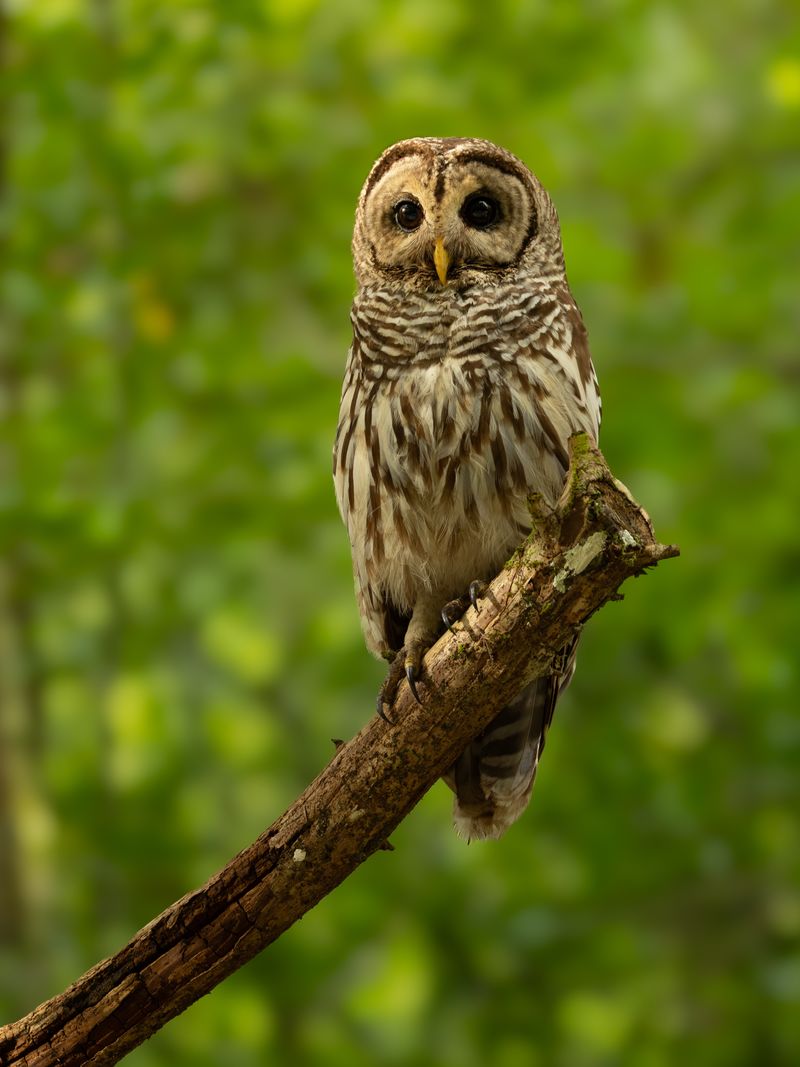
A single dusk sighting carries less weight than most homeowners assume. One owl in one tree on one evening could mean the bird was passing through, sheltering briefly from rain, or simply resting between hunting bouts in a territory that extends well beyond the property.
Repeated observations across multiple nights or seasons, combined with photographs, heard calls, found pellets, and visible prey remains, build a much more reliable picture of what the bird is actually doing and where.
Owl pellets, the compacted bundles of fur, feathers, and bones that owls regurgitate after a meal, are worth examining if you find them beneath the roost. They can reveal which animals the owl has been eating.
What they cannot tell you is where those animals came from. A pellet containing vole bones under your oak does not prove the vole lived in your yard; Barred Owls hunt across large territories and may have caught that animal in a field, a creek margin, or a neighboring lot entirely.
Resist the temptation to read a rodent-heavy yard as automatically healthy or desirable. Abundant mice and voles can reflect spilled birdseed, unsecured compost, dense brush against the foundation, or structural gaps that let animals enter buildings.
Cornell specifically cautions against luring Barred Owls by placing food near roads, noting that drawing predators toward traffic is a genuine hazard. A yard that produces lots of rodents because of poor sanitation is not an owl sanctuary; it is a liability for the bird and the homeowner alike.
Protect the habitat that makes the oak useful
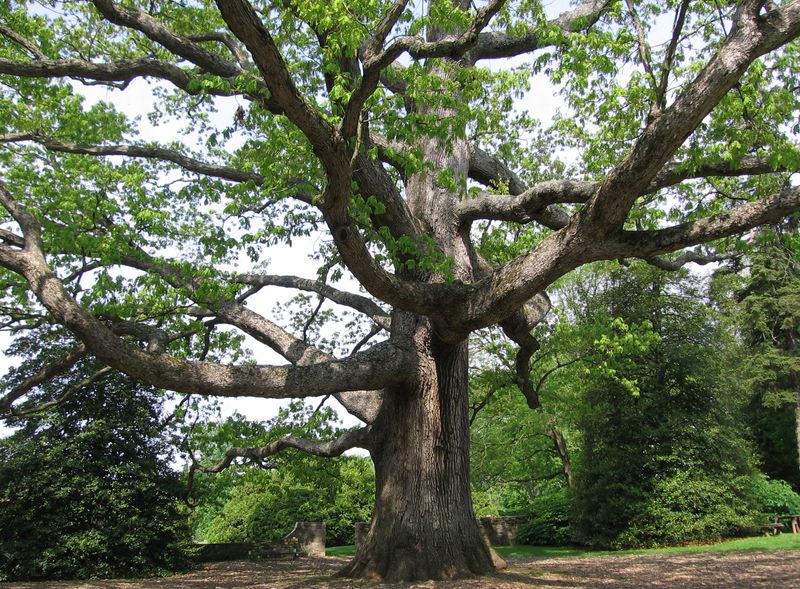
Mature trees are genuinely hard to replace, and the oak the owl keeps returning to may be doing more ecological work than any other single feature on the property. Large limbs provide stable roosting platforms, dense canopy hides a resting bird from harassment, and older trunks develop the cavities that Barred Owls use for nesting and shelter.
Cornell’s life history account places Barred Owls squarely in mature mixed forests and wooded areas, and the structural complexity of an old tree is part of what makes a site worth returning to.
When the oak is structurally sound, the straightforward stewardship move is to leave it alone. Avoid removing healthy limbs, filling natural cavities with expanding foam or concrete, or clearing the connected wooded cover that links the tree to the broader landscape.
Snags, brushy thickets, and leaf litter on the ground support the insects, amphibians, and small mammals that feed the food web an owl depends on. Keeping a wooded edge or a brushy buffer between the yard and a neighboring open area preserves travel and hunting corridors that matter far more than any single plant selection.
Safety comes first, though. A limb that is visibly cracked, dead, or overhanging a roof, walkway, or play area is a hazard that wildlife value alone cannot justify leaving in place.
Use a qualified arborist to assess any tree or limb that concerns you; a professional can distinguish a structurally sound cavity tree from one that poses real risk. Cornell’s Barred Owl overview notes that nest boxes can be appropriate where mature woodland and sufficient territory already exist, but a box cannot substitute for the real habitat structure an old tree provides.
Think of a nest box as a supplement in an already suitable landscape, not a shortcut to attracting an owl.
Remove avoidable risks instead of trying to feed the owl
The impulse to help the owl by giving it an easier meal is understandable, but it creates more problems than it solves. Putting out meat, pet food, or dead rodents to attract raptors can draw rats, raccoons, and feral animals to the yard, pull predators closer to roads where vehicle collisions are a serious hazard, and introduce disease or contaminated prey into the food chain.
Cornell explicitly warns against luring Barred Owls by placing food near roads, and the same logic applies to baiting a yard with food sources that attract prey animals.
Spilled birdseed under feeders, unsecured garbage cans, open compost piles, and pet food left outdoors overnight are all reliable rodent magnets. A yard that accumulates those attractants will draw mice and rats not because the ecosystem is thriving but because the management is loose.
Cleaning up those sources is the single most effective first step for anyone who wants fewer rodents without harming the wildlife that might eat them.
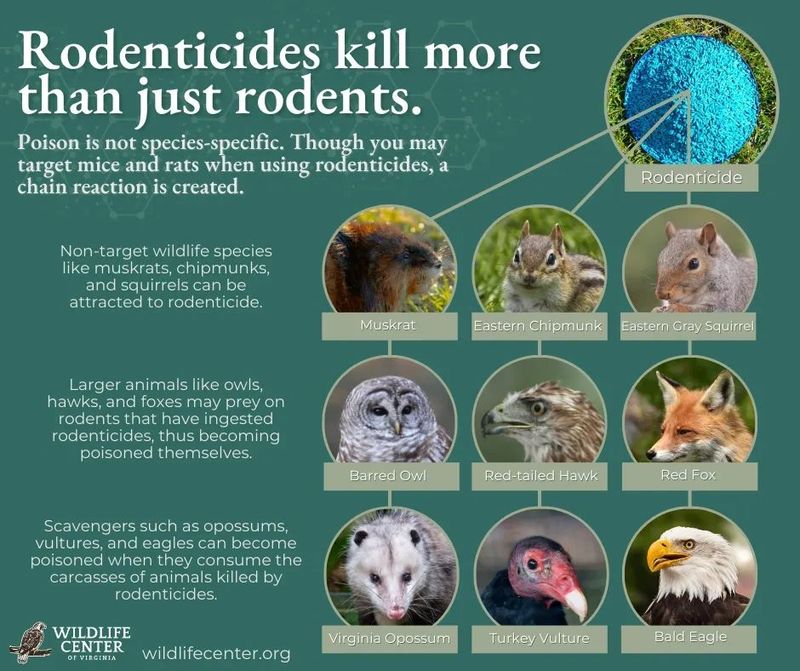
Rodenticides deserve careful attention in any yard where raptors are active. EPA’s rodenticide pesticide safety review documents that predators and scavengers can be exposed by eating poisoned rodents, and that second-generation anticoagulant rodenticides are particularly hazardous because they persist in prey tissues and can cause fatal bleeding after a single feeding.
Not every poisoned rodent will kill an owl, but the risk is real enough that outdoor poison use near an active roost or hunting area deserves serious consideration.
Start with exclusion and sanitation before reaching for any chemical control. Seal entry points into the home with hardware cloth or caulk, secure food and trash in lidded containers, repair gaps under porches and decks, and remove dense ground cover against the foundation where rodents shelter.
If a pesticide becomes necessary, read the label carefully and account for pets and non-target wildlife before applying it outdoors.
Watch the roost without disturbing the bird
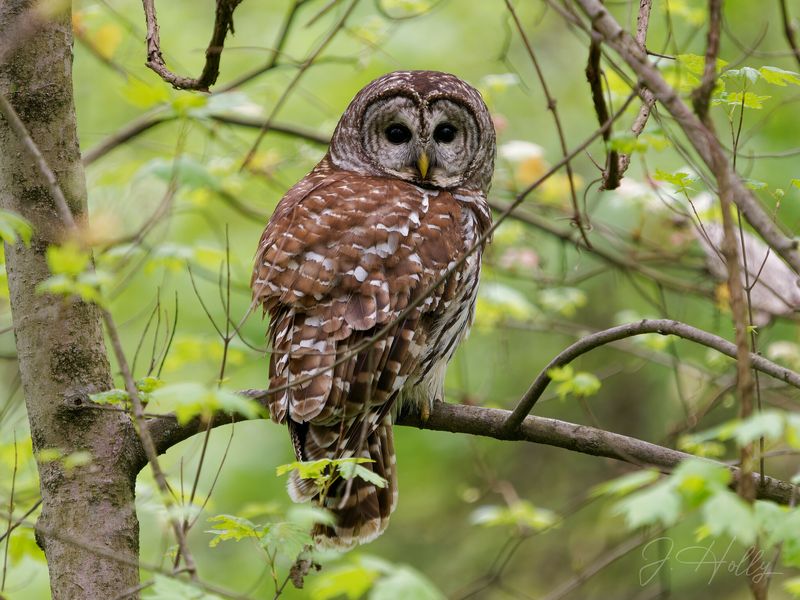
Getting a good look at a roosting owl is genuinely rewarding, and it does not require getting close. Binoculars from across the yard, a camera with a zoom lens, or simply standing still at the edge of the property will give you a clear view without putting pressure on the bird.
Barred Owls can appear calm and approachable, but calm is not the same as unbothered; repeated disturbance at a roost can cause a bird to abandon a site it has used reliably.
A few specific actions are worth avoiding. Shining a flashlight or spotlight into the tree at night disrupts the bird’s night vision and can interfere with its hunting preparation.
Playing recorded owl calls repeatedly near a roost can trigger a territorial or stress response and is considered poor practice by most wildlife observers. Climbing toward the bird, approaching an active nest, or attempting to move the owl to a different location are all actions that can escalate quickly.
Cornell notes that Barred Owls can become defensive around nests and may strike people who interfere, so physical proximity to a nesting site carries a genuine personal safety risk as well.
Keeping cats indoors after dusk is a prudent precaution in any yard where nocturnal raptors are active, even though the specific mortality data for North Carolina Barred Owls and household cats is limited. The broader wildlife-safety logic is sound: a cat moving through a dark yard overlaps with the same hours and ground-level spaces the owl uses for hunting.
Native owls are protected under the Migratory Bird Treaty Act, which prohibits unauthorized taking, capture, killing, transport, or possession of protected birds. Do not handle, remove, or interfere with an occupied nest, eggs, or bird.
If a specific situation requires guidance, such as a nest in a hazardous location or an injured bird, contact the U.S. Fish and Wildlife Service or your state wildlife agency for direction on permits and appropriate next steps.
Read the oak as a habitat clue
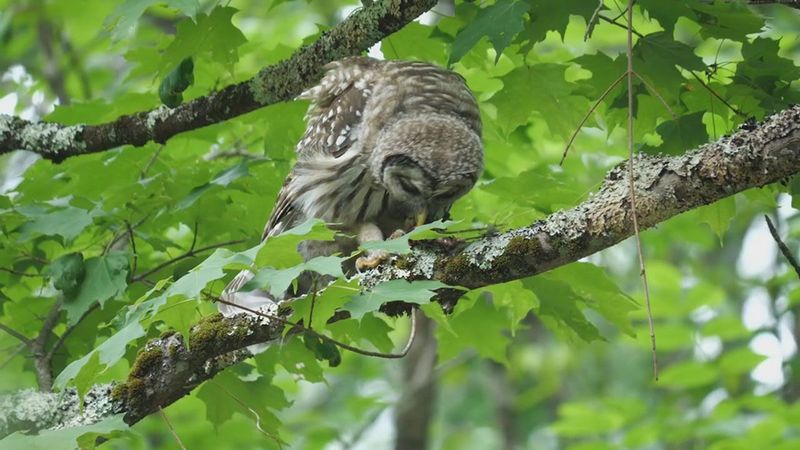
An owl returning to the same oak, season after season, is telling you something about the landscape it inhabits, not just the tree it prefers. Barred Owls are residents of mature, structurally complex habitats, and a bird that keeps coming back has found something worth coming back to: a stable roost, concealment from harassment, proximity to a hunting corridor, or a familiar corner of a large territory.
The yard may contribute to that picture, or the oak may simply be the best available shelter in a landscape the bird works on its own schedule.
Urban owl research confirms that developed landscapes can support Barred Owls when mature trees and sufficient prey remain, but also that those same landscapes expose owls to rodenticides, vehicles, and habitat loss. The defensible response to a recurring sighting is straightforward: protect safe mature structure, reduce poisons and attractants, preserve connected natural features where you can, and watch quietly from a respectful distance.
The oak is not proof of a perfect yard. It is an invitation to pay closer attention to what the broader landscape is doing well and where it could use a little less interference.