
The North Carolina Native Vine You Plant Once That Covers An Ugly Fence For Decades
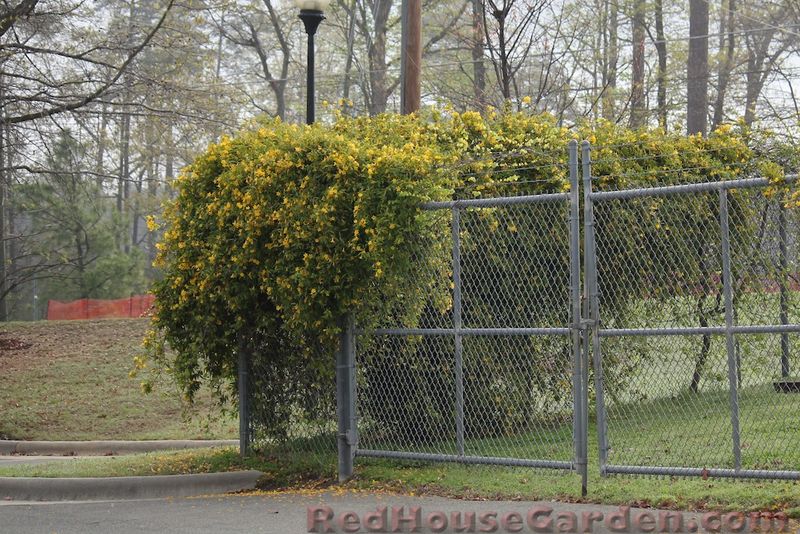
Bare chain-link fences are an eyesore, and most homeowners want a fast, permanent fix without buying new plants every spring. Carolina jessamine, a native woody vine found across North Carolina, can grow back year after year without routine replanting, making it a genuinely long-term option for screening a fence.
Getting the most from it, though, means understanding what it can realistically do and what it still needs from you.
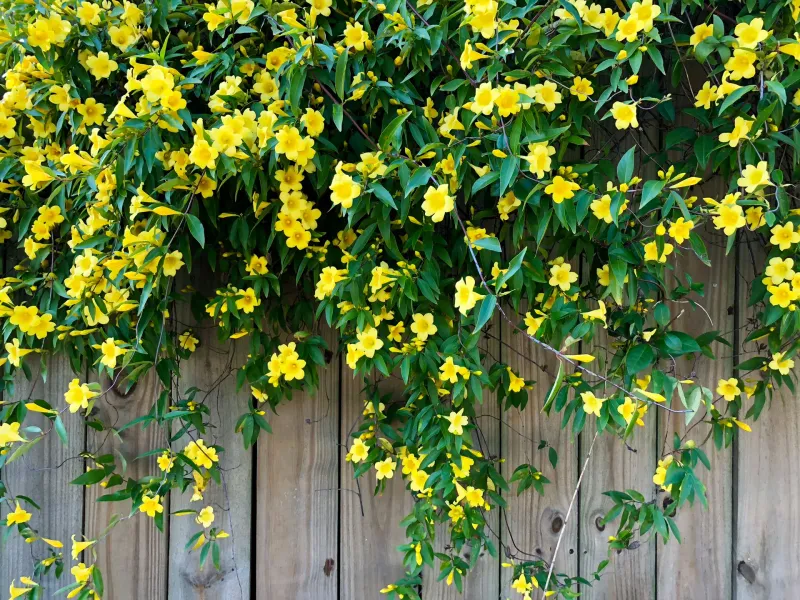
Carolina jessamine offers a strong native starting point for a fence screen
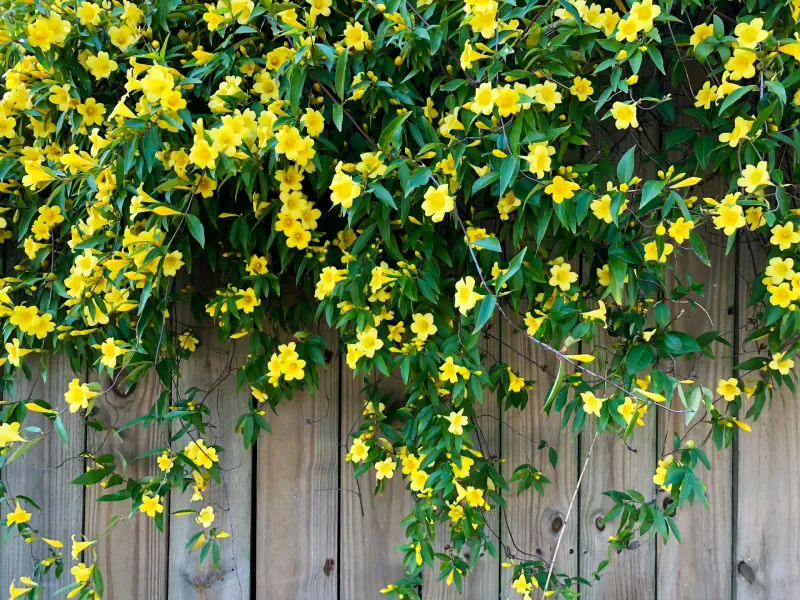
Gelsemium sempervirens, commonly called Carolina jessamine or yellow jessamine, is a native woody perennial vine with a long track record in North Carolina landscapes. NC State Extension’s plant toolbox lists it for the Coastal Plain, Piedmont, and Mountains and specifically recommends it for fences, trellises, screens, and arbors.
That regional reach matters: this is a plant that evolved here, which means it generally handles the heat, humidity, and variable winters of all three NC regions without needing to be coddled.
When trained on a fence or trellis, Carolina jessamine typically grows 12 to 20 feet tall. Its foliage is glossy and generally evergreen in much of its range, which means the fence screen holds through winter in many NC yards.
Mountain gardeners should expect some caveats: in colder elevations, the leaves can bronze or partially drop during harsh winters, making the vine semi-evergreen rather than fully evergreen in those spots.
What sets Carolina jessamine apart for this kind of project is its woody, perennial growth habit. Unlike annual vines that die back to nothing each fall and need to be replanted, Carolina jessamine puts down a permanent root system.
Once established, it grows back each season from those same roots, gradually building a denser, more structured screen. Clemson Extension’s factsheet notes that it can grow to 20 feet or more and specifically describes it as a fence-covering plant.
Calling it a strong native choice for a long-term fence screen is accurate and well-supported. Calling it the universally best North Carolina vine, or promising it will cover every fence for decades without fail, would go further than the evidence supports.
Site conditions, support quality, spacing, and maintenance all shape what you actually get.
Planting once means avoiding routine replacement, not avoiding all work
The phrase “plant once” is worth unpacking before you dig the first hole. For a woody perennial like Carolina jessamine, it means you are not buying new transplants every spring the way you would with morning glories or black-eyed Susan vine.
The root system survives winter and sends up new growth each season, so the vine stays in place and builds on itself year after year. That is genuinely different from annual vines, and it is a real advantage for anyone who wants a fence screen without repeat shopping trips.
What it does not mean is that the vine takes care of itself once you walk away. NC State Extension notes that initial growth can be modest until the plant establishes, and it may take three to four growing seasons before the vine approaches its typical trained height.
During that window, you are watering during dry spells, guiding new stems onto the fence, and watching for gaps in coverage. Patience is part of the deal.
Other perennial vines, including crossvine, coral honeysuckle, Virginia creeper, and American wisteria, share this same persistence. Extension guidance on flowering vines makes clear that many perennials can remain productive for years without replacement, so Carolina jessamine is not uniquely special in avoiding replanting.
What it offers is a combination of native status, evergreen tendencies, and suitability for NC fences specifically.
There is also no source-backed guarantee that any perennial vine will perform uniformly for decades. Long-lived, yes.
Capable of many productive seasons, yes. But severe winters, prolonged drought, disease, or structural damage to the fence can all interrupt that run.
Treating the vine as a long-term investment that benefits from regular attention is a more honest framing than expecting set-it-and-forget-it results.
Choose the site and support before you buy the vine
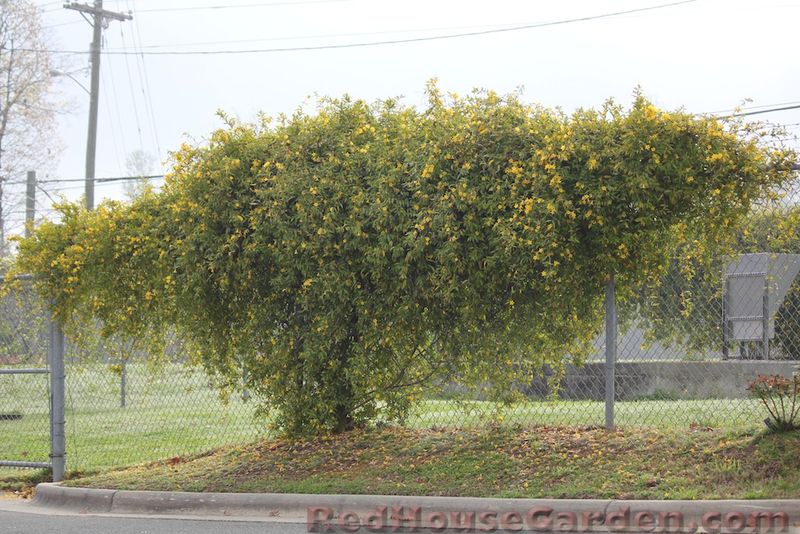
Site selection does more work than most gardeners expect. Carolina jessamine performs best in full sun with moist, organically rich, well-drained soil.
It tolerates light shade, but flowering and foliage density both tend to be noticeably better when the vine gets strong direct light for most of the day. A fence line that runs along the shaded north side of a building or under a heavy tree canopy is a harder situation, and coverage will likely be thinner and slower.
Before buying a single plant, walk the fence and ask a few practical questions: How much direct sun does this section get in summer? Does water pool here after rain, or does it drain quickly?
Is the fence itself structurally sound enough to hold the weight of a mature vine? Carolina jessamine climbs by twining its stems around available support, so it works naturally on chain-link, wire, or a deliberately installed trellis.
It cannot grip smooth surfaces the way clinging vines do.
NC State Extension’s profile recommends fences and trellises as appropriate supports and does not list house walls as a planting target. Keep that boundary firm.
Once stems get into gutters, behind siding, around window frames, or under roofing, extraction becomes destructive. The NC State Extension Gardener Handbook on woody ornamentals warns that vines growing against structures can trap moisture and cause lasting damage to siding, masonry, and building openings.
A chain-link fence running along a property line, away from the house foundation and roof overhang, is close to ideal. If the fence is too close to the home, consider installing a freestanding trellis a few feet out from the structure instead.
That small separation keeps the vine on its intended support and off the building.
Use spacing and training to build coverage without crowding
Getting the spacing right at planting sets the tone for everything that follows. Clemson Extension recommends spacing container-grown plants approximately 4 to 8 feet apart for fence or trellis coverage.
That range exists because conditions vary: a sunny, moisture-retentive Piedmont fence line may support plants 6 to 8 feet apart, while a drier or partially shaded spot might benefit from tighter spacing to compensate for slower growth.
Planting closer than 4 feet apart can speed up the initial visual screen, but it tends to create crowding as the vines mature. Stems compete for the same fence sections, airflow drops between plants, and the tangle becomes harder to manage during annual pruning.
Starting at 5 to 6 feet apart in average conditions gives each plant room to develop without leaving the fence bare for too long.
Before dropping plants in the ground, prepare the planting strip. Loosen the soil 12 inches deep, work in compost or other organic matter if the native soil is compacted or sandy, and check that drainage is adequate.
A shallow well-draining bed along the fence line gives roots a better start than planting directly into undisturbed clay. NC State Extension lists moist, organically rich, well-drained soil as the preferred growing medium.
Training begins at planting, not after the vine takes off. Loosely tie or weave new stems into the fence as they grow rather than waiting until they flop in random directions.
Directing growth horizontally along fence rails as well as vertically fills the screen more evenly. Remember that the three-to-four-season establishment window means the fence will not look finished right away.
Uniform height, mature fence height, sun exposure, soil moisture, and winter conditions all influence how quickly the screen fills in, and no single spacing plan overrides those variables.
Prune after flowering to keep the screen contained and productive
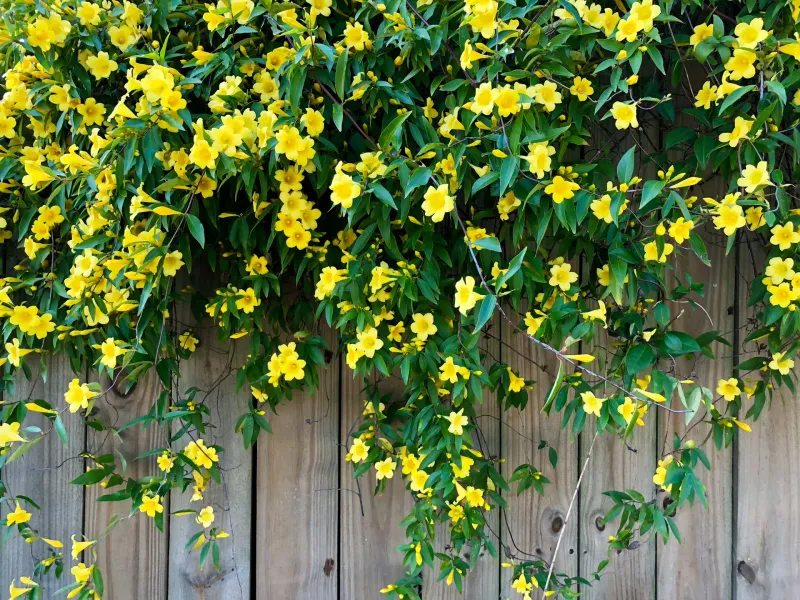
Pruning is where a lot of gardeners make their biggest mistake with Carolina jessamine: they either skip it entirely or do it at the wrong time. The right window is soon after flowering, generally in late spring once the yellow blooms have faded.
That timing matters because Carolina jessamine sets next year’s flower buds on wood that grows after the current bloom cycle. Cut too late in the season and you remove the stems that would have carried next spring’s flowers.
NC State Extension’s guidance recommends post-flowering pruning to shape, train, and remove dead growth, and notes that rejuvenation cuts can refresh older vines that have become sparse or top-heavy. An older Carolina jessamine that has been neglected for several seasons can often be brought back by cutting it back hard right after bloom, though it may skip a flowering season while it recovers.
Annual pruning also keeps the vine from overrunning its intended space. Carolina jessamine is not aggressive in the way invasive plants are, but a well-established vine on a sunny fence will push beyond the fence line if it is never redirected.
Trim stems that reach into pathways, over the fence top onto a neighbor’s property, or toward the house. Clemson Extension’s factsheet flags that the vine can spread in disturbed areas, so occasional containment is part of responsible ownership.
Beyond pruning, establishment-phase watering and ongoing training are normal parts of the job. Water during dry stretches in the first two growing seasons while roots are still building.
Guide new stems onto the fence rather than letting them pile on top of each other. These tasks are not signs the plant is struggling; they are the ordinary maintenance that keeps any perennial vine looking intentional rather than overgrown.
Check toxicity, fire exposure, and pollinator trade-offs before planting
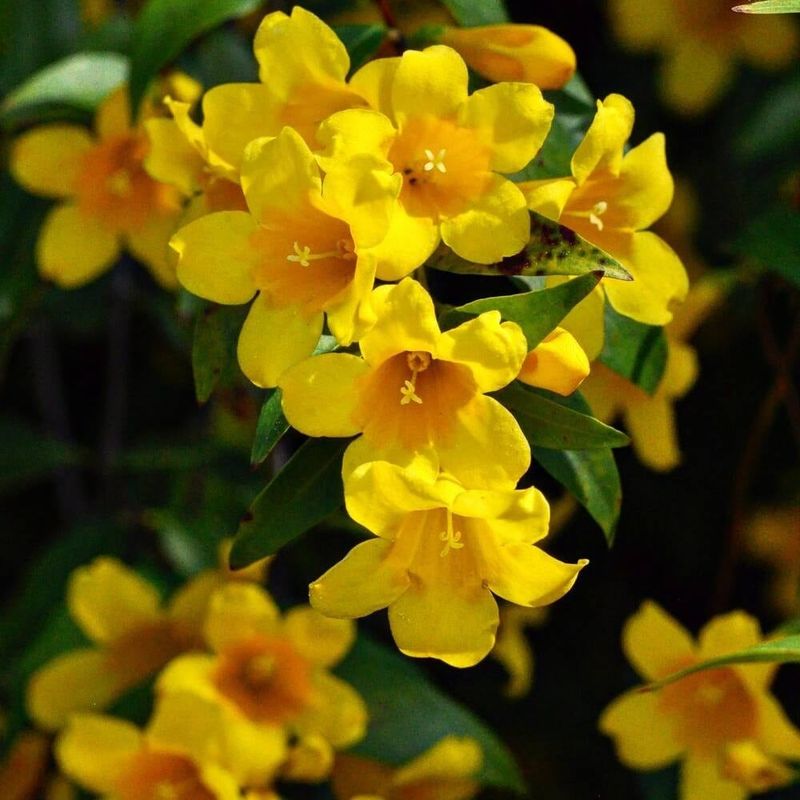
Carolina jessamine is genuinely beautiful and genuinely dangerous if ingested. All parts of the plant are poisonous, including the flowers, leaves, roots, and sap.
Children who pick and chew the attractive yellow blooms, or pets that graze near the fence line, face real risk. NC State Extension’s plant profile specifically flags the toxicity and notes that sap may irritate sensitive skin.
Wear gloves when pruning and wash hands afterward, and plant this vine where children and animals are unlikely to interact with it closely.
Fire risk is the second safety factor that often gets left out of the sales pitch. NC State gives Carolina jessamine a high flammability rating.
Planting it directly against a house wall, deck railing, or wooden fence panel that abuts the home creates a continuous fuel path toward the structure. The vine is better suited to a fence line that runs along the property perimeter, well away from the house and any outbuildings.
If your fence is within the home’s defensible space, this vine is not the right choice for that location.
The pollinator picture is also more complicated than “native vine equals pollinator magnet.” The early yellow flowers do attract hummingbirds, butterflies, and various bees. Clemson Extension notes that Carolina jessamine pollen has been linked to honeybee mortality and potential colony impacts in areas where yellow jessamine dominates the landscape.
If you keep bees or live near a beekeeper, factor that in before planting a long fence run of this vine.
When looking for easier alternatives, resist the temptation to grab whatever is cheap and fast at the garden center. English ivy is listed as invasive by NC Extension, and the NC Native Plant Society’s invasives flyer identifies Japanese honeysuckle, Oriental bittersweet, porcelain berry, wintercreeper, sweet autumn clematis, and Asian wisterias as problematic substitutes.
Each of those plants creates new problems in NC ecosystems that outlast any fence-screening benefit they provide.
Compare native alternatives when the site favors speed, shade, or different coverage
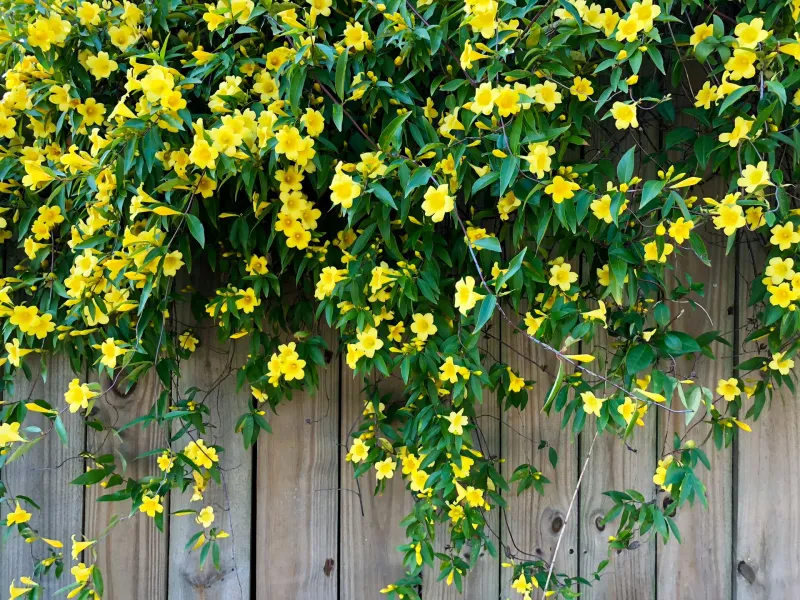
Carolina jessamine is a strong starting point for many NC fence projects, but it is not the only native perennial vine worth considering. Matching the vine to the site is more useful than picking a favorite and forcing it into the wrong conditions.
Crossvine (Bignonia capreolata) is the most direct comparison. NC State Extension describes crossvine as a faster grower that tolerates heavier shade than Carolina jessamine, which makes it useful on fence lines that get only partial sun.
It also produces striking orange-red flowers that attract hummingbirds. The trade-offs are real, though: crossvine can spread by root suckers beyond the planting area, and severe winters can kill its top growth, leaving a bare fence until it recovers from the roots.
If you are not prepared to manage occasional suckering and potential top dieback, crossvine may create more work than expected.
Coral honeysuckle (Lonicera sempervirens) brings softer, tubular red and orange blooms that hummingbirds seek out reliably. NC State Extension notes that coral honeysuckle is evergreen in warm-winter climates of the Deep South but may be less reliably evergreen in colder NC locations, including mountain communities.
If year-round fence screening is the goal, coral honeysuckle in the mountains is a gamble.
Virginia creeper (Parthenocissus quinquefolia) covers fence structures quickly and turns a dramatic red in fall. It attaches with adhesive disks rather than twining, so it grips chain-link and wood differently than the other options.
It is deciduous, though, which means winter screening disappears entirely. For readers who want a fast-growing, wildlife-friendly vine and can accept a bare fence from November through March, it is a practical choice.
The right vine is always a site-first decision, not a ranking.
Choose Carolina jessamine for the right site, not for an absolute promise
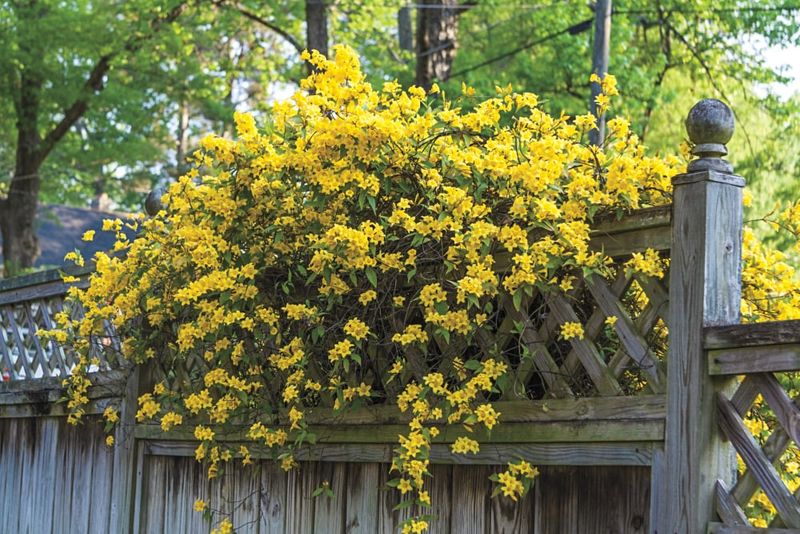
Carolina jessamine earns its place on a North Carolina fence when the conditions support it: a sunny or lightly shaded location, well-drained soil with decent moisture retention, a sturdy fence or trellis for twining support, and enough distance from the house to avoid fire and structural risk. When those boxes are checked, the vine has a realistic shot at becoming a durable, returning fence screen that does not need to be replanted season after season.
NC State Extension’s profile supports it as a long-lived woody perennial recommended for exactly this use. Planting once means skipping the annual replanting cycle, not skipping the establishment watering, the post-flowering pruning, the stem training, or the occasional containment trim.
Those tasks are what keep the screen healthy and the vine from overrunning its space.
No published source backs a guarantee of uniform, decades-long fence coverage from any single planting. What the evidence does support is this: given suitable sun, soil, support, and care, Carolina jessamine can provide a productive native fence screen for many seasons, returning each year from the same root system without requiring replacement.
For a North Carolina homeowner who wants a screen that works with the local ecosystem rather than against it, that is a meaningful and honest payoff. The vine earns its permanence; it does not arrive with it.