
The One Thing North Carolina Knockout Roses Need In Late Summer Or They Quit Blooming Before October

Knockout roses are known for being tough, but even the hardiest plants can hit a rough patch during a North Carolina August. If your rose has slowed down or stopped blooming, it does not automatically mean something is wrong.
Heat, drought, and the plant’s natural rhythm all play a role in what happens between summer and fall. Understanding which factor is at work helps you respond with the right fix rather than a guess.
An August lull does not always mean the rose is finished
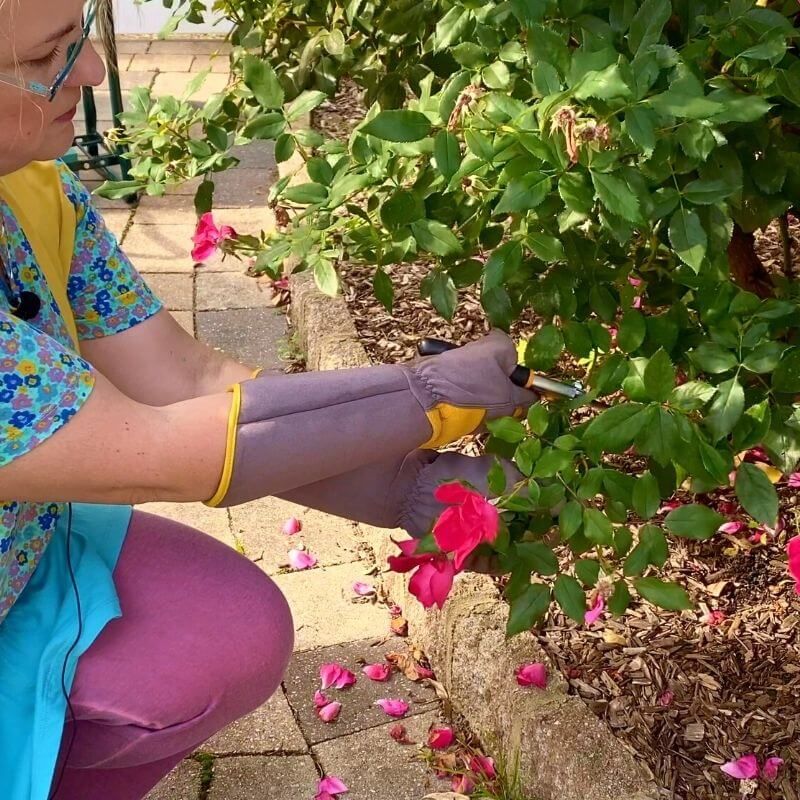
Plenty of North Carolina gardeners notice their Knockout roses slow down in August and immediately assume the plant has given up for the year. That reaction is understandable, but it skips over something worth knowing first: a temporary lull between bloom waves is part of how these roses naturally behave.
The Knockout brand’s own care guidance describes an abundant first flush of flowers followed by scattered blooms and later, heavier waves that can continue through the first hard frost. An August pause alone is not proof that the plant is done.
Heat can suppress flowering even in a rose that looks otherwise healthy. Arkansas Cooperative Extension’s Knockout rose guidance notes that intense summer conditions can cause these plants to slow or stop blooming temporarily, with improvement typically following rain and cooler temperatures.
Flower size may shrink, leaf drop can increase, and the plant may appear to be shutting down when it is actually conserving energy until conditions improve.
Drought layered on top of heat can push a stressed plant further, potentially triggering early dormancy or reducing the number of later bloom waves it produces. That combination is worth paying attention to, especially across North Carolina’s Piedmont, Coastal Plain, and mountain regions, where summer rainfall can be unreliable and soil dries out at very different rates.
The article’s title frames this as a single non-negotiable fix, but the honest answer is more conditional. Before reaching for a hose, fertilizer, or pruners, the better first move is to figure out what is actually happening at the root zone.
Checking soil moisture is where a useful response begins, not the calendar and not the bloom count.
Start with the soil, not the calendar
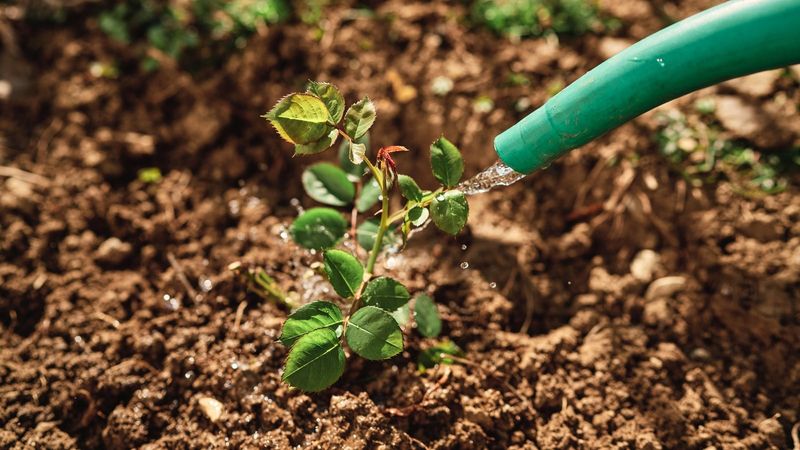
Before doing anything else, push a finger or a thin wooden dowel about four to six inches into the soil near the rose’s drip line, the outer edge of where the branches spread. If the soil feels damp at that depth, the plant may not need water right now regardless of how long ago it last rained.
If the soil feels dry and crumbly, that is a clear signal to act.
This simple check matters because NC State Extension’s woody ornamentals guidance emphasizes watering established landscape plants deeply and infrequently rather than on a fixed calendar. Watering when the soil does not need it can be just as harmful as waiting too long.
Saturated soil cuts off oxygen to the roots, which can lead to root decay, nutrient problems, and symptoms that look surprisingly similar to drought stress.
Poor drainage is a separate problem that more water will not fix. If the area around your rose stays soggy after a rain, holds standing water, or feels wet even during a dry stretch, the issue is likely drainage rather than moisture shortage.
UC IPM’s rose disease and abiotic disorder resource points out that overwatering and poor drainage can contribute to root disease and oxygen deprivation in much the same way as drought, making diagnosis by observation essential before adding more water.
The NC State landscape design handbook also reminds gardeners that site conditions, including slope, aspect, and surrounding hardscape, affect how water moves through and around a planting bed. A rose at the bottom of a slope may collect runoff while one near a paved driveway bakes in reflected heat.
Read the site before you read the calendar.
Deep watering reaches more of the root zone than a quick sprinkle
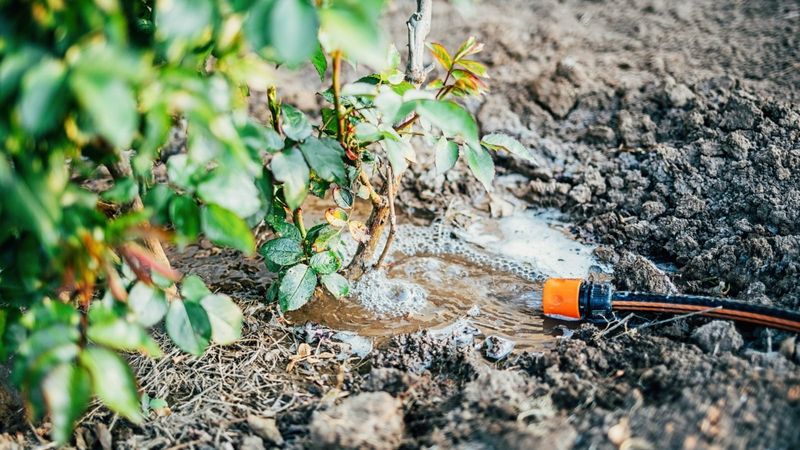
Once you have confirmed that the root zone is genuinely dry, the goal is to get water down where the roots actually are, not just to wet the surface. Knockout’s care guidance uses roughly 12 to 18 inches as a target for moisture penetration, which gives a useful benchmark without pretending that every yard, soil type, and plant size calls for the exact same approach.
Think of it as a direction rather than a hard rule: you want the water to reach the deeper root zone, not just dampen the top inch or two of soil.
A soaker hose, drip line, or a regular garden hose turned to a slow trickle placed at the base of the plant gives water time to soak in rather than run off. These methods put moisture where the roots can reach it and keep the foliage dry.
Routine overhead watering, by contrast, keeps leaves wet for extended periods and creates conditions that favor fungal disease. Illinois Extension’s rose care guidance specifically recommends avoiding overhead irrigation as a regular practice for this reason.
A quick surface sprinkle from a handheld wand may not push water deeply enough to benefit the root system, particularly in compacted clay or during a dry stretch when the top layer of soil has hardened. That does not mean a brief sprinkle causes harm, but it may leave the deeper root zone just as dry as before.
The practical fix is to run water slowly at the base for long enough that you can check a few inches down and find the soil noticeably moist.
NC State Extension reinforces the value of deep, infrequent watering over frequent shallow irrigation for established shrubs. Shallow watering over time can train roots to stay close to the surface, where they are more vulnerable to heat and drought.
Letting the soil dry slightly between deep sessions encourages roots to grow downward in search of moisture, which builds resilience over the long run.
North Carolina soil and site conditions set the interval
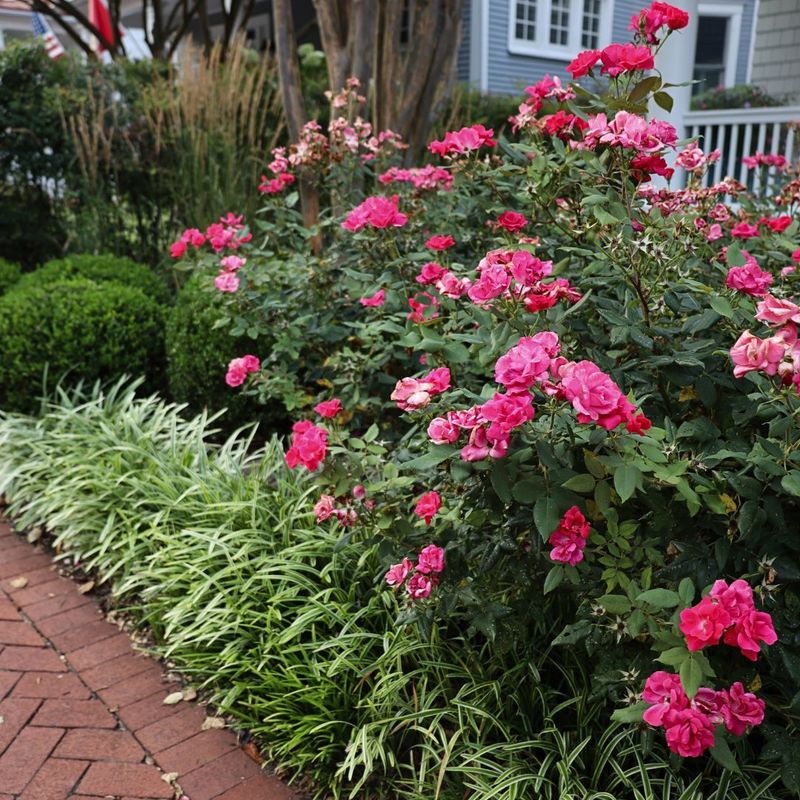
No single watering schedule works across all of North Carolina. The gap between a Coastal Plain rose planted in sandy loam and a Piedmont rose sitting in heavy red clay can be measured in days between waterings.
Sandy soils drain quickly and dry out fast, sometimes within a day or two of a heavy rain. Clay absorbs water slowly and holds it longer, which means it can stay damp well after the surface looks dry and can also stay saturated long enough to harm roots if drainage is poor.
NC State Extension’s woody ornamentals chapter makes clear that water needs vary with soil type, drainage, plant size, heat load, rainfall, slope, and exposure. A Blue Ridge rose on a south-facing slope in thin, rocky soil will dry out faster than one tucked into a partly shaded cove with deeper, moister ground.
A rose growing near a concrete driveway absorbs reflected heat that accelerates moisture loss. These differences mean the finger-test approach described earlier is more reliable than any printed schedule.
Mulch is one of the most practical tools for managing moisture between waterings. Applying about 2 to 3 inches of organic mulch, such as shredded pine bark, wood chips, or pine straw, over the root area slows evaporation, moderates soil temperature, and reduces the frequency with which you need to water.
University of Florida’s Knockout rose guide and NC State’s landscape design handbook both point to mulching as a standard moisture-conservation practice for ornamental shrubs.
Keep mulch pulled back a few inches from the base of the plant and away from direct contact with the stems. Mulch piled against the canes traps moisture and can encourage rot or disease at the crown.
A donut shape, with a small gap around the base, gives you the moisture benefits without the risk.
Support a rebound without forcing it
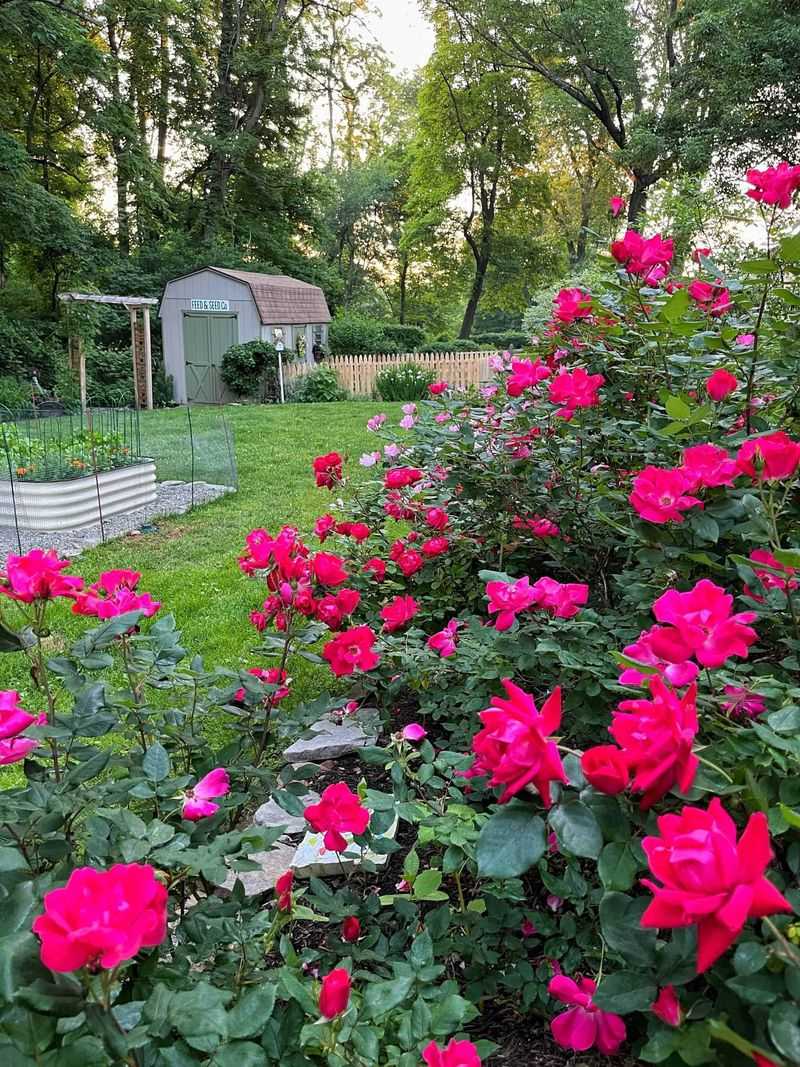
Water is the most direct response to a dry root zone, but a few supporting conditions also determine whether a stressed Knockout rose has a realistic path back to fall blooms. Sunlight is near the top of that list.
Knockout’s official guidance specifies roughly 6 to 8 hours of direct sun daily for strongest flowering. A rose that has been gradually shaded out by a growing tree or a nearby structure may not rebound fully even with consistent moisture, because it simply lacks the energy to push new buds.
Deadheading is one task you can skip. Knockout roses are self-cleaning, meaning they drop spent flowers and set new buds without any help.
Removing old blooms is cosmetic on these cultivars, not a trigger for repeat flowering the way it can be on some old-fashioned rose types. Spending time on deadheading in late summer is not harmful, but it will not speed up the next bloom wave.
Fertilizer is a more complicated question, and the short answer for late summer is: do not apply it automatically. Illinois Extension’s rose care guidance advises stopping fertilizer after August 15 because late-season nitrogen can push tender new growth that becomes vulnerable to early frost.
The Knockout producer similarly notes that the plants can perform well without regular fertilization and cautions against late-summer applications for the same reason.
If you suspect a genuine nutrient deficiency, the right move is a soil test rather than a bag of general-purpose fertilizer. NC State’s soil testing guide explains how a test reveals what the soil actually lacks, which prevents the waste and potential harm of adding nutrients that are already present in adequate amounts.
NC State’s shrub fertilization guidance reinforces that excess fertilizer can stimulate weak growth, increase disease pressure, and contribute to water-quality problems.
Hard pruning in August carries similar risks. Arkansas Cooperative Extension recommends reserving major annual pruning for late winter and limiting any summer work to light correction when necessary.
Cutting back hard removes foliage the plant needs for photosynthesis and encourages a flush of soft new growth that may not harden off before cold weather arrives.
When watering is the wrong diagnosis
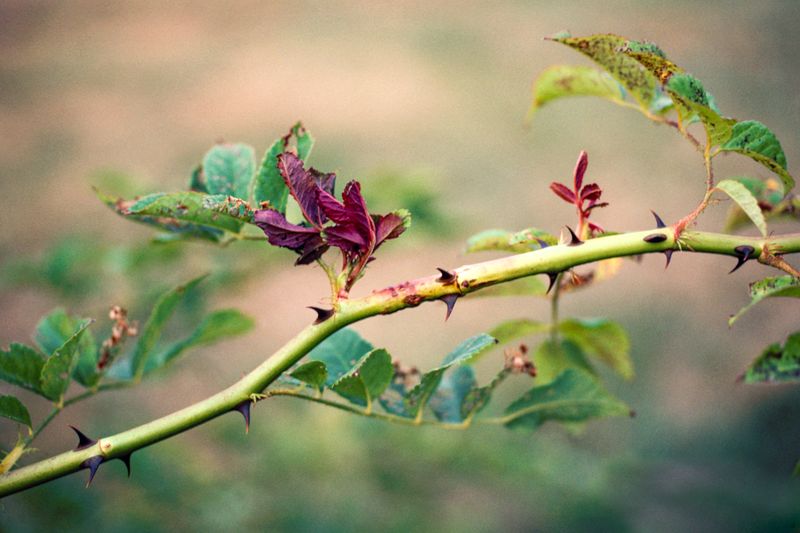
Some Knockout roses that stop blooming or decline in late summer are not dealing with drought at all. Certain symptoms point clearly away from a moisture problem and toward something that water, fertilizer, and pruning cannot fix.
Knowing the difference can save you time and prevent you from spreading a serious disease to nearby plants.
Rose Rosette Disease is the most important condition to recognize. UGA Extension’s Rose Rosette Disease resource describes the characteristic signs: abnormal bright red or burgundy new growth that does not green up normally, a dramatic increase in soft, flexible thorns on affected canes, witch’s broom branching where a single stem produces an excessive cluster of shoots, distorted or puckered foliage, and misshapen or stunted flowers.
These symptoms can appear on one cane at first and spread through the plant over time.
Rose Rosette Disease is caused by a virus transmitted by a tiny eriophyid mite, and there is no cure. UGA Fulton County Extension advises removing and disposing of infected plants entirely rather than attempting to treat them.
Keeping an infected rose in the landscape risks spreading the disease to other roses nearby. Watering more, fertilizing, or cutting back affected canes will not eliminate the virus.
Herbicide injury, particularly from glyphosate drift, can produce symptoms that closely resemble Rose Rosette Disease, including distorted new growth and twisted foliage. NC State’s glyphosate resource notes this overlap and points out that a definitive diagnosis may require examination by an Extension agent or plant-disease specialist.
If you are unsure whether you are looking at a disease or chemical injury, contact your local NC Cooperative Extension office before removing the plant or attempting treatment.
When you do prune any rose showing unusual symptoms, disinfect your tools between cuts and between plants. A solution of diluted bleach or a commercial disinfectant applied to blades reduces the chance of spreading disease mechanically.
Casual miticide applications are not a reliable response to suspected Rose Rosette Disease; UGA Extension notes that the effectiveness of available miticides against the responsible mite is unproven, and treating the wrong problem delays the right one.
Check, water, and observe before taking stronger action
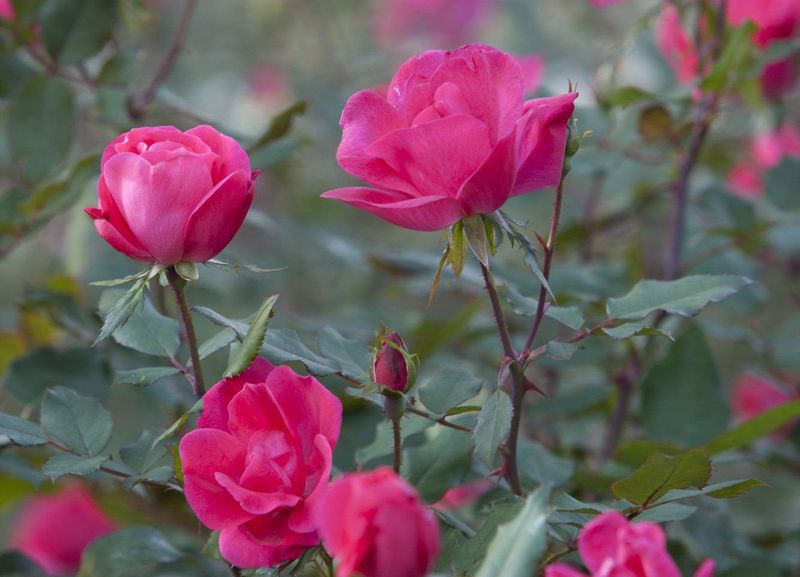
The most useful sequence for a Knockout rose that has slowed down in late summer is also the simplest: check the root zone before doing anything else. If the soil is dry several inches down, water slowly and deeply at the base until moisture reaches the deeper root zone, then let the soil partially dry before watering again.
If the soil is wet or drainage is poor, hold off and address the drainage issue instead.
Protect whatever moisture the soil holds by keeping 2 to 3 inches of organic mulch over the root area, pulled back from the base of the plant. Then observe.
Knockout’s guidance describes later bloom waves as a normal part of the plant’s cycle, and Arkansas Cooperative Extension notes that improvement often follows cooler temperatures and more reliable rainfall. Giving the plant consistent moisture and time is frequently more productive than intervening aggressively.
NC State Extension reinforces that established shrubs benefit from deep, infrequent watering rather than frequent shallow doses. Resist the pull toward fertilizer or hard pruning as a shortcut; both carry real risks in late summer and neither addresses a dry root zone.
Whether the rose produces more blooms before October depends on sunlight, plant health, cultivar behavior, disease, and the timing of the first cold night, not on how busy you stay in the garden. Sometimes the best thing you can do is water once, mulch well, and get out of the way.