
The One Thing North Carolina Lawns Need This Fall Or They Won’t Green Up Next Spring

Fall is the most important season for North Carolina homeowners with tall-fescue lawns, and the decisions you make before winter can shape how your yard looks come spring. But here is the catch: the right move depends entirely on which grass you have, and applying the wrong treatment at the wrong time can actually hurt your lawn instead of helping it.
Warm-season grasses like bermudagrass and centipedegrass follow completely different rules than cool-season tall fescue, so knowing your grass type is the first step. This article breaks down what each North Carolina lawn type actually needs this fall, and what to skip.
Identify the grass before choosing a fall treatment
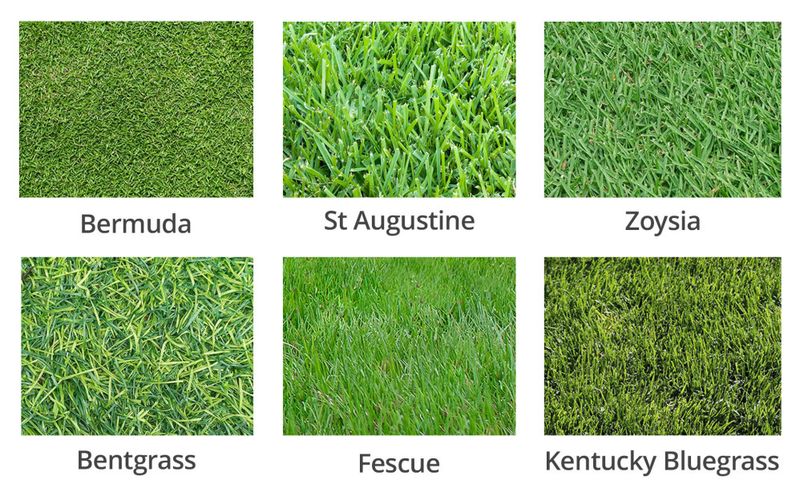
Picking the wrong fall fertilizer for your lawn type is one of the most common and costly mistakes North Carolina homeowners make. Before you buy a single bag of fertilizer, you need to know whether your lawn is a cool-season grass or a warm-season grass, because those two categories follow opposite fall-care calendars.
Cool-season grasses, including tall fescue, Kentucky bluegrass, fine fescue, and perennial ryegrass, grow most actively during the cooler temperatures of fall and spring. Tall fescue is especially common in the North Carolina mountains and Piedmont, where its deeper root system handles moderate heat and drought better than other cool-season options.
According to NC State Extension’s lawn management guidance, fall is the primary growing and recovery season for cool-season turf, making it the right time to fertilize and, when needed, reseed.
Warm-season grasses tell a completely different story. Bermudagrass, centipedegrass, St. Augustinegrass, and zoysiagrass grow primarily during the heat of summer and naturally slow down as temperatures drop in fall.
After the first frost, they go dormant and turn brown, which is a normal seasonal response, not a sign they need fertilizer.
The main fall-feeding recommendation in this article applies specifically to established tall fescue. Applying that same high-nitrogen treatment to a dormant or nearly dormant warm-season lawn can cause real harm, increasing disease risk and weakening the turf heading into winter.
If you are not certain which grass you have, take a small sample to your local NC State Extension office or use the photo comparison tools available through the Carolina Lawns guide before making any fertilizer decisions.
Getting this identification step right costs nothing and protects everything you do afterward.
Feed established tall fescue during its fall window
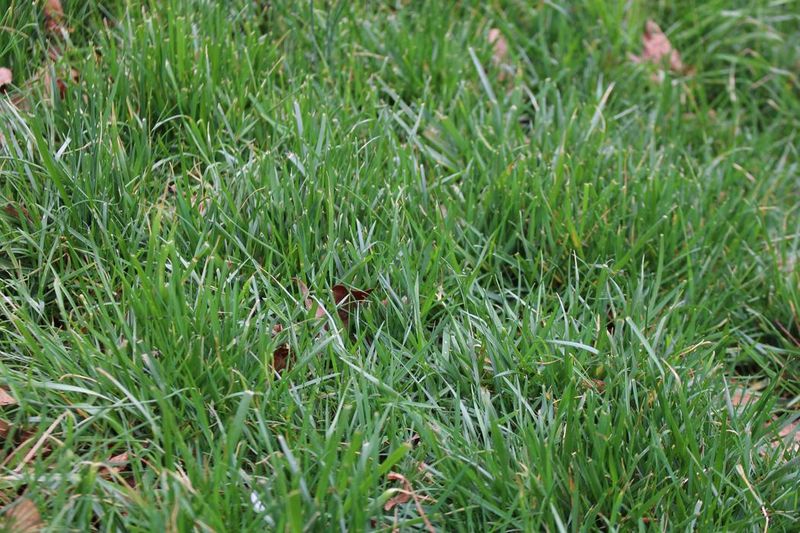
For homeowners with an established tall-fescue lawn, fall fertilization is genuinely meaningful, but the timing and amount matter more than simply putting something down before frost. Tall fescue uses the cooler weeks of fall to strengthen its root system and build the nutrient reserves it will draw on through winter and into early spring.
NC State’s Tall Fescue Lawn Maintenance Calendar recommends two fall applications for a basic fertility program: one around mid-September and a second in November, when the grass is still green but no longer putting on rapid top growth. Each application targets approximately one pound of actual nitrogen per 1,000 square feet.
That two-step approach spreads nutrient availability across the season rather than dumping a large amount at once, which can promote weak, disease-prone growth.
Timing is a regional guideline, not a single statewide deadline. Weather, elevation, soil temperature, and local frost patterns can shift the practical window by days or even a couple of weeks.
A homeowner in Asheville will experience cooler fall temperatures earlier than someone in Raleigh or Wilmington, so the mid-September target works differently across the state. Watch soil temperatures and local conditions rather than treating the calendar date as absolute.
A properly timed fall application supports seasonal growth and helps tall fescue enter winter in better condition. What it does not do is guarantee a specific spring appearance.
Spring color also depends on winter weather, soil moisture, disease pressure, and whether the grass is well-suited to the site. Think of fall fertilization as giving your lawn a reasonable advantage, not a promise.
Applied correctly and at the right time, it is one of the more reliable tools available to tall-fescue owners in North Carolina.
Treat seeding as the tighter deadline
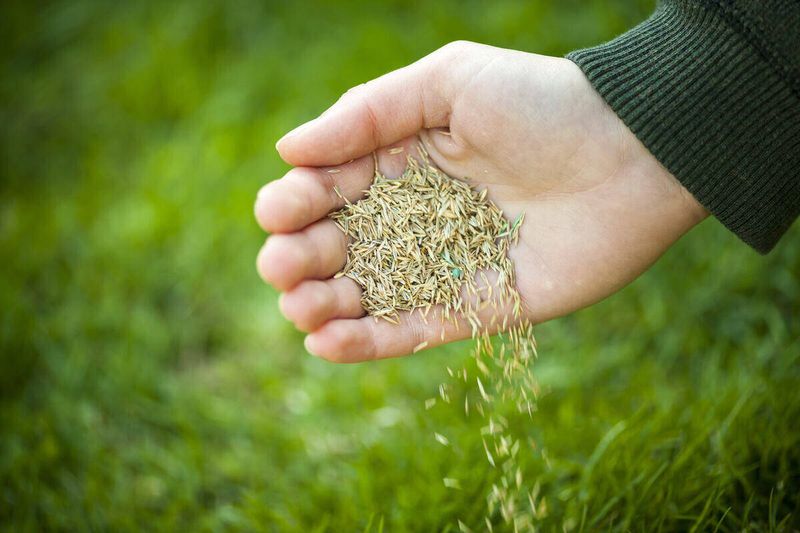
Routine fall fertilization has a generous enough window that a few days off the calendar will not ruin your lawn. Seeding and renovation are a different matter entirely.
Tall-fescue seedlings need enough time to put down roots before winter arrives and, just as critically, before summer heat returns the following year. Miss the window by too much and the seedlings may not survive either stress.
NC State Extension lays out regional planting windows that reflect those real differences in climate across the state. In the mountains and western North Carolina, the recommended window for tall-fescue seeding runs from August 15 through September 1.
The Piedmont gets a bit more time, with a window from September 1 through October 1. Along the Coastal Plain, where fall arrives later, the window extends from September 15 through October 15.
These ranges come directly from NC State’s lawn establishment guidance and reflect the soil temperature and frost-timing differences across the state.
Seedings made after those regional windows face a harder road. Seedlings that have not developed adequate root systems before cold weather sets in are more vulnerable to winter injury, and any that survive winter still have to face summer heat before they are fully mature.
Late seedings often produce thin, patchy results that require repeating the process the following fall.
For homeowners repairing thin or bare areas, the Carolina Lawns guide and the Tall Fescue Maintenance Calendar both recommend seeding at approximately six pounds of seed per 1,000 square feet. Using a blend of turf-type tall-fescue cultivars rather than a single variety improves disease resistance and overall performance.
Newly seeded areas need consistent moisture, with light, frequent watering until seedlings emerge and establish, typically over the first two to three weeks.
If you are simply maintaining an established lawn rather than filling in bare spots, the seeding window does not apply to you. But if renovation is on your list, the clock is already running.
Use a soil test to guide lime and fertilizer needs
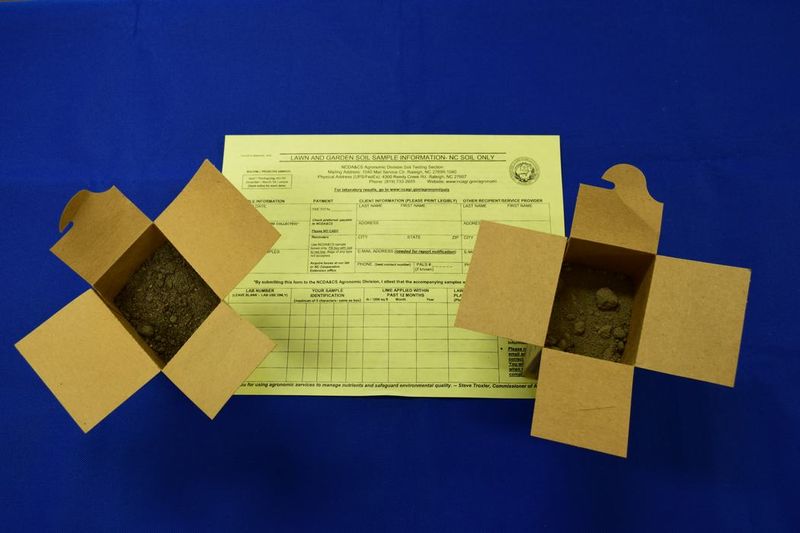
Fertilizing without a soil test is a little like taking medicine without knowing what is wrong. You might apply exactly what the lawn already has too much of, waste money on nutrients it cannot use, and potentially contribute to runoff problems in nearby streams and waterways.
A soil test tells you the pH of your soil and whether lime is needed to bring it into a range where nutrients become available to grass roots. It also shows current levels of phosphorus and potassium, which means you can choose a fertilizer that supplies only what is actually lacking.
According to NC State’s guide to soil testing, results include specific lime and fertilizer recommendations tailored to your lawn, which takes much of the guesswork out of fall treatment decisions.
One important clarification: a soil test guides nutrient and lime decisions. It does not diagnose drainage problems, compaction, irrigation needs, disease pressure, or pest activity.
If your lawn is thin and patchy, a soil test is a useful starting point, but other causes may also be at play and deserve their own investigation.
When a soil test is not available, NC State describes a basic fallback for established tall fescue: a turf fertilizer with a nutrient ratio around 3-1-2 or 4-1-2. That ratio reflects a higher proportion of nitrogen relative to phosphorus and potassium.
However, that fallback is not a universal prescription. If your soil test shows phosphorus is already adequate or high, adding a phosphorus-rich fertilizer or a starter fertilizer designed for new seedings is unnecessary and can contribute to water-quality problems, as noted in NC State’s water quality guidance for lawn care.
The NC State Extension system offers soil testing through county offices at low cost, and results typically come with straightforward recommendations. Running a test before fall treatment, or at least once every two to three years, keeps your fertilizer decisions grounded in what your specific lawn actually needs rather than what the bag suggests.
Calculate the nitrogen instead of guessing
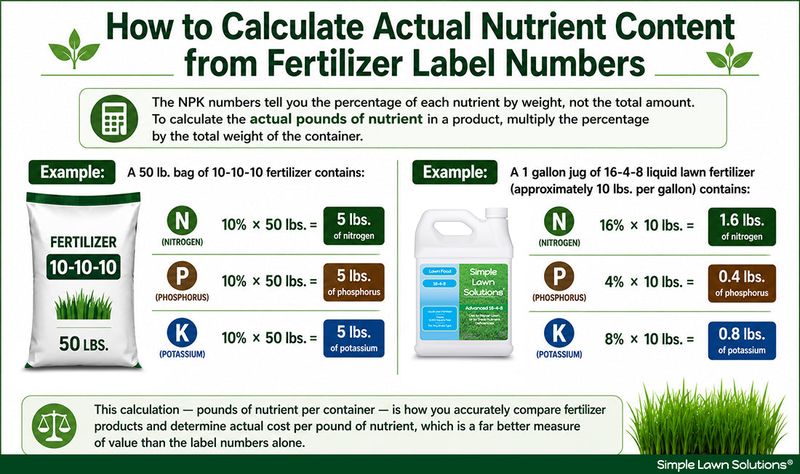
Reading a fertilizer label feels confusing until you understand the one number that matters most for a fall tall-fescue program: the first number on the bag. That number is the nitrogen percentage by weight, and it is the key to applying the right amount without overdoing it.
The target for an established tall-fescue application, as outlined in the NC State Tall Fescue Maintenance Calendar, is approximately one pound of actual nitrogen per 1,000 square feet. To find out how many pounds of fertilizer product you need to hit that target, divide 100 by the first number on the bag.
A 10-10-10 fertilizer, for example, contains 10 percent nitrogen. Dividing 100 by 10 gives you 10, so you would apply about 10 pounds of that product per 1,000 square feet to deliver one pound of actual nitrogen.
A fertilizer with a first number of 25 would require only 4 pounds of product to reach the same target.
That math keeps you from accidentally doubling or tripling the dose just because you used a different product. More fertilizer does not mean greener or healthier turf.
Excess nitrogen can promote weak, fast-growing leaf tissue that is more vulnerable to disease, and the surplus that grass cannot absorb can move into groundwater or nearby streams.
Application safeguards matter just as much as the calculation. Avoid spreading fertilizer before a heavy rain is forecast, because runoff can carry nutrients directly into drainage areas and waterways before the lawn has a chance to absorb them.
After applying a soluble granular fertilizer, water the lawn with roughly one quarter to one half inch of water to move nutrients into the root zone. On sandy soils or where the groundwater table is shallow, slow-release nitrogen formulations reduce the risk of leaching, as recommended by NC State’s water quality guidance and reinforced in guidance for commercial lawn care operations.
After spreading, sweep any granules that land on sidewalks, driveways, or roads back onto the lawn. Fertilizer left on hard surfaces washes directly into storm drains with the next rain, bypassing the soil entirely and contributing to nutrient pollution in local waterways.
Taking an extra two minutes with a broom after every application is one of the simplest ways to protect the streams and ponds near your neighborhood.
Warm-season lawns need a different fall plan
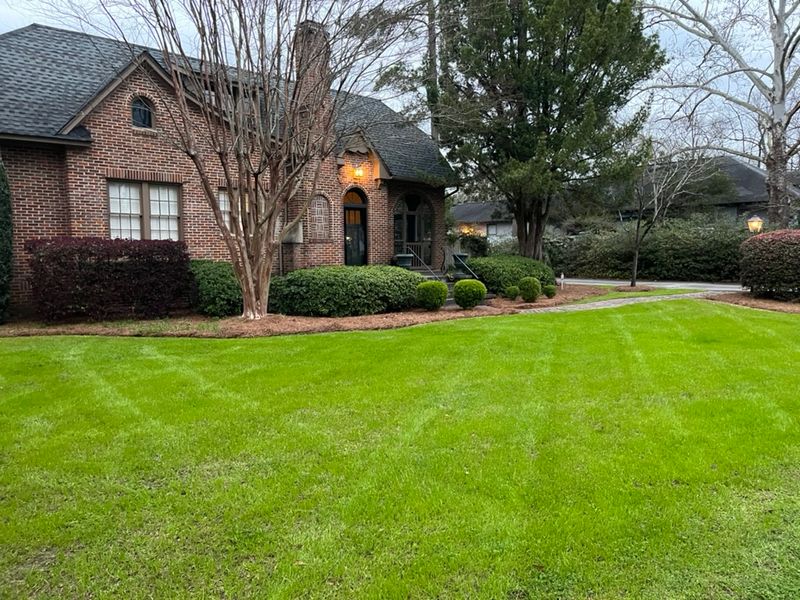
Roughly half of North Carolina homeowners are not growing tall fescue at all. Bermudagrass, centipedegrass, St. Augustinegrass, and zoysiagrass are common across the Piedmont and Coastal Plain, and those grasses follow a seasonal rhythm that makes fall nitrogen fertilization not just unnecessary but potentially damaging.
Warm-season grasses slow their growth as temperatures drop and enter dormancy after frost. During that dormant period, they are not actively taking up nutrients, and applying high-nitrogen fertilizer to a dormant or nearly dormant warm-season lawn can push late, weak growth that is vulnerable to cold injury.
According to NC State’s large patch disease guidance, excess nitrogen on warm-season grasses in fall and winter also raises the risk of large-patch disease, a fungal problem that can cause significant turf loss and is difficult to reverse once established. The Carolina Lawns guide reinforces that warm-season grasses should receive fertilizer during active growth after spring green-up, not during their dormant season.
Some bermudagrass owners choose to overseed with annual or perennial ryegrass in fall to maintain green color through winter and protect the dormant turf from foot traffic. That approach, described in NC State’s organic lawn care renovation guidance, places the Piedmont overseeding window generally around September 15 through October 15, with mountain areas running one to two weeks earlier and eastern areas one to two weeks later.
It is worth understanding what that strategy actually does and does not accomplish.
Ryegrass overseeding provides temporary winter color and a surface that holds up better under light traffic. It does not change how or when the underlying bermudagrass greens up in spring, because that process is driven by soil temperature, not by what is growing on top.
In spring, close mowing helps the warm-season grass reclaim the lawn as temperatures rise. Fertilizer for the bermudagrass itself should wait until it has clearly returned to green and active growth, as noted in the NC State Extension Gardener Handbook.
A brown warm-season lawn in late fall or early spring is not a sign that something went wrong. It is a sign the grass is doing exactly what it is supposed to do.
Fall care improves the odds but cannot guarantee spring color
Properly timed fall care gives an established tall-fescue lawn a real advantage heading into spring, but no single application eliminates every variable that shapes how a lawn looks in March or April. Understanding that distinction helps you make better decisions and avoid frustration when results are not perfect.
For tall-fescue owners, the practical checklist is straightforward: confirm the grass type, run a soil test when possible, follow the appropriate regional fall program from the NC State Tall Fescue Maintenance Calendar, and act quickly if renovation or seeding is needed. Seeding has a narrower window than feeding, and late-planted seedlings face the greatest risk of poor establishment.
Even with all of that done correctly, spring appearance can still be affected by drought during winter, soil compaction, drainage problems, disease pressure, insect damage, or winter injury from an unusually hard freeze. Tall fescue is also better adapted to the mountains and Piedmont than to much of the Coastal Plain, particularly on sandy, well-drained soils in full sun, as the NC State Extension Gardener Handbook notes.
In those situations, fertilizer alone cannot overcome a poor site match, and repeated thin or patchy results may point to a grass-type problem rather than a fertility problem.
The clearest decision rule is this: feed established tall fescue according to its needs and the regional timing from the Carolina Lawns guide, but do not apply fall nitrogen to a warm-season lawn simply because it has turned brown. Brown in fall means dormant, not deficient.
Doing the right thing for the right grass at the right time is what fall lawn care in North Carolina actually looks like.