
The Right Way To Water Your Hanging Baskets So The Blooms Stop Wilting By Afternoon
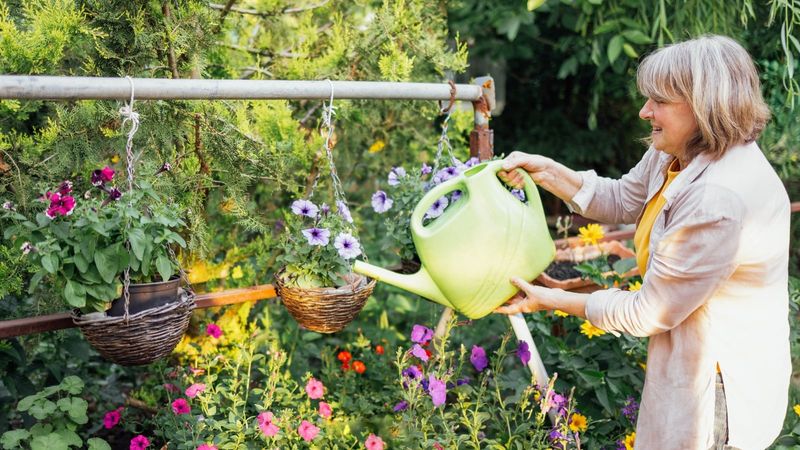
Your petunias look great at 8 a.m. and droopy by 2 p.m., and it feels like you can never get ahead of it. The good news is that a smarter watering routine can make a real difference – but only if dry soil is actually the problem.
Before you grab the hose, it helps to understand why hanging baskets behave so differently from plants in the ground, and how to tell a thirsty basket from one that has a different problem entirely.
Why hanging baskets wilt faster than garden beds
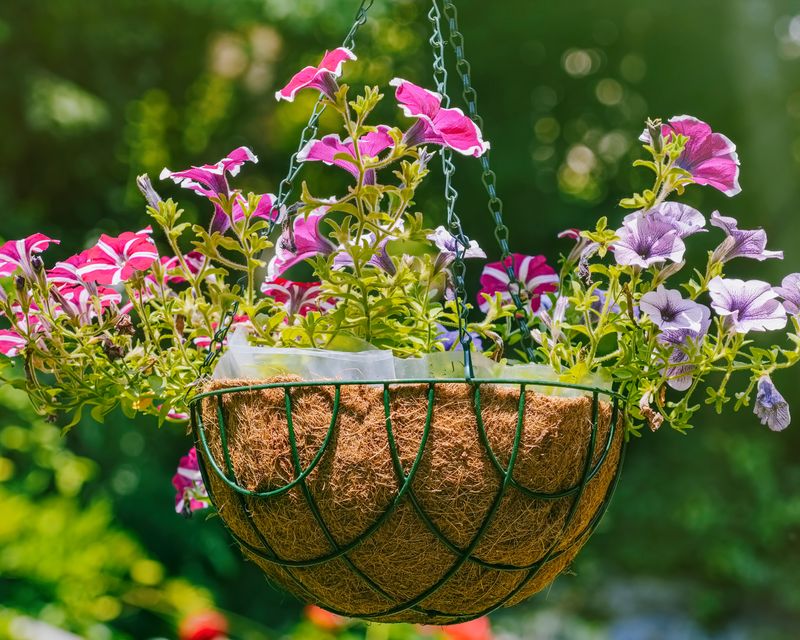
A hanging basket lives in a much tougher environment than a garden bed. The container holds a small volume of potting mix, and that mix is surrounded by air on all sides, which means heat and wind pull moisture out from every direction at once.
An in-ground plant can draw water from a much larger soil volume and benefits from the insulating effect of the earth around its roots.
Petunias and geraniums are among the most popular choices for hanging baskets, and both are heavy drinkers during warm weather. A full petunia basket in direct sun can exhaust its available moisture in a single day, and the same is true for geraniums once they fill out the root zone.
Colorado State University Extension guidance on container gardens notes that containers dry faster than in-ground beds because they hold little mix and face full exposure to sun, wind, and evaporation – so established baskets may need daily or even twice-daily checks in hot, dry weather.
That exposure is compounded by basket size. A smaller basket has even less buffer against drying out, and a plant that has grown to fill the container uses available water faster.
Wind accelerates evaporation further, so a basket hanging in a breezy spot may need attention more often than one in a sheltered location.
Better watering technique can manage wilt that is genuinely caused by dry soil. What it cannot do is guarantee that every basket will stay upright through the hottest part of the afternoon.
RHS hanging basket guidance confirms that checking baskets at least daily during active summer growth is standard practice, with twice-daily checks warranted during hot, dry, or windy spells. Accepting that reality – rather than expecting one watering trick to eliminate all afternoon droop – is the starting point for keeping your baskets in better shape all season.
Check the potting mix before you water
Wilting alone is not enough information to decide whether to water. A plant can droop because the mix is bone dry, but it can also droop because the media is saturated and the roots are struggling, because heat stress is overwhelming the plant’s ability to move water, or because root damage has cut off the supply.
Watering a basket that is already wet will not help and can make root problems worse.
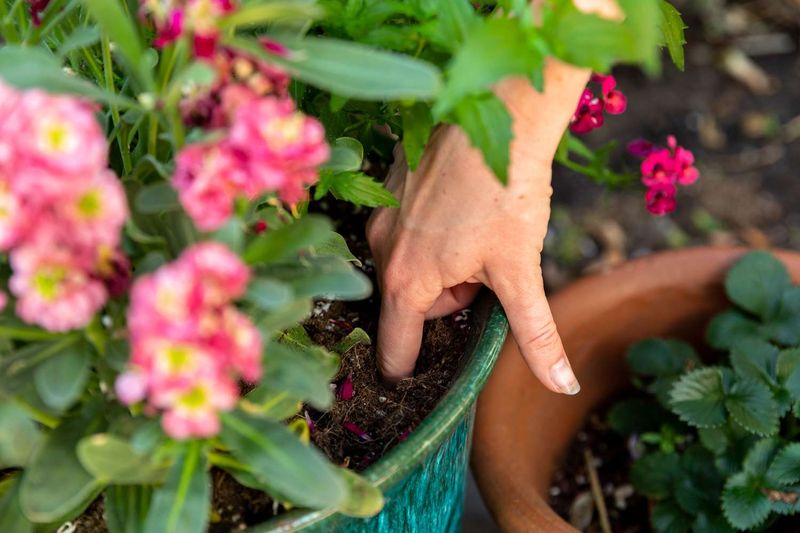
The most reliable first step is a quick finger test. Push your finger about one to two inches into the potting mix.
If it feels dry at that depth, the basket needs water. If it feels moist or cool, hold off and look for another cause.
University of Illinois Extension’s container watering guidance recommends checking soil moisture directly rather than watering on a fixed schedule, because basket conditions vary too much for a calendar to be reliable.
You can also lift the basket. A dry basket feels noticeably lighter than a well-watered one, and with a little practice you will learn what your particular basket should weigh when it has adequate moisture.
This weight check is especially useful for baskets hung too high to reach easily for a finger test.
Pay attention to what the foliage is telling you as well. Dry, slightly crisp leaf edges or a general papery texture alongside a light, dry container are consistent signs of underwatering.
On the other hand, Virginia Cooperative Extension’s guide to container plant water stress explains that overwatered plants also wilt, but their foliage tends to be yellow, soft, or mushy rather than dry and brittle, and the mix stays persistently wet.
University of Georgia Cooperative Extension’s container gardening publication reinforces that drainage is a key diagnostic clue: if water sits in the basket rather than moving through, root health and oxygen supply may already be compromised. Make this moisture check your decision point before every watering, and you will stop guessing.
Wet the root zone without chasing runoff
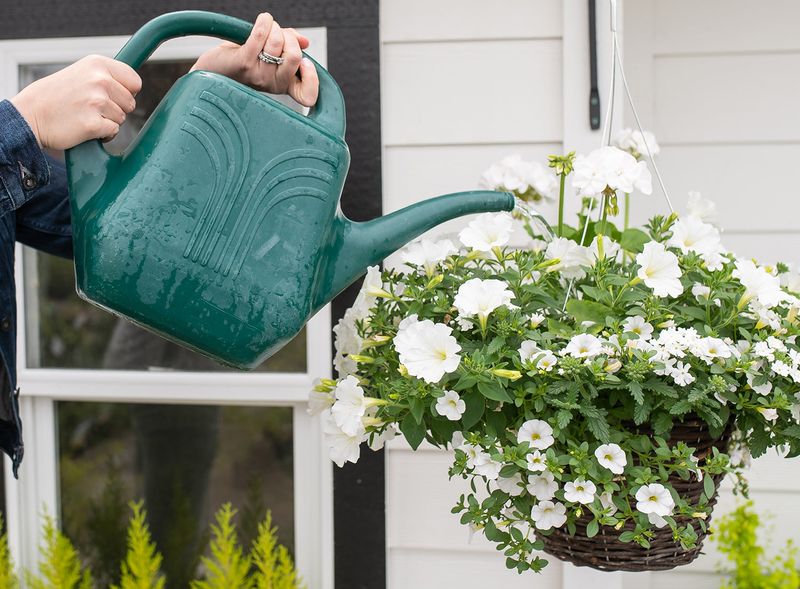
Once you have confirmed the mix is dry, the goal is to wet the entire root zone evenly without generating more runoff than necessary. That distinction matters because a fast splash from a hose nozzle often runs straight down the inside wall of the basket rather than soaking into the mix, leaving the center of the root ball dry even though water poured out the bottom.
Apply water slowly and steadily at the surface of the potting mix rather than at the foliage. Work your way around the basket so water contacts the mix from multiple points, giving it time to absorb rather than channeling down one path.
Oregon State University Extension’s watering basics resource describes the goal as wetting the root zone thoroughly – not maximizing drainage or hitting a fixed volume.
A small amount of water appearing at the drainage holes can be a useful sign that moisture has reached the lower portion of the mix. That is different from heavy, sustained runoff, which wastes water and can carry dissolved nutrients out of the basket.
RHS research on watering hanging baskets and containers found that applying roughly twice as much water did not produce twice as many flowers in petunia baskets, because much of the extra water drained away without benefiting the plants. More water at once is not automatically better.
Illinois Extension’s container watering page similarly advises that the aim is even moisture throughout the root zone, not a maximum drainage event. The practical takeaway is to slow down, apply water in a steady arc across the mix surface, and stop when you see a modest amount of drainage rather than a steady stream.
This approach works well for normally functioning baskets, though severely dry mix requires a different technique covered in the next section.
Rehydrate a basket that has gone bone-dry
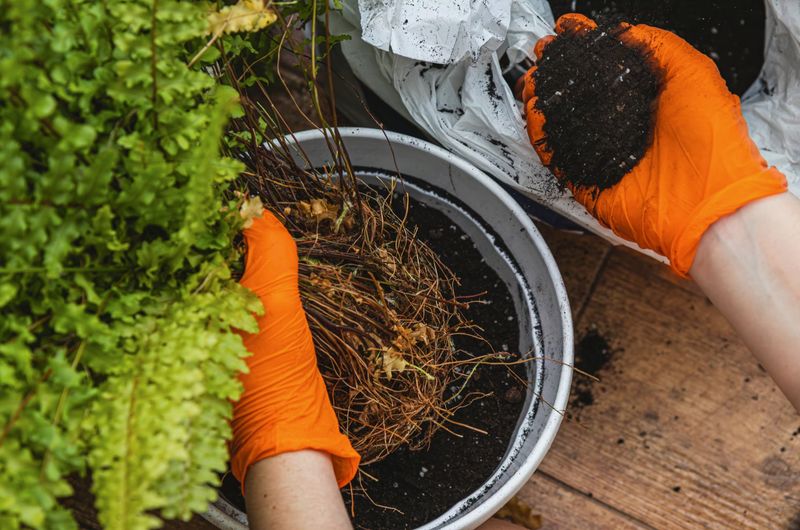
A basket that has dried out completely behaves differently from one that is just a bit low on moisture. When potting mix dries severely, it can shrink away from the container wall and become hydrophobic, meaning water beads on the surface or runs straight down the gap between the mix and the liner instead of soaking in.
One forceful drench in that state can pour straight through without hydrating the root ball at all.
The fix is a staged approach. Apply water slowly across the surface of the mix, then stop and wait two to three minutes.
That pause lets the mix begin to absorb moisture and swell slightly before the next application. Follow with a second slow pass, again working around the basket evenly.
Illinois Extension’s container watering guidance recommends this kind of staged re-wetting for severely dry media, noting that it allows the root ball to absorb moisture more effectively than a single fast drench.
If the basket is small enough to handle safely, you can also try bottom watering. Set the basket in a bucket or basin of water for fifteen to twenty minutes, letting the mix draw moisture upward by capillary action.
This can rehydrate a compacted or shrunken root ball more evenly than top watering alone. Do not leave it submerged for an extended period, though – prolonged soaking can deprive roots of oxygen.
After rehydration, check the mix again an hour later by pressing your finger into the center. A recovered basket should feel consistently moist throughout, not just wet on the surface.
Going forward, catching dryness before it reaches this extreme stage is easier on the plant and easier on you.
Use morning watering for routine care
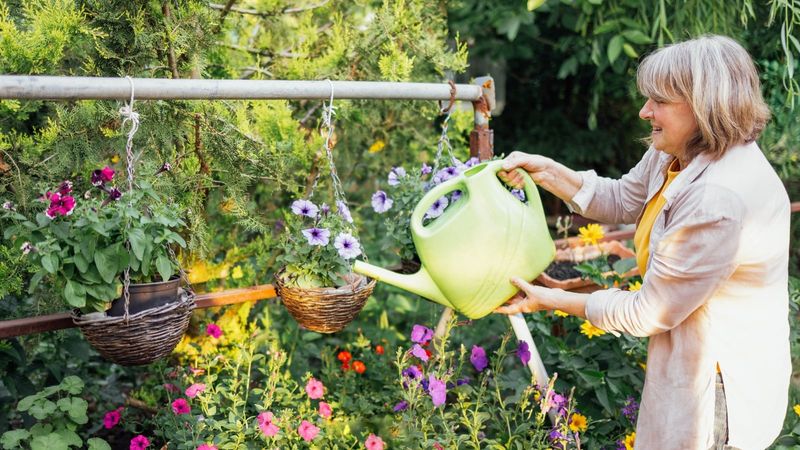
Morning is the most practical time for routine basket watering. Plants have the full day ahead to use that moisture during peak photosynthesis and growth hours, and the mix starts the hottest part of the day with a full reservoir rather than a depleted one.
Foliage also has time to dry if any water lands on leaves during the process, which matters more in the evening than at other times of day.
OSU Extension’s watering basics recommends morning as the preferred time for container watering because it gives plants access to moisture before the heat peaks. That preference comes with an important exception: if you walk out in the afternoon and find a basket that is genuinely dry and visibly wilting, water it then.
Do not wait until the next morning because the plant is already under stress, and prolonging that stress makes recovery slower and harder on the roots.
Illinois Extension’s Over the Garden Fence post on watering hanging pots makes the same point directly: a dry, wilting basket should be watered when you discover it, not held to a schedule. The morning preference is for routine care, not a rule that overrides a plant in distress.
One persistent myth is that watering in the afternoon or midday will burn leaves because water droplets act like tiny magnifying glasses. Penn State Extension’s garden myths page on watering identifies that claim as unsupported.
The real reasons to prefer morning over midday watering are evaporation and wind: water applied during peak heat and breeze is less likely to reach the root zone efficiently before it is lost to the air. Directing water at the base of the plant rather than the foliage also keeps leaves drier, which Illinois Extension notes can help reduce the risk of foliar disease by limiting the time leaves stay wet, especially in the evening hours.
When more water will not fix afternoon wilt
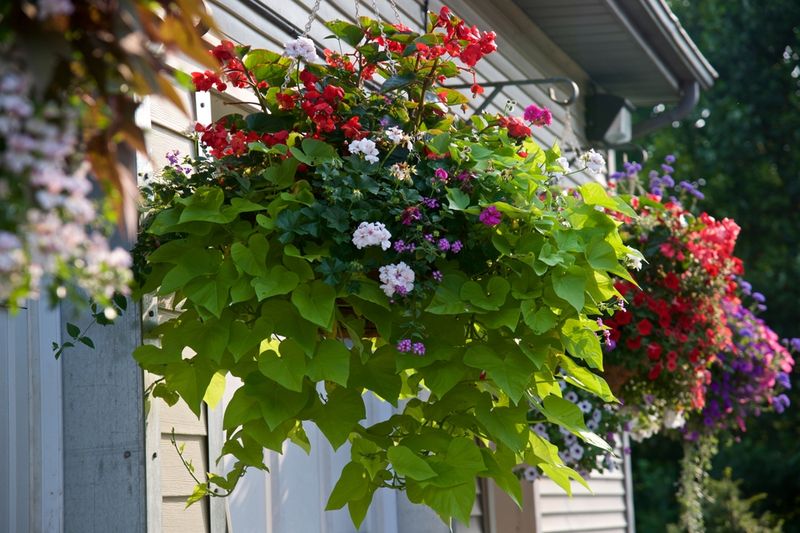
A basket that droops every afternoon even though the potting mix feels moist is sending a different message than one that is dry. During the hottest part of a summer day, leaves can lose water to the air faster than the roots can replace it, even when moisture is present in the mix.
That temporary state is heat stress, not drought, and adding more water to an already moist basket will not solve it.
OSU Extension’s guide to heat stress in garden plants explains that temporary midday wilt in adequately watered plants is a normal physiological response to high temperatures and vapor pressure. If the plant recovers on its own by evening or the following morning and the mix is moist, the basket is functioning as expected under the conditions.
Persistent wilt in a moist basket can also point to root damage or root rot from chronically saturated media. Overwatered roots lose the ability to move water into the plant, so the foliage wilts despite a wet container.
UGA Cooperative Extension’s container gardening guide notes that roots in saturated media lack adequate oxygen and can decline rapidly, and that wilt in a wet basket is a sign to check drainage and root condition rather than to add more water.
Virginia Cooperative Extension’s container water stress publication describes how overwatered and underwatered plants can look similar on the surface, making a substrate check essential before acting. If the mix is moist and drainage is working, consider non-watering responses: move the basket to a spot that gets shade during the hottest two or three hours, reduce wind exposure, or upgrade to a larger basket that holds more mix and moderates temperature swings better.
A plant that consistently struggles in a location may simply be a poor match for those conditions, and swapping it for a more heat-tolerant variety is sometimes the most practical fix of all.
Improve the basket setup for steadier moisture
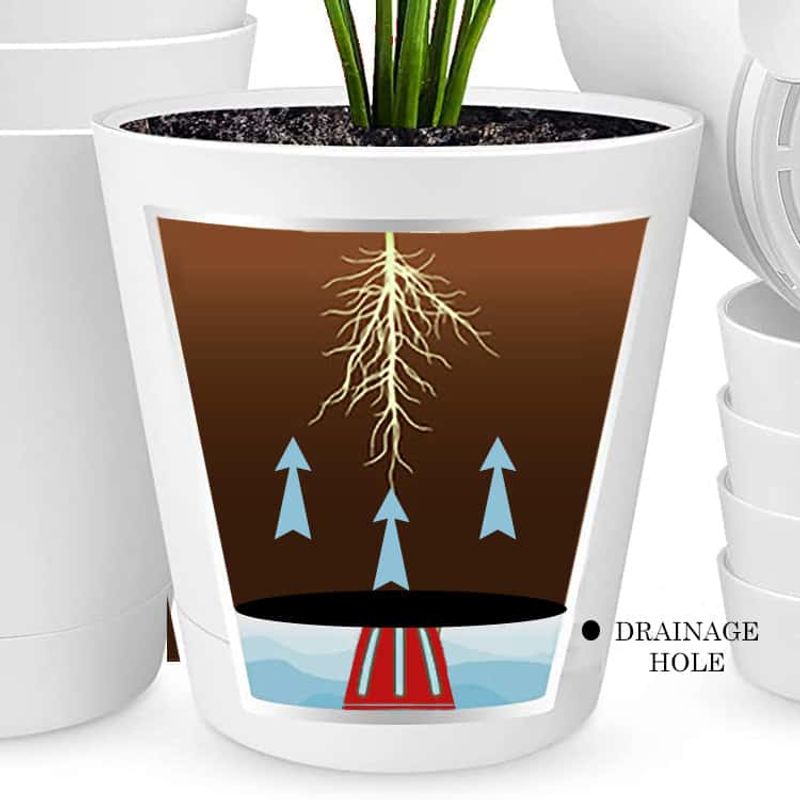
How well your watering routine works depends partly on the basket itself. Drainage holes are non-negotiable: without them, excess water pools at the bottom, roots lose oxygen, and rot sets in.
Check that the holes are open and unobstructed before the season starts, and use a potting mix formulated for containers rather than dense garden soil, which compacts quickly and restricts drainage in a small basket.
Basket size also affects how often you will need to water and how forgiving the setup is during a hot stretch. A larger basket holds more mix, which buffers temperature swings and gives roots more moisture to draw from before the mix dries out.
If a plant has grown to fill its current basket and still wilts frequently despite good watering technique, moving it to a larger container is worth considering before assuming the watering approach is the problem.
Self-watering or reservoir baskets are a practical option for gardeners who want more consistent moisture between checks. These designs hold water in a lower reservoir that the potting mix draws from gradually, which can reduce the frequency of heavy runoff and smooth out moisture levels.
RHS research into watering hanging baskets found reservoir systems among the more efficient approaches tested, while also noting that overly wet media can create its own problems. A reservoir basket is not a set-and-forget solution.
Both the growing medium and the reservoir itself require regular monitoring. The reservoir needs to be refilled before it empties completely, and the mix above it should still be checked for moisture and root health.
RHS hanging basket guidance and UGA Extension’s container gardening resource both emphasize that good drainage and appropriate mix choice underpin every other watering strategy – without those, no technique or tool will consistently keep baskets healthy.
The practical routine: check, water, and reassess
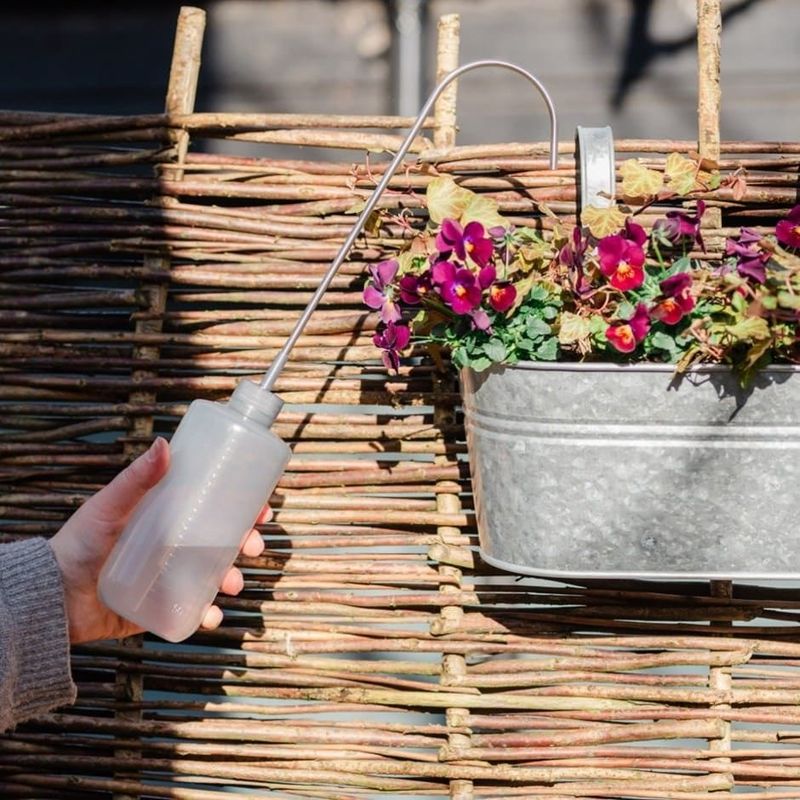
The routine that keeps hanging baskets healthiest is straightforward: check the potting mix first, water slowly at the base until the root zone is evenly moist, and come back to reassess the next day. During hot, dry, or windy weather, check twice daily rather than once.
Illinois Extension’s container watering guidance and RHS hanging basket advice both support daily checking as standard practice in summer – not as a sign that something is wrong, but as the nature of the plant and its container.
The goal is not to avoid daily watering at all costs. The goal is to stop surface-splashing by habit and to stop treating every afternoon droop as the same problem.
A dry basket gets a slow, thorough soak with a staged second pass if the mix resists water. A moist basket that is wilting in the afternoon heat gets shade and time, not more water.
When wilt persists despite consistently moist media, that is the signal to look at heat load, drainage, root condition, and whether the plant is a good fit for its location. OSU Extension’s heat stress guide is a useful reference for that next step.
A basket that recovers every evening and performs well through spring and early summer is probably doing exactly what it should – the afternoon slump in peak heat is often the plant’s response to the weather, not a failure of your watering routine.