
Thyme as a Low-Growing, Insect-Friendly Companion for Peonies

If your peonies seem to be struggling or you just want to make the bed around them look a little more finished, you may have heard that one simple herb can quietly do the trick. The idea is appealing, especially when the herb is low-maintenance and easy to find at any garden center.
The truth is more nuanced than the hype suggests, but there is a real, practical case for planting thyme near your peonies as long as you understand what it can and cannot do.
Thyme Is a Reasonable Low-Growing Peony Companion

Before anything else, a fair correction is in order: no herb has been shown in reliable research to make peonies grow stronger. That claim circulates in gardening content, but it does not hold up when you look for the evidence behind it.
What gardeners can say honestly is that thyme is a reasonable, low-maintenance plant to place near peonies for a few practical reasons, not because it has proven power to boost their vigor.
Thyme stays relatively low to the ground, which makes it less likely to crowd a peony’s crown or shade out the stems. It can cover bare soil between plantings, which reduces the exposed dirt that might otherwise invite weeds.
Penn State Extension’s herb companion guide notes that herbs like thyme work well alongside other plants in certain garden combinations, and University of Delaware Cooperative Extension points out that low-growing plants can contribute to garden diversity without overwhelming neighboring perennials.
Thyme also appears in published perennial planting combinations alongside peonies. Kansas State University Extension’s perennial plant combinations guide lists herbs including thyme in compatible perennial designs, which speaks to design compatibility, not improved peony performance.
Chives are another low-maintenance perennial herb that fits a similar role, but no source compared the two beside peonies in any kind of trial. Thyme is a reasonable editorial choice here because of its low growth habit and general garden compatibility, not because research ranks it above chives or any other herb for peony beds.
A compatible neighbor and a proven growth enhancer are two very different things, and thyme qualifies only as the former.
Thyme’s Possible Benefits Stay Indirect
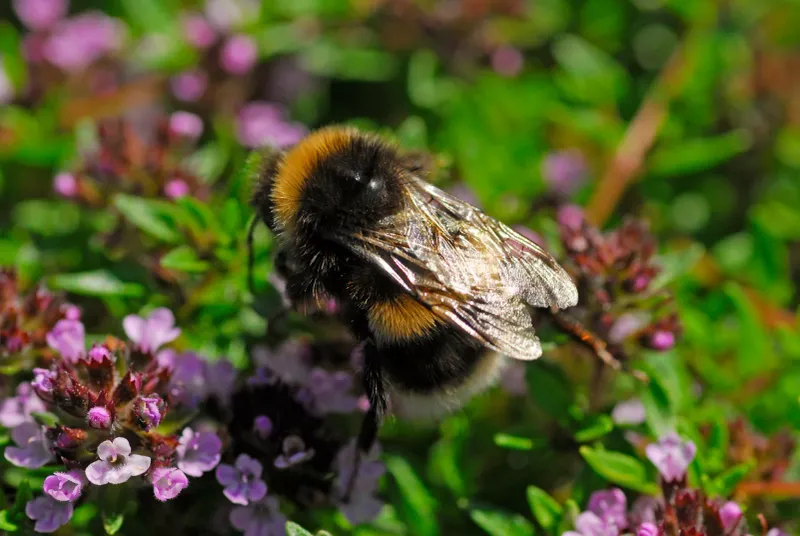
Gardeners sometimes assume that if a plant is called a companion, it must be doing something active to help its neighbor. With thyme near peonies, the realistic picture is more modest.
The credible benefits are indirect, meaning they happen at the level of the broader garden environment rather than inside the peony plant itself.
A mat of low-growing thyme can reduce bare soil between peony clumps, which may slow weed establishment and limit soil splash during rain. When thyme flowers, it produces small blooms that attract bees, hoverflies, and other beneficial insects.
University of Delaware’s guide on adding diversity to the garden explains that flowering plants can provide nectar and habitat that support a wider range of insects, including those that prey on common garden pests. Penn State Extension similarly notes that herbs allowed to flower can attract natural enemies of pest insects in vegetable and ornamental settings.
Those are genuine garden-level benefits, but they stop well short of feeding the peony, strengthening its roots, increasing its bloom count, or changing its disease resistance. Thyme is not a nitrogen-fixing plant, so growing it beside a peony does not enrich the soil the way a legume might.
Washington State University Extension’s companion planting guide cautions that one companion plant may not produce a measurable pest-control effect on its own, and that results vary by pest species, plant density, timing, and climate. A peer-reviewed review of companion planting research reinforces that context matters enormously and that benefits seen in one setting do not automatically transfer to another.
Keep those qualifications in mind when reading enthusiastic claims about thyme and peonies.
Plant Thyme at the Bed’s Edge
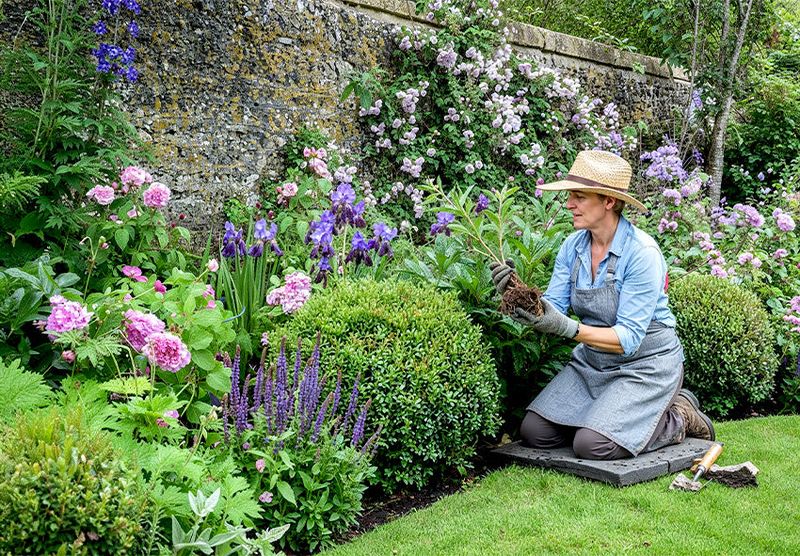
Knowing where to put thyme matters as much as knowing why you might want it there. The placement that makes the most practical sense is along the outer edge of the peony planting, not tucked directly against or over the crown.
That distinction protects the parts of the peony that need the most attention.
Peony crowns and the emerging shoots in spring need open air, easy access for watering, and space for you to inspect them. University of Connecticut’s peony fact sheet emphasizes that good air circulation around peony plants is one of the key factors in reducing disease pressure, particularly from fungal problems like Botrytis blight.
Filling the center of the bed with groundcover, even a low one, can restrict that airflow and make it harder to spot early signs of trouble. Keeping the area directly around the crown open also lets you water at the base without soaking groundcover foliage that could hold moisture against the stems.
Iowa State University Extension’s peony planting guidance notes that well-drained soil and good air movement are fundamental to peony health. Placing thyme at the bed’s perimeter respects both of those needs by keeping the companion plant where it can cover bare soil and offer floral interest without competing with the crown for space or moisture.
This is a practical inference drawn from documented peony requirements, not a formally tested thyme-and-peony spacing rule. No university trial has measured the ideal distance between a thyme plant and a peony crown.
What it does reflect is common sense applied to what peonies are known to need: drainage, airflow, and unobstructed emergence in spring. Treat the bed’s edge as your working guideline and adjust based on how your specific cultivar spreads.
Peony Fundamentals Matter More Than Any Herb
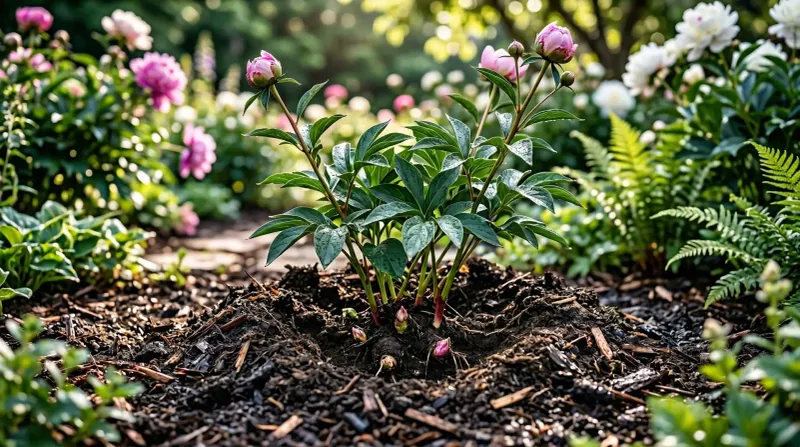
Any conversation about companion herbs should start after the basics are already in place, because no herb compensates for a poorly sited peony. The conditions that most directly determine whether a peony grows and blooms well are sunlight, drainage, soil, planting depth, and air movement, and all of them outweigh the identity of a nearby plant.
Iowa State University Extension’s peony planting FAQ specifies that peonies perform best with at least six hours of direct sunlight each day and well-drained soil. Sites that are shaded by trees, structures, or taller plants routinely produce fewer blooms, and no amount of companion planting offsets that deficit.
Drainage is equally non-negotiable: roots sitting in wet soil are vulnerable to rot and disease, regardless of what grows nearby.
Planting depth is one of the most commonly overlooked factors. Bare-root herbaceous peonies should have their buds, called eyes, positioned about one to two inches below the soil surface.
Planting them deeper than that is a well-documented cause of poor or absent flowering, and it is a mistake that thyme cannot correct. NC State Extension’s herbaceous peony profile notes that performance also varies by region because peonies rely on winter chilling to set buds, which means gardeners in warm climates may face additional challenges unrelated to their companion choices.
Air circulation matters for disease prevention as well. Crowded plants with poor airflow are more likely to develop fungal problems.
Good spacing between peonies and between peonies and any neighboring plant, including thyme, supports the airflow that keeps foliage drier. Think of thyme as an optional finishing touch you add once the site, depth, drainage, and sun exposure are all working in the peony’s favor, not as a first step toward better performance.
Let Thyme Flower for Insect-Friendly Diversity
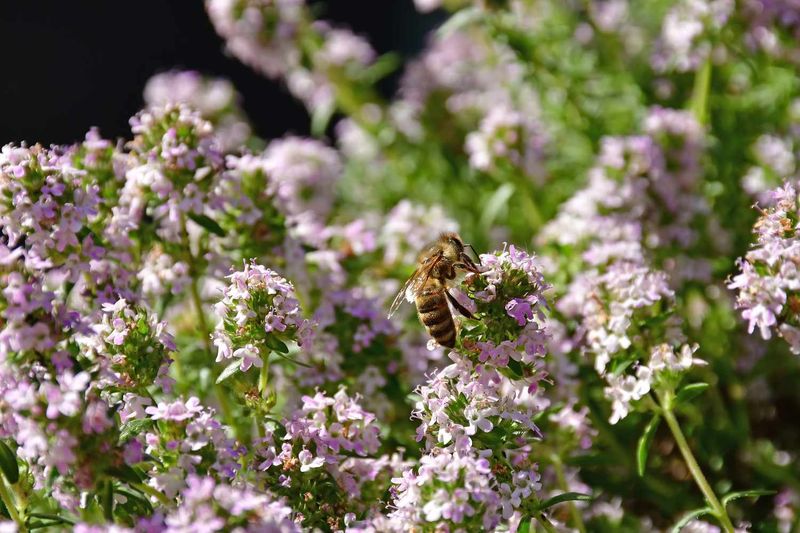
Many gardeners trim thyme back as soon as it starts to flower, treating the blooms as untidy. Skipping that habit, at least in part of the bed, can add something genuinely useful to the garden: a source of nectar and habitat for small beneficial insects during the season when peonies are also active.
University of Delaware Cooperative Extension’s guide on garden diversity explains that flowering plants support a wider range of insects, including predatory and parasitic species that help manage pest populations. Penn State Extension echoes this point, noting that herbs allowed to flower attract natural enemies of common garden pests.
Allowing thyme to bloom near the edge of a peony bed contributes to that diversity without requiring any extra work.
What flowering thyme does not do is directly fertilize the peony, guarantee pest control, or produce a measurable improvement in peony blooms. Washington State University Extension’s companion planting publication is clear that outcomes vary significantly with pest species, plant density, timing, landscape design, and local climate, and that evidence from vegetable gardens does not establish the same effects in ornamental settings.
A peony bed bordered by flowering thyme may attract more pollinators and beneficial insects than a bare bed, and that is a real, modest benefit worth having. Just keep the expectation proportionate: you are supporting garden diversity, not applying a treatment to the peony itself.
Letting thyme flower is a low-effort, low-risk choice that adds something to the planting without asking anything extra of you.
Thyme Cannot Solve Every Peony Problem
A gardener who plants thyme hoping it will rescue a peony that refuses to bloom is likely to be disappointed, because the most common reasons peonies underperform have nothing to do with what grows beside them. University of Connecticut’s peony fact sheet lists the primary culprits for poor flowering: planting too deep, not enough sunlight, drought stress, overcrowding, excess nitrogen fertilizer, plant immaturity in the first few years, late spring freezes that kill buds, pest damage, and disease.
Every one of those problems requires a targeted correction, not a companion herb.
Disease is worth addressing separately because it is sometimes blamed on the wrong cause. Botrytis blight, Phytophthora blight, leaf blotch, and powdery mildew are all associated with wet conditions, infected plant debris, poor drainage, and restricted air circulation.
UC IPM’s peony disease guidance identifies removing diseased debris and avoiding persistently wet soil as the practical measures that reduce disease pressure. Planting thyme nearby does not sanitize the soil, dry out the crown, or replace the need to clean up infected foliage at the end of the season.
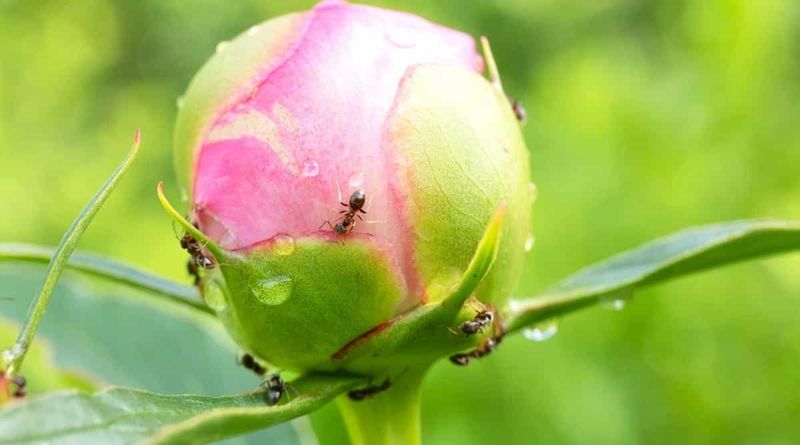
Ants are another topic that sometimes prompts unnecessary alarm. If you see ants on your peony buds, that is almost certainly normal.
Peony buds produce a sugary nectar on their surface that attracts ants, and Kansas State University Extension’s peony guidance notes that peonies do not require ants to open their blooms, and that routine use of insecticides against ants on peony buds is not recommended. The ants may actually provide some incidental protection by deterring other insects from the bud.
Adding thyme nearby does not reliably keep ants away, and trying to eliminate them is unnecessary. Address the real causes of poor peony performance first, and reserve the thyme for the finishing role it actually fits.
Use Thyme as a Helpful Neighbor, Not a Miracle Fix
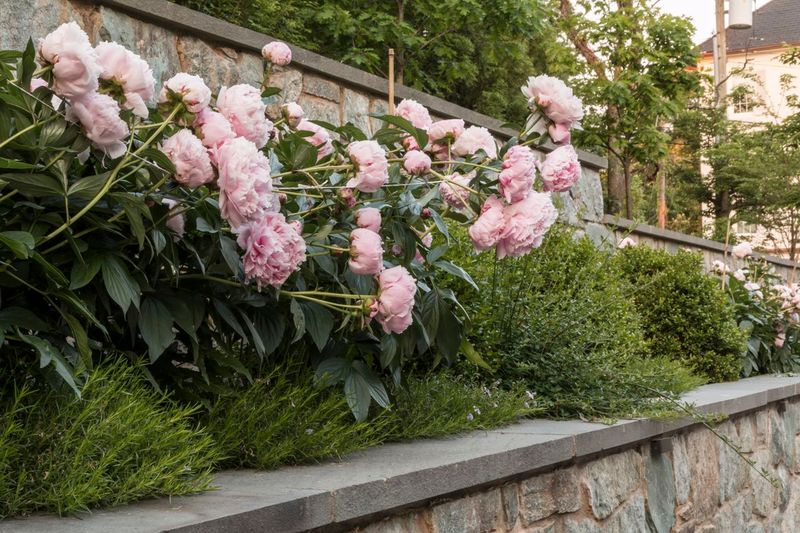
The most useful way to think about thyme near peonies is as a low-maintenance finishing plant, not a treatment. Give your peony a sunny spot with at least six hours of direct light, well-drained soil, and eyes planted no deeper than one to two inches below the surface.
Keep the area around the crown open for airflow, watering, and inspection. Once those fundamentals are in place, placing flowering thyme at the bed’s edge is a sensible, low-effort choice if you want to cover bare soil and offer a little more habitat for beneficial insects.
University of Delaware Extension’s diversity guide frames this kind of planting honestly: flowering companions support garden diversity, and that is a real benefit, even if it is a modest one. Thyme may improve the look and insect activity around a peony bed.
Whether the peony itself grows and blooms well depends almost entirely on the conditions you give it, not on what grows at its feet.