
Watering Your Lawn In Full Sun Won’t Scorch The Grass — Here’s The Myth Finally Settled
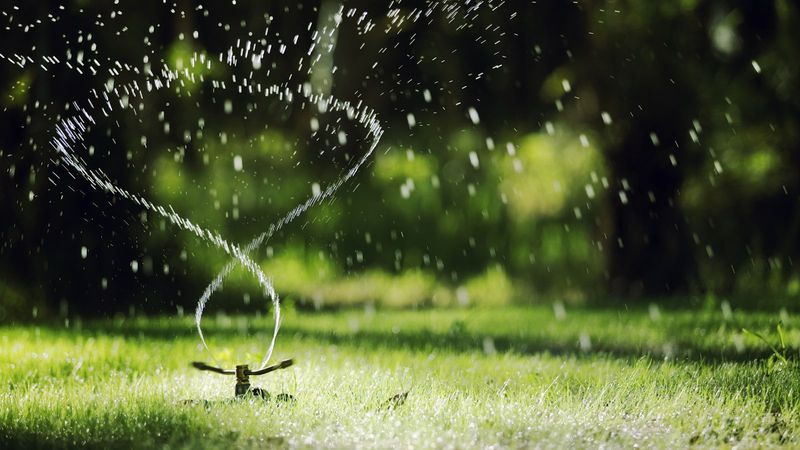
Every summer, the same warning spreads through neighborhoods and gardening groups: never water your lawn in direct sunlight or you will burn the grass. Plenty of homeowners have held off on running the sprinklers during a heat wave because of it. The good news is that the main fear driving that advice, the idea that water droplets act like tiny magnifying glasses and focus sunlight onto your grass, does not hold up to scrutiny for ordinary lawn watering situations.
Why ordinary full-sun watering does not normally scorch an established lawn
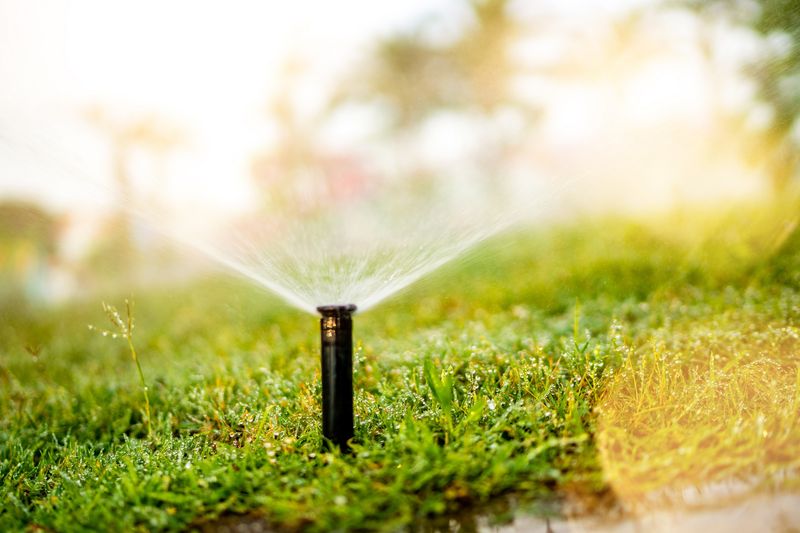
The headline version of this myth goes something like this: water droplets sitting on grass blades in full sun act like tiny lenses, focusing light to a point hot enough to burn the turf. That specific claim, scorching through focused droplets, is not supported by the evidence for ordinary sprinkler watering of established lawn grass. Multiple university extension programs list it plainly as a gardening myth, and the peer-reviewed optics research behind the topic does not back it up for typical smooth foliage.
What the evidence does show is that a published optical study found no burn from water droplets on smooth leaves. The researchers concluded that burning was only possible under a very unusual set of conditions involving a different kind of leaf surface entirely, not the kind of scenario a lawn sprinkler creates. The word “scorch” in this context refers specifically to that droplet-focusing mechanism, not to every form of summer browning or turf damage.
Daytime watering does carry a genuine downside worth knowing: heat, sun, and wind can increase evaporation, meaning some of the water you apply may never reach the root zone. EPA WaterSense guidance notes that watering during the hottest part of the day is less efficient for exactly that reason. Runoff is another separate concern, but it has nothing to do with sunlight. Whether water runs off your lawn depends mainly on how fast your sprinkler applies water compared to how fast your soil can absorb it, along with slope, compaction, and whether the sprinkler pattern covers the area evenly.
Colorado State University Extension and Oregon State University Extension both identify the burning-droplet idea as a myth while pointing to evaporation efficiency as the more practical concern. Qualifying the headline is the honest move: ordinary full-sun sprinkler watering does not normally scorch established turf through focused sunlight, though midday application is generally less efficient than early morning.
Why the evidence does not support the magnifying-glass explanation for ordinary lawn watering

Water droplets can refract sunlight in principle. A curved water surface bends incoming light rays and, under the right conditions, could theoretically focus them onto a surface below. The question researchers actually tested was whether those conditions occur on real leaves during ordinary outdoor watering, and the answer was more nuanced than the popular myth suggests.
The peer-reviewed optical study published in New Phytologist tested water droplets on smooth maple and ginkgo leaves and found no burn. On those surfaces, droplets spread out and flatten rather than maintaining a tight spherical shape, which means they cannot focus light to a damaging point. The researchers did identify one exceptional scenario: when hairy leaf surfaces held droplets suspended above the leaf on tiny hairs, the droplets kept a more spherical shape and the geometry of focused light changed enough to make burning theoretically possible under intense conditions. That hairy-leaf result is real, but it describes a very specific physical setup, not what happens when a sprinkler runs over a lawn.
Grass blades are narrow, flexible, and packed closely together. They are nothing like the broad, flat, horizontal surfaces the study examined, and they are even less similar to the unusual hairy-leaf scenario. Applying the study’s findings to ordinary turf watering is a reasonable practical comparison, not a controlled experiment on every turfgrass species, sprinkler type, or climate. The study’s scope was specific leaves under laboratory and field conditions, not an entire lawn canopy.
Penn State Extension’s garden myth guidance reinforces this conclusion directly, listing the sunlight-focused-droplet explanation as a myth and noting that leaf damage has many other plausible explanations. The takeaway from the science is not that water is always harmless on every plant under every condition, but that the standard magnifying-glass explanation for scorched lawn grass does not reflect what ordinary sprinkler watering actually does to smooth turf foliage.
Brown patches can have many causes besides focused sunlight
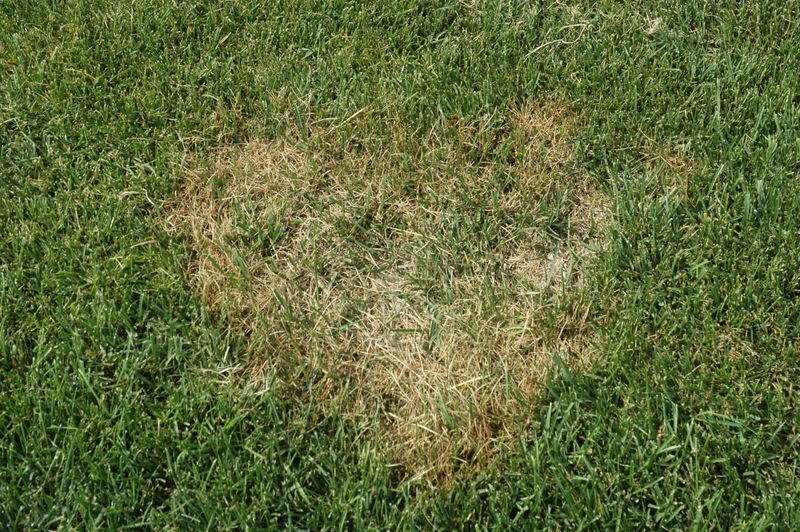
Brown grass in summer is genuinely common, and the instinct to connect it to a recent watering session is understandable. The problem is that a brown patch alone does not tell you what caused it. Drought stress, heat stress, poor sprinkler coverage, compacted soil, mowing too short, fertilizer or salt injury, fungal disease, insect damage, and pet urine can all produce brown or dead-looking areas, and several of those causes can show up at the same time.
Penn State Extension notes that leaf damage blamed on sun or water often has other explanations entirely, including moisture problems, insects, disease, excess fertilizer, wind, and frost. Diagnosing a brown patch from its appearance alone is not reliable. Before assuming sunlight or water droplets are responsible, a closer look at the actual conditions is always worth the few minutes it takes.
Start by checking soil moisture a few inches down. Dry, powdery soil in the affected area points toward drought stress or poor sprinkler coverage rather than any burning mechanism. Check whether your sprinkler heads are reaching the brown zone evenly, since gaps in coverage are a surprisingly common culprit. EPA WaterSense guidance recommends watching for signs of drought stress across the whole lawn rather than reacting to patchy browning without investigation.
Mowing history matters too. Cutting grass shorter than its recommended height, a practice called scalping, stresses the plant and can leave the soil exposed to intense heat. Fertilizer applied at the wrong rate or during a heat wave can also cause chemical burn that looks similar to drought damage. For brown patches that appear in roughly circular shapes with a darker border, or that spread rapidly, Penn State’s brown patch disease resource describes what fungal infection looks like and when conditions favor it.
Inspect thoroughly before drawing conclusions.
Let established turf show when it needs water
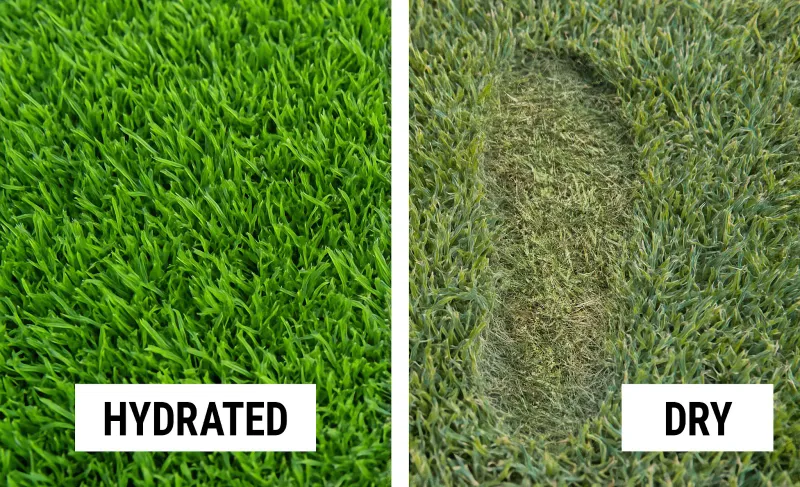
Watering on a fixed schedule regardless of what the lawn actually needs is one of the most common ways homeowners either over- or under-irrigate. Established turf gives clear visual cues when it is ready for water, and learning to read those signals is more reliable than counting days on a calendar.
Three signs are worth knowing. First, walk across the lawn and look back: if your footprints stay visible for more than a few seconds rather than springing back, the grass is losing turgor and starting to stress. Second, look at the color. Healthy turf is a clear green; grass under moisture stress often takes on a dull, bluish-gray cast that stands out once you know what to look for.
Third, run your hand across the blades. Grass that has wilted slightly feels limp rather than firm and upright. EPA WaterSense and University of Illinois Extension both describe these same visible cues as practical triggers for irrigation.
A commonly cited rough guideline is about 1 to 1.5 inches of water per week, including rainfall, but treat that as a starting point rather than a fixed rule. Colorado State University Extension’s irrigation scheduling resource explains that actual demand shifts with grass species, soil type, sun exposure, rooting depth, temperature, humidity, wind, and local water restrictions. A fescue lawn on heavy clay in a mild coastal climate needs something quite different from a bermudagrass lawn on sandy soil during an inland heat wave.
Penn State Extension’s turfgrass irrigation principles reinforce that matching water application to actual plant need, rather than a set day and time, produces healthier, deeper-rooted turf over time. Checking for rainfall before running the sprinklers and adjusting for recent heat or cool spells takes only a moment and prevents both waste and stress.
Choose a watering time based on efficiency and lawn conditions
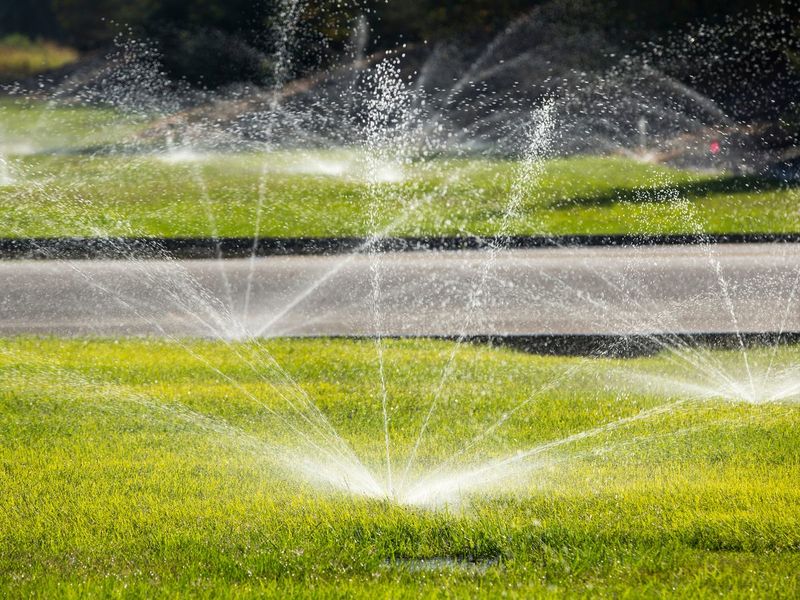
Morning is the practical default for running lawn sprinklers, and the reasoning has nothing to do with avoiding scorched grass. Early morning air is typically cooler, calmer, and more humid, which means less water is lost to evaporation before it soaks into the soil. Grass blades that get wet during watering also have time to dry out as the day warms up, which matters for disease-prone turf.
EPA WaterSense recommends watering in the early morning as the most efficient window, while also noting that evening is cooler and less evaporative than midday. Evening watering is not automatically harmful, but there is a meaningful caveat: if grass stays wet through the night, especially in warm, humid conditions, certain fungal diseases become more likely to develop in susceptible turf. Penn State’s brown patch disease guidance explains that prolonged overnight leaf wetness combined with warm temperatures creates favorable conditions for Rhizoctonia, the fungus behind one of the most common summer lawn diseases.
Colorado State University Extension describes both late evening and early morning as efficient periods, with early morning generally preferred because foliage dries more quickly once the sun comes up. The best choice for your lawn depends on your local climate, your grass type, and whether disease has been a recurring problem.
Where the timing question gets important is during a heat wave or visible drought stress. Holding off on watering solely because it happens to be midday can make stress worse rather than better. Mississippi State University Extension advises watering a plant that urgently needs water rather than waiting for a textbook-perfect hour. If your lawn is showing serious stress signals and restrictions allow it, water when the lawn needs it.
Efficiency matters, but letting established turf suffer through a preventable drought episode costs more in the long run.
Deliver water to the root zone instead of guessing by sprinkler time
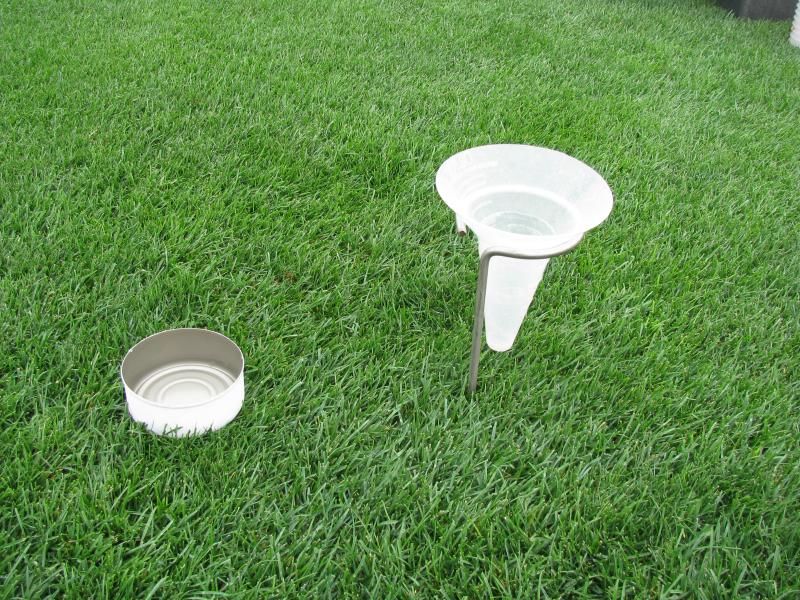
Running a sprinkler for what feels like a reasonable amount of time is one of the least reliable ways to know how much water your lawn is actually getting. Sprinkler heads vary widely in output depending on their design and your water pressure, and coverage patterns are rarely as uniform as they look. The only way to know what your system is actually delivering is to measure it.
Catch cans placed around the lawn while the sprinkler runs collect water just as the soil does, and after the cycle you can measure the depth with a ruler. A standard rain gauge works the same way. Colorado State University Extension’s efficient watering guide recommends this approach specifically because it reveals both how much water is being applied and whether coverage is uneven, which is often the hidden cause of dry patches.
For compacted, sloped, or clay soils, water tends to pool and run off before it can soak in. The solution is a technique called cycle and soak: instead of running the sprinkler for one long session, split the total time into two or three shorter cycles with pauses in between. Colorado State’s drought watering resource explains that these pauses give water time to infiltrate rather than sheet off the surface, so more of it actually reaches the roots where it is needed.
Penn State Extension’s turfgrass irrigation principles emphasize thorough, less-frequent watering for established lawns rather than frequent shallow applications. Shallow watering encourages roots to stay near the surface, where they are more vulnerable to heat, drought, and traffic. Mowing connects to this too: EPA WaterSense and Colorado State Extension’s lawn care basics both note that keeping grass at the right height for its species, and never removing more than one-third of the blade at a single mowing, helps the turf develop deeper roots, shade the soil surface, and hold moisture more effectively between watering sessions.
Adjust the plan for new grass and different turf types
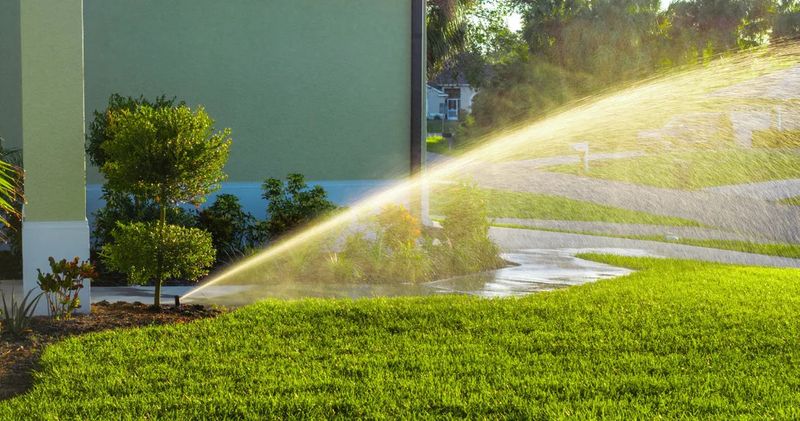
Advice built around established turf does not transfer automatically to every situation. Newly seeded lawns, freshly laid sod, and recently transplanted plugs or sprigs all have shallow, undeveloped root systems that cannot draw on moisture stored deeper in the soil. Those situations call for lighter, more frequent watering until roots establish contact with the surrounding soil, even if that means watering daily during a heat spell.
Penn State Extension’s turfgrass irrigation principles and Colorado State University Extension both note that establishment watering is a distinct phase with different requirements. Applying the deep-and-infrequent rule mechanically to new seed or fresh sod can let the surface dry out between waterings and kill seedlings or cause sod edges to lift and die before roots anchor.
Grass type also shapes the whole irrigation picture. Warm-season grasses like bermudagrass, zoysiagrass, and St. Augustine actively grow through the hottest months and generally tolerate drought better once established, though they still need water during extended dry spells. Cool-season grasses like tall fescue, Kentucky bluegrass, and perennial ryegrass peak in spring and fall and may go partially dormant during midsummer heat, which is a natural survival response rather than a sign of poor care. Colorado State Extension’s lawn care basics and University of Illinois Extension both address how grass type changes what a healthy watering schedule actually looks like.
Local water restrictions, soil conditions, and seasonal weather all factor in as well. A single irrigation plan rarely works across different grass types, climates, or growth stages, so checking resources specific to your region and turf type gives you more accurate starting points than any one-size rule can provide.
Use the practical rule: water when the lawn needs it, then investigate browning
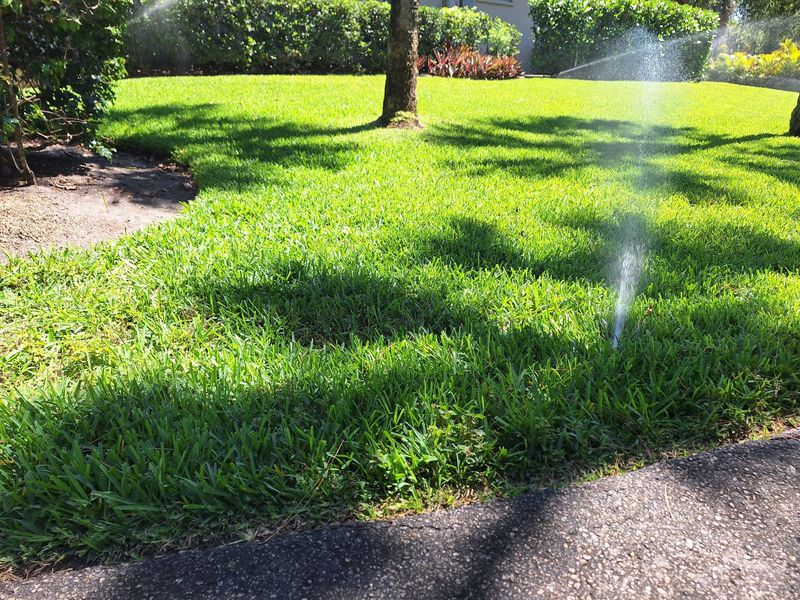
The clearest takeaway from all of this is straightforward: run the sprinklers when the lawn shows stress signals, not on a fixed schedule and not according to fears about the sun burning wet grass. The optical research does not support the magnifying-glass explanation for ordinary sprinkler watering on established turf, and holding water back during a heat wave based on that idea can make drought stress worse.
That said, plenty of real problems can still brown a lawn. Heat stress, drought, uneven sprinkler coverage, compacted soil, scalping, fertilizer injury, disease, insects, and pet urine are all genuine possibilities. EPA WaterSense guidance and Penn State Extension both point toward investigation rather than assumption when brown patches appear. Check the soil moisture, look at the sprinkler pattern, review recent mowing and fertilizer applications, and look for visible signs of disease or insect activity before drawing any conclusion.
Getting the timing, depth, and uniformity of irrigation right matters more than avoiding sunlight while watering. A lawn watered efficiently and at the right amount will be far more resilient than one watered on a fearful schedule. When something does go wrong, the brown patch is a clue worth reading carefully, not a verdict.