
What It Really Means When A Black Snake Shows Up In Your North Carolina Garden
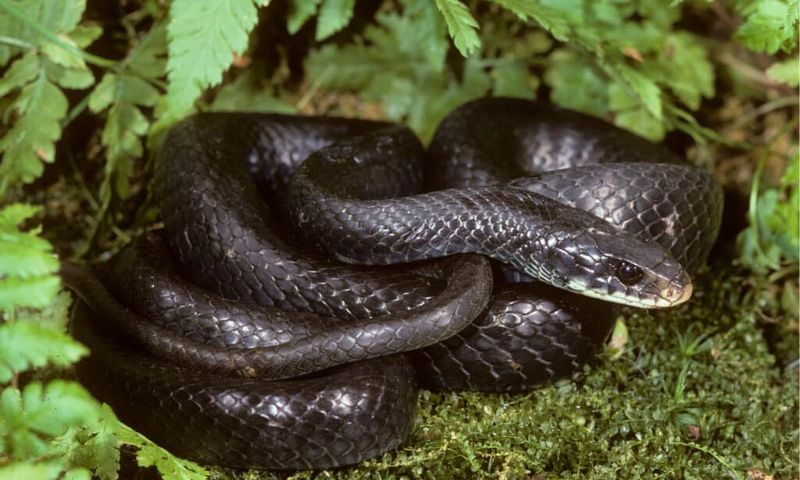
Spotting a black snake sliding through your garden beds can stop you cold, and that gut-level alarm is completely understandable. North Carolina is home to dozens of native snake species, and figuring out which one just crossed your path matters more than most people realize.
The answer depends on where in the state you live, what your yard offers, and how carefully you can observe without getting closer than you should.
A black snake is a description, not an identification
Color is one of the least reliable clues you can use when a snake crosses your path. North Carolina has dozens of native snake species, and NC Wildlife Resources Commission guidance confirms that only six of them are venomous: the copperhead, cottonmouth, timber rattlesnake, eastern diamondback rattlesnake, pygmy rattlesnake, and eastern coral snake.
The overwhelming majority of snakes a homeowner encounters are harmless to people, but that majority does not include every dark-colored species in the state.
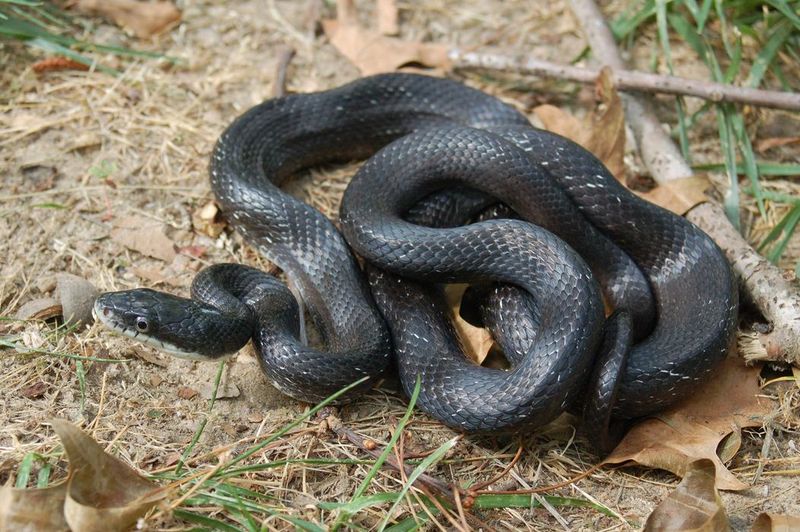
“Black snake” works fine as a description of what you saw, but it does not point to a single species the way a field guide entry might. Several completely different snakes share that general appearance, including the eastern rat snake, the black racer, various water snakes, and kingsnakes.
Geography and habitat shift which of those possibilities is most likely, but none of those factors settle the question on their own.
The cottonmouth complicates the picture in a specific way. NC Wildlife documentation on the cottonmouth notes that older individuals in the Coastal Plain can become very dark or nearly patternless, making them visually similar to the harmless species that share the same region.
A glossy black body, therefore, does not guarantee a nonvenomous snake regardless of where you are in North Carolina.
The practical takeaway is that appearance, behavior, habitat, and geography should all inform your thinking, not just the color you remember. CDC guidance for outdoor workers reinforces that safe observation from a distance is the right starting point.
A clear photograph taken without approaching or cornering the animal may later help an expert or clinician narrow the identification, but even a good photograph does not guarantee a definitive answer. The first rule is to stay back and let the snake show you what it does next.
Inland clues usually point toward rat snakes or racers
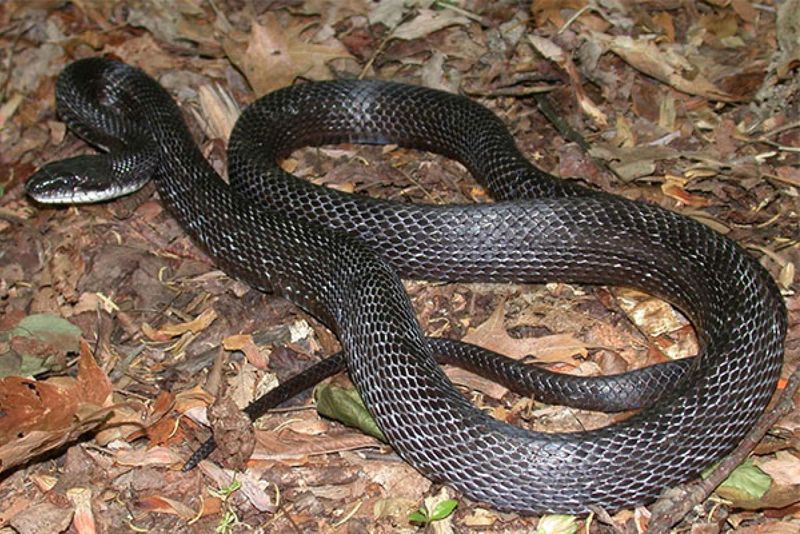
For gardeners in the Piedmont and mountain regions, the two nonvenomous species most likely to show up as a large, dark snake are the eastern rat snake and the black racer. Understanding what makes each one distinct helps you read the situation more clearly, even from several feet away.
The eastern rat snake is the heavier-built of the two. Adults are commonly glossy black on top with a pale white or grayish chin and throat, and NC Wildlife’s rat snake profile notes they can reach five to six feet in length.
Their scales have a faint ridge along the center, called a keel, which gives the body a slightly dull or matte texture rather than a mirror shine. Rat snakes are accomplished climbers and will move through shrubs, fence posts, and tree branches with ease.
If you find a large black snake investigating a bird feeder pole, a garden shed wall, or the upper branches of a shrub, a rat snake is a reasonable first guess in Piedmont or mountain habitat.
Additional NC Wildlife documentation confirms that rat snakes feed primarily on rodents, though they also take birds, eggs, and other small animals. That rodent focus is one reason they tend to show up near structures where mice and rats find shelter.
The black racer looks related but behaves quite differently. NC Wildlife’s racer species page describes it as a slender, smooth-scaled snake with a solid black body and a white chin, usually smaller in diameter than a rat snake of comparable length.
Racers are fast, active during daylight hours, and tend to flee quickly when disturbed. Their diet is broader, covering small rodents, lizards, frogs, and insects.
NC State Extension’s colubrid snake resource reinforces that these two species are often confused with each other but are not interchangeable in habit or body type. Neither description is a field-identification rule you can apply from a glance, and none of these clues justify approaching the animal.
They are probability-based observations meant to inform your awareness, not replace professional confirmation.
Coastal Plain water changes the risk calculation
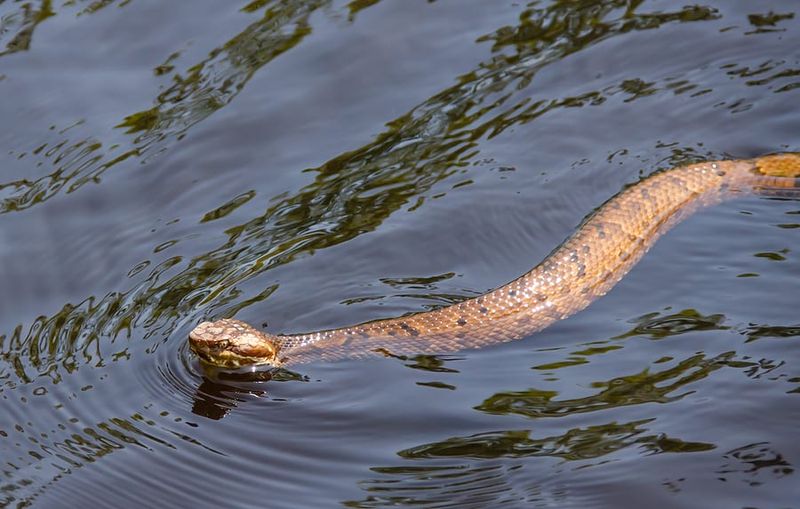
A dark snake spotted near a pond, drainage ditch, swamp, or any standing water in eastern North Carolina deserves a different level of caution than the same sighting in a Piedmont vegetable bed. Geography genuinely changes the probability of what you are looking at, even if it cannot tell you for certain.
NC Wildlife’s cottonmouth documentation establishes that the eastern cottonmouth is associated primarily with Coastal Plain habitats near water, and that older individuals can become very dark or nearly patternless. A snake that might confidently be called a rat snake in the mountains becomes a less certain identification when it is sitting at the water’s edge in Craven or Brunswick County.
The cottonmouth is venomous. NC Wildlife’s venomous snake guidance makes clear that these species should never be approached, handled, or provoked.
A dark body near water is not proof of a cottonmouth, but it is enough reason to treat the situation with more caution than you would in an inland garden setting far from any wetland habitat.
A clear photograph taken from a safe distance – without stepping closer, cornering the snake, or blocking its exit – may eventually help an expert or clinician make a more informed assessment. CDC guidance on venomous snakes is clear that photographs do not guarantee identification and that the priority is always keeping distance between yourself and the animal.
Location shifts what is plausible; it does not replace careful, remote observation as the only safe approach.
The visitor reveals opportunity, not a verdict on garden health
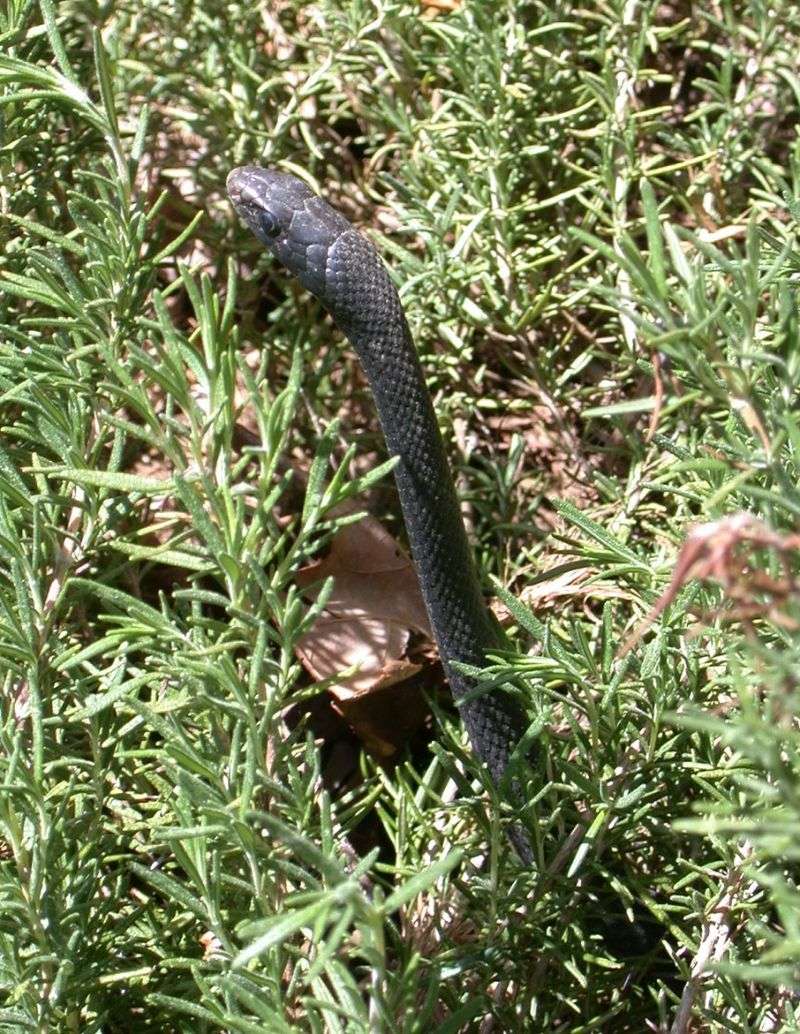
Finding a snake in your garden can feel like receiving a report card on your yard, but the sighting is more modest than that. What the snake’s presence actually tells you is that your property offered something it needed at that moment, whether that was prey, a patch of warm pavement, a sheltered gap under a raised bed, moisture from a drip line, or simply a convenient route between two larger habitat areas.
NC State Extension’s wildlife gardening guidance describes snakes as part of a functioning yard ecosystem, but functioning does not mean perfect. A single observation cannot certify that your soil is healthy, that your plant diversity is high, that your pesticide use is low, or that rodents are under control.
Those conclusions require much more evidence than one snake crossing a garden path.
NC Wildlife’s seasonal snake activity guidance notes that snake sightings increase in warmer months as animals become more active and move through residential areas in search of food and shelter. That seasonal pattern means a spring or summer sighting in your yard may reflect regional snake activity just as much as anything specific about your garden’s condition.
The more useful framing is to treat the sighting as one data point. Your yard provided at least one thing a snake found worth visiting.
That could be a mouse population under a woodpile, a warm stone path, a gap under the shed, or simply an open travel corridor between your property and a neighbor’s. None of those conditions says anything definitive about the yard as a whole, and none of them requires an immediate overhaul of your garden practices.
Rat snakes and racers can help with rodents—but not everything
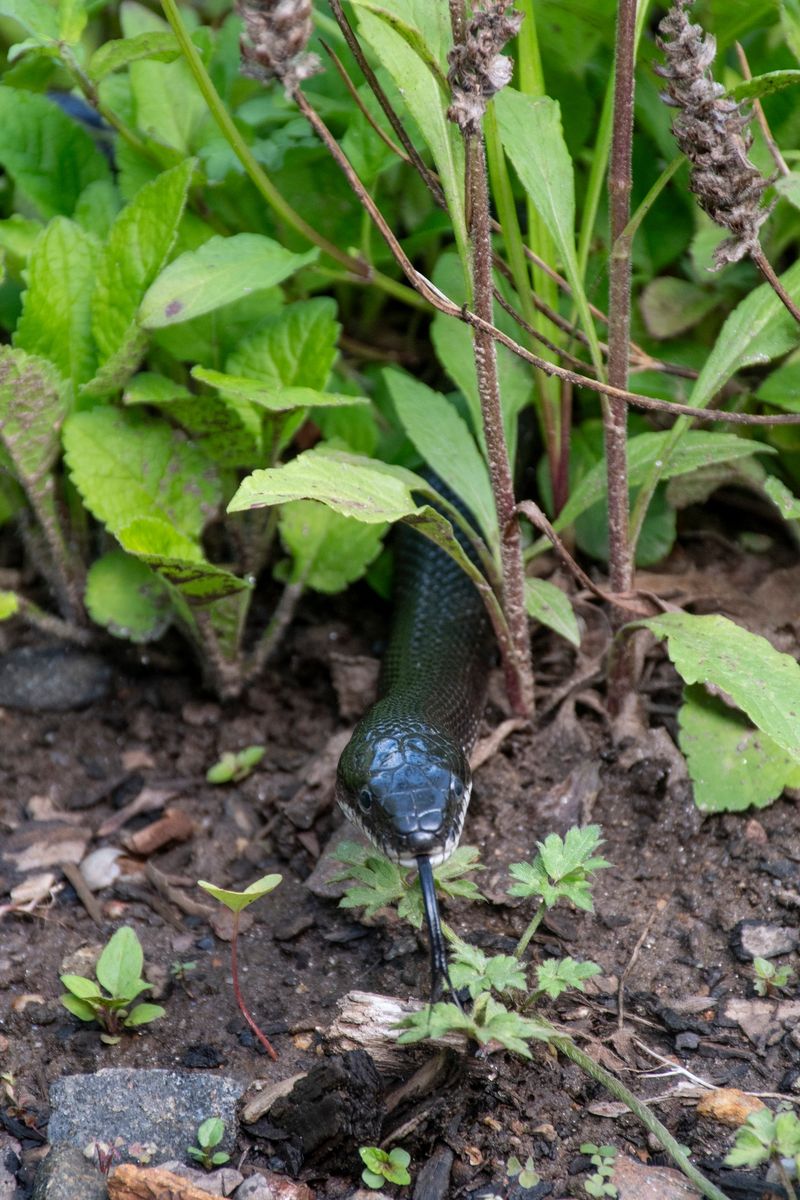
Confirmed rat snakes and racers do eat rodents, and that feeding habit can translate into a real, if modest, benefit for homeowners dealing with mice or rats around garden structures. NC Wildlife’s rat snake profile describes rodents as the primary prey for adult rat snakes, making them one of the more effective natural predators a residential yard might host.
NC Wildlife’s racer profile confirms that racers also take small rodents alongside lizards, frogs, and insects, so their contribution is broader but still real. Neither species, however, should be treated as a guaranteed solution to a rodent problem.
One snake visiting your yard does not mean the mouse population under your shed is under control, and no reasonable reading of the evidence supports that claim.
NC State Extension’s wildlife section frames snakes as useful predators that help keep rodents and other pests in check, which is an accurate description of their role without overstating what a single animal can accomplish. The benefit is real and worth acknowledging; it is just not a replacement for other responsible pest management steps.
One claim that goes too far is the idea that a rodent-eating snake also controls ticks. The sources reviewed here support rodent and insect predation by these species, but they do not establish that a backyard snake meaningfully reduces human tick exposure.
Those are separate ecological questions, and conflating them gives the snake more credit than the evidence allows.
Rodenticide use adds another layer of concern. EPA’s rodenticide pesticide safety review identifies secondary exposure as a documented ecological risk: predators and scavengers, including reptiles, can be poisoned when they eat rodents that have already consumed bait.
If you use rodenticide, label compliance, secured bait stations, and awareness of that secondary risk matter whether or not a snake is present in your yard.
Give the snake an exit instead of escalating the encounter
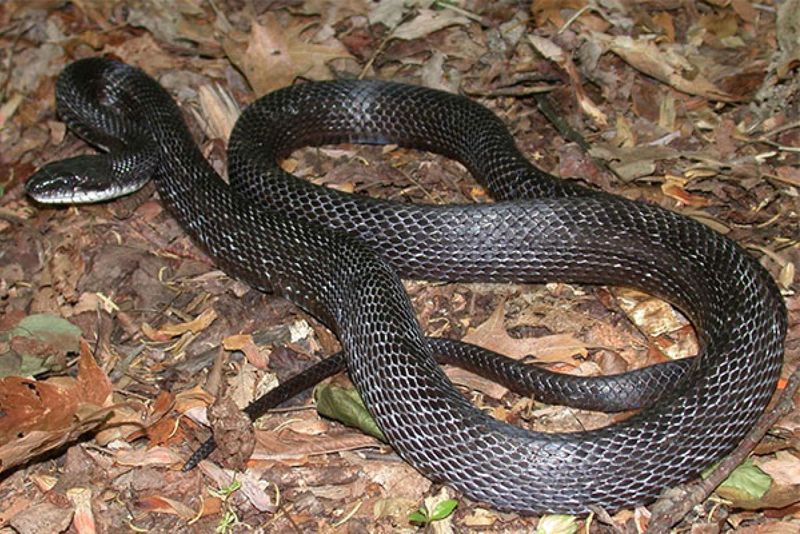
Seeing a snake in the garden triggers the urge to do something immediately, but the most effective response is also the quietest one. Stop moving, keep children and pets away from the area, and give the snake plenty of room to travel in whatever direction it chooses.
Most outdoor snakes, given a clear path and no perceived threat, will move on within minutes.
NC Wildlife’s copperhead guidance advises giving snakes space and allowing them to leave rather than trying to force the outcome. When a snake is sitting directly in a doorway or blocking a path you genuinely need to use right away, NC Wildlife’s spring encounter guidance suggests that gently spraying the snake with a garden hose from a distance can encourage it to move without requiring you to approach.
What you should not do is try to kill, capture, corner, or handle the animal. Bites in North Carolina frequently happen when people attempt to kill or pick up a snake they have already found, so the act of escalating the encounter is itself one of the most common ways people get hurt.
A snake that holds its ground, raises its head, or strikes is not being aggressive toward you; it is responding to what it perceives as a threat and looking for an escape route.
Defensive behavior is not the same as predatory behavior, and understanding that distinction helps take some of the fear out of the moment. If the snake is outside and not posing an immediate hazard, the right call is simply to wait it out at a safe distance.
A snake inside a home, or one in a location where children or pets cannot be kept away, may require help from a certified wildlife damage-control professional rather than a DIY response.
Target the house, not the whole habitat
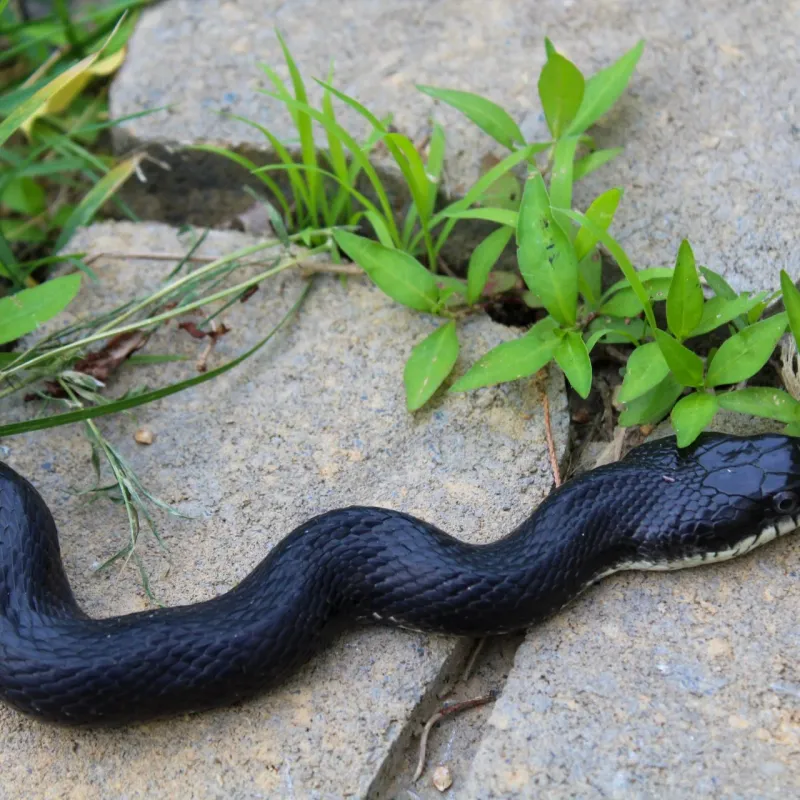
Reducing snake encounters around your home does not require turning the yard into a sterile landscape. The goal is targeted exclusion around the structures where people live and work, not the elimination of every piece of cover across the entire property.
Start with the areas immediately around the house and outbuildings. NC Wildlife’s residential wildlife guidance recommends clearing piles of wood, rocks, and debris that sit near the foundation, trimming vegetation that grows dense against the house, and sealing gaps around doors, foundation edges, siding, windows, and utility penetrations.
Each of those steps removes either shelter that a snake might use or access points that allow entry. None of them guarantee a snake-free property, but they meaningfully reduce the conditions that draw snakes close to where people spend their time.
The same logic applies during gardening. CDC guidance for outdoor workers around venomous snakes recommends watching where you place your hands and feet, using tools to move debris or shift woodpiles rather than reaching in bare-handed, and avoiding blind reaches into brush, holes, or any concealed space where a snake could be resting.
Gloves add a layer of protection during heavy garden work, especially when clearing areas that have been undisturbed for a while.
Chemical repellents and mothballs scattered outdoors are not a reliable or legal solution. EPA guidance on illegal pesticide uses flags outdoor mothball application as a hazardous misuse of a registered pesticide, and no chemical snake repellent has demonstrated consistent effectiveness in peer-reviewed research.
Spending time on physical exclusion and cleanup will accomplish more than any product that claims to repel snakes.
Further out in the yard, some cover and complexity are worth keeping. A yard with native plantings, brush piles away from the house, and undisturbed leaf litter supports the insects, frogs, and small mammals that make a garden genuinely diverse.
The practical balance is tidy near the foundation and more naturalistic farther out.
A safe distance matters more than a perfect identification
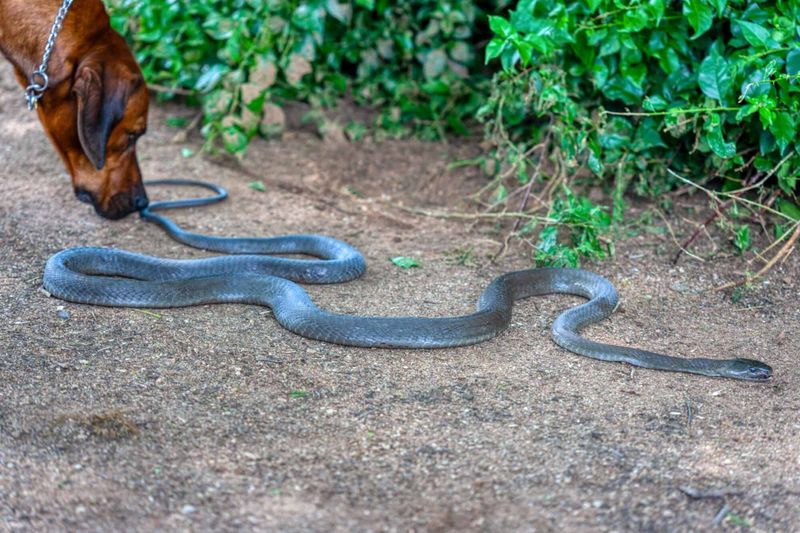
Even with careful observation, good photographs, and an awareness of regional probabilities, you may never know for certain which species crossed your garden. That uncertainty is not a failure of preparation; it is the honest reality of snake identification in a state with dozens of native species and significant variation within them.
If a bite does occur, the response is straightforward: seek emergency medical care promptly. CDC guidance on venomous snake bites is explicit that speed of medical treatment matters more than any field action you might take.
Do not try to capture or kill the snake to bring it along for identification; that attempt is how many secondary bites happen.
If a photograph of the snake already exists, or if one can be taken from a safe distance without approaching the animal, CDC reptile and amphibian guidance acknowledges that images may help a clinician or expert with identification. A photograph is a useful piece of information, not a requirement, and it should never be obtained by getting closer to the snake.
The first-aid practices to avoid are well established. CDC Yellow Book guidance on envenomations specifically warns against tourniquets, cutting the wound, attempting to suck out venom, applying ice, using electric shock, and any folk remedy.
None of those approaches help and several can cause additional harm. Keep the affected limb at or below heart level, stay calm, and get to an emergency facility.
The broader lesson from every section of this article comes back to the same place: a black snake in your North Carolina garden may well be a native rat snake or racer doing quiet, useful work on your rodent population, and it probably is in the Piedmont or mountains. Respecting that possibility and respecting the animal begin the same way, with space, patience, and a willingness to let uncertainty guide you toward caution rather than a shovel.