
What It Really Means When A Broad-Headed Skink Keeps Sunning On Your North Carolina Woodpile
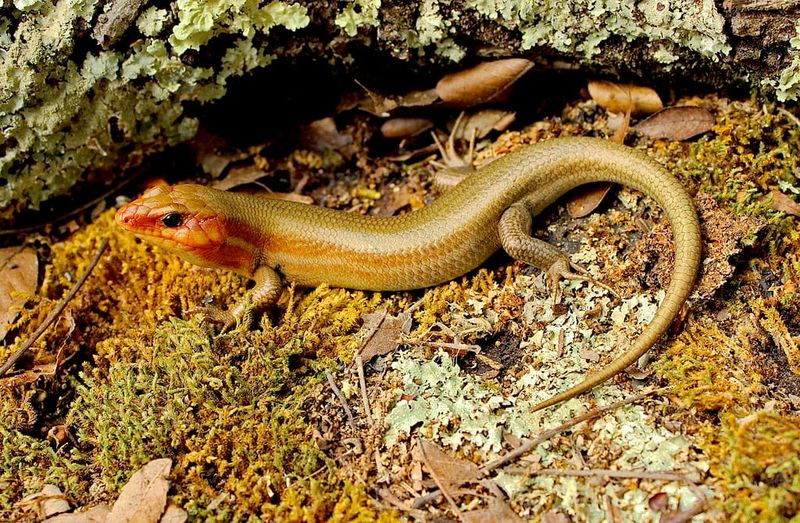
Spot a large lizard with a blazing orange head stretched out on your woodpile, and it tends to stop you in your tracks. That animal is most likely a broad-headed skink, one of North Carolina’s biggest native lizards, and its repeated appearances on the same sunny log tell you something worth understanding.
Knowing what the skink is actually doing there, and what its presence does and does not mean, can save you from unnecessary worry and help you be a better steward of your own backyard.
The orange head usually points to a breeding-season male
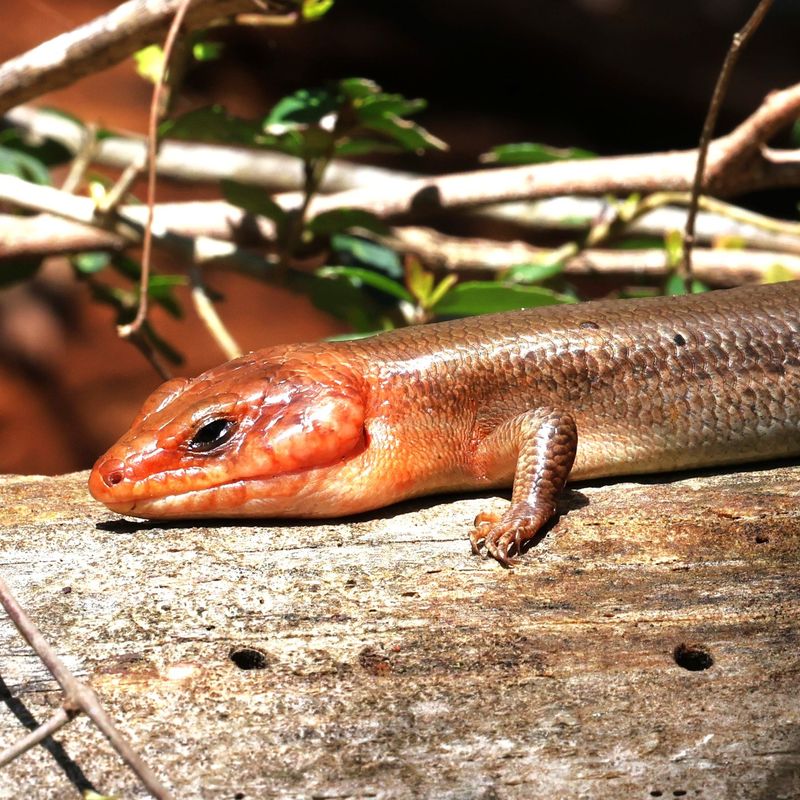
Adult male broad-headed skinks, Plestiodon laticeps, are among the most striking lizards a North Carolina homeowner is likely to find in the yard. NC Wildlife Resources Commission records place adults between roughly 6.5 and 12.75 inches in total length, making them noticeably larger than most other skinks you might encounter near a woodpile or garden bed.
The oversized, triangular head is the feature that earns the species its name.
During the breeding season, which runs roughly from April through early June in most of the state, adult males develop a head color that ranges from deep orange to brick red. That color is a seasonal trait, not a permanent marking.
By midsummer, the intensity fades considerably, so a skink spotted in July with a duller, more brownish-orange head is still worth a second look rather than a quick dismissal.
Females and juveniles of the same species look quite different, and that creates a real identification challenge. Young broad-headed skinks carry five pale stripes running down a dark body, and they sport a vivid blue tail, a pattern they share with the common five-lined skink and the southeastern five-lined skink.
NC Wildlife’s five-lined skink profile makes clear how closely these species resemble each other at younger ages, and a photograph compared against both species accounts is the most practical way to sort them out. Scale counts can confirm identity in ambiguous cases, but most homeowners will find a good photo and a known location sufficient for a confident working identification.
The practical takeaway is this: a large lizard with a bright orange or red head in the Piedmont or Coastal Plain, sunning on a woodpile in spring, fits the adult male broad-headed skink profile well. Treat it as the leading candidate while staying open to the possibility that a younger animal or a female may need a second look.
Why does it keep returning to the top of the pile?
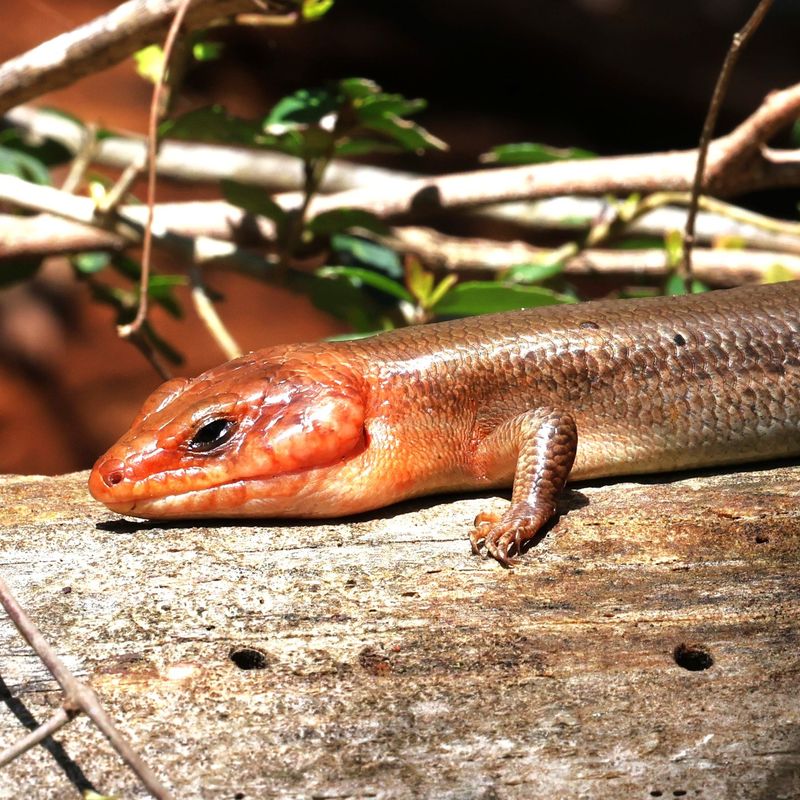
Lizards cannot generate body heat the way mammals do, so they rely on their environment to warm up and stay warm enough to function. Broad-headed skinks are active during daylight hours and spend meaningful time on elevated perches, including stumps, fallen snags, fence posts, and the tops of stacked logs, precisely because those surfaces absorb solar heat and hold it.
NatureServe’s account of Plestiodon laticeps describes the species as semi-arboreal and documents its regular use of stumps, logs, branches, and similar elevated structures, which matches what North Carolina homeowners commonly observe when a skink claims a favorite spot on the woodpile.
Research on Plestiodon skinks places preferred body temperatures in the low-to-mid 30s Celsius, a range that requires active warming on cool mornings and careful retreating to shade on the hottest summer afternoons. A woodpile oriented to catch morning sun can reach that target temperature faster than the shaded ground nearby.
From the skink’s perspective, returning to the same log top on successive days simply means that spot keeps delivering what it needs.
Homeowners sometimes read repeated appearances as a signal that the animal is trying to communicate something specific. Basking is not a deliberate message aimed at the person watching from the porch.
The skink keeps returning because the site works, not because it is alerting anyone to a problem. What the behavior does tell you is that your woodpile sits in a location with enough direct sun and enough thermal mass to serve as a reliable warming station, which is useful information about the microclimate of that corner of the yard, nothing more alarming than that.
A woodpile may offer cover, warmth, and foraging opportunities
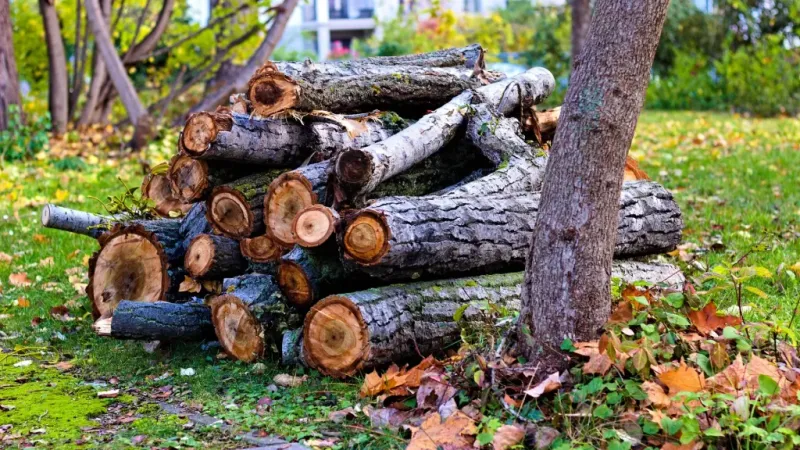
Woody debris is genuinely useful habitat for broad-headed skinks, and a well-established woodpile can function as a small mosaic of the features the species uses in the wild. Loose bark, gaps between split logs, hollow sections, and accumulated sawdust or wood chips at the base all replicate the kind of cover found at the base of rotting stumps and fallen snags in mature hardwood forest.
NC Wildlife’s species account notes that broad-headed skinks use hollow logs, rotting stumps, tree cavities, and loose bark for shelter, so a woodpile with aged, slightly weathered pieces is plausibly offering some of those same resources.
The skink’s diet is broad enough that a range of prey types living in or near the pile could matter. A 1986 study of Plestiodon laticeps foraging and diet found the species takes insects and larvae, spiders, snails, isopods, and occasionally small lizards or other small vertebrates.
Leaf litter and bark around a woodpile can harbor many of those invertebrates, so the area around the stack, not necessarily the interior of the pile itself, is a plausible foraging zone.
That last point matters for how you interpret the sighting. The skink may be using the pile’s surface for basking and retreating into nearby gaps for shelter, while hunting in the surrounding leaf litter and garden beds.
It does not need to be living inside the stack to find the location worthwhile, and one animal sunning on the logs is not evidence that the interior is teeming with a specific pest. Seeing a broad-headed skink near your firewood means the yard is offering the combination of warmth, structure, and potential prey access the species uses, not that you have an infestation that needs diagnosing from the outside.
North Carolina location changes how confidently you can identify it
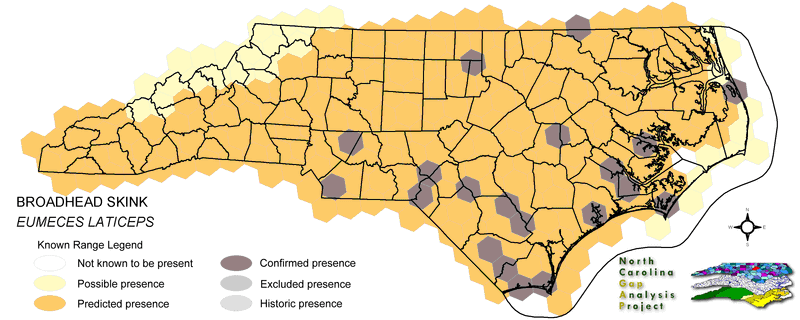
Where in North Carolina you spot the skink matters more than many homeowners realize. NC Wildlife places the broad-headed skink across most of the state’s lowland and mid-elevation areas, covering the Coastal Plain, the Piedmont, and the lower elevations of the Blue Ridge.
A sighting in Raleigh, Fayetteville, Wilmington, or a similar location in those regions fits the expected range without any additional explanation needed.
The picture changes as you move toward the northern mountains. Broad-headed skinks are largely absent from the higher northern mountain counties, and the barrier islands along the Outer Banks represent another gap in the range.
If you live in a high-elevation county and see what looks like an orange-headed skink, a photograph and a careful comparison against both broad-headed and five-lined skink accounts will give you a much more defensible identification than a quick glance. NatureServe’s range data for Plestiodon laticeps supports treating unusual-location sightings as needing closer attention.
Moisture conditions are another place where assumptions can go wrong. Broad-headed skinks do use moist hardwood forests, swamps, and woodland edges, but they also turn up in open, mature forests and suburban lots that are not particularly wet.
Seeing one on your woodpile does not establish that your yard has a drainage problem or that the wood is dangerously damp. The species is flexible enough in its habitat use that a single sighting cannot pin down a specific moisture level.
Finally, observing a male basking on the pile does not mean a nest is hidden inside it. Females may choose rotting stumps, hollow logs, or tree cavities for nesting, but a male resting on the surface is simply using the structure that is available to him, not advertising a breeding site underneath the logs.
What the skink does not prove about insects, moisture, or ticks
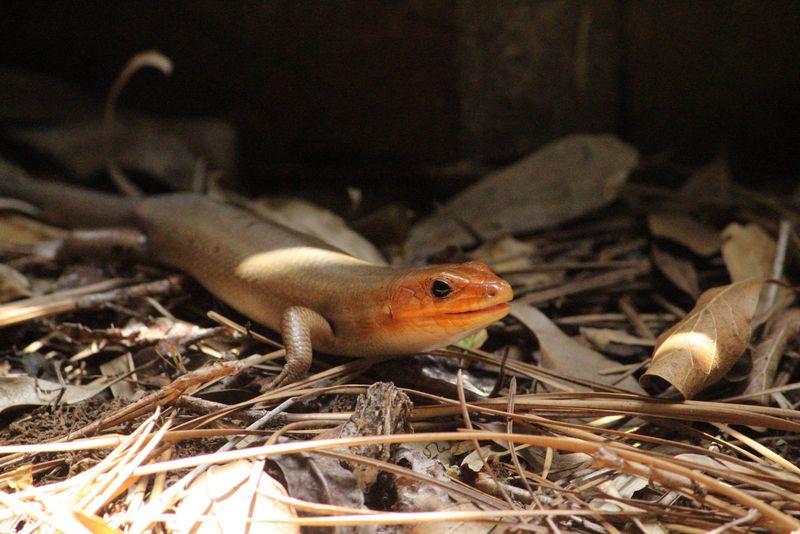
Watching a large skink work its way along the edge of your woodpile makes it tempting to draw conclusions about what is happening underneath. A few of those conclusions are worth correcting before they lead to unnecessary action.
One skink using a yard as a basking and foraging site does not identify which insects are present, confirm that any particular pest is abundant, or prove that the wood or soil is holding excessive moisture. NatureServe’s habitat account for the species describes use of varied moisture conditions and open forest as well as wetter sites, so the animal’s presence cannot be read as a moisture meter for your yard.
The diet question deserves the same care. Published foraging research on Plestiodon laticeps documents a wide prey range that includes spiders, snails, isopods, larvae, and occasionally small vertebrates alongside insects.
Because the skink eats broadly and opportunistically, you cannot look at one animal and conclude that a specific household pest is thriving nearby. The skink is finding something edible in the area, but what that is and in what numbers remains unknown from the sighting alone.
Ticks are a topic that comes up quickly when people learn that skinks eat invertebrates. A USGS-linked study on tick-lizard associations in the southeastern United States found that broad-headed skinks can host immature blacklegged ticks, meaning the skink itself may carry ticks rather than eliminating them.
Available research does not show that a broad-headed skink in your yard suppresses residential tick populations or makes any part of your property tick-safe. Treating the skink as a tick-control solution would be reading well beyond what the science supports.
The safest response is observation, not removal
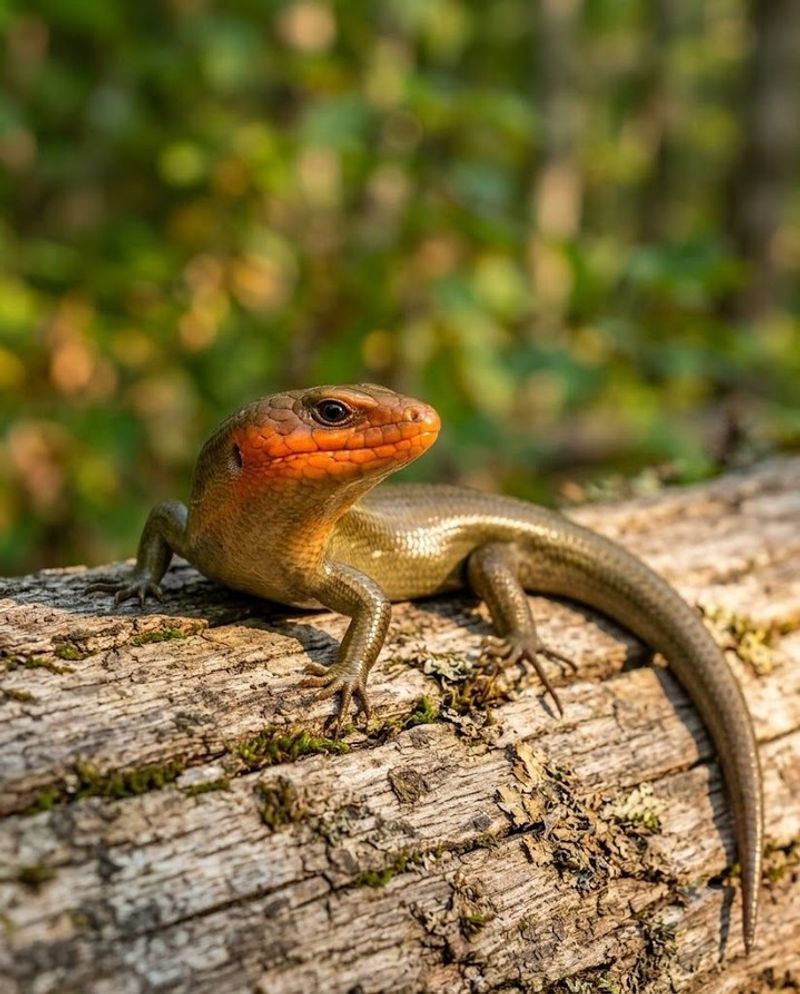
When a broad-headed skink is using your woodpile and not causing any actual property problem, the most practical course is straightforward: leave it alone. The animal is not a pest, and attempting to handle it creates risk for both parties.
Large adults can deliver a firm bite if picked up or cornered, and NC Wildlife notes that broad-headed skinks should not be handled or disturbed unnecessarily. Beyond the bite risk, North Carolina regulates the possession and collection of native reptiles, and the NC Wildlife possession and collection rules make clear that collecting native animals from the wild and keeping them at home are separate legal questions with real consequences.
If you are curious about what the rules allow, the NC Wildlife amphibian and reptile possession permit page lays out the permit requirements. For most homeowners, simple observation is both the safest and the legally cleanest choice.
Relocating the skink to another part of the yard or a nearby park is not a good solution either. Moving a territorial animal drops it into unfamiliar ground where it has to reestablish cover, thermoregulation spots, and foraging routes, often at a significant cost to its survival.
If the skink has found your yard usable, let it stay.
If you are concerned about actual insects in or around the woodpile, address those concerns through proper pest identification rather than preventive spraying. EPA integrated pest management guidance recommends identifying the specific pest, monitoring its population, setting a threshold for when action is truly needed, and trying nonchemical controls before reaching for any pesticide.
Broad preventive spraying around an occupied woodpile can harm the skink directly and reduce the invertebrate community it depends on. NC Wildlife’s skink stewardship guidance also points out that free-roaming cats can kill large numbers of native lizards.
Keeping cats indoors or under supervision where practical is one of the most effective protections you can offer the skink without changing anything else about your yard.
Keep wildlife cover separate from safely stored firewood
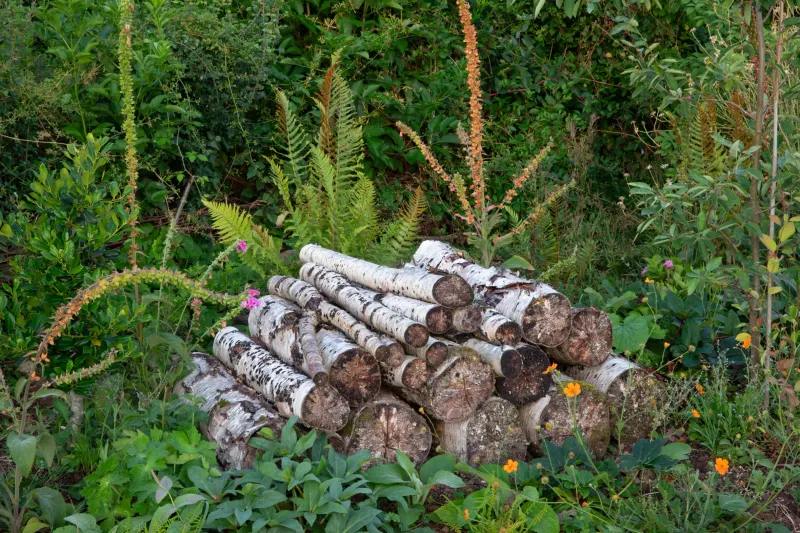
One tension that comes up when a skink claims a woodpile is the question of what to do with the wood itself. Firewood stacks are genuinely useful wildlife cover, but they are also a household resource that needs to be managed safely and responsibly.
The good news is that you can serve both goals without sacrificing either, as long as you keep them physically separate.
NC Forest Service fire-safety guidance recommends keeping firewood stacks at least 30 feet from the house. That distance reduces fire risk and, as a practical side effect, places the stack closer to the woodland edge where a skink is more likely to be comfortable anyway.
Store wood off the ground on a rack or pallets to allow air circulation and reduce moisture buildup in the bottom layers.
Moving firewood is a separate concern. NC State Extension’s guidance on firewood as a vector for invasive pest dispersal recommends burning firewood close to where it was cut, ideally within 10 miles and no more than 50 miles, to avoid transporting invasive insects and diseases into new areas.
Hauling a stack from one county to another risks moving emerald ash borer, spotted lanternfly, or other destructive pests along with the wood.
If you want to keep some wildlife cover in the yard without making the firewood stack the primary refuge, consider leaving a small brush pile or a couple of untreated logs in a back corner away from the house. That gives skinks, toads, and other native species a stable, undisturbed shelter that does not compete with your firewood management or fire-safety practices.
The two features can coexist in most yards with just a little planning about placement.
Read the woodpile as habitat, not a warning label
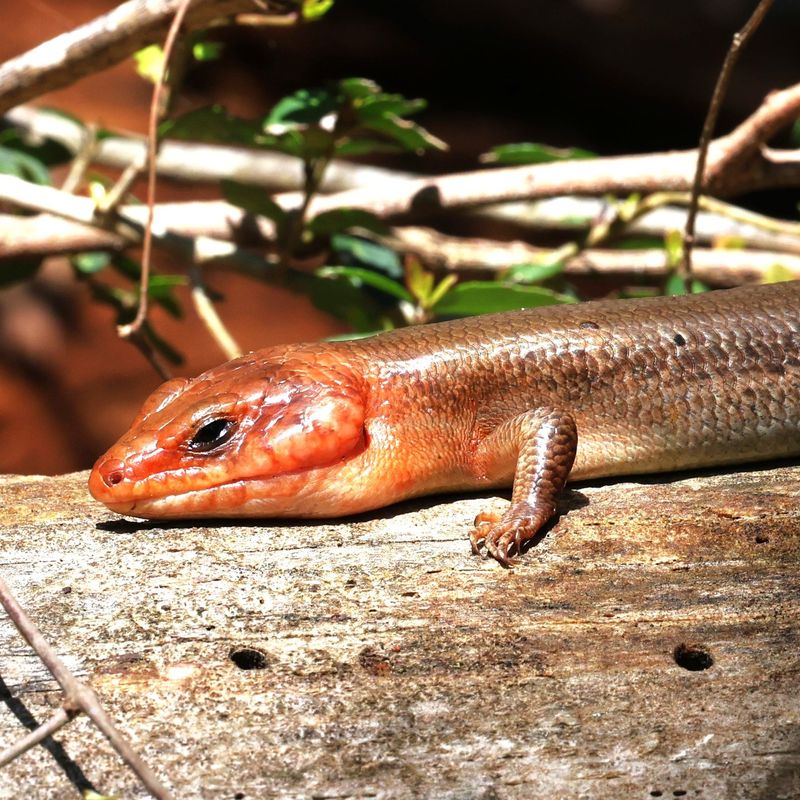
A broad-headed skink that keeps returning to the top of your woodpile is most likely telling you that your yard offers something genuinely useful: a warm, elevated surface, some structural cover nearby, and enough invertebrate activity in the surrounding leaf litter and garden beds to make the area worth visiting. NC Wildlife’s species profile and NatureServe’s range and habitat data both support reading the sighting as a sign of a functional backyard microhabitat, not as proof of an infestation, a moisture problem, or a pest outbreak that demands a chemical response.
The practical steps that follow from that reading are modest and manageable. Observe the skink without handling it, protect it from cats and unnecessary pesticide exposure, store firewood at a safe distance from the house, and investigate any actual pest concern through proper identification and monitoring rather than preventive spraying.
EPA integrated pest management principles give you a clear framework for that kind of measured response.
An orange-headed skink on the woodpile is, in the end, a sign that your yard is doing something right. Native lizards do not linger where conditions are hostile; they stay where the warmth, cover, and food access add up.
That is a reasonable thing to feel good about on a spring morning.