
What It Really Means When A Luna Moth Lands On Your North Carolina Porch At Night
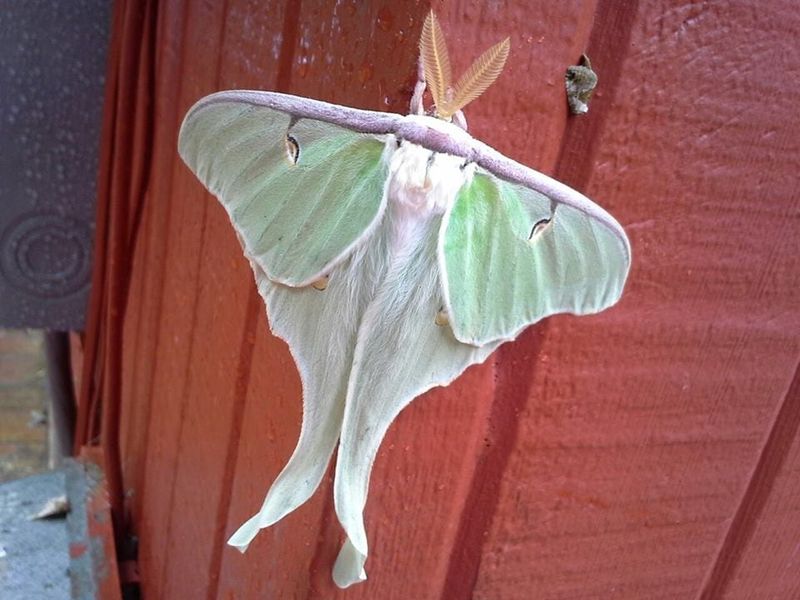
Stepping outside on a warm North Carolina night and finding a pale green moth the size of your hand clinging to the porch wall is the kind of moment that stops you cold. Most people reach for their phone to take a photo, then start wondering what the visit means for their yard.
The answer is more interesting than the folklore, and a little more complicated than a simple “your garden is healthy” headline. Understanding what brought that moth to your door, and what it cannot tell you, makes you a sharper observer of the wildlife already sharing your property.
The porch visit tells you less than the folklore suggests
Plenty of backyard lore treats a luna moth sighting as a report card: the yard must be pesticide-free, the soil must be pristine, the ecosystem must be thriving above the neighborhood average. That framing is appealing, but it overstates what a single adult moth can actually tell you.
The most reliable explanation for why a luna moth appeared on your porch is simpler and less flattering to the homeowner’s pride: the light drew it there.
Luna moths are nocturnal and strongly attracted to artificial light, which means the porch is where the moth became visible rather than necessarily where it belongs. North Carolina’s moth species account describes luna moths as occurring statewide, including in wooded residential areas, so the encounter reflects a widespread native species doing what it does at night, not an extraordinary ecological event reserved for pristine properties.
The sighting does carry real natural-history value. Luna moth caterpillars depend on deciduous hardwood host trees, so an adult in your neighborhood suggests that suitable habitat may exist somewhere in the surrounding landscape.
However, the adult could have flown in from a neighboring lot, a nearby greenway, or a woodlot down the road. One porch visit cannot identify a host tree in your yard, confirm that your property is free of pesticides, or establish that a breeding population is present.
Butterflies and Moths of North America assigns the species a global G5 rank, the highest conservation security rating, which reinforces that this is a widespread moth rather than a fragile rarity tied only to exceptional habitats.
Think of the sighting as useful information with a limited scope. You saw a native moth that needs hardwood trees somewhere in the area, and your porch light made it findable.
That is worth knowing, and worth acting on, but it is not a certification of your yard’s ecological status.
Artificial light probably brought the moth to your door
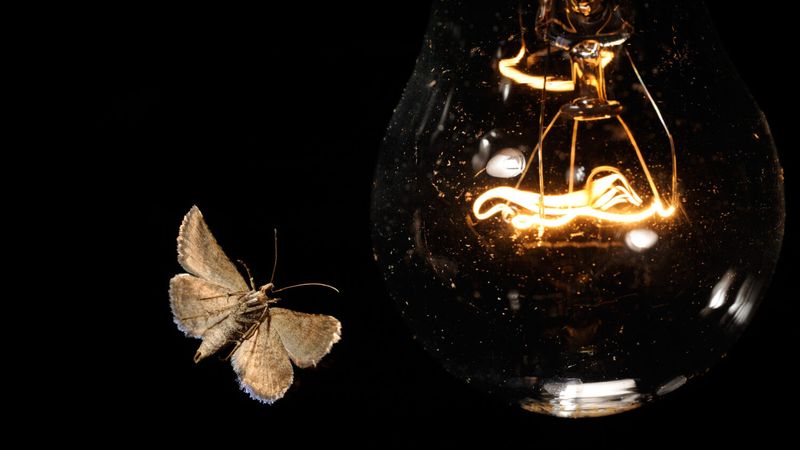
Moths have navigated by moonlight and starlight for millions of years, using those distant, consistent light sources to hold a stable flight angle. A bright porch bulb scrambles that system entirely.
Because the artificial source is close and far brighter than the night sky, a moth trying to maintain a fixed angle relative to it ends up spiraling inward or hovering nearby rather than traveling in a straight line.
Luna moths are particularly responsive to artificial light, especially wavelengths rich in ultraviolet energy. University of Florida IFAS guidance on luna moths notes the species’ strong attraction to lights, which is why you are far more likely to find one on a porch than resting quietly on a sweetgum leaf fifty feet away.
The porch is simply where the light made the moth stop.
Research on moth behavior more broadly shows that artificial lighting can disrupt normal nocturnal flight patterns and alter or suppress activity. A large-scale study published in Nature Communications found that flying insects gather at artificial lights because upward-tilted flight near a bright source causes them to lose altitude control, trapping them near the fixture.
A separate review of artificial light research, examining how nighttime lighting affects moth activity levels, found measurable behavioral and physiological effects across multiple species.
What those studies do not establish is that a single porch light directly causes a luna moth population to collapse. The evidence points clearly to altered behavior at the individual level, not to one fixture wiping out a regional population.
The moth on your porch is experiencing a disorienting pull toward your light, but the broader population’s health depends on many overlapping factors, including habitat, parasites, weather, and pesticide exposure across the landscape.
For the homeowner, the practical takeaway is straightforward: the porch is where the moth became visible, not necessarily where it originated. It may have started its night near a hickory stand in a neighbor’s yard or along a wooded creek corridor nearby, only to veer toward your light once it entered range.
Nearby hardwoods offer the real habitat clue
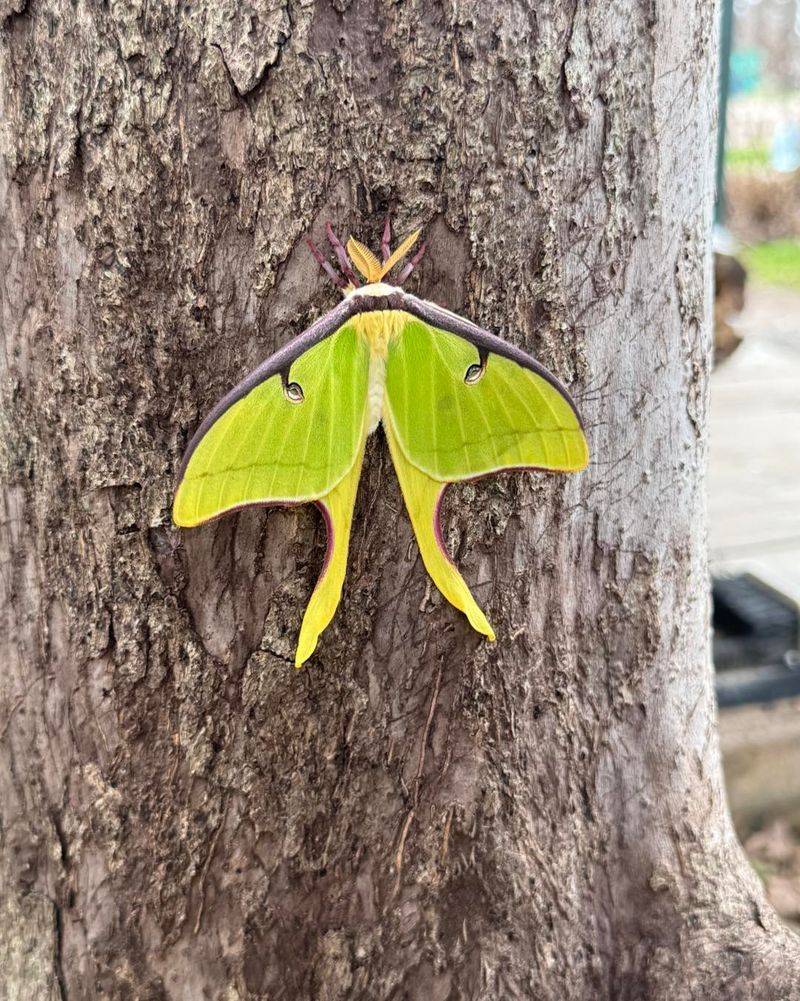
Adult luna moths do not eat, so the moth on your porch is not searching for food or a particular plant. What it was searching for, earlier in its short adult life, was a mate.
What the caterpillar it once was needed, however, was a specific kind of tree. That larval requirement is the real habitat signal hidden inside a porch sighting.
Luna moth caterpillars feed on the leaves of deciduous hardwood trees. North Carolina’s confirmed host plant records for luna moths include American sweetgum, American persimmon, hickories, black walnut, pecan, and winged elm.
Sweetgum appears to be a particularly common host in the Piedmont, though host use can shift depending on what trees are available in a given area. The North Carolina luna moth species account notes that the moth occurs across the state wherever suitable hardwood habitat exists, from coastal lowlands to mountain coves.
Here is the important qualification: an adult luna moth is capable of flying a considerable distance from wherever it emerged. The moth resting on your porch tonight may have developed as a caterpillar in your neighbor’s sweetgum, in a woodlot at the end of the street, or along a riparian corridor a quarter mile away.
A single adult sighting does not point to a specific host tree on your property, and it does not confirm that reproduction occurred in your yard.
Stronger evidence of local reproduction would look different. Eggs laid in small clusters on the underside of hardwood leaves, plump green caterpillars feeding on sweetgum or hickory foliage in late spring or summer, papery cocoons wrapped in leaves on the ground beneath a host tree, or repeated adult sightings near the same trees over multiple seasons, each of these would give you a more grounded reason to think luna moths are completing their life cycle nearby.
Luna moth life history records through the USA National Phenology Network can help you understand when to look for each stage in your region. One adult on a May night is a promising sign, but it is still just the beginning of a longer investigation.
Its size and color make it memorable, not necessarily rare
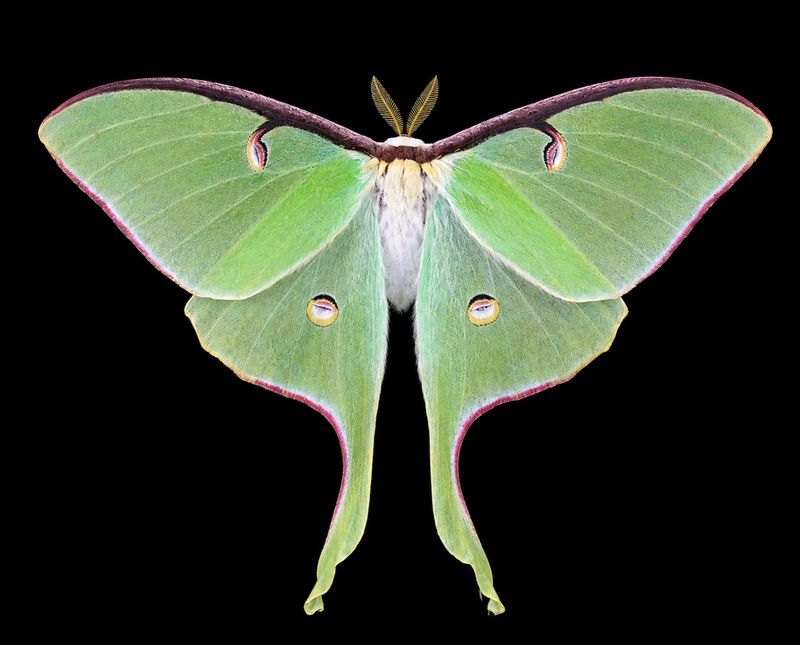
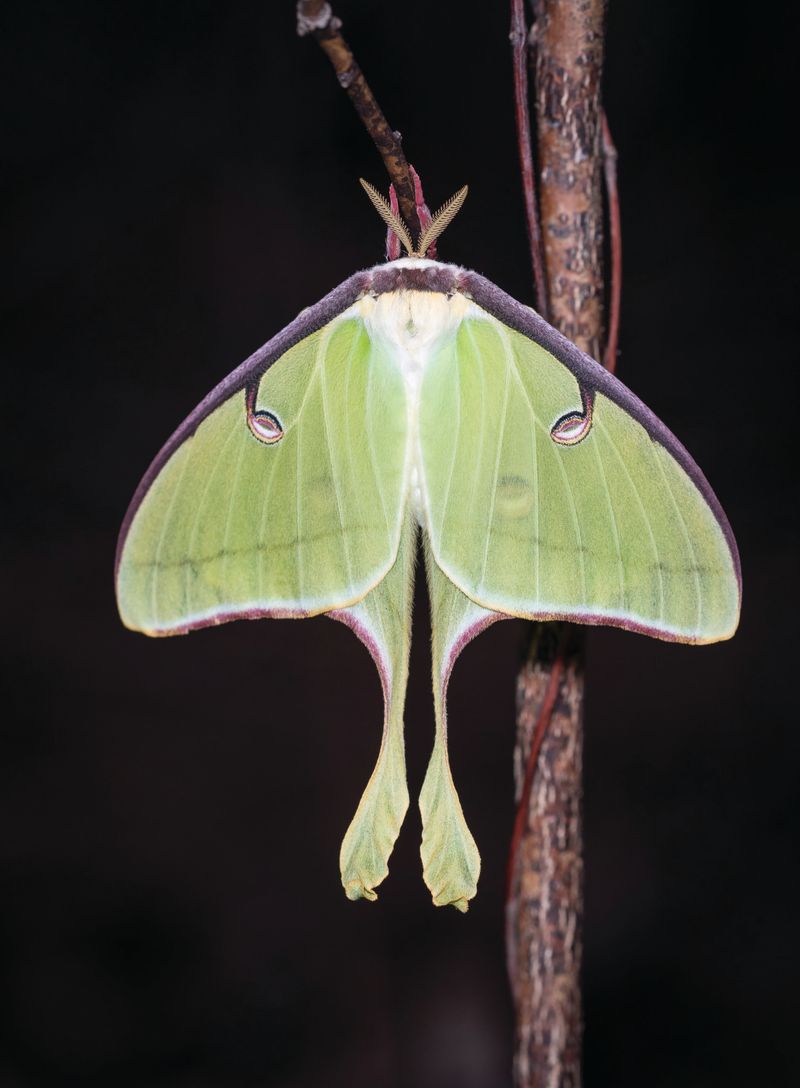
Few moths stop people in their tracks the way a luna moth does. The wingspan reaches roughly 7.5 to 10.5 centimeters, making it one of the largest moths a North Carolina homeowner is likely to encounter, and the pale lime green color is unlike almost anything else flying at night in the state.
North Carolina’s luna moth species account describes the adult as essentially unmistakable, with long trailing hindwing tails, subtle eyespots, and a delicate purple or maroon border along the leading wing edge.
When a porch light catches a luna moth at close range, the wings can look almost luminous. That quality is purely visual: the pale green scales reflect and scatter light in a way that reads as a soft glow to human eyes.
Luna moths do not produce their own light and are not bioluminescent in any way. “Glowing” is a perfectly good description of how they appear under a bulb, but it describes reflected light, not a biological feature of the moth itself.
The species is statewide and widespread in North Carolina, from the barrier islands to the Blue Ridge, and Butterflies and Moths of North America lists it as common with a secure global conservation status. Most people see luna moths infrequently because adults are nocturnal and live for only about a week, according to Clemson Cooperative Extension’s luna moth factsheet.
Their short adult window, combined with nighttime activity, means many adults complete their entire lives without anyone noticing.
One thing worth knowing before you try to offer the moth a snack: adult luna moths do not feed at all. Their mouthparts are non-functional, and every bit of energy powering their flight and reproduction was stored during the caterpillar stage.
Sugar water, nectar plants, and fruit set out for a luna moth will go untouched. The adult’s only jobs are to find a mate and, for females, to lay eggs before the week is out.
Leave the visitor undisturbed tonight
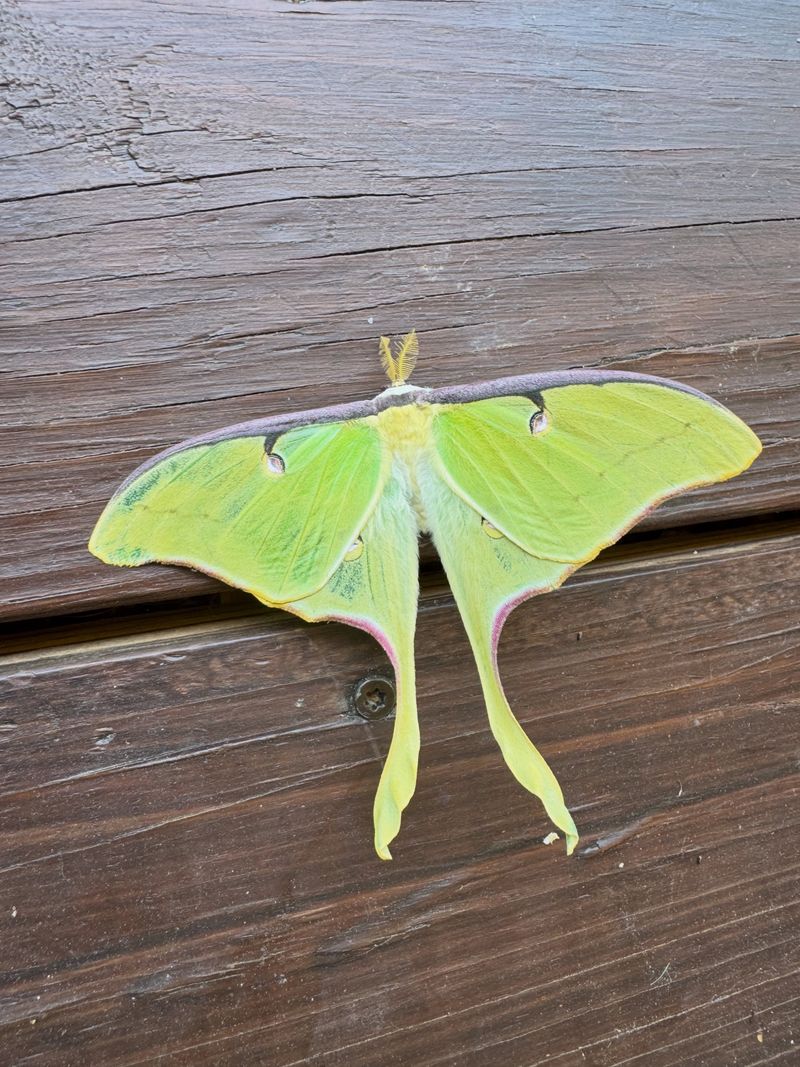
Watching a luna moth from a few feet away is genuinely one of the better wildlife encounters a North Carolina porch can offer. The best thing you can do for the moth is exactly that: watch.
Resist the urge to pick it up for a closer look. The wings are covered in microscopic scales that transfer easily to fingers, and handling can damage structures the moth needs for flight and, in the case of females, for finding a mate before her week-long adult window closes.
Clemson Extension’s luna moth guidance recommends observation without handling as the safest approach. Beyond avoiding touch, do not bring the moth indoors, where brighter lighting and unfamiliar surfaces add unnecessary stress.
Do not spray it with anything, including water misters, insect repellent, or any pesticide. Do not attempt to feed it, for the reasons covered earlier.
If the moth is resting quietly and not in any immediate danger, the right move is to let it rest and leave when it is ready.
Occasionally a moth settles in a genuinely risky spot: directly in a doorway with heavy foot traffic, on a surface a dog or cat is actively investigating, or somewhere it will almost certainly be crushed. In those situations, University of Florida IFAS guidance suggests that a cautious transfer to a nearby shaded vertical surface, such as the underside of a porch railing or a tree trunk just off the porch, can reduce that immediate risk.
Slide a piece of paper or a thin cardboard under the moth if it needs to be moved, avoid gripping the wings, and keep the transfer short and close. No published authoritative source lays out a precise universal protocol for every scenario, so use your judgment and err toward minimal intervention.
Reducing your porch lighting while the moth is present is a straightforward kindness. Turning off unnecessary fixtures, using a timer or motion sensor so lights are only on when needed, and shielding fixtures so light points downward rather than broadcasting in all directions are all steps supported by research on how artificial light affects moth behavior.
Studies examining artificial lighting and moth activity find consistent behavioral disruption, and research on how insects gather at artificial lights points to unnecessary illumination as the main variable worth controlling. No single bulb color has been shown to be harmless to every moth species, so the safer goal is simply less light overall, pointed in directions that serve people rather than flooding the night sky.
A wildlife-friendly yard protects the trees and caterpillars
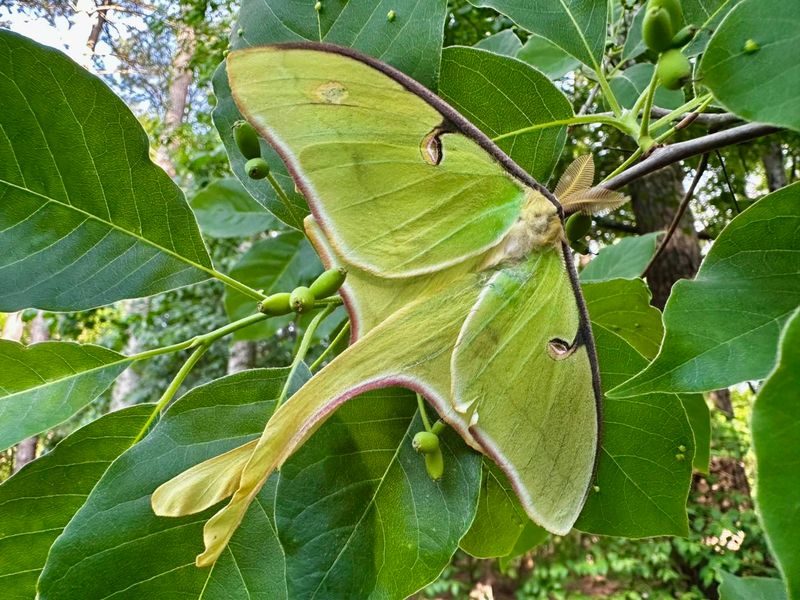
A luna moth encounter is a reasonable moment to take stock of how your yard treats the insects that depend on it, even if the moth itself cannot confirm what your management practices have been. The caterpillar stage is where habitat quality actually matters, and caterpillars need living hardwood trees that have not been treated with systemic insecticides or blanketed with broad-spectrum sprays during feeding season.
Preserving mature native hardwoods is the single most durable thing a homeowner can do for luna moths and dozens of other species that share the same trees. When a sweetgum, hickory, or black walnut is healthy and structurally sound, the case for keeping it is strong even if it drops debris or leafs out in an inconvenient spot.
If leaf feeding by caterpillars appears on a tree in late spring or summer, University of Minnesota Extension guidance on caterpillars in ornamental plantings notes that healthy trees generally tolerate moderate defoliation and that treatment is often unnecessary for plant health. Luna moth caterpillars do not build up in the numbers needed to cause serious harm to an established tree.
Pesticide decisions deserve careful thought. NC State Extension’s integrated pest management guidance recommends minimizing pesticide applications because insecticides can harm beneficial insects and nontarget organisms alongside any pest being targeted.
NC State’s guidance on biological pest control reinforces that broad-spectrum treatments can undermine the natural predator and parasite communities that already help regulate pest populations in a yard. Skipping an unnecessary spray on a host tree protects far more than luna moths.
Planting additional native hardwoods can expand available habitat over time. NC State Extension’s landscaping for wildlife guidance frames native plantings as long-term investments in the local food web.
That framing is accurate, but it comes with honest expectations: adding a sweetgum or persimmon to your yard improves the odds for future generations of luna moths and many other native insects, but host suitability, local population levels, seasonal timing, light pollution, predators, and pesticide exposure across the broader landscape all influence whether any reproduction actually occurs on your property. A new tree is an invitation, not a guarantee, and that is still worth extending.
University of Florida IFAS luna moth guidance supports this measured framing, noting the many interacting factors that affect whether a species successfully uses a given patch of habitat.
Read the Luna moth as an invitation to look closer

A luna moth on your porch confirms one clear thing: a native moth was present in your area that night. Beyond that, the sighting is consistent with, or may indicate, suitable hardwood habitat somewhere in the surrounding landscape, though it does not prove that this individual developed on your property or that reproduction occurred there.
That distinction matters because it keeps your response proportionate and honest.
The practical steps that follow from a sighting are modest and durable. Reduce unnecessary night lighting, use shielded fixtures and timers where possible, and preserve the native hardwoods already growing on or near your property.
If you want stronger evidence of local luna moth activity, start looking at your sweetgums, hickories, and persimmons in late spring and early summer for eggs, feeding caterpillars, or leaf-wrapped cocoons near the ground. North Carolina’s luna moth species account and the state’s confirmed host plant records can guide what to look for and where.
A single glowing visitor on a warm night is not a verdict on your yard, but it is a reasonable prompt to tend what you have. Healthy hardwoods, restrained pesticide use, and quieter nights are good stewardship whether or not a luna moth ever returns to confirm it.