
Why North Carolina Homeowners Should Never Knock Down The Mud Dauber Nests On Their Porch
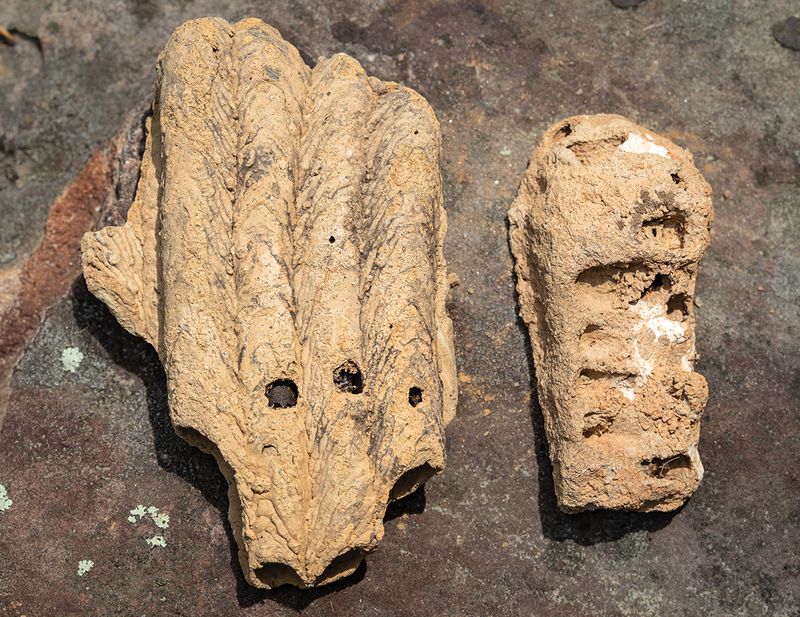
That clump of dried mud stuck to your porch ceiling might look like a mess worth scraping off, but it tells a more interesting story than most homeowners realize. The wasp that built it is a mud dauber, a solitary, generally docile insect that quietly hunts spiders around your door and asks for almost nothing in return.
Before you reach for a putty knife, a closer look at what that nest actually is, and what lives inside it, can help you make a smarter call for your household and your yard.
Identify the Nest Before You Touch It
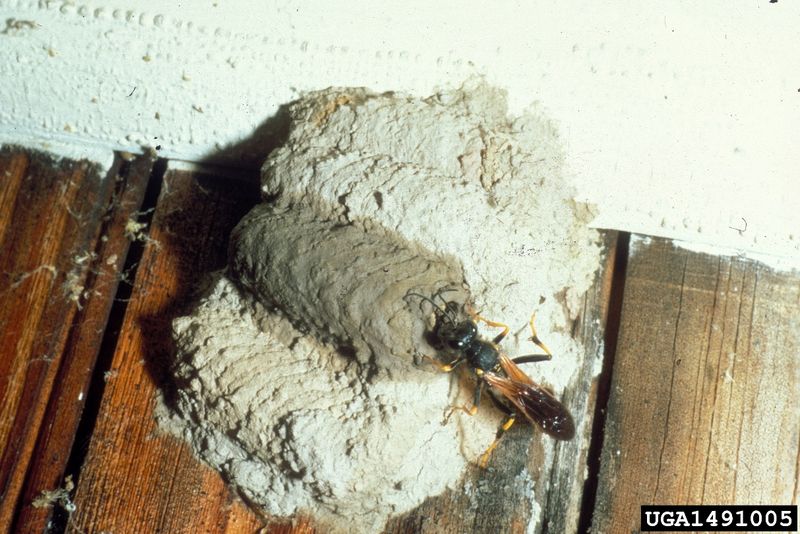
Reaching for the putty knife before you know what you are dealing with is the one move most likely to create a real problem. The first step with any wasp nest on a North Carolina porch is observation: stand back, watch for a minute, and look at what is actually built there before you decide anything.
A mud dauber nest and a paper wasp nest can both appear on a porch ceiling, but they call for very different responses.
Mud daubers are solitary wasps, and their nests reflect that. NC State Extension describes mud daubers as dark blue or black metallic wasps that construct mud nests on sheltered surfaces including porch ceilings, eaves, garages, sheds, and walls.
The mud structure is the defining feature: these wasps carry wet mud to the site and shape it into cells, producing anything from a lumpy cluster of rounded tubes to the long, parallel pipes associated with organ-pipe mud daubers. The nest is solid, earthy, and dull.
Paper wasp nests look nothing like that. They are made from chewed plant fiber, not mud, and they hang as open, papery combs with visible hexagonal cells.
If you can see individual cells from a distance and the material looks like gray paper rather than dried dirt, you are almost certainly not looking at a mud dauber. Paper wasps, yellowjackets, and hornets defend their colonies actively, which means an unfamiliar or defensive wasp nest should not be scraped down on a hunch.
“Mud dauber” also covers more than one species. University of Minnesota Extension notes that black-and-yellow mud daubers, blue mud daubers, and organ-pipe mud daubers all fall under this common name, and their nests can look noticeably different from one another.
Blue mud daubers, for example, often renovate old nests built by other species rather than starting from scratch. When you are not certain which insect built what you are looking at, treat the nest as unidentified and do not disturb it until you can confirm what you have.
Why a Correctly Identified Mud Dauber Usually Keeps Its Distance
Social wasps, the kind most people have been stung by, live in colonies and rely on a workforce of stinging defenders. Yellowjackets, hornets, and paper wasps all have workers whose job includes protecting the nest from disturbance.
Mud daubers operate on a completely different model.
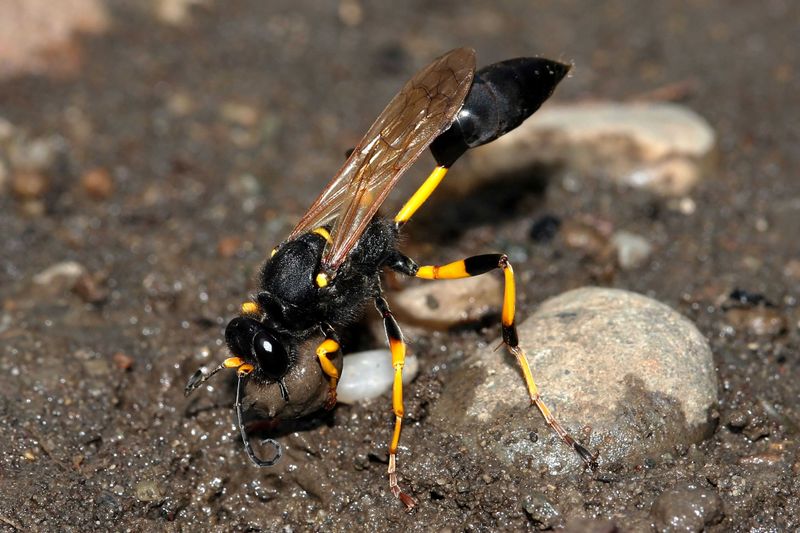
A female mud dauber builds and provisions her nest entirely on her own. There is no colony, no queen to protect, and no worker force patrolling the perimeter.
University of Minnesota Extension confirms that solitary wasps like mud daubers do not defend their nests the way social species do, which is the practical reason a mud-dauber nest on an out-of-the-way porch rafter generally poses less immediate risk than a paper wasp nest near a doorframe.
NC State Extension describes mud daubers specifically as “not prone to sting,” and that reputation holds up across multiple university sources. A mud dauber flying around the porch or returning to the nest with a load of mud is not behaving aggressively.
She is focused on construction or provisioning, not on defending territory.
That said, “not prone to sting” is not the same as “incapable of stinging.” Colorado State University Extension is clear that a sting remains possible when a mud dauber is handled, trapped, crushed, or pressed against the body. People with a history of serious reactions to insect stings should factor that risk into any decision about tolerating or removing a nest, regardless of how low the baseline sting risk is.
The useful framing for this section is “low risk when left undisturbed,” not “harmless.”
What the Wasp Actually Does With Spiders
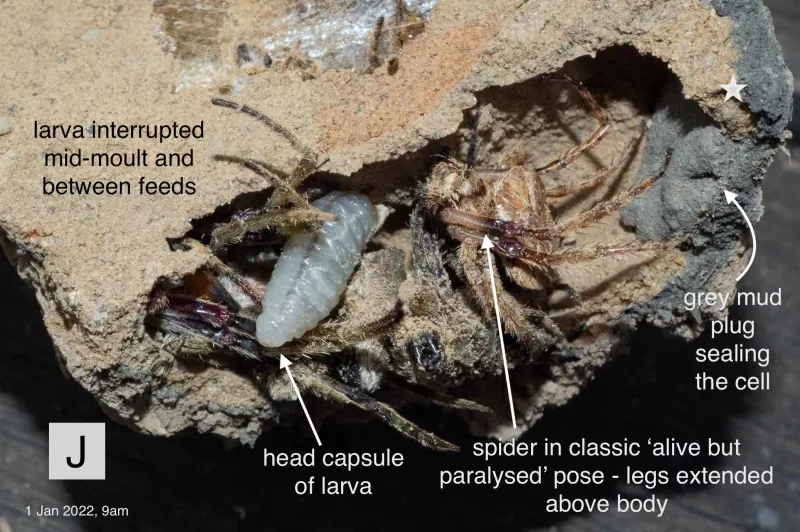
The mud-dauber-as-spider-patrol idea has a real biological basis, even if it gets oversold. Every mud cell the female builds is intended as a food cache for a single larva, and spiders are what she stocks it with.
The process is precise: she locates a spider, stings it to paralyze rather than kill it, hauls it back to the nest, and deposits it inside the cell before sealing the chamber. Ask Extension confirms this sequence, describing the female capturing and paralyzing spiders and placing them in cells as larval food.
One cell can hold more than one spider. Research on Sceliphron caementarium, the black-and-yellow mud dauber, documents considerable variation in how many spiders end up in a single cell.
A study published in Behavioral Ecology found that individual wasps within the same population can behave as specialists or generalists when it comes to prey selection, meaning one female may concentrate on a single spider family while another collects from several. Colorado State Extension reports that a typical black-and-yellow mud dauber cell may contain six to fifteen spiders, but counts as high as 25 have been documented.
The exact number depends on the wasp, the species, the cell, and what prey is locally available.
That variability matters when you are thinking about what the nest on your porch ceiling is actually doing. A female mud dauber hunting around your door is capturing spiders she finds nearby, but her selections are not curated for your benefit.
She is not targeting only the species you would prefer to have removed, and she is not working through a list of medically significant spiders first. Research on prey choice shows she may collect orb-weavers, crab spiders, wolf spiders, jumping spiders, or other species depending on what she encounters.
The practical takeaway is that a mud dauber nest represents genuine spider predation, not a guarantee of spider-free conditions. Tick control is a separate matter entirely: the sources reviewed here describe spider predation, and there is no established evidence that a mud-dauber nest meaningfully reduces ticks around a North Carolina home.
Fewer Spiders Does Not Automatically Mean a Better Yard
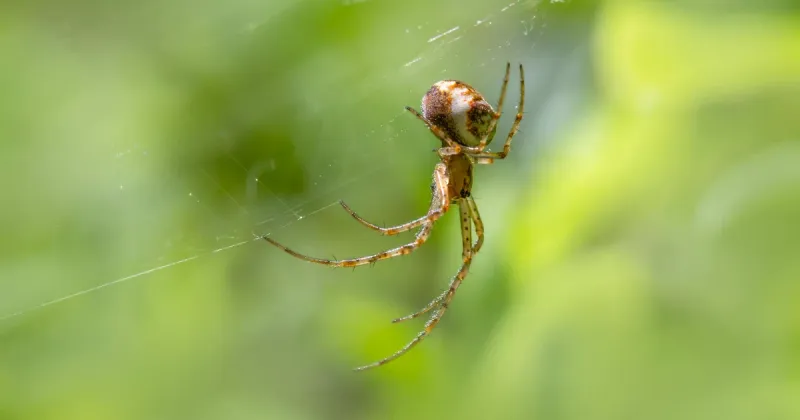
Mud daubers hunt spiders, and that sounds like a straightforward win for the homeowner. Before treating a nest as a free pest-control service, though, it helps to know what spiders are actually doing in your yard.
NC State Extension’s guide to spiders in and around homes describes spiders as beneficial predators that consume large numbers of insects, including flies, mosquitoes, and other nuisance species around the house.
Removing spiders from a porch ecosystem is not a neutral act. Most of the spiders a mud dauber collects are harmless to people and actively useful as insect predators.
The prey-selection research shows that mud daubers collect from a range of spider families depending on local availability, which means the wasps are not selectively removing the species a homeowner might consider unwanted while leaving the rest. A mud dauber nest may reduce the number of spiders near a particular surface, but that reduction does not automatically improve the yard’s overall insect balance.
The smarter frame for a North Carolina homeowner is this: a mud-dauber nest in an unobtrusive spot is a modest, low-cost reason to leave a native predator in place, not a guaranteed household pest-control upgrade. The wasp contributes to the backyard food web by cycling spiders into larval nutrition, and that has value in a wildlife-conscious yard.
What it does not do is reliably clear a porch of unwanted spiders, eliminate medically important species, or stand in for other pest-management practices.
Treat the wasp’s presence as a small ecological bonus rather than a service contract. If the nest is correctly identified and out of the way, tolerating it supports the native food web around your home without creating meaningful risk.
That is worth something, even when the benefit cannot be measured precisely.
When Leaving the Nest Makes Sense
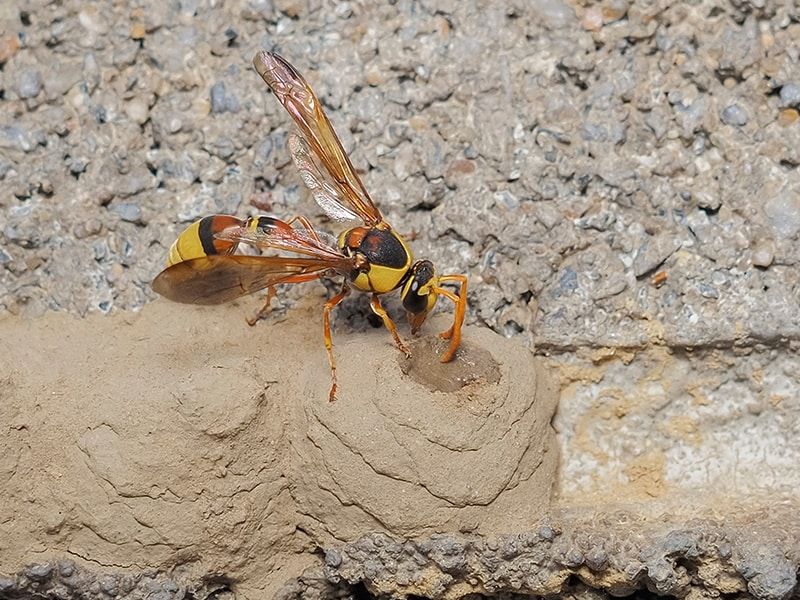
Not every mud-dauber nest needs a decision right away. When the nest sits high on a porch rafter, tucked under an eave, or in a corner well away from doors, seating, paths, and play areas, the simplest and lowest-risk choice is usually to leave it alone.
University of Minnesota Extension explicitly notes that homeowners may simply ignore mud-dauber nests when they are not causing a problem, and that guidance reflects the low sting risk associated with an undisturbed, correctly identified nest.
Location is the primary factor. A nest that sits above a doorway people use several times a day, over a chair where children sit, or directly above a maintenance area creates more contact opportunity than one in a quiet corner of the garage or beneath a seldom-used porch overhang.
The further a nest sits from regular foot traffic and daily activity, the more reasonable toleration becomes.
The condition of the nest also offers useful information. Sealed mud cells may contain developing insects, including immature stages that can overwinter inside the hardened mud.
Ask Extension notes that the immature stages of solitary wasps can be found inside nest cells well after the adult has gone. A nest with small, clean exit holes in some of the cells is a different situation: those holes indicate that adults have already emerged from those chambers, meaning that portion of the nest has served its purpose.
An old nest with multiple exit holes may be partly or fully vacated, while a nest with all cells still sealed is more likely to contain developing insects.
Toleration is a reversible choice. Leaving a nest in place this season does not commit you to keeping it permanently.
If the wasp returns and extends the nest into a less convenient location, or if the porch layout changes and the nest now sits in a higher-traffic spot, you can reassess. Treating the decision as flexible rather than permanent makes it easier to choose the lower-disruption option when the nest is genuinely out of the way.
How to Remove a Nest Without Creating a Bigger Problem
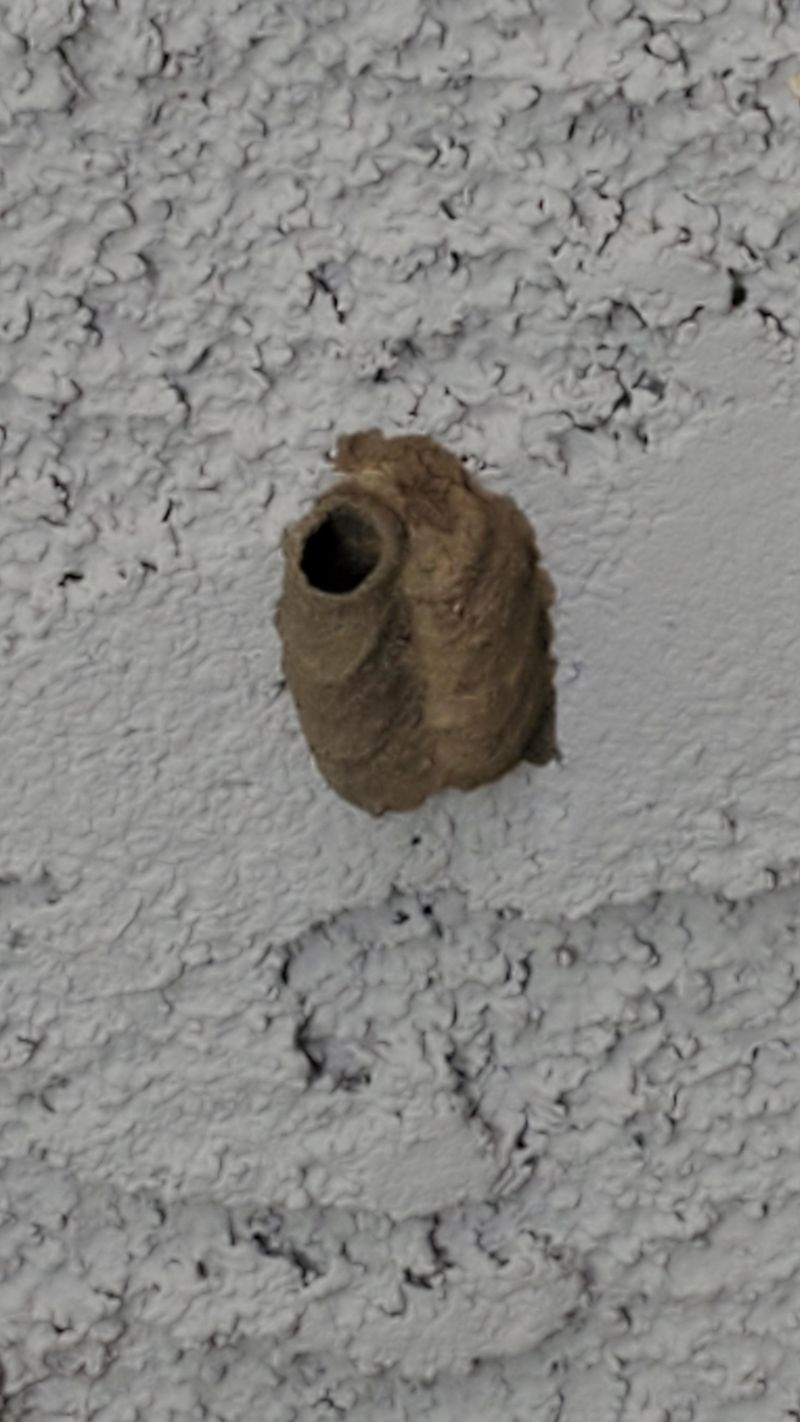
Sometimes a nest needs to come down. Maybe it sits directly over a door handle, above a spot where a child plays, or along a maintenance route where someone will inevitably brush against it.
Removal is a legitimate option for a correctly identified mud-dauber nest, and university extension sources support it. The key is doing it without turning a low-risk situation into a higher-risk one.
Confirm the nest and the insect before you act. If the wasp behaves defensively, if you cannot see the insect clearly, or if the nest does not look like dried mud, stop and reassess.
NC State Extension notes that mud daubers and paper wasps are commonly confused, and paper wasp nests require a different response. An uncertain identification is reason enough to call a pest professional rather than proceed on your own.
For a dry, correctly identified nest with no adult wasp present, Penn State Extension describes scraping the dried mud from the surface as the standard physical approach. Use a putty knife or similar flat tool, work steadily, and clean any residual mud from the surface with soap and water afterward.
Do not scrape an active nest or attempt to handle a live adult. Wait until the wasp is absent from the nest before you begin.
If you cannot reliably wait for the adult to leave or cannot safely confirm she is gone, hire a pest professional.
Colorado State University Extension recommends physical removal over chemical treatment for mud-dauber nests, and that guidance applies here. Pesticides are generally unnecessary for a solitary, nonaggressive wasp that does not defend its nest.
If you choose to use a pesticide for any reason, the product must be registered for that specific use, and EPA guidance is explicit: using a pesticide inconsistently with its label violates federal law. Read the current label before applying anything.
Extra caution applies any time a ladder or overhead work is involved. Working above shoulder height while watching for a wasp increases the risk of a fall.
Wear eye protection and gloves even for a nest that looks empty. Keep children and pets away from the work area until the nest is completely removed and the surface is clean.
Anyone with a sting-allergy history should not attempt removal and should contact a pest professional instead.
Replace “Never” With a Better Porch Rule
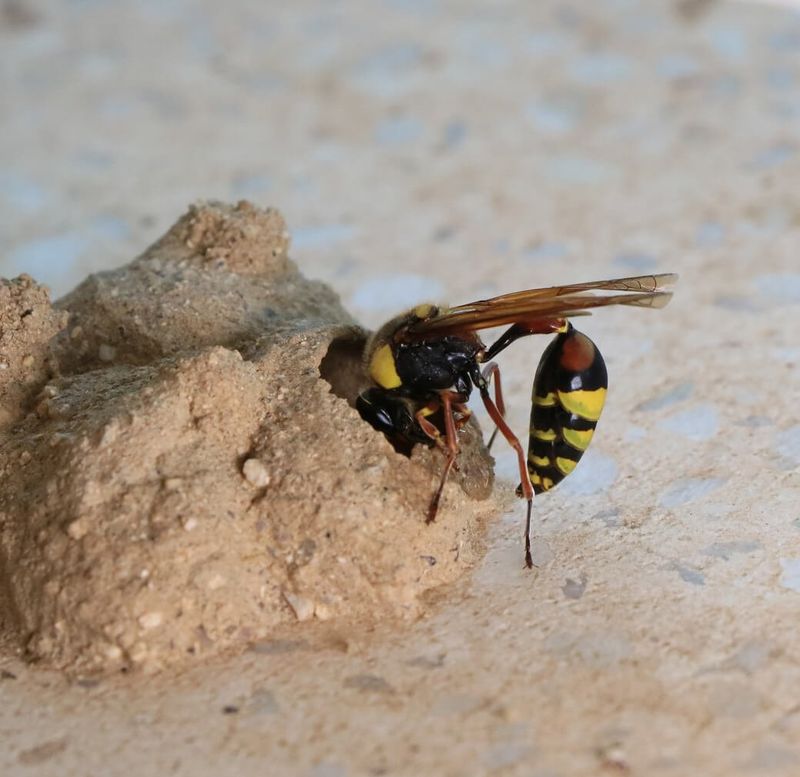
The title’s “never” makes a better headline than a safety rule. A more useful version goes like this: observe the nest, confirm what it is, and then decide based on where it sits and what it is doing.
NC State Extension and University of Minnesota Extension both support leaving a correctly identified mud-dauber nest alone when it is not causing a problem, and both acknowledge that removal is a reasonable option when the location creates a genuine safety or access concern. Neither source instructs homeowners to preserve every nest indefinitely or to remove every nest automatically.
The decision belongs to the household, and it should be based on identification first.
A mud dauber nest in a quiet corner of the porch is a small, native contribution to the backyard food web. The wasp hunts spiders, stocks her cells, and moves on without defending territory or threatening anyone who gives her space.
That is worth tolerating when the location allows it. When it does not, careful physical removal is a well-supported alternative that does not require pesticides or unusual risk.
The best porch rule is a simple one: look before you scrape, and let the location, not the reflex, make the call.