
What It Really Means When A Great Blue Heron Keeps Visiting Your North Carolina Garden Pond
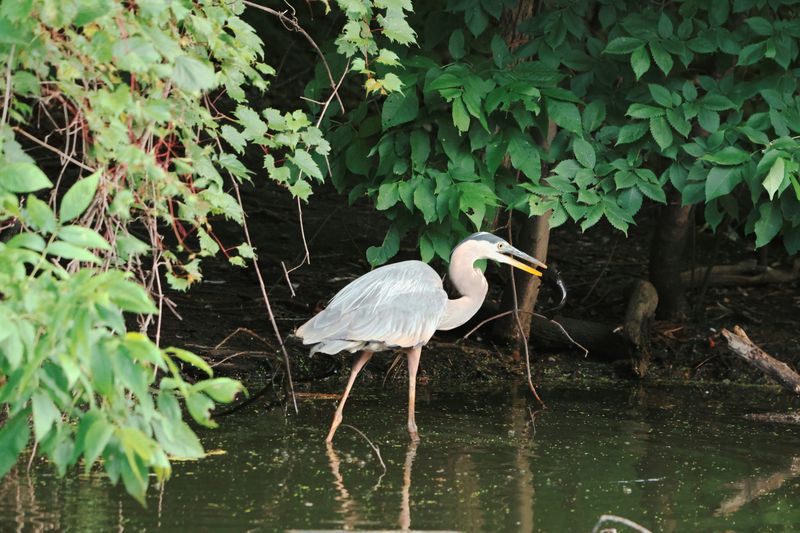
Spotting a great blue heron at your garden pond once is a thrill. Seeing that same bird pick its way back to the water’s edge again and again raises a question most North Carolina homeowners haven’t thought to ask: what does this bird actually know about my pond that I don’t?
The answer has less to do with how clean or healthy the water is and more to do with what the heron is hunting. Understanding that difference can change how you manage your pond and how you respond to the bird.
A returning heron has found a reliable feeding site
When a great blue heron shows up at your garden pond more than once, the most straightforward explanation is also the correct one: the bird found food there and came back for more. NC Wildlife’s profile of the great blue heron confirms that these birds are common across the entire state, using freshwater ponds, rivers, swamps, drainage ditches, and developed shorelines wherever shallow water gives them a place to stand and hunt.
Your garden pond fits that description almost perfectly.
Herons are deliberate foragers. They do not wander randomly from yard to yard hoping something edible turns up.
Once a bird identifies a site that reliably produces a meal, it returns, sometimes at the same time of day, sometimes by the same approach path. Penn State Extension’s pond and lake wildlife guide notes that herons may learn the characteristics of individual ponds and revisit whenever the hunting is good.
That pattern of return is evidence of a feeding choice, nothing more and nothing less.
What repeat visits do not tell you is whether your pond is chemically sound, ecologically balanced, or unusually productive. A heron is a predator reading the landscape for prey, not a water-quality inspector signing off on your filtration system.
The pond may be in excellent condition, or it may have nutrient problems, runoff issues, or low dissolved oxygen, and the bird will visit either way if the prey is accessible. Treat the returning heron as a sign that your pond has become a usable feeding site, then look separately at the water and the broader habitat to understand what that actually means for the ecosystem you are managing.
What the bird is standing still to track
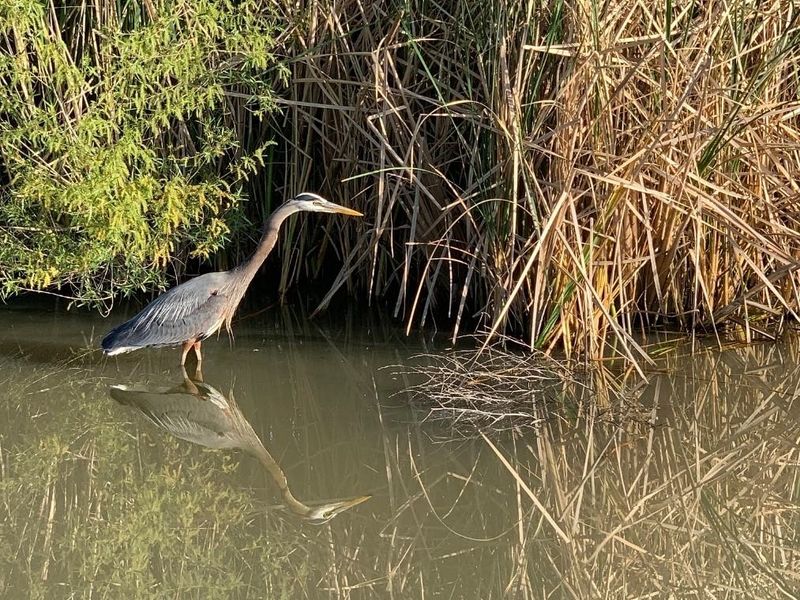
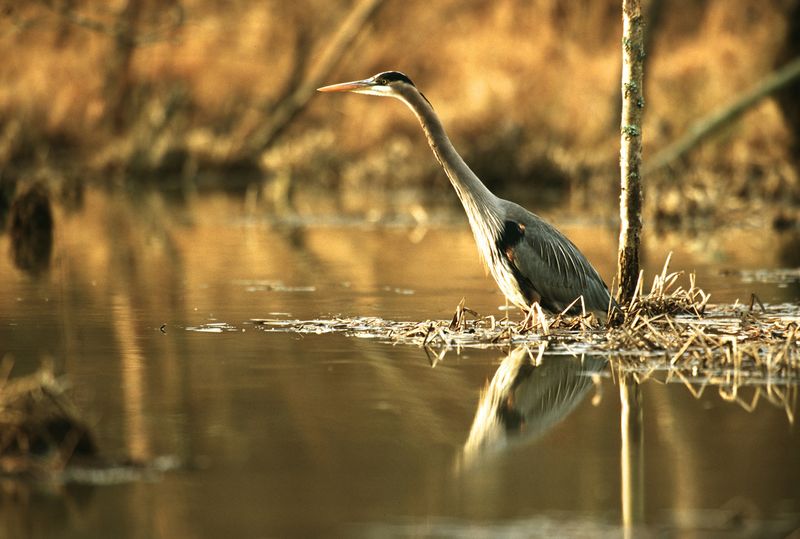
That frozen, statue-like posture at the pond edge is one of the most effective hunting techniques in the bird world. The heron locks its body still, watches the water below, and waits for movement.
Most pond owners assume the target is koi, but the bird’s menu is considerably broader than that.
According to Cornell Lab of Ornithology’s species account for the great blue heron, the bird takes fish, frogs and other amphibians, crayfish, snakes and lizards, large insects, and occasionally small mammals such as voles. NC Wildlife’s species page echoes that range, noting that herons hunt in both freshwater and saltwater environments and adapt their diet to whatever prey is available.
A heron standing at the edge of your pond could be tracking a bullfrog tucked under a lily pad just as easily as it is eyeing an orange koi near the surface.
Repeat visits reveal that the bird has found prey that is accessible, concentrated, or easy to catch at your specific pond. That does not mean the prey community is thriving in any ecological sense.
A shallow pond with little cover, for example, may expose fish or frogs to predation precisely because they have nowhere to hide. A homeowner who recently restocked koi has essentially set a well-stocked table.
Seasonal changes matter too: spring brings frog breeding activity to the water’s edge, drawing herons that may not visit at all during the drier months of summer.
Paying attention to what the heron actually does at the pond, whether it strikes at the surface or wades into shallower margins, can help you identify which prey it is targeting. That observation is genuinely useful information when you are deciding how to manage the pond or protect specific animals you care about.
The heron does not certify your pond’s water quality
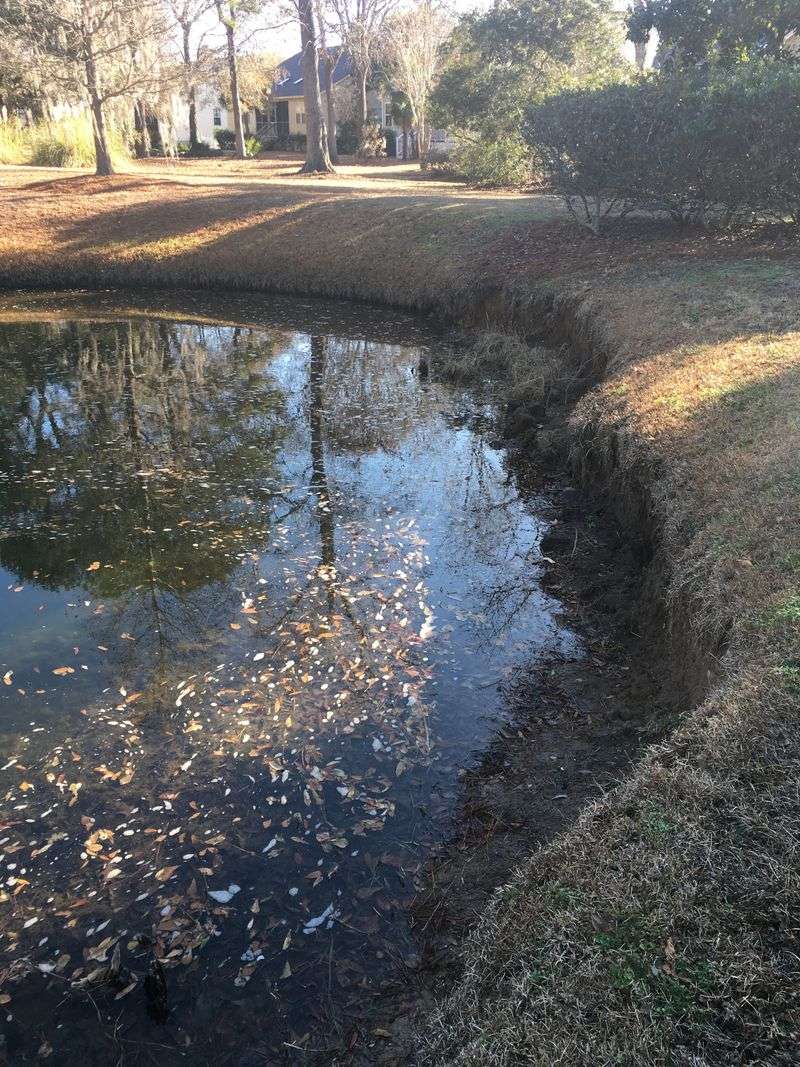
A predator choosing a feeding spot and a pond passing a water-quality assessment are two entirely separate things, and it is worth being direct about that distinction. The heron is making a hunting decision based on where prey is accessible.
It is not evaluating your pond’s nutrient levels, sediment load, or dissolved oxygen concentration before deciding to land.
NC State Extension’s pond management guide identifies runoff, excess nutrients, sediment accumulation, and low dissolved oxygen as serious pond-management concerns that can develop even in ponds that look clear and well-maintained from the surface. Algae blooms, nutrient loading from surrounding lawn fertilizers, and stormwater carrying sediment from nearby construction can all affect water chemistry without producing obvious visual clues.
A heron hunting in that water has no way to signal those problems to you, and its presence offers no assurance that they do not exist.
Reliable water-quality assessment combines physical observation with chemical testing and biological evaluation. EPA guidance on biological water quality criteria explains that healthy aquatic ecosystems are evaluated using multiple lines of evidence, including physical habitat, chemical parameters, and the composition of biological communities.
A single conspicuous bird at the water’s edge cannot substitute for any of those measures. Similarly, USGS research on ecological health in the nation’s streams demonstrates that assessing aquatic ecosystem condition requires coordinated physical, chemical, and biological data rather than any single indicator.
Think of the returning heron as a prompt to look more carefully at the pond, not as a clean bill of health. Check for algae mats, unusual odors, fish gasping at the surface, or murky water after rain.
Those observations, combined with a simple water-chemistry test kit or a conversation with your local Cooperative Extension office, will tell you far more about pond condition than the bird ever can.
Frogs can reveal habitat conditions the heron cannot
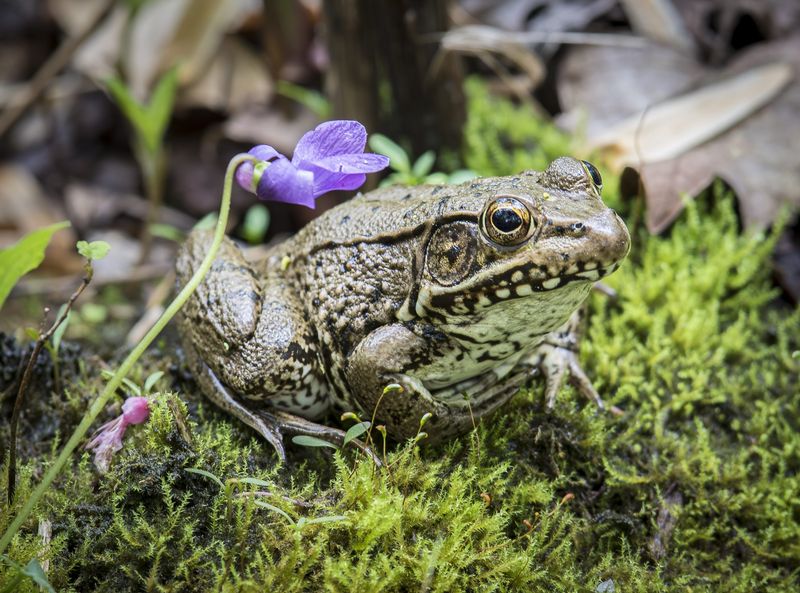
Frogs are worth paying close attention to, but for reasons that have nothing to do with the heron hunting them. Amphibians spend critical parts of their life cycle in direct contact with the water, the sediment, and the air above the pond.
That exposure makes them genuinely sensitive to changes in water and habitat quality in ways a large wading bird simply is not.
NC State Extension’s guide to reptiles and amphibians in your backyard notes that amphibians are considered important indicators of environmental health because many species cannot complete their development in water that is heavily polluted or chemically altered. Frog eggs and tadpoles are especially vulnerable to pesticide runoff, acidification, and changes in dissolved oxygen.
If several native frog species are breeding successfully in or near your pond across multiple seasons, that pattern is more meaningful than a single sighting on a warm April evening.
Even so, frog presence alone cannot establish that every dimension of water quality is acceptable. A pond might support one tolerant species while conditions remain unsuitable for others.
Seasonal drought, regional variation across the Piedmont, Coastal Plain, and Blue Ridge, and the specific amphibian community in your area all affect which frogs you are likely to see and when. NC State’s pond management guidance also points out that water quality and habitat suitability are shaped by local land use, runoff patterns, and pond structure, factors that vary considerably across the state.
Resources from NC Wildlife’s wetlands and ponds landowner page offer practical starting points for improving habitat conditions that benefit amphibians. Watching which frog species appear, whether egg masses develop successfully, and whether tadpoles survive through metamorphosis gives you a richer picture of pond health than any single visit from a predator at the waterline.
Fish and frogs may need different kinds of ponds
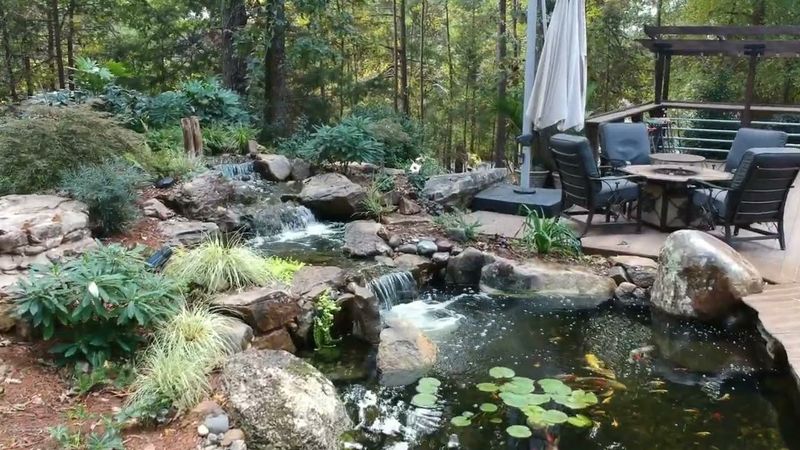
One of the most practical decisions a North Carolina pond owner can make is figuring out which goal matters most: supporting ornamental fish, supporting amphibians, or trying to balance both. Those goals are not always compatible, and understanding why can save a lot of frustration.
Fish eat amphibian eggs and larvae. That is not an edge case or an occasional problem; it is a regular feature of pond ecology.
NC State Extension’s guide to pools for amphibians recommends fishless seasonal pools specifically for homeowners whose primary goal is amphibian conservation. A shallow, temporary pool that fills with winter and spring rains and dries by midsummer can support breeding populations of salamanders and frogs that would never survive in a permanent pond stocked with koi or goldfish.
The absence of fish is the feature, not a flaw.
A permanent ornamental fish pond, by contrast, is a managed system built around the needs of the fish. Koi and goldfish require good filtration, stable water temperature, and adequate depth to survive North Carolina winters.
NC State’s amphibian and reptile guidance makes clear that fish-filled permanent ponds are generally poor amphibian habitat, even when they look lush and naturalistic from the outside.
If you want both, consider maintaining two separate water features: a filtered permanent pond for ornamental fish and a smaller, shallower, fishless basin planted with native vegetation for amphibians. That separation lets each system do what it does best.
The heron will likely focus on the fish pond regardless, so the fishless pool also serves as a refuge for frogs that might otherwise be exposed to predation at the main pond’s edge. Separating goals by feature, rather than hoping one pond serves every purpose, tends to produce better results for both the fish and the frogs.
Pond structure can support prey while giving fish cover
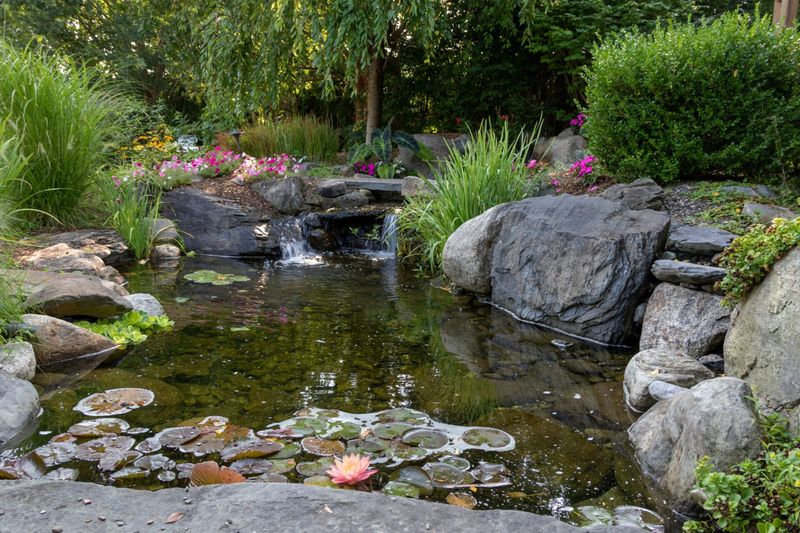
Rather than viewing the heron purely as a problem to solve, consider what its visits reveal about the pond’s physical layout. A bird that wades easily along a flat, open shoreline is telling you that fish and frogs have few places to hide.
Improving pond structure addresses that exposure directly, and it benefits the broader habitat at the same time.
Native marginal plants such as pickerelweed, blue flag iris, and lizard’s tail planted along the pond edge create stem and root tangles that give small fish and amphibians places to shelter. Submerged woody debris, a recommendation found in NC Wildlife’s supplemental water habitat guidance, adds structural complexity below the surface and increases the number of microhabitats available to fish and invertebrates.
Varied depth across the pond, with shallower margins for amphibians and deeper zones for fish, also improves the overall habitat value of the feature.
For ornamental fish specifically, Cornell Lab’s great blue heron species account recommends placing large-diameter drainpipe sections or similar stable structures on the pond floor as hiding spots. Fish that can retreat into a sheltered space when a shadow crosses the water are harder to catch than fish schooling in open, shallow water.
NC State’s pond management guide also supports adding structural complexity as a way to improve overall pond function.
None of these changes guarantee that the heron will stop visiting. A patient bird will wait out a cautious fish, and herons are nothing if not patient.
What structural improvements do accomplish is shift the balance slightly in favor of prey survival while making the pond more ecologically interesting for the full range of animals that use it across the seasons.
Protect koi with exclusion, not improvisation
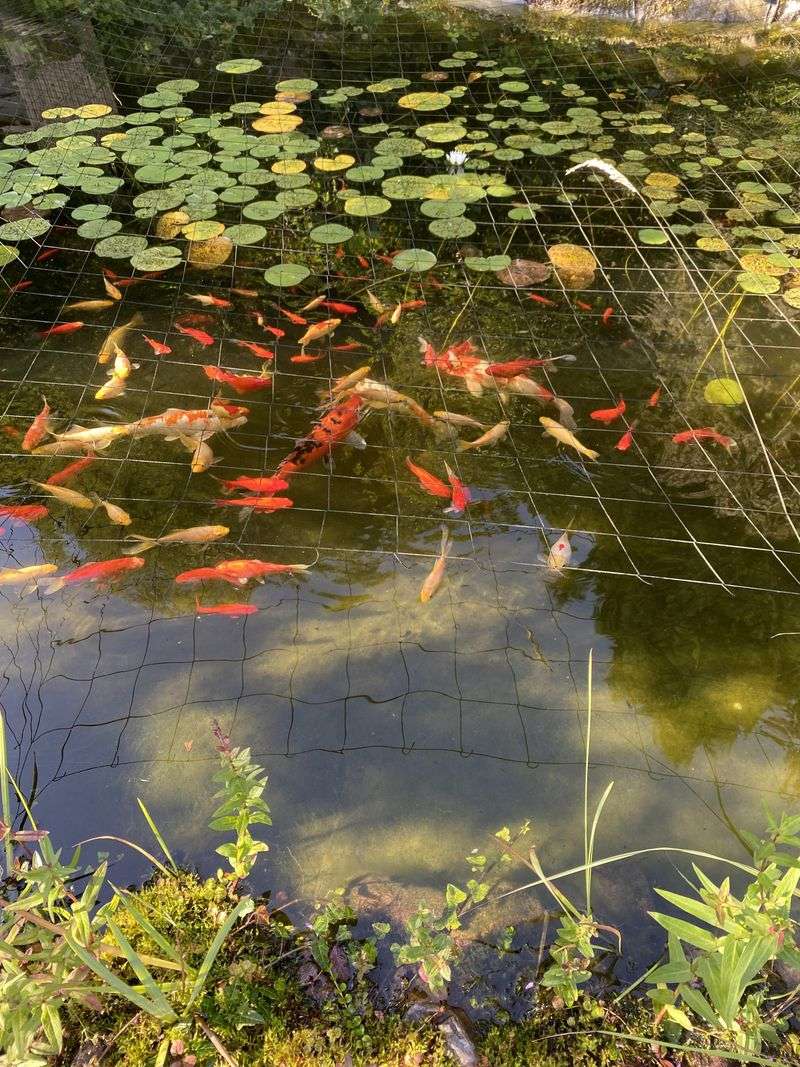
For homeowners who have invested in koi or other ornamental fish, watching a heron work the pond edge is more than a wildlife observation. It is a real threat to animals that can cost hundreds of dollars each and may have been in the pond for years.
The good news is that effective protection exists. The less good news is that it requires more care than most improvised solutions provide.
USDA APHIS wildlife damage management guidance for herons and egrets identifies total exclusion as the most dependable approach for urban water gardens. That means a physical barrier, properly installed pond netting or an exclusion frame, that prevents the bird from reaching the water’s surface entirely.
Penn State Extension’s heron guidance specifically recommends taut pond netting as a reliable protective measure for small ornamental ponds.
Installation matters enormously. Virginia Tech Extension’s wildlife in the home pond garden guide warns explicitly that loose or poorly supported mesh can trap and injure herons, turtles, and other wildlife.
Netting should be held taut by a supported frame or stakes, pulled tight enough that a bird landing on top cannot reach through to the water, and inspected regularly for sagging, tears, or gaps. Loose fishing line strung across the pond is not a safe or dependable substitute.
Scare devices, motion-activated sprinklers, reflective tape, and decoys may slow a heron down, but birds can habituate to stationary or repetitive deterrents over time. Penn State’s aquaculture bird-control guidance recommends rotating devices and changing their position regularly rather than relying on any single method.
A plastic heron decoy placed at the pond edge may deter a bird initially, but it can lose effectiveness quickly, and during breeding season some sources note it may actually attract other herons rather than repel them. Physical exclusion, done correctly, remains the most consistent option for protecting fish you cannot afford to lose.
Watch the visitor, then manage the pond you actually have
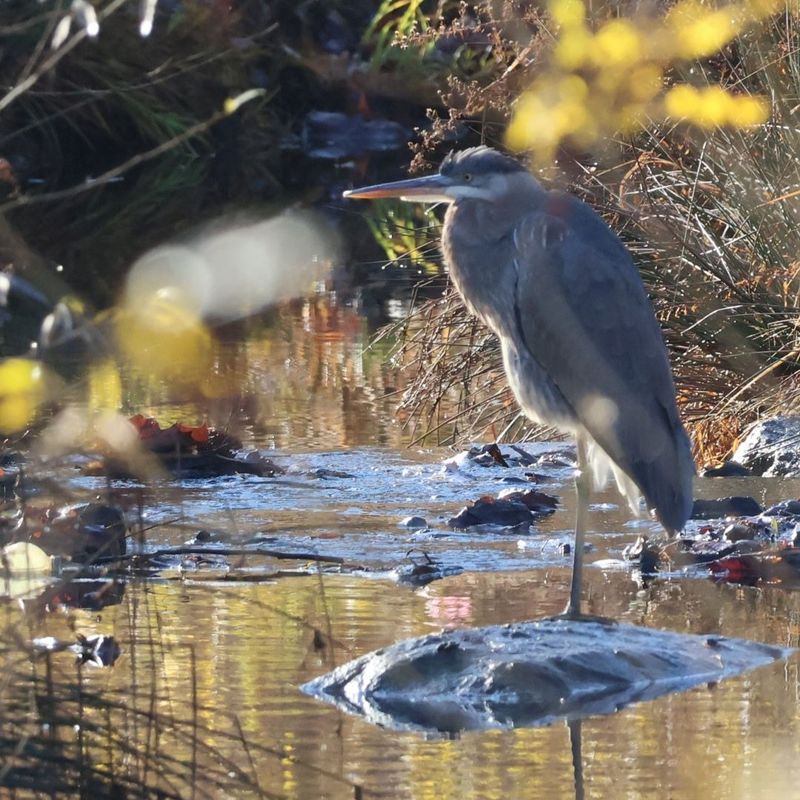
Good pond stewardship starts with observation, and the heron has already done you a favor by drawing your attention to the water’s edge. Before changing anything, spend a few mornings watching from a comfortable distance.
Note whether the pond shoreline is shallow and open, giving the bird easy wading access, or whether plants and structure push it to hunt from a single exposed spot. Watch whether the heron strikes at the surface or wades into the margins, which can help you figure out whether fish or amphibians are the primary draw.
After observing, assess the pond on its own terms. Check water clarity, look for algae accumulation, and consider whether runoff from nearby lawn areas reaches the pond after rain.
NC State Extension’s pond management guide is a practical starting point for identifying common problems and matching them to management options. If a nesting colony is anywhere nearby, keep well back and avoid foot traffic near the site during nesting season, following NC Wildlife’s guidance that nesting colonies are sensitive to human disturbance.
For an individual bird at a backyard pond, observing from a respectful distance is sufficient.
Great blue herons are protected under the federal Migratory Bird Treaty Act, which means harassing, trapping, or harming the bird is not a legal option. For complex management questions, the NC Wildlife Resources Commission and the U.S.
Fish and Wildlife Service are the right places to turn. The heron at your pond is a clue worth reading carefully.
What it tells you is that the water is feeding something. What you do with that information, and how you assess everything the bird cannot tell you, is where real pond stewardship begins.