
What It Really Means When Deer Keep Bedding Down In The Same Corner Of Your North Carolina Yard

Glancing out the back window to find a deer curled up in the same shady corner for the third time this week is one of those moments that makes you stop and wonder. Most North Carolina homeowners want to know whether the animal is sick, whether it has chosen their yard for a reason, and whether they should do anything about it.
The answer is simpler and more practical than most people expect, and understanding it can help you protect your plants, your family, and the deer itself.
A Deer Bed Is Usually a Daytime Refuge, Not a Message
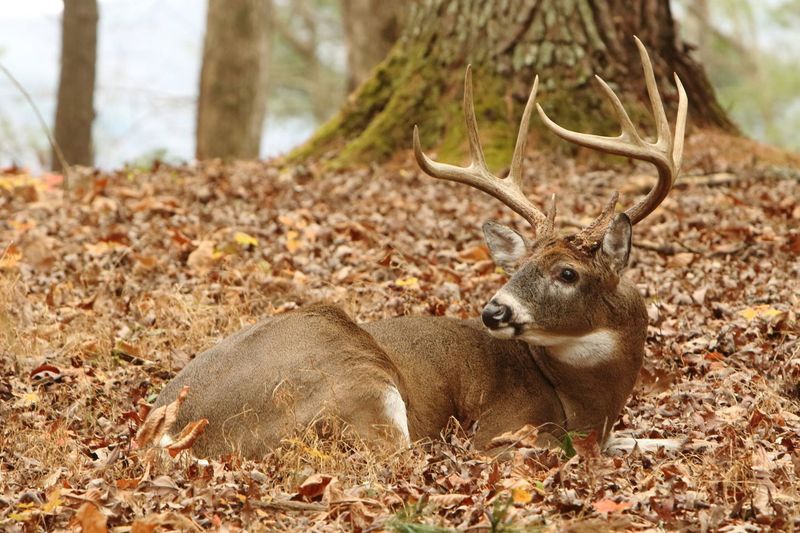
Quiet, tucked-in, and perfectly still, a deer resting in your yard corner is almost certainly doing exactly what deer do every day: recovering from a night of feeding by settling into reliable cover. NC State Extension’s wildlife guidance notes that white-tailed deer typically feed during dawn, dusk, and nighttime hours before pulling back into heavier cover during daylight.
That pattern is normal, seasonal, and repeated across millions of yards and woodlots throughout North Carolina.
A deer lying calmly in place is not signaling distress, illness, or a special attachment to your household. NC Wildlife’s species profile for white-tailed deer describes daytime resting in thickets and concealed areas as expected behavior, not a warning sign.
The animal is not choosing your yard because it trusts you or considers your family its own. It is choosing a location because that location works.
What the behavior shows is straightforward: the corner reliably offers something the deer needs during daylight hours. What it cannot show is the animal’s identity, its emotional state toward people, or any specific motive beyond habitat suitability.
NC Wildlife’s deer habitat guidance identifies food, water, and cover as the three factors deer consistently seek, and a suburban yard corner that provides even two of those will naturally attract repeated use. Interpreting the behavior as a message, a bond, or a red flag puts the homeowner in the wrong frame of mind for making good decisions about what, if anything, to do next.
Why That Corner Works So Well
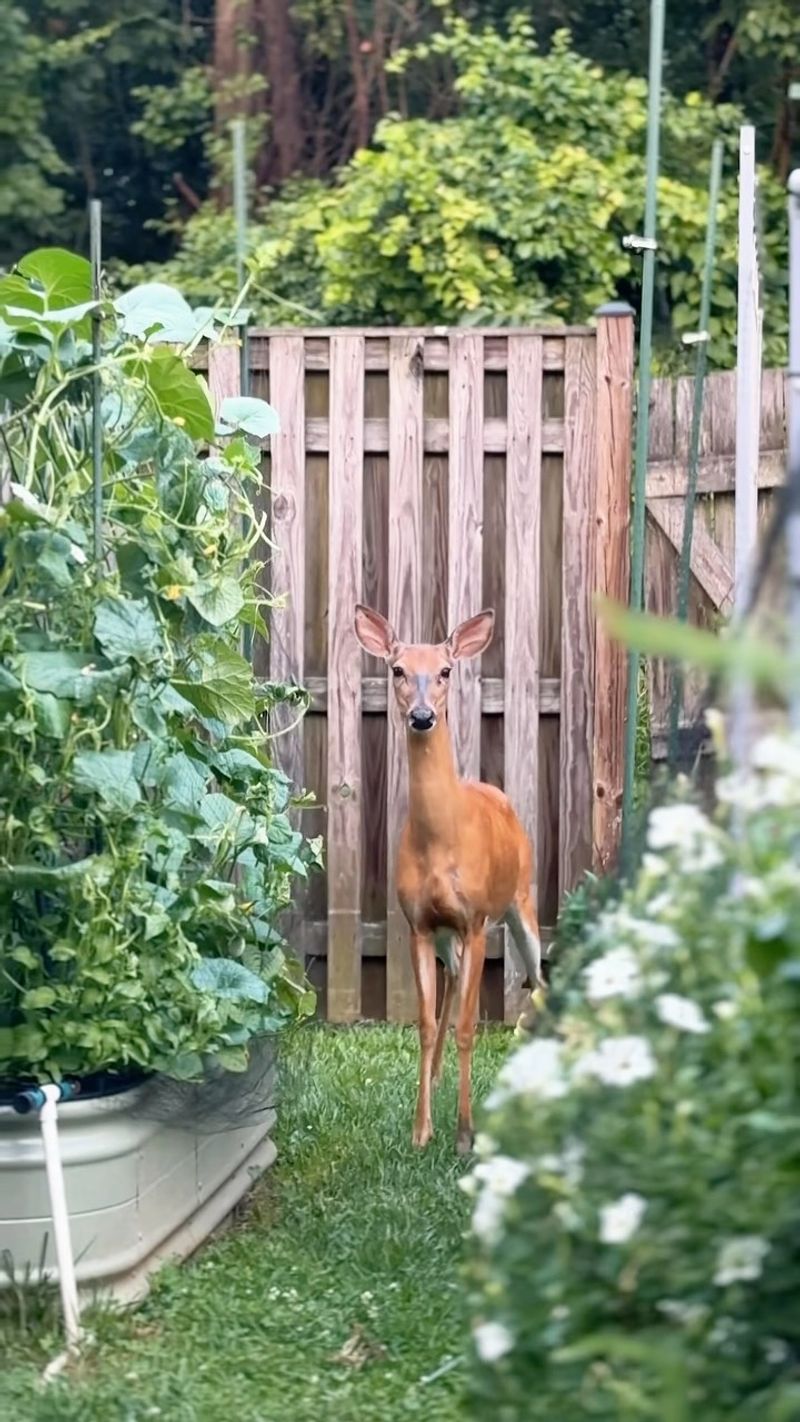
Residential yards in North Carolina can accidentally assemble exactly what a deer looks for in a daytime resting spot. Dense shrubs, an evergreen screen, tall ornamental grasses, a slope that blocks wind, the shaded north side of a fence or shed, or the edge where a lawn meets a wooded buffer can each supply a piece of the puzzle.
When two or three of those features cluster in one corner, that corner becomes a preferred microhabitat.
Research on white-tailed deer bedding site selection identifies hiding cover, thermal relief, and vegetation structure as key factors, though preferences shift with the animal’s sex, the season, local climate, and the surrounding landscape. A doe in July may prioritize shade and concealment near a fawn drop zone, while a buck in November may favor a spot with a clear sightline and wind advantage.
No single corner works for every deer at every time of year.
NC State deer ecology research on multidimensional cover use reinforces that deer weigh several habitat variables at once rather than responding to a single feature. A corner that combines visual concealment from the street, thermal buffering from summer heat, and low foot-traffic disturbance will score well on multiple dimensions simultaneously.
NC Wildlife’s suburban deer resource notes that deer adapt readily to residential sprawl by taking advantage of landscaped plants and lawns for food while using structural elements like fences, sheds, and dense plantings for cover. Your yard may be offering both within a short walk of each other.
Extension guidance on white-tailed deer habitat further explains that edge environments, where open feeding areas meet woody cover, are among the most attractive configurations a deer can find. Many suburban yards are essentially one continuous edge, which is why NC Wildlife’s deer management page consistently lists suburban and residential areas among the habitats where deer populations remain high.
The Same Corner Does Not Prove It Is the Same Deer
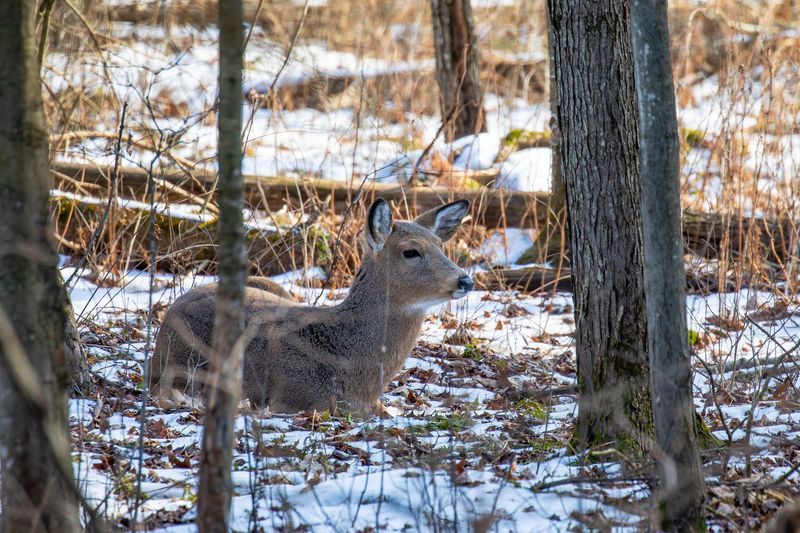
Seeing a deer in the same spot repeatedly feels like recognizing a familiar face, and it is tempting to name the animal and assume it keeps coming back. The problem is that the evidence supports only one conclusion: that corner is being used regularly.
It does not tell you whether one deer or several are responsible.
Cornell’s Deer Advisor research on suburban deer movement shows that home ranges in residential landscapes can overlap substantially, meaning multiple deer may travel through and use the same attractive patch without ever encountering each other. Published movement studies on suburban white-tailed deer confirm that range boundaries are fluid and that favored resources, including reliable resting sites, can draw animals from different social groups across a neighborhood.
A wildlife camera is the most practical tool for sorting this out. Placed at a respectful distance from the corner, it can record time of day, the number of animals present, and any distinctive physical features like antler shape, notched ears, or unusual coat markings.
When those features are visible and consistent across multiple visits, you have reasonable evidence of an individual. When the footage shows similar-looking deer without distinguishing marks, repeated use of the location is all you can confirm.
NC Wildlife’s deer habitat guidance points out that deer populations in North Carolina are shaped by available habitat, and a yard that reliably provides cover will attract use from the local population as a whole, not necessarily from one bonded individual. Keeping that distinction in mind helps homeowners respond to what is actually happening rather than to a story the evidence cannot yet tell.
Read the Evidence Before You Decide What the Deer Needs
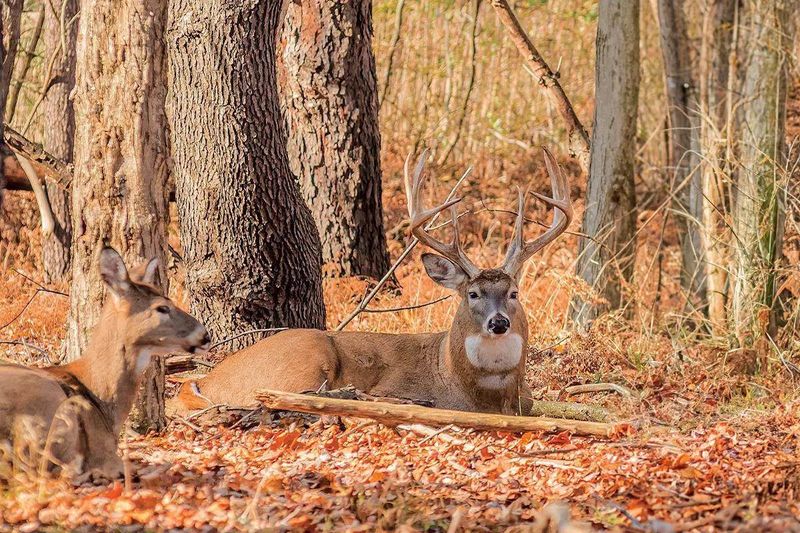
Before drawing conclusions about why the deer is there or what it needs from you, spend a few days simply gathering information. Place a wildlife camera at a distance that does not require you to approach the bedding area, and let it run across multiple days and weather conditions.
Review the footage for time of arrival, direction of approach, number of animals, visible browsing damage, and whether the deer departs after sunrise or stays well into the morning.
On foot, look for physical evidence that confirms deer activity. NC State Extension’s wildlife chapter identifies two reliable field signs: pointed, heart-shaped hoofprints in soft soil and jaggedly torn vegetation, since deer lack upper incisors and pull rather than cut when they browse.
A flat, oval depression in grass or leaf litter marks where a deer actually rested. These three signs together confirm a bedding deer rather than a passing one.
Distinguish the bed from other deer signs nearby. A scrape, which is a cleared patch of bare ground often found beneath a low overhanging branch, is a communication site rather than a resting place.
USDA APHIS guidance on deer scrapes explains that scrapes are associated especially with buck behavior during the breeding season and serve as scent-marking locations. Finding one near the corner tells you something different from finding a bed.
If your camera or observations suggest the bedding animal might be an adult doe, resist the urge to search nearby cover for fawns. Fawns are born mainly in late spring and early summer in North Carolina, but a bedded adult can be a buck, doe, or yearling at any time of year.
A bed alone does not establish that fawns are present. NC Wildlife’s guidance on injured and orphaned animals is clear that a quiet fawn lying alone should be left alone, because does routinely leave fawns unattended for hours.
NC Wildlife’s spring encounter guidance reinforces that people should not approach, touch, or move a fawn unless it is clearly injured, extremely thin, or showing obvious distress. Searching through dense cover to find one is not recommended and can cause more harm than leaving the area undisturbed.
Protect the Yard Without Turning the Bed Into a Confrontation
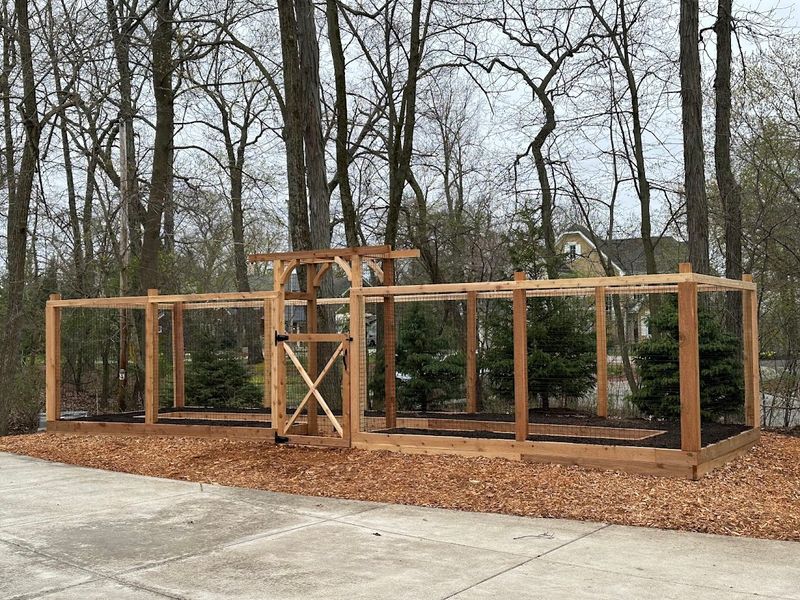
Changing the appeal of the bedding corner or protecting specific plants does not require chasing, trapping, or confronting the deer. Start by removing any unintentional food attractants near the area, such as fallen fruit, bird feeders positioned low enough for deer to reach, or garden beds planted directly against the corner’s cover.
Reducing the food reward near the resting site is a low-effort first step.
For plants you genuinely want to protect, physical barriers are the most dependable option. NC State’s deer damage management guidance identifies properly installed fencing, wire cylinders, and mesh barriers as the strongest tools available to homeowners.
Wake County Cooperative Extension’s deer damage guide notes that solid fencing of about 8 feet is the common benchmark for full deer exclusion, while shorter double-fence designs can work in smaller spaces where deer have limited room to assess a jump. Iowa State Extension’s garden protection guide adds that even individual plant cages or wrapped cylinders provide meaningful protection for high-value shrubs or perennials when a full fence is not practical.
Repellents are worth understanding honestly. UC ANR’s integrated pest management guidance on deer explains that repellent effectiveness varies with deer hunger, weather, available alternative food, and whether deer have already established a feeding pattern in the area.
NC State’s pest management handbook specifies that repellents must be reapplied after rain and as new plant growth appears, since untreated growth is fully accessible. Motion-activated sprinklers and noise devices can interrupt deer visits temporarily, but deer often habituate to predictable, harmless stimuli over time and resume using the area.
Plant selection offers another layer of protection, but approach it carefully. NC State’s native plants handbook warns that native status does not guarantee resistance to deer browsing, especially where deer density is high or natural food is scarce.
Species like inkberry, American holly, and arrowwood viburnum are listed as relatively less preferred by deer in North Carolina, but suitability still varies across the Piedmont, Coastal Plain, and mountain regions, and a hungry deer will browse plants it normally ignores.
A Wildlife-Friendly Response Also Protects People and Pets
Watching a deer settle into your yard corner can bring out the impulse to help it, sometimes by leaving out food or water. That impulse, however well-intentioned, creates problems that outlast the gesture.
NC Wildlife’s guidance on feeding deer explains that conditioning deer to associate people with food increases the risk of conflict, raises road hazards as deer congregate near homes, and can spread disease within a group that is now gathering artificially. NC Wildlife’s deer coexistence resource is direct: hand-feeding or habituation is not a kindness to the animal or the neighborhood.
Feeding restrictions carry legal weight in some North Carolina counties. As of May 1, 2026, the NC Wildlife Resources Commission has designated Cumberland, Forsyth, Sampson, Stokes, Surry, Wilkes, and Yadkin counties as CWD Management Areas, and Edgecombe, Halifax, Martin, and Pitt counties as CWD Surveillance Areas.
In both categories of area, placing bait, food, or food products to purposefully congregate wildlife is prohibited from January 2 through August 31. The rules differ between Management Areas and Surveillance Areas, so homeowners in any of those counties should check the current NC Wildlife Commission page for their specific county before taking any action involving food or attractants.
Deer do not infect ticks with Lyme disease bacteria. CDC’s Lyme disease cause page explains that deer are not reservoir hosts for the bacterium that causes Lyme disease; rodents and other small mammals play that role.
CDC tick ecology research confirms that tick risk depends on habitat, the presence of reservoir hosts, tick species, and how much time people and pets spend in tick habitat. A deer sighting alone does not mean your yard has a dangerous tick problem.
Practical tick precautions focus on habitat and exposure rather than on the deer itself. EPA tick prevention guidance recommends wearing protective clothing, using registered repellents, and checking people and pets after outdoor time.
EPA tick safety resources add that mowing tall grass, reducing leaf litter near frequently used areas, and placing a mulch or gravel barrier between lawns and wooded edges reduces tick habitat at the property level. If a deer in your yard looks thin, disoriented, unsteady, or is drooling and holding its head low, do not approach it.
NC Wildlife’s wildlife disease page advises contacting the Wildlife Helpline or a district biologist rather than attempting to handle or diagnose the animal yourself.
The Corner Reveals a Reliable Habitat, Not a Secret Bond

Repeated bedding in one corner points to a dependable combination of cover, comfort, low disturbance, and nearby access to food or travel routes. NC Wildlife’s deer habitat guidance and NC State Extension’s wildlife chapter both frame this as a habitat response, not a personal message, proof of one deer’s identity, or evidence of hidden fawns.
The most useful next steps are also the least dramatic. Observe from a distance, use a camera to document the pattern, protect valued plants with physical barriers if browsing becomes a problem, and avoid feeding or approaching the animal.
If the deer appears genuinely injured or ill, contact NC Wildlife’s injured and orphaned wildlife resources rather than attempting to handle it yourself.
A yard that a deer finds worth returning to is, in its own quiet way, a healthy piece of North Carolina landscape. The most a homeowner can do is understand what that corner is offering, protect what needs protecting, and let the wildness do what it does best.