
What It Really Means When Yellowjackets Start Building An Underground Nest In Your North Carolina Yard
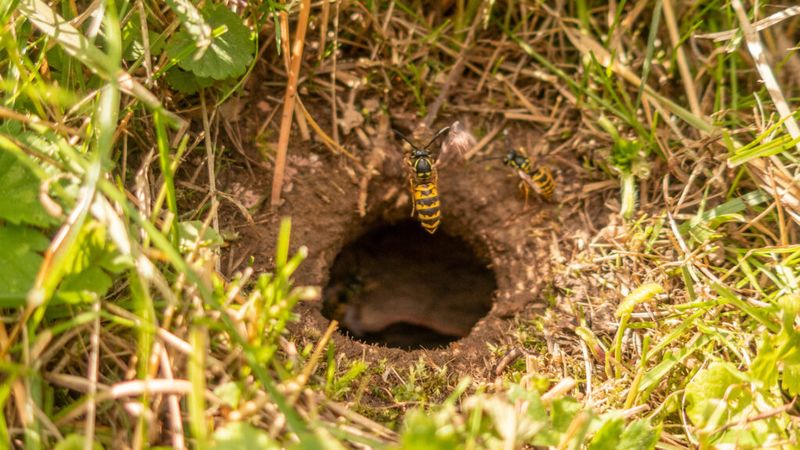
Spotting a steady stream of wasps disappearing into a hole in your lawn can stop a mowing run cold. Most North Carolina homeowners who notice this in late summer assume the nest just appeared, but the colony has likely been growing underground since spring.
Understanding what that entrance really signals, and how to keep your family, pets, and yard workers safe around it, makes all the difference before you fire up the mower again.
A late-summer entrance usually marks an older colony
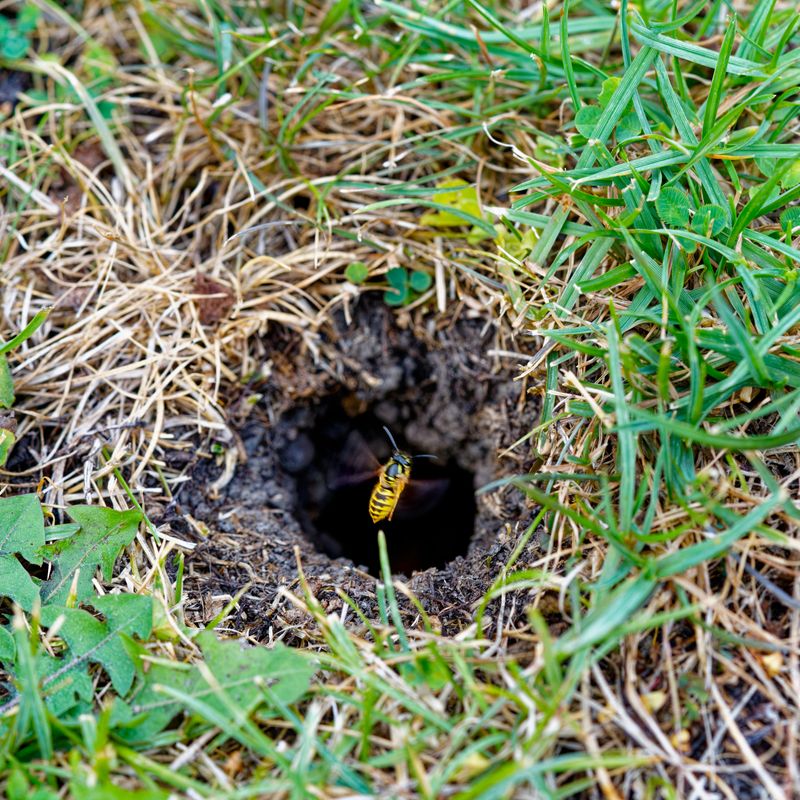
Spotting a busy hole in your lawn on an August afternoon can feel alarming, as though yellowjackets moved in overnight. The reality is more useful to know: NC State Extension guidance on turf arthropod pests confirms that yellowjackets are most active in late summer and fall, which is exactly when their colonies reach peak worker numbers and become far more conspicuous to anyone walking or mowing nearby.
Every yellowjacket colony follows an annual cycle. An overwintered queen emerges in spring, selects a sheltered cavity, and begins building a small paper nest on her own.
Workers hatch through early summer, and the colony grows steadily but quietly for months before the entrance traffic becomes noticeable to a casual observer. By late summer, hundreds or even thousands of workers may be using that single opening daily, making the hole look new when it has actually been active since spring.
Late-summer food pressure adds to the visibility. As natural prey becomes harder to find and sugary food sources grow scarcer, workers forage more widely and return to the nest more frequently.
UC IPM’s overview of yellowjackets and social wasps notes that this seasonal shift in foraging behavior is a key reason colonies seem to appear suddenly when they have, in fact, matured over several months.
For a North Carolina homeowner, the practical meaning is a localized hazard near a mowing route, walkway, play space, pet area, or garden. The entrance does not signal a yard-wide infestation.
It signals a mature colony in one specific location that warrants attention before anyone moves equipment or allows children and pets back into that part of the yard.
The hole may not sit over the nest
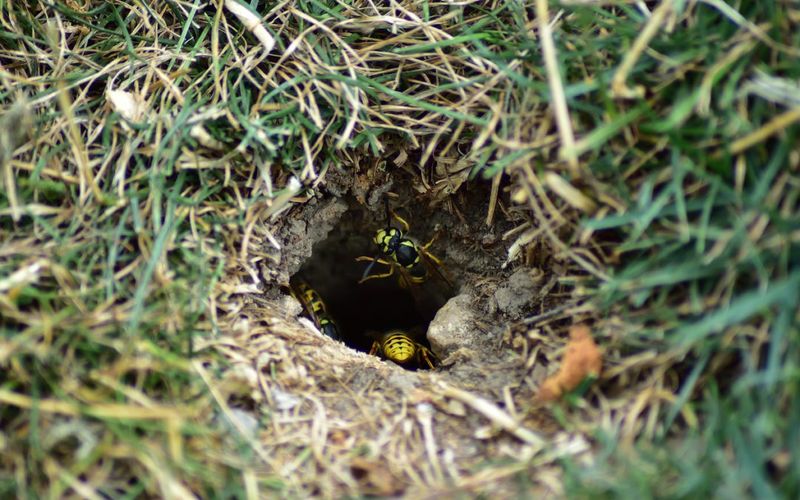
One of the most common assumptions homeowners make is that the nest lies directly beneath the visible opening. That assumption can lead to misplaced digging, probing, or treatment that misses the colony entirely while still provoking a defensive response.
UC IPM’s yellowjacket resource explains that the actual nest chamber is often hidden below ground or positioned in a cavity that extends away from the entrance, meaning the hole you can see may be several feet from the colony’s center.
Yellowjackets are opportunistic about nesting sites. They frequently take over old rodent burrows, root voids left by decayed stumps, or other existing cavities rather than excavating from scratch.
This is why the tunnel can run horizontally or at an angle before reaching the paper nest inside. The surface opening may be small and easy to overlook until traffic increases.
Common locations in North Carolina yards include open lawn areas, sandy or exposed soil patches, and the bases of trees or shrubs, all settings noted by NC State Extension as typical yellowjacket nesting habitat. A slight depression or disturbed soil ring around the hole can sometimes hint at an older burrow origin, though the entrance itself often looks unremarkable.
The safest response is to treat the entire immediate area around the entrance as potentially active rather than trying to locate the nest chamber by probing or digging. Inserting a stick, garden tool, or any object into the opening can trigger an immediate defensive reaction from workers inside.
Mark off the zone, keep people and pets clear, and evaluate the situation from a comfortable distance before deciding on next steps.
Identify the insects, not just the opening
A hole in the lawn is not a diagnosis by itself. Several different insects nest in or near the ground in North Carolina yards, and treating the wrong one, or panicking over a harmless one, wastes time and can cause unnecessary harm to beneficial species.
Identification should come from watching the insects themselves, not from the opening alone.
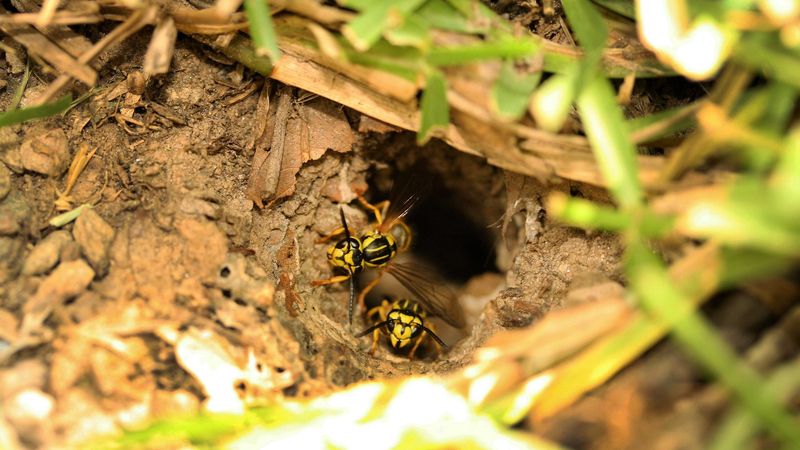
Yellowjackets in late summer have a recognizable profile: roughly house-fly-sized, with distinct black-and-yellow banding, and a habit of flying directly and repeatedly into and out of one small opening. Their flight pattern tends to be purposeful and quick, without the hovering or circling behavior of some other wasps.
NC State Extension’s turf pest guide lists cicada killers, ground-nesting bees, and scoliid wasps as other lawn-associated insects that can be mistaken for yellowjackets at a glance.
Cicada killers are much larger, often an inch and a half or more, and typically more active in midsummer when cicadas are most available. They tend to create visible soil mounds near their individual burrows.
Ground-nesting bees, including several native species, are generally fuzzier than yellowjackets and are far less likely to sting unless physically handled. Scoliid wasps are dark and large and are typically seen flying low over lawns in search of grubs rather than commuting to a fixed underground nest.
Timing matters as well. High traffic into a single small hole in August or September, combined with the appearance of black-and-yellow, smooth-bodied, house-fly-sized insects, points toward yellowjackets.
UC IPM notes that wasps flying directly in and out of one location are likely traveling to and from a nest. Resist the urge to crouch down for a closer look; binoculars from a comfortable distance are a safer tool for confirming the insect’s size and markings.
Repeated traffic matters more than one stray wasp
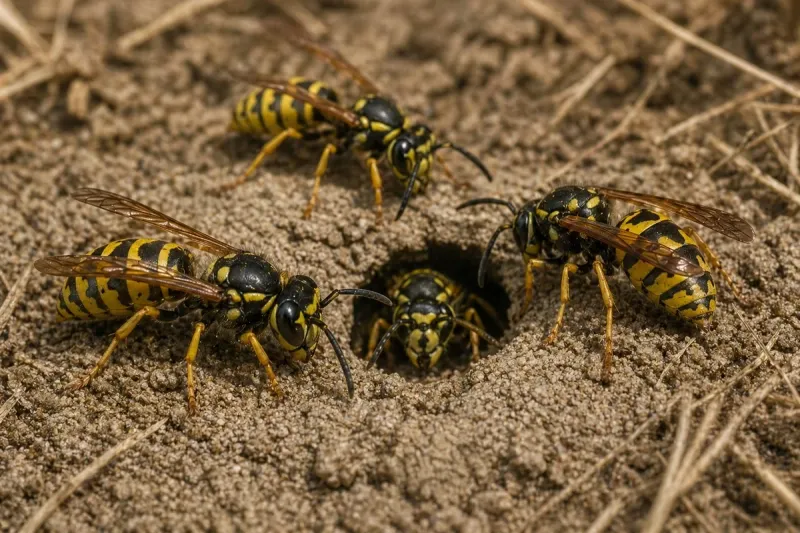
Before resuming any mowing or yard work near a suspicious hole, pause and watch from a distance for a minute or two. The single most informative thing to look for is repeated, purposeful traffic: multiple wasps entering and exiting the same small opening within a short observation window.
UC IPM’s guidance on social wasps specifically identifies wasps flying directly in and out of one location as a strong indicator of a nearby nest entrance.
One yellowjacket at a trash can lid, a pet food bowl, or an open soda left on a picnic table is a foraging scout, not necessarily evidence of a nest in the yard. Scavenging behavior around food sources is a separate context from nest traffic.
A single wasp investigating a food source can come from a colony several hundred yards away and tells you very little about what is happening in the ground nearby.
What does tell you something is a consistent stream of wasps returning to one fixed point in the lawn, especially if they carry food particles or seem to disappear directly into the soil. Do not poke the hole with a stick, kick the surrounding soil, trim vegetation around the entrance, or bring a running mower within several feet.
Vibration from equipment is a well-known trigger for defensive behavior, and running over or near an active entrance is how most lawn-mowing stings happen.
Once you have confirmed repeated traffic, the next step is to judge how close the entrance sits to areas people and pets actually use. NC State Extension recommends management wherever people may be stung, particularly in recreational or frequently traveled areas.
An entrance along a regular mowing route, near a play structure, beside a garden path, or in a pet run calls for a faster response than one tucked in an unused corner of the property.
Create distance before choosing a solution
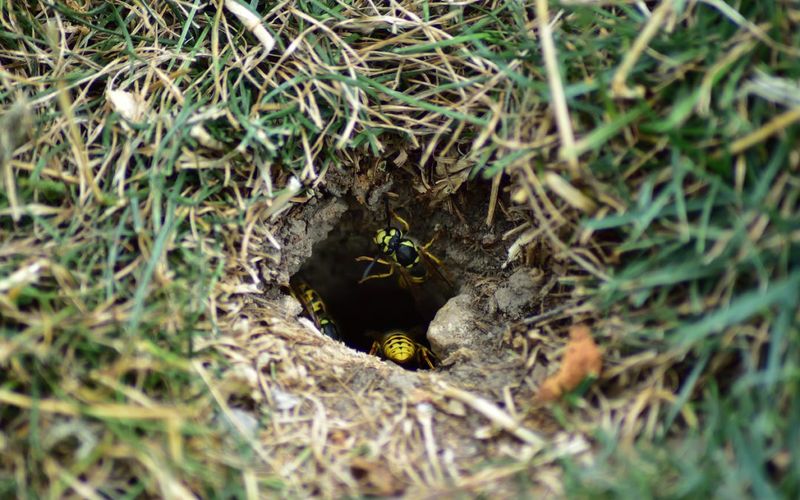
The first practical step after spotting a probable yellowjacket entrance is straightforward: keep everyone away from the area. Mark the zone with something visible, a few garden flags, a ring of stakes, or even an overturned bucket placed well clear of the hole, so that family members, lawn workers, and pets do not wander into it accidentally.
Do this without approaching the entrance yourself.
After creating that buffer, consider whether the location genuinely requires treatment or whether the colony can be left alone to complete its seasonal cycle. NC State Extension’s yellowjacket-in-turf resource confirms that yellowjacket colonies are annual: when sufficiently cold conditions arrive, workers and the queen die, and the old nest is never reused.
If the entrance sits in a corner of the yard that no one walks through, a remote garden bed edge, or along an unused fence line, tolerating the colony through the end of the season is a legitimate choice that requires nothing more than keeping the area off-limits.
Yellowjackets are also worth keeping in perspective ecologically. They prey on caterpillars, flies, and other pest insects, providing a measure of natural pest control in the yard.
NC State Extension notes this predatory role, which is why removal is most defensible when the colony creates a realistic sting hazard rather than simply existing in the yard.
Reducing what draws foraging yellowjackets toward the house is also worthwhile regardless of what you decide about the nest. Cover outdoor garbage cans with tight-fitting lids, bring in pet food bowls after feeding, pick up fallen fruit, and keep sugary drinks covered during outdoor meals.
UC IPM notes that sanitation measures can reduce foraging activity around the home, though they will not eliminate a colony that is already established underground. Think of these steps as reducing daily encounters while you work out a longer-term plan for the nest itself.
Let the location determine whether treatment is necessary
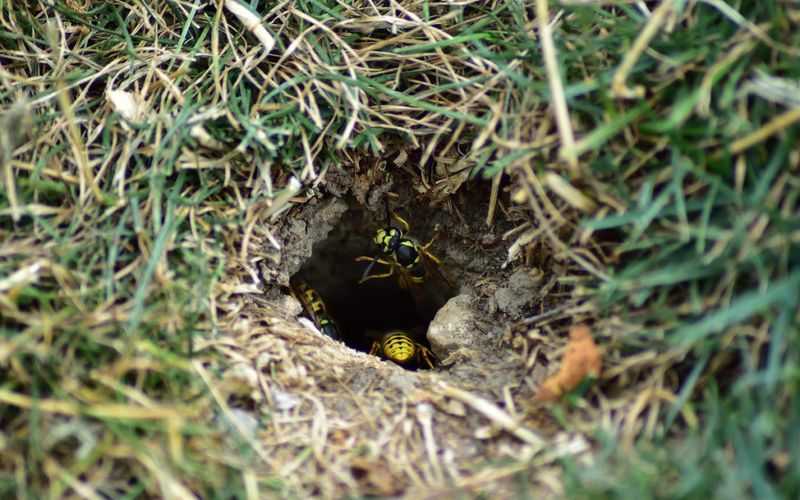
Location is the deciding factor when weighing whether to treat a yellowjacket colony. A nest tucked in a far corner of the property that no one passes through is a very different situation from one beside a garden gate, a foundation vent, a play set, a dog run, or the regular mowing path.
When the entrance sits anywhere near frequent human or pet activity, professional treatment is the safest and most reliable option.
University of Minnesota Extension’s wasp and bee guidance states clearly that people with a known sting allergy should not attempt to treat a yellowjacket nest themselves. That recommendation applies regardless of how approachable the entrance looks.
A licensed pest professional has the protective equipment, the correct products, and the experience to treat a colony with far less risk of triggering a mass defensive response.
If a homeowner chooses to use a pesticide independently, the product must be labeled specifically for yellowjacket control, and the current label must be followed exactly. NC State Extension’s yellowjacket-in-turf guidance describes direct treatment of the nest entrance near dusk, when more workers are likely inside, but also warns that emerging wasps may attack during and after application.
Do not shine a flashlight beam directly into the entrance, as light can cause wasps to emerge before the product is applied.
Several approaches that circulate online are genuinely dangerous. Pouring gasoline, kerosene, or any fuel into a nest entrance is explicitly prohibited by extension guidance and poses a serious fire and environmental hazard.
Burning the nest carries similar risks. Flooding the entrance with water is not supported by reliable sources as an effective control method and can provoke the colony.
Sealing the entrance before all insects are dead, particularly near a structure, can force yellowjackets into a wall void or interior space. Penn State Extension’s stinging insect guidance identifies fire-based removal as more dangerous than appropriate insecticide methods.
Traps sold for yellowjacket control may catch individual foraging workers but will not eliminate an established underground colony. UC IPM notes that placing traps near patios or outdoor eating areas can actually draw more wasps toward people rather than away from the nest.
Traps are not a substitute for addressing a high-risk colony location.
Know when a sting requires emergency help
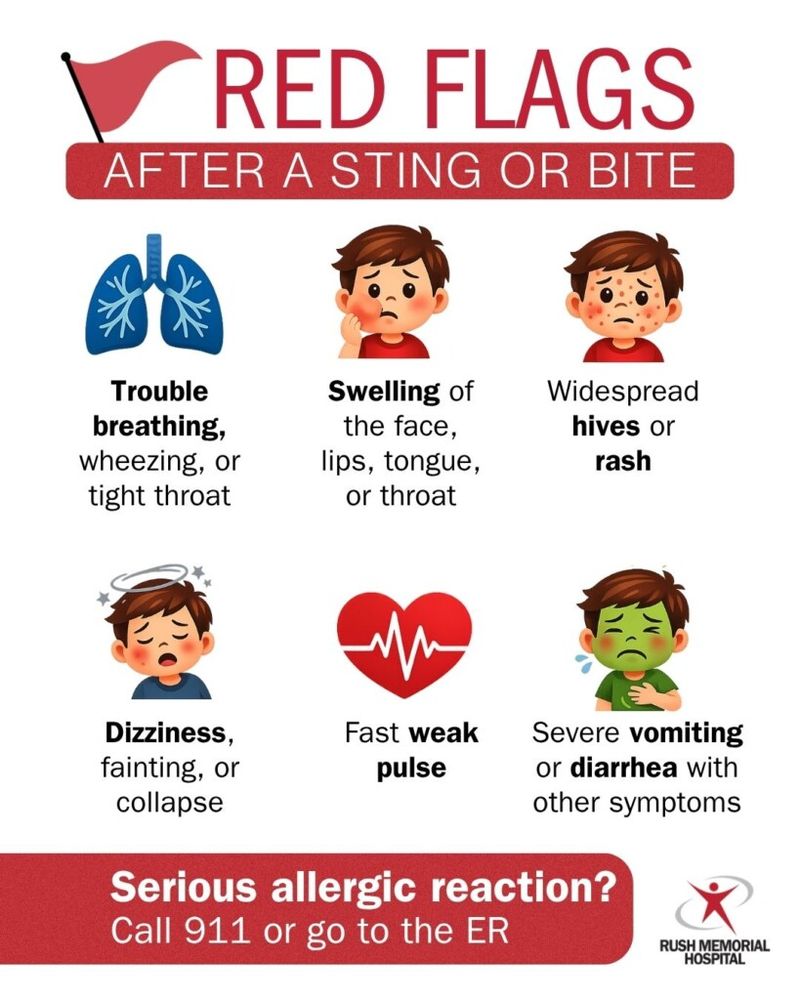
Most yellowjacket stings cause localized pain, redness, and swelling that resolves on its own within a few hours. However, a small number of stings trigger a severe allergic reaction called anaphylaxis, which is a medical emergency that requires immediate help, not a wait-and-see approach at home.
Seek emergency care right away if anyone stung shows trouble breathing, swelling of the lips, tongue, or throat, hives spreading across the body, dizziness, a sudden drop in blood pressure, or collapse. MedlinePlus guidance on wasp stings lists these as signs of a serious allergic reaction requiring emergency treatment.
Do not wait to see whether symptoms improve on their own when any of these signs are present.
Anyone with a known sting allergy who has been prescribed an epinephrine auto-injector should use it as directed by their doctor and then seek emergency care, even if symptoms appear to improve after the injection. MedlinePlus information on insect bites and stings reinforces that epinephrine is a first response, not a substitute for emergency evaluation.
Children, elderly individuals, and anyone with cardiovascular conditions face higher risk from multiple stings, so keeping these household members well away from a suspected nest entrance is a priority. If someone is stung multiple times, monitor closely for any of the systemic signs listed above and be ready to call for emergency help.
Local pain and swelling from a single sting in a non-allergic person can be managed with basic first aid, but systemic symptoms always warrant a call to emergency services.
Treat the entrance as a localized warning, not a new infestation
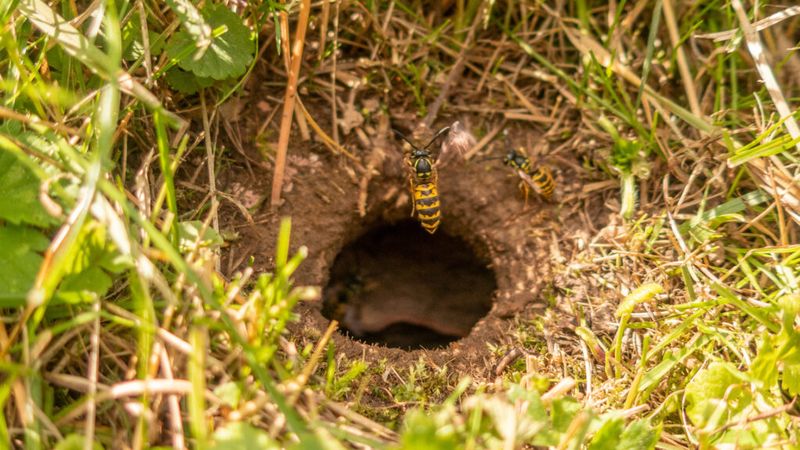
A late-summer entrance in your North Carolina lawn almost always points to a mature annual colony that has been growing since spring, not a nest that started this week. The colony became noticeable because worker numbers peaked and foraging activity increased, not because something new moved into the yard overnight.
Repeated traffic into one fixed opening confirms a localized concern, while a single wasp near your cooler or trash can is a much weaker signal.
The practical rule holds across every situation covered here: keep distance first, protect the areas people and pets actually use, confirm the insect before acting, and get professional help when the location creates a realistic sting hazard or when anyone in the household has a sting allergy. A colony in a genuinely out-of-the-way spot can reasonably be left to finish its seasonal cycle, since NC State Extension confirms that old nests are never reused and the colony ends when cold conditions arrive.
NC State’s turf pest guidance recommends management where stings are a realistic risk, which is the clearest line between watching and acting. A hole in the lawn is a clue worth reading carefully, not a reason to treat every inch of the yard.