
What Sphinx Moths Are Really Finding When They Turn Up In Your North Carolina Garden At Sunset
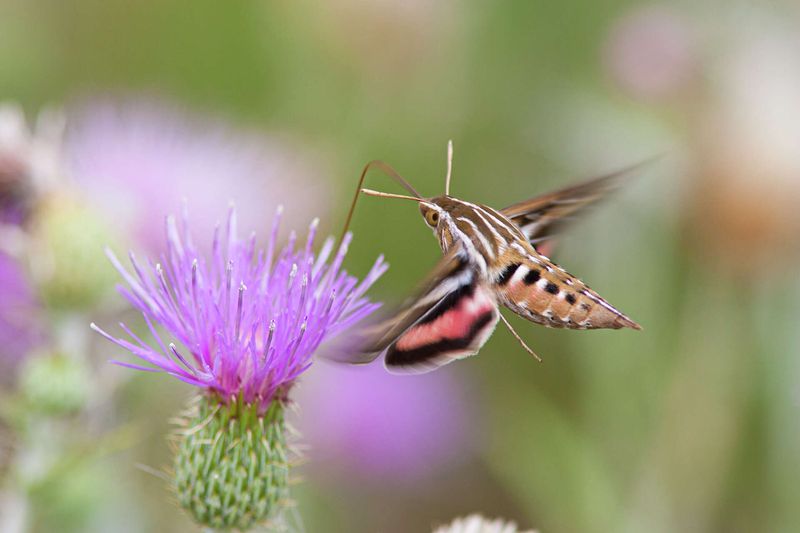
Watching a large moth hover at a flower just as the sun slips below the tree line is one of those backyard moments that stops you in your tracks. That visitor is a sphinx moth, and it showed up at your garden for a reason you can actually learn from.
North Carolina is home to dozens of sphinx moth species, each with its own schedule, preferred plants, and life history. Understanding what the moth is finding in your yard turns a surprising sighting into a practical guide for being a better steward of your little patch of the state.
Sunset Is a Clue, Not a Diagnosis
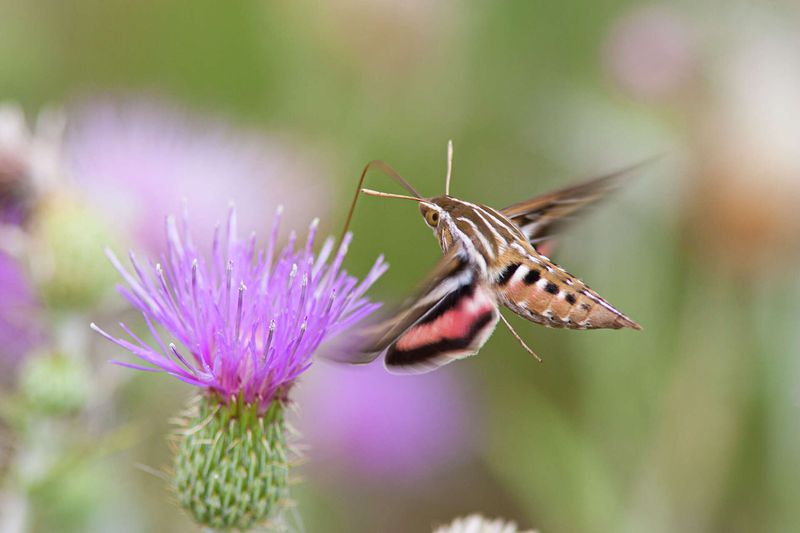
Spotting a sphinx moth at your garden’s edge as the light fades is genuinely exciting, but the smartest first move is to treat the sighting as a question rather than an answer. What the moth found is a usable nectar resource at that hour, and possibly a navigable path through your yard to reach it.
That is meaningful information, but it does not tell you that your garden is thriving, that the moth was born nearby, or that your yard is a complete habitat for that species.
North Carolina supports a wide range of sphinx moths, and the state’s moth database lists numerous resident and recorded Sphingidae, including the Carolina sphinx, white-lined sphinx, rustic sphinx, banded sphinx, and several clearwing species. Their activity schedules vary considerably.
The Carolina sphinx is documented as active from dusk onward, while white-lined sphinx moths may visit flowers during the day or at dusk depending on conditions. Sunset timing is suggestive of the visitor’s identity, not proof of it.
A single adult at one flower on one evening says something real: your yard offered a workable resource at that moment. What it does not say is that the yard is broadly biodiverse, that the moth is breeding there, or that this species is doing well or poorly in your neighborhood.
Think of the sighting as a prompt to look closer rather than a report card. The North Carolina Native Plant Society notes that moths need native plants across their whole life cycle, which means one flowering moment is just one piece of a larger picture worth investigating.
The Moth Reads More Than Color
Before a sphinx moth ever reaches your garden flower, it has already been reading the yard like a map. Hawkmoths combine scent and visual information together, and research shows they use both channels at the same time rather than relying on one alone.
Studies on color vision in diurnal and nocturnal hawkmoths show that these insects can distinguish colors even in dim light, which helps them locate pale or reflective blooms as evening settles in. Color, brightness, contrast, and flower shape all contribute to a moth’s ability to spot a potential food source from a distance.
Scent adds another layer. Research on multimodal floral signals and moth foraging decisions documents that odor and visual cues work together, with scent often drawing a moth toward a flower and visual detail guiding the final approach.
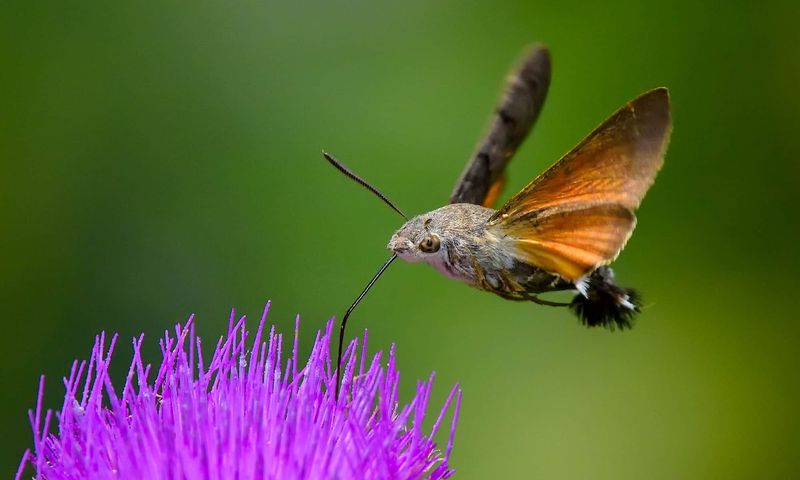
Once close, the moth’s long proboscis allows it to reach nectar deep inside tubular flowers, a feeding style that USDA Forest Service resources on Sphingidae describe as characteristic of the family. Hovering flight keeps the moth stable during feeding without requiring it to land.
One experimental finding adds an interesting wrinkle. Laboratory work on floral humidity as a sensory cue found that white-lined sphinx moths could distinguish more nectar-rich flowers partly through the humidity those flowers released, when other cues were held constant.
This is a controlled research result, not something a homeowner can observe or test in a backyard, but it illustrates that sphinx moths are integrating more environmental information than most gardeners might expect.
Broader work on the sensory ecology of hawkmoth foraging reinforces that these insects are not simply attracted to a general category of flower. They are making real-time assessments of scent, light quality, shape, and reward cues as they move through a landscape.
When one turns up in your yard at sunset, it has passed a sensory evaluation you arranged without knowing it.
Which Sphinx Moth Came to Dinner?
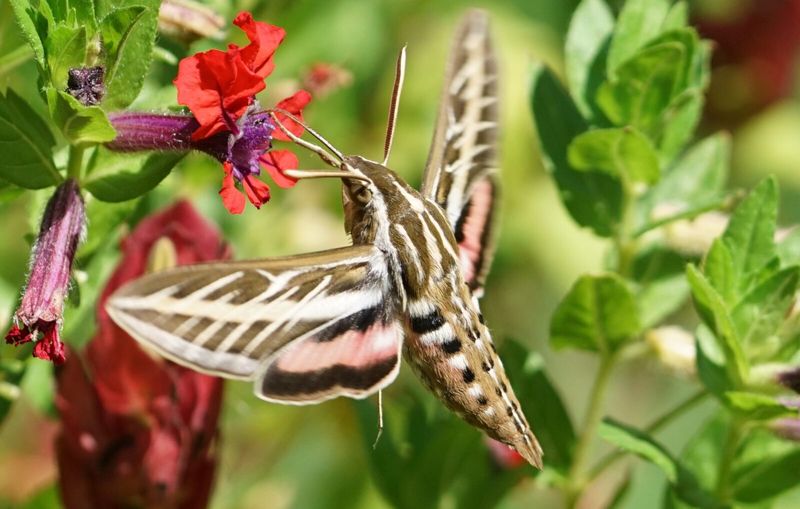
Resisting the urge to name the moth from a single evening sighting is one of the most useful habits a careful observer can develop. Hovering flight, large size, and a long tongue are family-level traits shared by many sphinx moths, not a species ID.
The moth you saw at sunset could be any number of residents depending on your region of North Carolina, the season, and which plants were blooming.
Several species are plausible visitors in the state. Clearwing moths in the genus Hemaris fly during daylight hours and can look startlingly like bumblebees or hummingbirds, as NC State Extension notes for the bumblebee moth and hummingbird moth.
The white-lined sphinx is a boldly striped species that may visit flowers by day or at dusk. The Carolina sphinx tends to fly from dusk onward and is often confused with the five-spotted hawk moth.
The rustic sphinx is another dusk-active species with a broad range of larval host plants. Each of these has a different appearance, schedule, and life history, which means the practical actions you might take differ depending on which one actually visited.
A simple observation routine makes future identification possible. Write down the date, time, temperature, and general weather conditions.
Note which plant the moth was visiting and describe or sketch the flower. Record how the moth behaved: did it hover steadily, move quickly between blooms, or fly off in a particular direction?
Then take a photograph, ideally with the moth in focus against the flower, with enough light to show wing pattern and body color. The Moths of North Carolina database and its species gallery are genuinely useful starting points once you have a clear image.
Behavior alone rarely clinches a sphinx moth ID; a good photograph is the tool that opens the door to a real answer.
The Visited Bloom Reveals One Resource Your Yard Offers
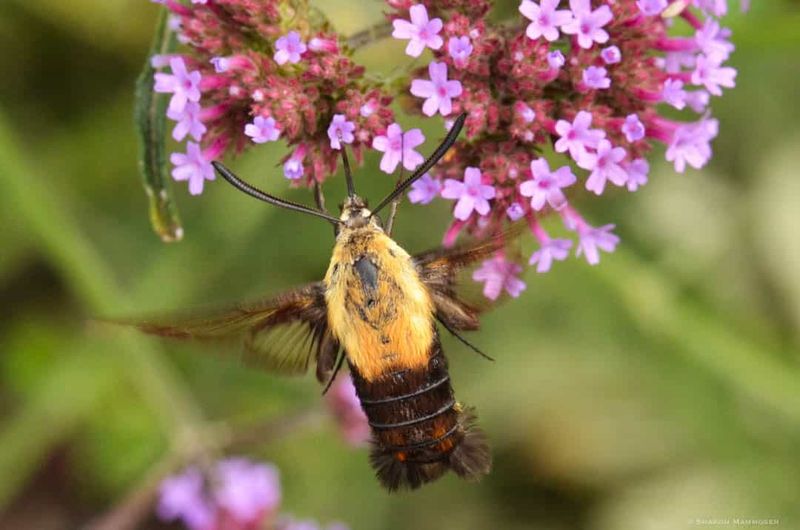
The flower your sphinx moth visited is a data point, not a prescription. Go back to the same spot at the same time of evening over the next few days and take stock of what is actually open, fragrant, or newly unfurled.
You may find that the moth had only one or two realistic choices, or you may discover a richer sequence of blooms than you realized. Either way, you are now doing a sunset bloom audit, which is a far more useful exercise than simply adding the plant the moth visited to a shopping list.
Pale, fragrant, tubular, or evening-opening flowers are commonly associated with hawkmoth foraging, and research on hawkmoth color vision helps explain why reflective or high-contrast blooms stand out in low light. Studies on multimodal floral signals confirm that scent and shape are part of the same foraging assessment.
The USDA guide to attracting pollinators in the eastern US lists evening primrose, native phlox, and other fragrant species among plants suited to moth visitors. Those are reasonable starting points, but they are not the whole picture.
North Carolina clearwing moths are less specialized than some of their relatives. NC State Extension reports that hummingbird and bumblebee moths visit many types of flowers, including brightly colored daytime blooms that do not fit the classic pale-and-fragrant profile.
The plant your moth visited was usable on that occasion. That is what the evidence actually shows.
Whether it is the moth’s preferred plant, its only option in your yard, or simply the most accessible bloom at that hour is a question that repeated observation, not a single evening, can begin to answer.
Nectar Plants and Host Plants Do Different Jobs
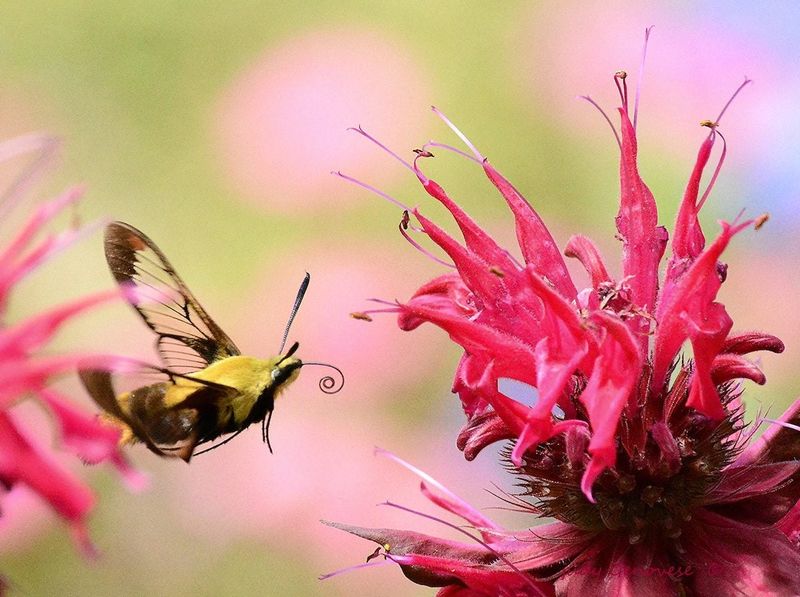
One of the most common misreadings of a sphinx moth sighting is assuming that the plant being visited is the same plant where the moth will lay its eggs. Adult sphinx moths feed on nectar to fuel flight and reproduction, but their caterpillars eat something else entirely, often a specific group of native trees, shrubs, vines, or herbaceous plants that may not even be blooming when the adult appears.
An adult may travel a meaningful distance between a nectar patch and a suitable host plant, and the two do not need to be in the same yard.
North Carolina examples illustrate how varied these relationships can be. NC State Extension’s banded sphinx profile lists evening primrose, grape relatives, Virginia creeper, magnolia, and water-associated plants among the larval hosts for that species.
The rustic sphinx caterpillar has been recorded on a notably broad list that includes beautyberry, ash, basil, crossvine, fringe tree, gardenia, and sunflower, among others. Two moths in the same family, with overlapping flight periods, feeding caterpillars on very different plant communities.
For a North Carolina homeowner, this means that supporting sphinx moths across their full life cycle requires thinking beyond the nectar garden. The NC Native Plant Society identifies native oaks, hickories, maples, cherries, elms, and willows as important host plants for many moth caterpillars, and goldenrods, asters, coneflowers, and evening primroses as productive herbaceous options.
These recommendations support moth diversity broadly, which is a more honest goal than trying to engineer habitat for one specific sphinx species whose identity you may not yet know.
Adding a native tree or shrub with documented host value is a meaningful step, but it should be chosen for regional suitability and confirmed as appropriate for your part of the state. A plant native to the NC mountains may not perform the same ecological role in the Coastal Plain.
Browse the NC Native Plant Society’s recommended species list filtered by your region before purchasing, and aim for variety rather than a single celebrated host.
Protect the Evening Route Through Your Yard
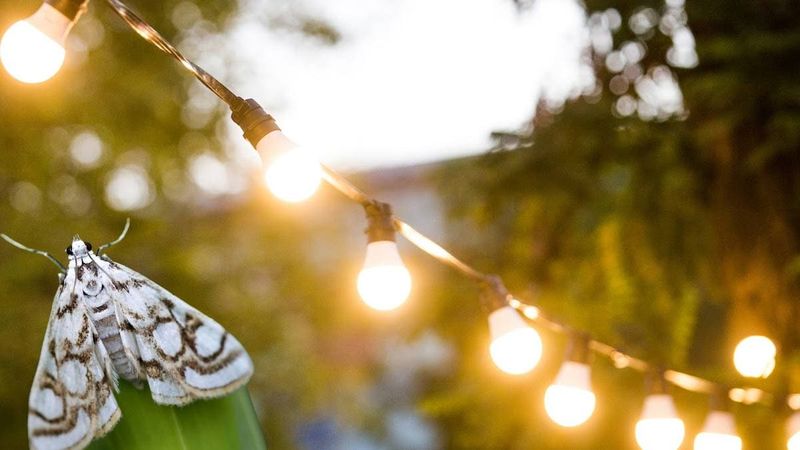
A sphinx moth that finds a usable nectar source still has to navigate to it, and the conditions along that route matter as much as the flower itself. Two common yard features can quietly undermine that navigation: unnecessary outdoor lighting and routine pesticide use.
Both are worth reconsidering once you understand how they interact with insects active at dusk and after dark.
Artificial light is not simply a neutral convenience for moths. Xerces Society guidance on light pollution and pollinators explains that lights can attract and disorient moths, pulling them away from foraging routes and increasing their exposure to exhaustion and predators.
Their moth-specific lighting guidance recommends switching off unneeded outdoor lights, particularly near flowering areas, using motion sensors so lights are on only when necessary, shielding fixtures so light is directed downward rather than broadcast outward, and choosing warmer, amber-toned bulbs when illumination cannot be avoided. Bright white or blue-spectrum lights are more disruptive to nocturnal insects than warm amber alternatives.
Turning off a porch light near your flower beds during peak moth activity hours is one of the lower-effort changes with real potential benefit.
Pesticide decisions deserve the same careful attention. Xerces Society’s pollinator FAQ recommends an integrated pest management approach: identify the specific organism causing a problem, monitor the actual extent of damage, tolerate minor feeding when the plant is healthy enough to absorb it, and choose the most targeted available method when treatment becomes genuinely necessary.
The Xerces managing pests while protecting pollinators guide is specific about timing: avoid applying any pesticide to flowering plants while pollinators are active, and that window includes nighttime hours when moths are foraging. Spraying after dark is not a workaround that protects bees while leaving moths unharmed.
The Xerces habitat assessment guide for yards and gardens reinforces that reducing routine broad-spectrum pesticide use is one of the most consistent improvements a homeowner can make for nocturnal and daytime pollinators alike.
Let Repeated Visits Refine What You Plant
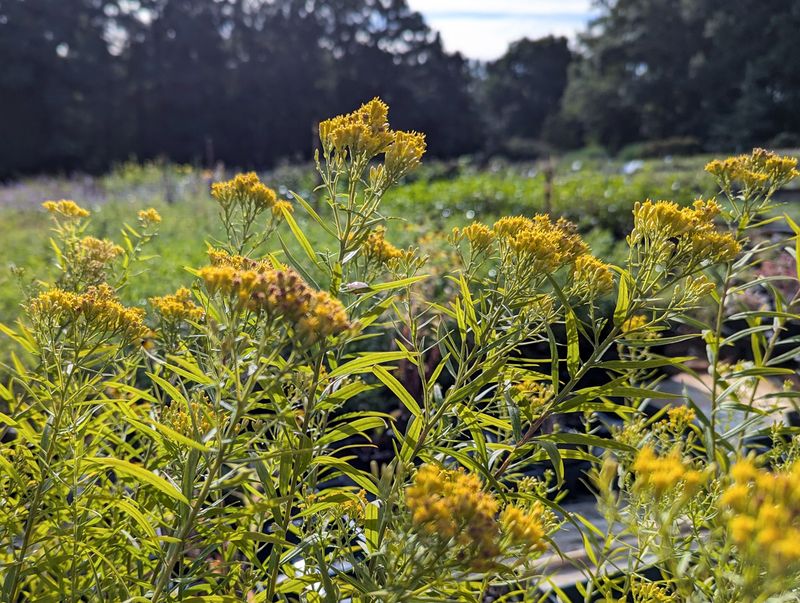
One evening’s sighting gives you a starting point, but a pattern of observations gives you something to act on. Returning to the same area at the same hour across multiple evenings, and across different weeks and months, reveals which blooms are available through the season and where the gaps are.
A yard that offers nectar in June but nothing useful in August or September is only doing part of the job for a moth that may be active across a longer window.
When gaps appear, the goal is not to find one celebrated native plant that solves the problem. The NC Native Plant Society’s landscape guide encourages layering plants with different bloom times so that nectar and foliage are available through multiple seasons, and their recommended species list can help you find regionally appropriate options for your specific part of the state.
Diversity, both in bloom time and plant type, is more durable than any single addition.
Shelter is part of the picture too, though the specifics depend on your yard’s conditions. Leaving some leaf litter under shrubs and allowing hollow stems to stand through winter can provide overwintering resources for moths and other beneficial insects, as Xerces Society’s Wings publication discusses in the context of supporting nocturnal insects.
That practice should be adapted to fire safety, drainage, and disease management in your specific yard rather than applied as a blanket rule. The Xerces habitat assessment guide frames these adjustments as flexible, property-specific choices rather than universal requirements.
Repeated observation is the habit that turns one moth encounter into a running record of what your yard offers and what it still could.
A Sunset Visitor Is an Invitation to Pay Attention
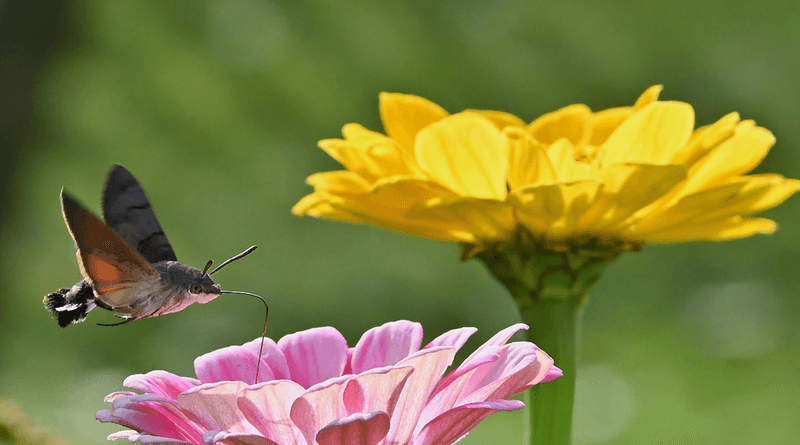
The sphinx moth that showed up at your garden’s edge found a workable nectar source and a sensory path that led it there. That is what the visit confirms.
It does not certify the yard as a thriving habitat, identify the moth to species, or guarantee that caterpillars are feeding anywhere nearby. What it does do is hand you a prompt, and a good steward uses it.
Follow the practical sequence the sighting opens up. Check which blooms are available at that hour.
Document the visitor with notes and a photograph, then consult the Moths of North Carolina database for help with identification. Look at whether native host plants are present alongside your nectar sources, and consider whether outdoor lighting or pesticide timing could be working against the insects you want to support.
The NC Native Plant Society is clear that moths need native plants across their full life cycle, not just one well-chosen bloom.
None of this requires perfection or a complete yard overhaul. Xerces Society’s writing on moths as nocturnal pollinators frames the goal simply: reduce avoidable harm, add useful plants where you can, and keep paying attention.
A yard that earns a second sphinx moth visit is one where someone noticed the first one and asked what it needed.