
Why North Carolina Homeowners Should Never Sweep Away The Paper Wasp Nest Under Their Eaves
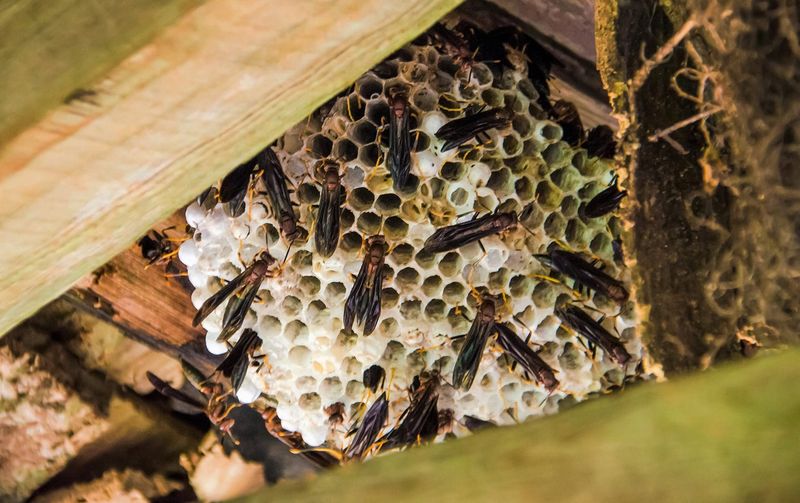
Spotting a papery nest tucked under your porch eave can send most homeowners straight for the broom, and that instinct is completely understandable. But the nest hanging up there may actually be working in your garden’s favor, quietly hunting the caterpillars chewing through your vegetables and ornamentals.
Before you knock it down, there are a few things worth knowing about what those wasps are doing, where the nest sits, and whether it actually needs to come down at all.
Do not sweep away a paper-wasp nest automatically
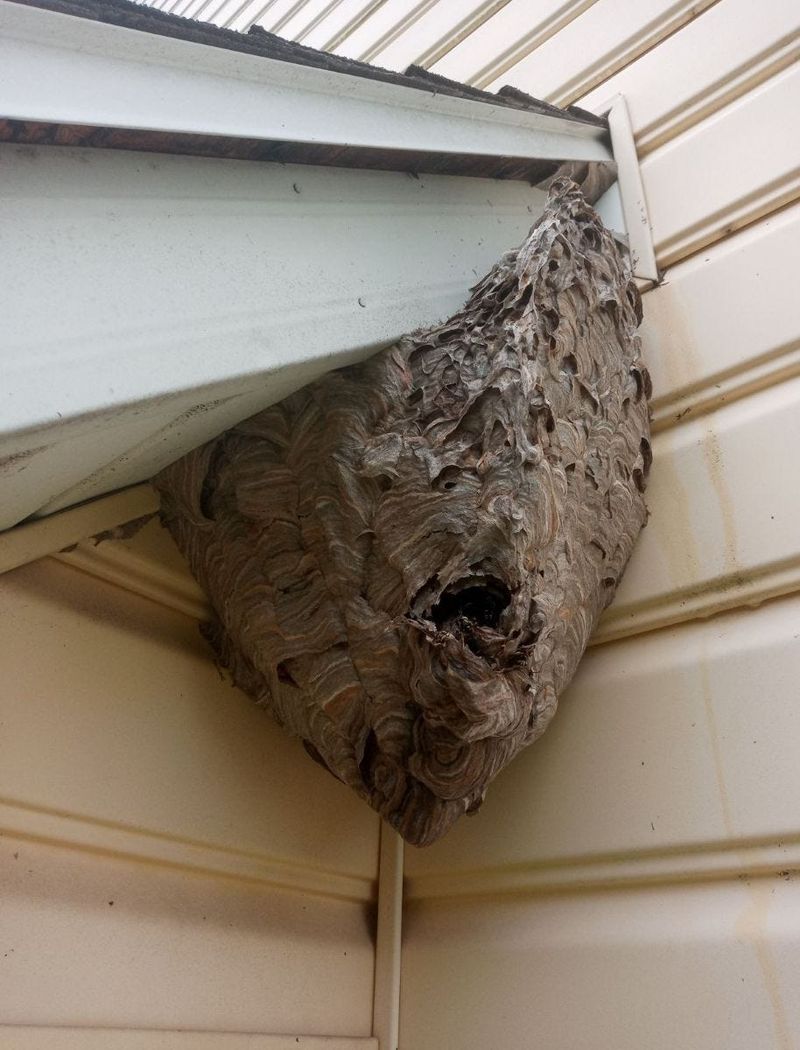
Reaching for the broom the moment you notice a papery nest under your eave is one of the most common reflexes in North Carolina yards, and it skips a step that matters: figuring out whether the nest actually needs to go. NC State Extension describes paper wasps as “quite beneficial” and notes that they commonly build nests beneath eaves, overhangs, awnings, window sills, and deck railings across the state.
That description alone is worth pausing over before you act.
The case for leaving a nest alone rests on a straightforward idea: adult paper wasps capture caterpillars and other soft-bodied insects and feed them to their developing young. A colony quietly working above your garden beds may reduce pressure from some of the caterpillars that damage your plants.
That is a real, if limited, service, and destroying the nest on instinct throws it away without gaining anything in return.
The case for removal is just as real. A nest positioned beside a front door, a walkway, a children’s play area, or outdoor seating creates a genuine risk every time someone passes close enough to disturb the colony.
Penn State Extension emphasizes that the decision should turn on location and the likelihood of disturbance, not on a blanket rule.
The practical decision rule for North Carolina homeowners is this: identify the insect, evaluate the nest’s location and how easily people or pets might disturb it, and then choose noninterference or removal based on actual exposure rather than fear. No single nest will protect an entire yard, but a safely placed one may do more good than harm.
That is the question worth asking before the broom comes out.
Identify the nest before you judge its risk
Not every papery structure hanging under a roofline belongs to a paper wasp, and the difference matters because the insects inside can behave very differently. Paper wasps are slender, long-legged insects that build an open, single-layer comb attached to a surface by a thin central stalk.
Viewed from below, the nest often has a slight umbrella or upside-down dome shape, with the individual cells clearly visible and no outer paper envelope surrounding them.
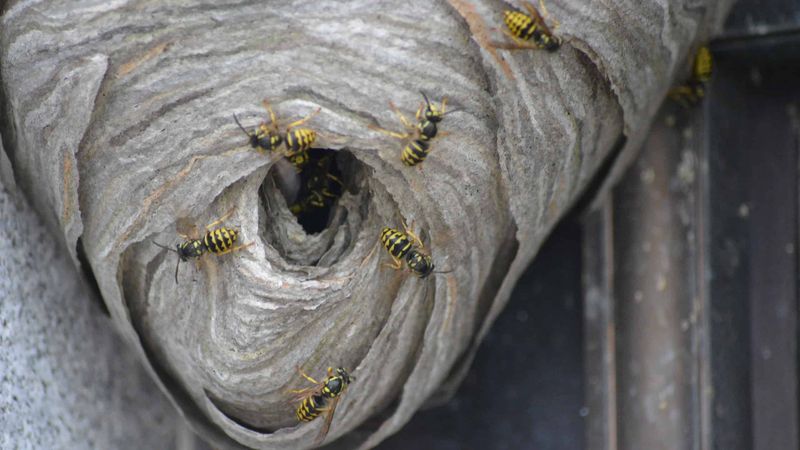
An enclosed nest, one covered by a layered paper shell with a small entrance hole, is more likely to belong to yellowjackets or a bald-faced hornet. University of Maryland Extension notes that yellowjackets may also nest in wall voids, underground cavities, and other concealed spaces, and that their colonies can grow considerably larger than a typical paper-wasp colony.
Treating an enclosed or cavity nest the same way you would treat a small open-comb nest is a mistake that can lead to a much more serious defensive response.
Timing gives you a partial clue but not a definitive answer. In North Carolina, reproductive females typically begin constructing new nests in April and May, so a small, fresh comb appearing in spring is more likely to be a paper-wasp queen starting her colony than anything else.
NC State Extension confirms this spring construction window for paper wasps in the state, but season alone cannot tell you which species you are dealing with.
The safest approach is to observe the nest from a comfortable distance, far enough that you are not within the colony’s immediate defensive zone. Look for the open comb structure and the slender, dangling-legged wasps resting on it.
If the nest is enclosed, large, or located in a cavity you cannot see clearly, treat it as a higher-risk situation from the start and do not attempt a closer inspection.
Paper wasps hunt caterpillars for their young
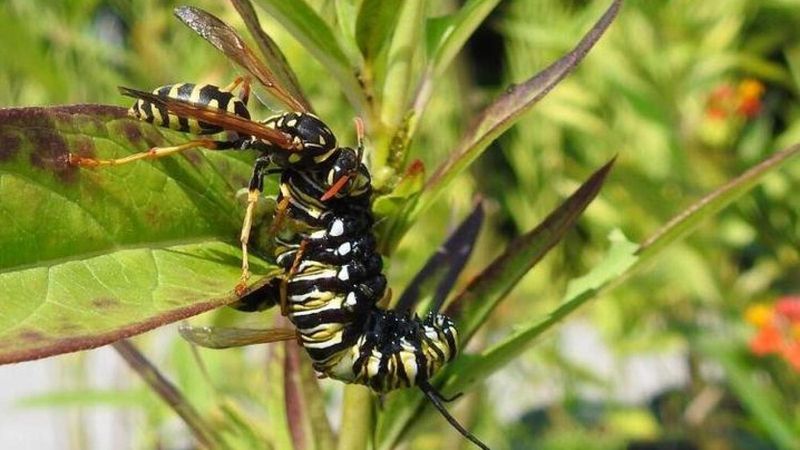
Adult paper wasps do not eat caterpillars themselves. What they do is capture them, chew them into a protein-rich paste, and carry that material back to the nest to feed their larvae.
This hunting behavior is what makes a paper-wasp colony potentially useful to a gardener, because the wasps are actively searching garden foliage for soft-bodied prey during the same season when caterpillar pressure on plants tends to peak.
NC State Extension lists paper wasps as predators of garden caterpillars, and its biological-control guidance uses them as a direct example of a beneficial insect that catches caterpillars and feeds them to its young. That framing is accurate as far as it goes, but it stops well short of calling paper wasps reliable or controllable pest managers.
They hunt where and when conditions suit them, not according to a gardener’s priorities.
NC State’s biological-control guidance for home gardeners makes clear that beneficial insects do not always focus on pest species and can be inconsistent as deliberate garden assistants. Paper wasps are generalist hunters.
They take the soft-bodied arthropods they can find and subdue, which means the caterpillars they remove may include ones the homeowner values, such as butterfly or moth larvae, alongside the ones causing plant damage.
Predation, rather than any role in pollination, is the strongest documented service paper wasps provide in a residential backyard context. University of Maryland Extension notes that while adult wasps do visit flowers and may contribute incidentally to pollination, their primary and most consistent ecological role in the yard is as insect predators.
Keeping that distinction clear helps set realistic expectations for what a nest under your eave can and cannot do.
Studies show potential control, not guaranteed yard protection
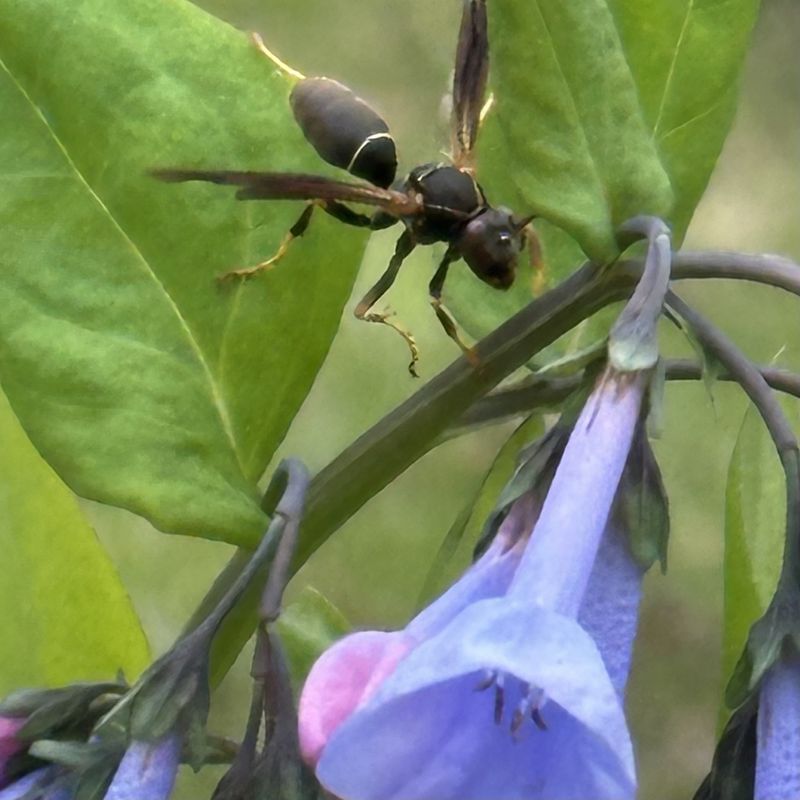
Peer-reviewed research does give the garden-benefit claim some real support, but the details matter as much as the headline finding. A study on native Polistes metricus and Polistes fuscatus found that these paper wasps substantially reduced selected caterpillar pests of Brassica crops under screened hoop-house conditions and reduced measurable plant damage in one of the experiments.
The authors describe the wasps as having “potential” as biological-control agents, which is an encouraging but carefully hedged conclusion.
That hoop-house setting is important context. The experiments controlled which prey was available, how far the wasps had to travel, and what other predators or variables were present.
A residential yard in the North Carolina Piedmont, Coastal Plain, or mountains involves far more complexity: multiple caterpillar species at different densities, varied plant types, competing predators, and a colony that hunts on its own schedule. The study does not establish that a single porch nest will protect an entire yard or prevent all caterpillar damage across a season.
Several factors can change how much predation actually occurs in a real garden. Caterpillars that feed inside folded leaves, hide in soil, or mimic plant tissue are harder for wasps to locate.
Colony age and size affect how many foragers are active at any given time. The plants being protected and the caterpillar species present may not match the experimental conditions at all.
Separate field research on caterpillar susceptibility to Polistes predation found that different caterpillar species were not equally vulnerable, reinforcing the point that paper wasps do not hunt all prey with equal success.
The honest takeaway from the science is that a paper-wasp colony may reduce pressure from some caterpillars under the right conditions, and that is worth something. Treating it as a guarantee of clean, undamaged plants sets expectations the research does not support.
Think of it as a useful, unpredictable ally rather than a reliable service contract.
Paper wasps may protect plants from some caterpillars while preying on others
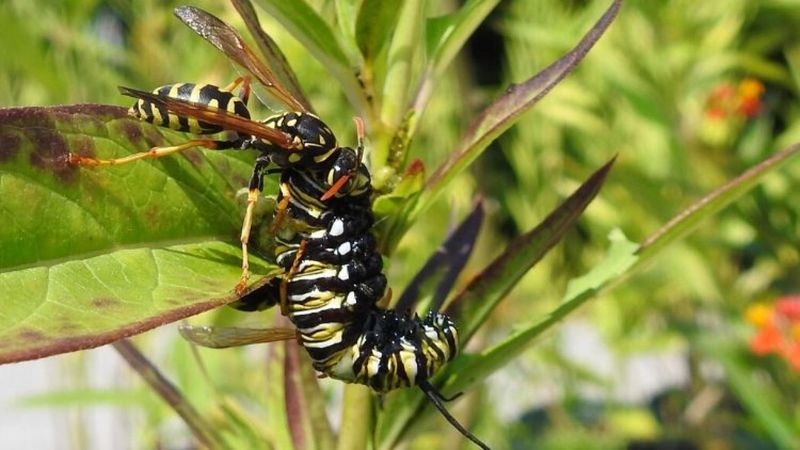
Generalist predation cuts both ways. A paper-wasp colony hunting through your yard does not sort caterpillars into “pest” and “valued” categories before striking.
NC State Extension notes that beneficial insects are not reliable enough to serve as deliberate pest managers, partly because they pursue whatever prey is accessible, not whatever prey the gardener most wants removed. For a homeowner who plants native milkweed for monarchs or fennel for black swallowtails, that lack of discrimination is a real consideration.
The concern is not theoretical. Research published in Scientific Reports found that the invasive European paper wasp, Polistes dominula, created an “ecological trap” for monarch butterfly larvae in urban pollinator gardens by heavily preying on the caterpillars.
Gardens planted specifically to support monarchs were attracting and then losing monarch larvae to these wasps at high rates. That is a meaningful finding, but it applies specifically to Polistes dominula, an invasive species, under urban pollinator-garden conditions.
Native Polistes species common in North Carolina, such as Polistes metricus and Polistes fuscatus, are not the same insect and do not necessarily produce the same outcomes. The monarch study is a documented qualification, not a verdict on every paper wasp in every yard.
Still, any homeowner who actively cultivates host plants for butterflies or moths should factor in the possibility that a nearby wasp colony may occasionally take larvae they were hoping to see survive to adulthood.
The practical message is to hold both things at once: paper wasps may reduce some pest caterpillars while also taking some larvae you value. Neither outcome is guaranteed, and neither cancels out the other.
Where you have invested heavily in pollinator habitat, that tradeoff deserves a little more weight in your decision about whether to leave a nearby nest undisturbed.
Judge the nest by its location and likelihood of disturbance
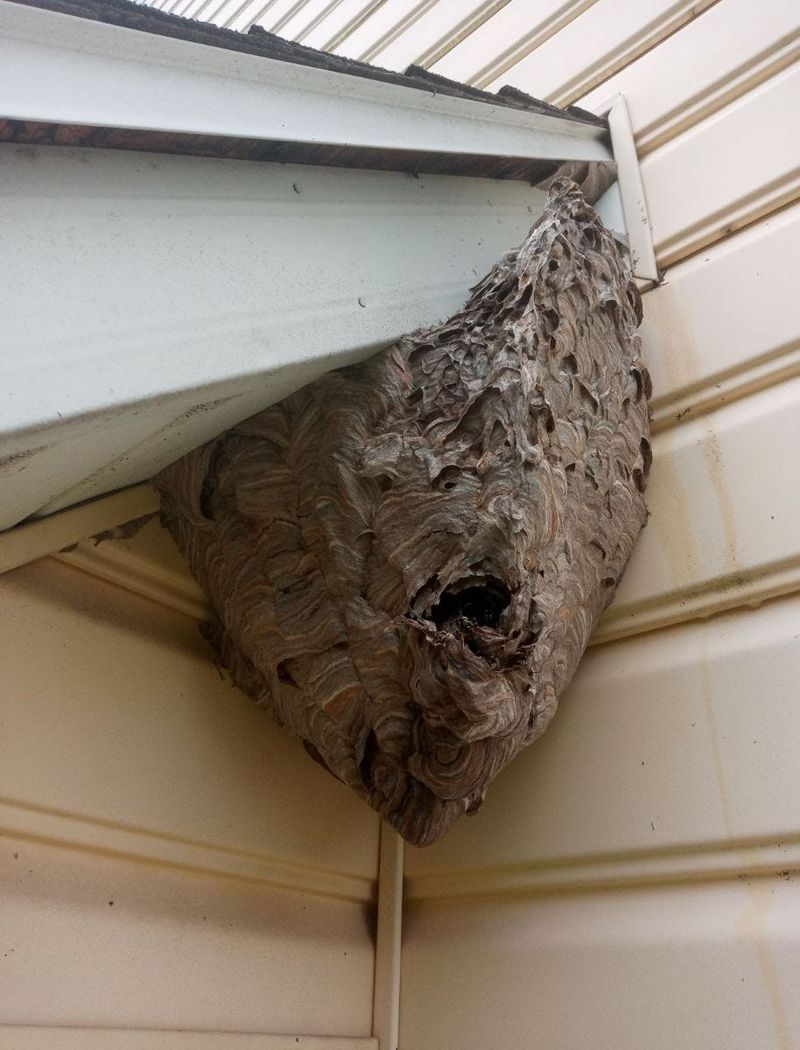
Location is the single most useful variable when deciding what to do with a paper-wasp nest. A colony tucked under a high, rarely visited eave at the back of the house sits in a very different category from one hanging directly above a front door, a garden gate latch, a children’s play set, or a patio chair that gets moved every weekend.
The nest itself has not changed, but the chance of someone accidentally disturbing it has changed dramatically.
Penn State Extension frames the risk assessment around colony size, nest location, and the frequency with which people or pets come near the colony. A small early-season nest in a low-traffic spot may never cause a problem.
A larger, late-summer colony beside a door that the household uses a dozen times a day is a different calculation entirely.
Colony size also matters independently of location. A newly established spring nest with a handful of wasps is generally less reactive than a mature summer colony with dozens of workers defending a larger investment.
As the season progresses and the colony grows, the defensive response to disturbance can intensify, which is one reason a nest that seemed manageable in May may feel more pressing by August.
University of Maryland Extension explains that paper wasps typically become defensive when the nest is directly disturbed, not simply because a person is walking nearby. Passing several feet below a high eave nest at a normal pace is a very different interaction than brushing against a nest while reaching for a garden tool or mowing grass directly beneath it.
The practical question is not whether a wasp could sting you, but whether your normal household routine brings you close enough to make a disturbance likely.
Leave a safely placed nest alone and reduce disturbance
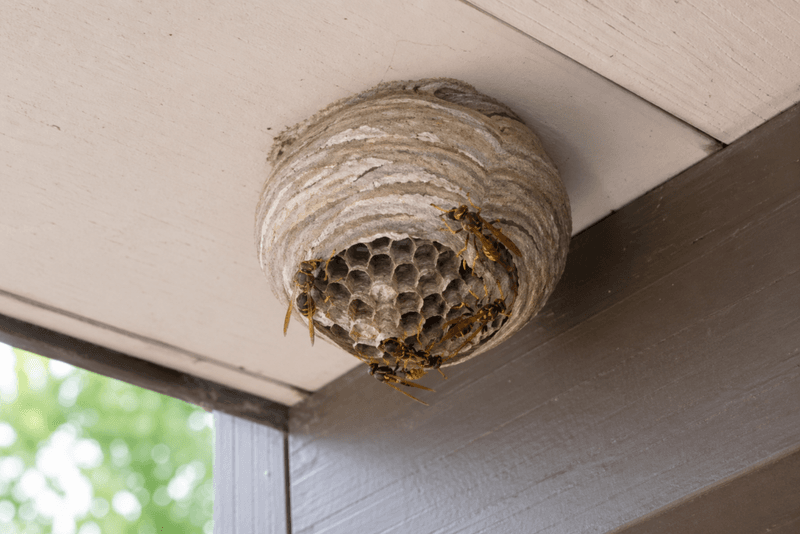
When a nest occupies a spot that your household rarely passes close to, the lowest-risk choice is simply to leave it alone. Noninterference costs nothing and preserves whatever predation benefit the colony is providing while it remains active.
The goal is to avoid triggering a defensive response, and that means keeping the nest undisturbed in every practical sense.
Specific actions to skip around an occupied nest: do not touch it, sweep it, strike it, or throw anything at it. Avoid mowing the lawn directly beneath it, since vibration and noise from a mower can register as a threat.
University of Maryland Extension notes that shining a light at a nest at night can also draw wasps toward the light source, which is worth remembering if you are doing evening yard work near a nest you had forgotten about. Keep children, pets, and regular foot traffic routed away from the immediate area during the colony’s active season.
Patience is a reasonable strategy here because social-wasp colonies are generally annual. Purdue Extension’s guide to social bees and wasps explains that colony activity winds down as temperatures drop in late fall, and the nest is typically abandoned by winter.
The physical nest structure may persist on the eave, but it will be empty. That said, no one can promise you an exact date when a specific colony will go quiet, and a mild fall can extend activity longer than expected.
The following year, a new queen may or may not choose the same site.
Tolerating a safely placed nest for a season is one of the more genuinely low-effort things a North Carolina homeowner can do for their yard’s ecological balance. The colony does its work, the season ends, and the nest empties on its own timeline.
Remove hazardous nests with the right level of help
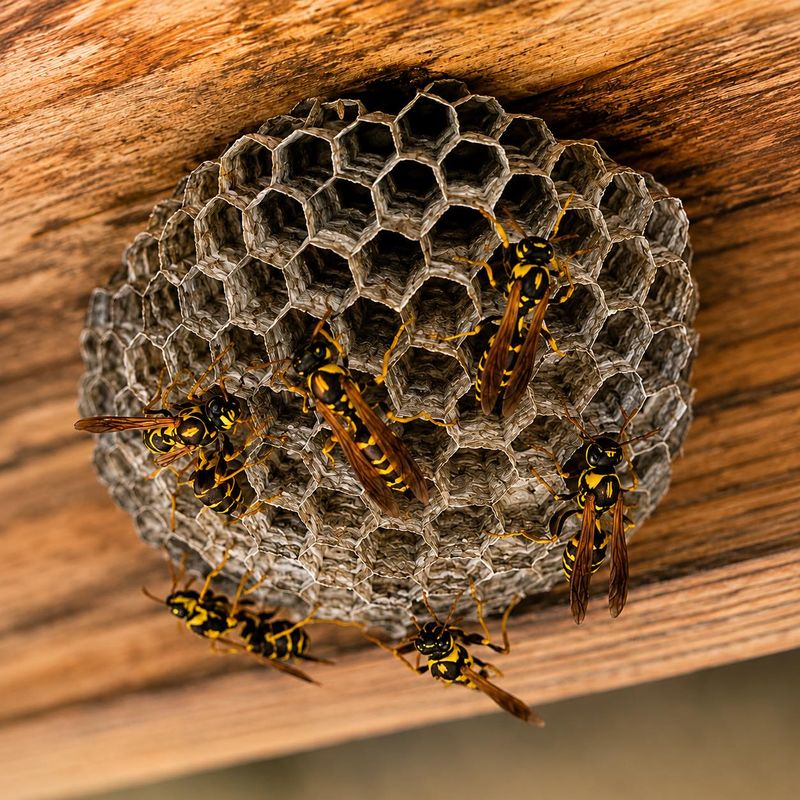
Some nests genuinely need to come down, and deciding that is not a failure of stewardship. When a colony sits beside unavoidable foot traffic, near a door that young children use constantly, or in a location that makes accidental disturbance almost certain, the sting risk reasonably outweighs the limited predation benefit.
The same applies when the nest is high on the structure, enclosed in a soffit or wall void, or otherwise difficult to reach safely.
Penn State Extension recommends professional pest control specifically for nests in soffits, wall voids, high eaves, and similarly difficult locations, because those situations expose the person attempting removal to a concentrated defensive response with limited ability to retreat quickly. Not every necessary removal requires a professional, but difficult access and enclosed spaces are strong reasons to call one.
A nest on a low, open surface in a rarely used corner of the yard is a different situation from one wedged into a structural gap twelve feet overhead.
If a homeowner does attempt removal of a small, accessible, low nest, NC State Extension advises using a product specifically labeled for wasps or hornets and following the label exactly. A common extension recommendation is to treat when wasps are back at the nest, often after dark, while avoiding lights that may draw wasps toward the applicator.
Broad yard spraying is not an appropriate response: NC State’s biological-control guidance notes that indiscriminate pesticide use kills beneficial insects alongside target pests and does not address the nest itself.
One boundary is firm regardless of nest size or location: anyone with a history of serious allergic reactions to stings should not attempt removal under any circumstances. The American College of Allergy, Asthma and Immunology identifies trouble breathing, throat or tongue swelling, widespread hives, dizziness, vomiting, or collapse after a sting as possible signs of anaphylaxis, requiring prescribed epinephrine and immediate emergency medical care.
For households with a known sting allergy, professional removal is not optional – it is the only sensible path. A wasp nest is a manageable yard situation; anaphylaxis is a medical emergency, and no garden benefit is worth that risk.